
Sternal Closure Systems Market Growth, Trends & Forecast 2031
Coverage: By Product (Closure Devices (Wire, Plates & Screw, Cables, and Clips) and Bone Cement), Procedure (Median Sternotomy, Hemisternotomy, Bilateral Thoracosternotomy, and Others), Material (Titanium, Polyether Ether Ketone, Stainless Steel, and Others), and Geography (North America, Europe, Asia Pacific, Middle East and Africa, and South and Central America)
- Status : Published
- Report Code : TIPRE00005200
- Category : Life Sciences
- No. of Pages : 283
- Available Report Formats :


- Last update date : January 02, 2026


2024 Market Size
US$ 4.22 Bn
Base year value
2031 Forecast
US$ 5.94 Bn
Projected by 2031
CAGR 2025-2031
5.2 %
Growth rate
Addressable Market
US$ 36.37 Bn
(2025-2031)
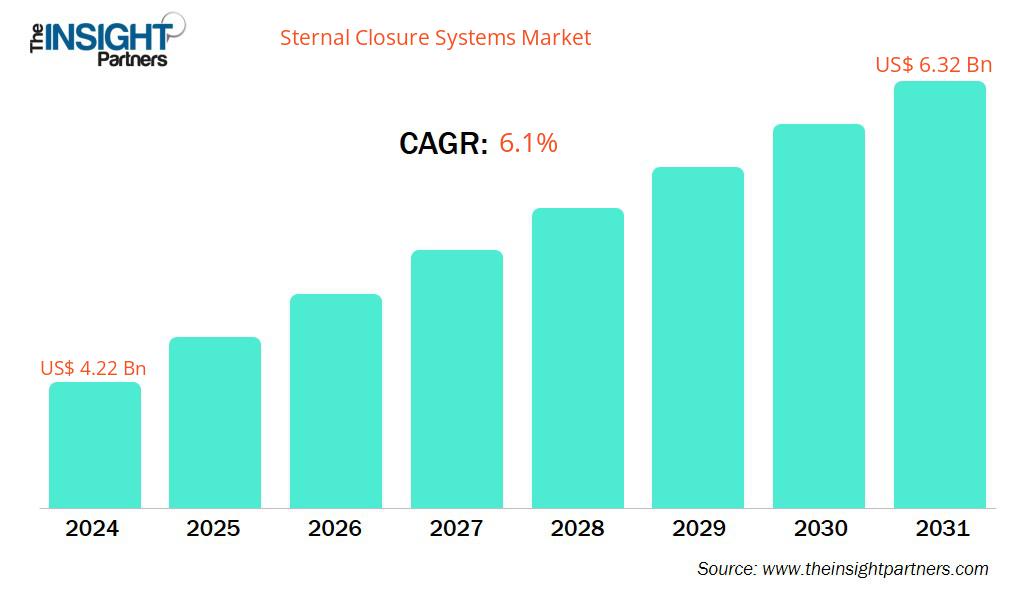
The sternal closure systems market size is expected to reach US$5.94 billion by 2031 from US$4.22 billion in 2024. The market is anticipated to register a CAGR of 5.2% during 2025–2031.
Sternal Closure Systems Market Analysis
The sternal closure systems market is growing because more people need heart surgeries, populations are getting older, and implant technology is getting better. The need for strong, body-friendly materials and less invasive options encourages new ideas, while costs and rules affect how companies compete.
Sternal Closure Systems Market Overview
Several hospitals use sternal closure systems as they focus on keeping the chest stable, preventing infections, and helping patients recover quickly. Improvements in plates, bands, and new materials help more hospitals use these systems, while complicated payment rules and proof of effectiveness affect how the market changes.
Market Assessment and Insights
- North America dominated the market with 45.2% share in 2024.
- Asia Pacific is poised to grow at a CAGR of 5.6% over the forecast period.
- United States market is projected to grow at a CAGR of 5.5% over the forecast period.
- By Product, the Closure Devices segment accounted for the largest market share of 79.2% in 2024.
- By Closures Devices, the Wire segment is anticipated to witness the fastest growth, registering a CAGR of 6.1% over the forecast period
- By Procedure, the Median Sternotomy segment accounted for the largest market share of 48.7% in 2024.
- By Material, the Polyether Ether Ketone (PEEK) segment is anticipated to witness the fastest growth, registering a CAGR of 6% over the forecast period
- The report profiles key industry players such as Teleflex Inc, B Braun SE, Stryker Corp, KLS Martin Group, Johnson & Johnson, Zimmer Biomet Holdings Inc, Ortolog Medikal Sanayi Ve Ticaret AS, IDEAR SRL, Acumed LLC, Able Medical Devices Inc., while also analyzing key developments in novel ideas, disruptive products, and innovative services that could reshape the future market and reveal emerging themes across the industry.
Source: The Insight Partners' analysis based on proprietary research, government publications, company annual reports, investor presentations, industry databases, and expert interviews.
● REPORT CUSTOMIZATION
Tailor This Report To Align With Your Specific Business Requirements
This report can be customized to align precisely with your business objectives, scope, and target markets. Customization options include tailored segmentation, geography, competitive analysis, and strategic insights to support informed decision-making.
Customize This Report →WHAT YOU CAN ADJUST
- ● Segmentations
- ● Geography
- ● Competitive Analysis
- ● Language Preferences
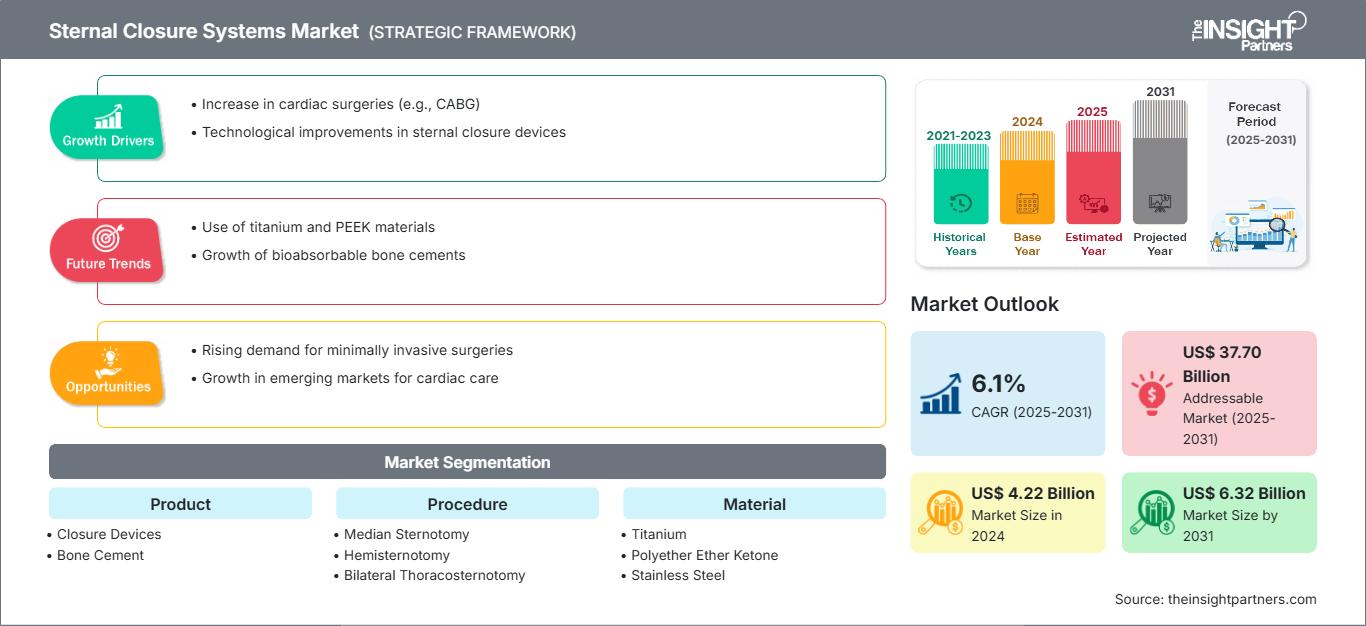
Sternal Closure Systems Market: Strategic Insights
-
Get Top Key Market Trends of this report.This FREE sample will include data analysis, ranging from market trends to estimates and forecasts.
Sternal Closure Systems Market Drivers and Opportunities
Market Drivers:
- Rising cardiac surgery volume: Increasing rates of CABG and valve procedures boost the need for reliable sternal closure solutions.
- Growing elderly population: Higher prevalence of comorbidities in aging patients drives demand for stronger, stable closure systems.
- Shift toward rigid fixation: Growing preference for plates and advanced devices by surgeons that reduce complications and improve healing.
- Focus on reducing sternal wound infections: Hospitals adopt enhanced closure technologies to lower postoperative infection and readmission risks.
- Technological advancements: Innovations in biocompatible materials and ergonomic device designs support wider clinical adoption.
Market Opportunities:
- Expansion of minimally invasive cardiac procedures: Devices tailored for smaller incisions can open new market segments.
- Development of patient-specific solutions: Customizable fixation systems allow better fit and targeted healing outcomes.
- Growth in emerging healthcare markets: Rising cardiac care investments in developing regions create adoption potential.
- Integration of digital surgical tools: Smart instrumentation and workflow-supporting technologies can differentiate product offerings.
Sternal Closure Systems Market Report Segmentation Analysis
The sternal closure systems market is divided into different groups to better understand how it works, how it can grow, and new trends. Here is the usual way industry reports break it down:
By Product:
- Closure Devices: Closure devices, including wires, plates, and bands, dominate the market due to their strong fixation, reduced complication rates, and suitability for diverse cardiac procedures.
- Bone Cement: Bone cement is used as an adjunct to enhance sternal stability, particularly in high-risk or osteoporotic patients. Its ability to improve load distribution and support faster recovery drives steady, niche demand.
By Procedure:
- Median Sternotomy: The most common cardiac procedure, driving the highest demand for sternal closure systems due to its widespread use and need for stable healing.
- Hemisternotomy: Minimally invasive approach with growing adoption, increasing demand for specialized closure devices compatible with smaller incisions.
- Bilateral Thoracosternotomy: This is a complicated surgery that needs very strong ways to close the chest, which increases the need for advanced closure systems in patients with higher risks.
- Others: Includes unconventional or hybrid approaches, offering niche opportunities for innovative closure devices and adjunct materials.
By Material:
- Titanium
- Polyether Ether Ketone
- Stainless Steel
- Others
By Geography:
- North America
- Europe
- Asia Pacific
- South & Central America
- Middle East & Africa
Sternal Closure Systems Market Report Scope
| Report Attribute | Details |
|---|---|
| Market size in 2024 | US$ 4.22 Billion |
| Market Size by 2031 | US$ 5.94 Billion |
| Global CAGR (2025 - 2031) | 5.2% |
| Historical Data | 2021-2023 |
| Forecast period | 2025-2031 |
| Segments Covered |
By Product
|
| Regions and Countries Covered |
North America
|
| Market leaders and key company profiles |
|
Sternal Closure Systems Market Players Density: Understanding Its Impact on Business Dynamics
The Sternal Closure Systems Market is growing rapidly, driven by increasing end-user demand due to factors such as evolving consumer preferences, technological advancements, and greater awareness of the product's benefits. As demand rises, businesses are expanding their offerings, innovating to meet consumer needs, and capitalizing on emerging trends, which further fuels market growth.
Sternal Closure Systems Market Share Analysis by Geography
The sternal closure systems market in Asia Pacific is growing quickly because more money is being spent on healthcare, technology is improving, and more people know about advanced ways to fix the chest bone. New markets in South & Central America, the Middle East, and Africa offer new chances for these systems, helping doctors give better treatments and improve patient results in these areas.
The sternal closure systems market growth differs in each region due to differences in healthcare infrastructure, regulatory environments, funding availability, technological adoption, and disease prevalence. Below is a summary of market share and trends by region:
1. North America
- Market Share: Holds a significant portion of the global market
- Key Drivers:
- High volume of cardiac surgeries : Large patient base and advanced healthcare systems increase procedure rates.
- Advanced healthcare infrastructure
- Strong presence of research and development
- Trends: Shift toward minimally invasive and robotic-assisted cardiac procedures.
2. Europe
- Market Share: Substantial share owing to early, stringent EU regulations
- Key Drivers:
- Increasing aging population : An aging population drives the need for more cardiac surgeries, fueling sternal closure demand.
- Stringent quality and safety regulations
- Growing preference for rigid fixation.
- Trends: Increasing use of patient-specific and customizable closure systems.
3. Asia Pacific
- Market Share: Fastest-growing region with dominant market share
- Key Drivers:
- Rising cardiac disease prevalence: Rapid urbanization and lifestyle changes increase heart surgery rates.
- Expanding healthcare infrastructure
- Growing awareness of postoperative care
Trends: Rapid adoption of minimally invasive cardiac procedures.
4. Middle East and Africa
- Market Share: Although small, it is growing quickly
- Key Drivers:
- Increasing investment in healthcare : Investment in healthcare infrastructure enhances the availability of advanced sternal closure systems.
- Rising cardiac disease burden
- Medical tourism growth
- Trends: Adoption of modern, minimally invasive cardiac interventions.
5. South & Central America
- Market Share: Growing market with steady progress
- Key Drivers:
- Increasing cardiovascular disease prevalence : Rising cardiovascular diseases directly increase the demand for sternal closure systems
- Growing private healthcare sector.
- Government initiatives for cardiac care
- Trends: Shift toward advanced closure devices to improve surgical outcomes.
Sternal Closure Systems Market Players Density: Understanding Its Impact on Business Dynamics
High Market Density and Competition
Competition is intense due to the presence of major global players such as Ortolog Medikal Sanayi Ve Ticaret AS; Johnson & Johnson; Zimmer Biomet Holdings Inc; KLS Martin Group; Acumed LLC; IDEAR SRL; B Braun SE; Stryker Corp; Teleflex Inc; and Able Medical Devices Inc.
This high level of competition urges companies to stand out by offering:
- Innovative and advanced products
- Customized solutions
- Enhanced clinical support
- Cost-effective options
- Strong post-market services.
Opportunities and Strategic Moves
- Expansion in emerging markets – Rising cardiac surgery demand in Asia Pacific, Latin America, and Middle East offers growth potential.
- Minimally invasive procedure adoption – Development of closure systems compatible with small-incision techniques.
Other companies analyzed during the course of research:
- ABYRX, Inc.
- A&E Medical Corporation
- Acute Innovations LLC
- Kinamed Incorporated
- Jeil Medical Corporation
- JACE Medical, LLC
- Praesidia S.r.l.
- NEOS Surgery
- Invibio Biomaterial Solutions
- Lotus Surgicals
Sternal Closure Systems Market News and Recent Developments
- Ortholox Sternal Closure System Introduced to Thoracic Surgeons at Memorial Thoracic Surgery Days, January 2024 - Ortholox Sternal Closure System Introduced to Thoracic Surgeons at Memorial Thoracic Surgery Days. Thoracic Surgeons from various cities in Turkey, but mostly from Istanbul, updated their knowledge of treatment techniques as well as theoretical information, and learned the effectiveness of theoretical knowledge in practice through live surgery.
- DePuy Synthes announced the launch of the MatrixSTERNUM Fixation System, May 2024 - DePuy Synthes, a company within Johnson & Johnson's Orthopaedics division and part of Johnson & Johnson MedTech, announced the launch of the MatrixSTERNUM Fixation System, a plate and screw fixation system designed to help stabilize and secure the front part of the chest wall after procedures such as open-heart surgery and chest surgery. This advanced system is designed to meet patients’ needs in the operating room3,4||,§§ by providing stronger locking strength, faster chest fixation, and thinner, low-profile plates as compared to competitive offerings.
Sternal Closure Systems Market Report Coverage and Deliverables
The "Sternal Closure Systems Market Size and Forecast (2021–2031)" report provides a detailed analysis of the market covering below areas:
- Sternal Closure Systems Market size and forecast at global, regional, and country levels for all the key market segments covered under the scope
- Sternal Closure Systems Market trends, as well as market dynamics such as drivers, restraints, and key opportunities
- Detailed PEST and SWOT analysis
- Real-time Location Systems Market For Healthcare analysis covering key market trends, global and regional framework, major players, regulations, and recent market developments
- Industry landscape and competition analysis covering market concentration, heat map analysis, prominent players, and recent developments for the sternal closure systems market
- Detailed company profiles
Frequently Asked Questions

- Comprehensive Market Sizing and Forecast Analysis
- Detailed Segmentation Analysis
- In-Depth Market Dynamics Assessment
- Regional and Country-Level Insights
- Competitive Landscape and Company Benchmarking
- Strategic Business Intelligence
Recent Reports
Testimonials

The Insight Partners provided valuable market intelligence that supported our global go-to-market strategy. Their team was professional, responsive, and attentive to our feedback, providing thoughtful analysis and helpful methodological clarifications throughout the project.
Junmo Kim Chief Financial Officer (CFO), Enertech Co., Ltd.
The Insight Partners' SCADA System Market report is comprehensive, with valuable insights on current trends and future forecasts. The team was highly professional, responsive, and supportive throughout. We are very satisfied and highly recommend their services.
RAN KEDEM Partner, Reali Technologies LTDs
I requested a report on a very specific software market and the team produced the report in a few days. The information was very relevant and well presented. I then requested some changes and additions to the report. The team was again very responsive and I got the final report in less than a week.
JEAN-HERVE JENN Chairman, Future Analytica
We worked with The Insight Partners for an important market study and forecast. They gave us clear insights into opportunities and risks, which helped shape our plans. Their research was easy to use and based on solid data. It helped us make smart, confident decisions. We highly recommend them.
PIYUSH NAGPAL Sr. Vice President, High Beam Global
The Insight Partners delivered insightful, well-structured market research with strong domain expertise. Their team was professional and responsive throughout. The user-friendly website made accessing industry reports seamless. We highly recommend them for reliable, high-quality research services
YUKIHIKO ADACHI CEO, Deep Blue, LLC.
This is the first time I have purchased a market report from The Insight Partners.While I was unsure at first, I visited their web site and felt more comfortable to take the risk and purchase a market report.I am completely satisfied with the quality of the report and customer service. I had several questions and comments with the initial report, but after a couple of dialogs over email with their analyst I believe I have a report that I can use as input to our strategic planning process.Thank you so much for taking the extra time and making this a positive experience.I will definitely recommend your service to others and you will be my first call when we need further market data.
JOHN SUZUKI President and Chief Executive Officer, Board Director, BK Technologies
I wish to appreciate your support and the professionalism you displayed in the course of attending to my request for information regarding to infectious disease IVD market in Nigeria. I appreciate your patience, your guidance, and the fact that you were willing to offer a discount, which eventually made it possible for us to close a deal. I look forward to engaging The Insight Partners in the future, all thanks to the impression you have created in me as a result of this first encounter.
DR CHIJIOKE ONYIA MANAGING DIRECTOR, PineCrest Healthcare Ltd.Reason to Buy
- Informed Decision-Making
- Understanding Market Dynamics
- Competitive Analysis
- Identifying Emerging Markets
- Customer Insights
- Market Forecasts
- Risk Mitigation
- Boosting Operational Efficiency
- Strategic Planning
- Investment Justification
- Tracking Industry Innovations
- Aligning with Regulatory Trends





 Get Free Sample for