
Wireless Sensors Precision Agriculture Environmental Market Size, Share & Demand by 2034
Wireless Sensors Precision Agriculture Environmental Market Size and Forecasts (2021–2034), Global and Regional Share, Trends, and Growth Opportunity Analysis Report Coverage : By Product Type (Physical, Acoustic, Flow, Humidity, Others), Application (Environmental Monetoring, Precision Agriculture)
- Status : Data Released
- Report Code : TIPRE00039682
- Category : Electronics and Semiconductor
- No. of Pages : 150
- Available Report Formats :


- Last update date : October 07, 2026


2025 Market Size
US$ 679.42 Mn
Base year value
2034 Forecast
US$ 1,071.91 Mn
Projected by 2034
CAGR 2026-2034
5.87 %
Growth rate
Addressable Market
US$ 8,221.39 Mn
(2026-2034)
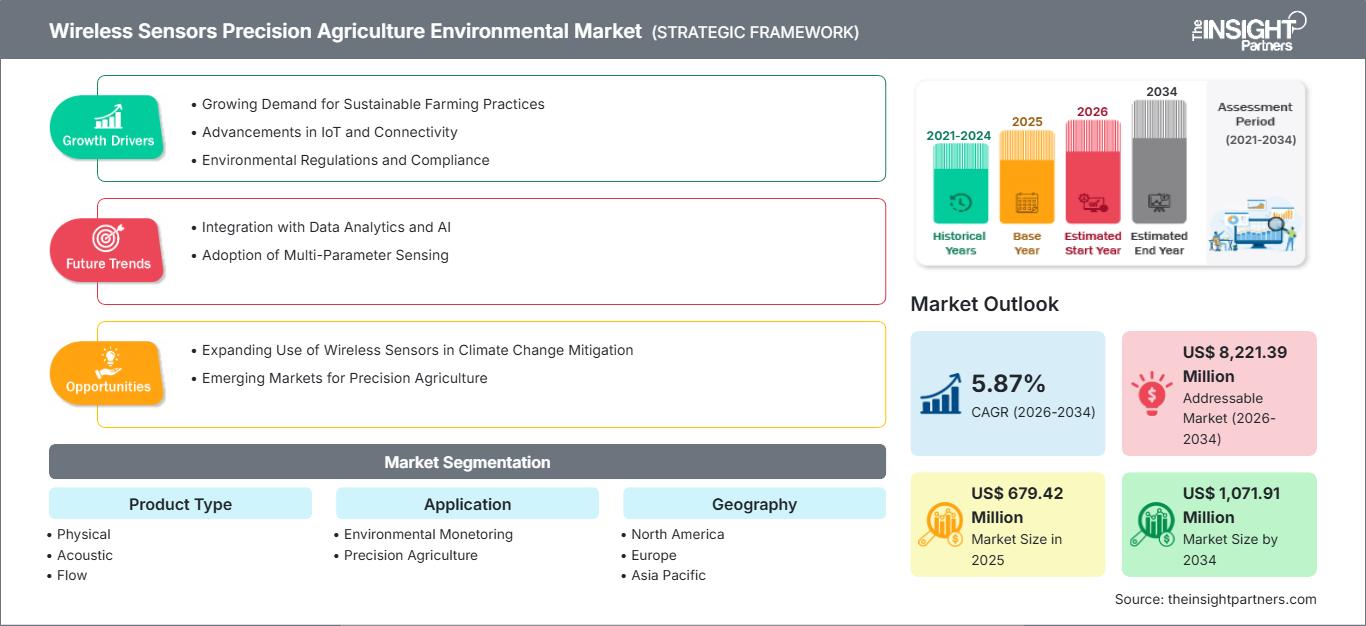
The wireless sensors precision agriculture environmental market is positioned at US$ 679.42 Million in 2025 and is projected to reach US$ 1,071.91 Million by 2034, advancing at a CAGR of 5.87% during 2026–2034. The market encompasses wireless sensing technologies used to capture physical, acoustic, flow, and humidity conditions across agricultural and environmental applications. Its development reflects increasing requirements for continuous field intelligence, resource optimization, remote monitoring, and data-supported operational decisions.
North America is expected to remain a leading regional market, supported by established precision farming infrastructure, connected equipment adoption, and investment in water-efficient agriculture. The wireless sensors precision agriculture environmental market size is likely to expand at an estimated 6.10–6.70% CAGR during 2026–2034 as farms integrate connected sensing with analytics, automated irrigation, and environmental compliance workflows.
Wireless Sensors Precision Agriculture Environmental Market Assessment and Insights
- North America holds an estimated 32–36% wireless sensors precision agriculture environmental market share in 2025 and is projected to grow at a 6.10–6.70% CAGR between 2026–2034, supported by mature precision agriculture ecosystems, connected machinery, irrigation technology, and demand for field-level environmental intelligence.
- US accounts for approximately 68–72% of North America's 2025 market, with a projected 6.30–6.90% CAGR between 2026–2034, driven by commercial farm digitization, telemetry adoption, and integration with precision equipment.
- Europe represents an estimated 24–28% share in 2025 and is projected to expand at a 5.40–6.00% CAGR between 2026–2034. Germany, France, Italy, Spain, and the UK support demand through sustainable agriculture programs, water management, and digital farming initiatives.
- Asia Pacific captures approximately 27–31% share in 2025 and is expected to register a 6.40–7.10% CAGR between 2026–2034, led by China, Japan, India, South Korea, and Australia as sensor-enabled agriculture expands.
- Largest Segment is Precision Agriculture, representing approximately 60–64% market share in 2025 and expanding at a 6.00–6.50% CAGR between 2026–2034, reflecting strong adoption of field intelligence and resource optimization.
- High Growth Segment is Humidity, with an estimated 17–21% market share in 2025 and a 6.60–7.20% CAGR between 2026–2034, supported by crop disease management, greenhouse control, and microclimate monitoring.
- Key companies analyzed in detail: American Sensor Technologies, Inc.; ASM Automation Sensorik Messtechnik GmbH; Automata; Avir Sensors; BioForce Nanosciences Holdings, Inc.; Coastal Environmental Systems, Inc.; E.S.I. Environmental Sensors, Inc.; Measurement Specialties, Inc.; MEMSIC, Inc.; Meridian Environmental Technology, Inc.; Libelium Comunicaciones Distribuidas S.L.; Pessl Instruments GmbH; CropX Technologies, Inc.; Monnit Corporation.
Source: The Insight Partners' analysis based on proprietary research, government publications, company annual reports, investor presentations, industry databases, and expert interviews.
There has been a progression from disconnected sensors to interconnected measuring systems incorporating sensors in the field, gateways, wireless technology, cloud computing, and analytical software. In addition to physical and humidity measurements being used in irrigation, crop health, and environment applications, acoustic and flow measurements have enabled monitoring to be extended into equipment, water supply systems, and controlled farming operations. LoRaWAN, Cellular IoT, Bluetooth Low Energy, and edge computing are making deployments more flexible in distributed agricultural landscapes.
Investment during the forecast period is projected to move from individual hardware to interoperable sensor networks. Developing agricultural countries can utilize low-cost wireless sensors, network infrastructure sharing, and service-oriented deployment solutions. Water efficiency, nutrient runoff, climate resilience, and traceability concerns will strengthen the need for measurability of field conditions. Combining the information from sensors with satellite imaging, artificial intelligence, and management software is expected to become increasingly critical.
Wireless Sensors Precision Agriculture Environmental Market Report Scope
| Report Attribute | Details |
|---|---|
| Market size in 2025 | US$ 679.42 Million |
| Market Size by 2034 | US$ 1,071.91 Million |
| Global CAGR (2026 - 2034) | 5.87% |
| Historical Data | 2021-2024 |
| Forecast period | 2026-2034 |
Wireless Sensors Precision Agriculture Environmental Market Analysis
There is demand created due to the necessity of taking farming-related decisions at an ever-finer granularity. This is possible because wireless devices are able to monitor the condition of the soil as well as the environment continuously without having to have many cables installed. Research released in 2025 reveals wireless sensor networks, IoT, artificial intelligence, and machine learning as some of the crucial aspects of precision agriculture, especially with regard to irrigation, plant health, fertilization, and decision-making.
There are many participants involved in the wireless sensors precision agriculture environmental market, such as sensors providers, communications modules suppliers, gateways providers, connectivity companies, analysis providers, irrigation firms, machines manufacturers, agronomists, and farmers. More and more value is being added to hardware through reliable data, battery performance, compatibility, ease of installation, and integration with the farm management systems.
The wireless sensors precision agriculture environmental market report shows that competitive positioning is evolving to include integrated sensing architectures. American Sensor Technologies, Inc. and Measurement Specialties, Inc. have experience in sensory technologies, while ASM Automation Sensorik Messtechnik GmbH, MEMSIC, Inc., and E.S.I. Environmental Sensors, Inc. cater to specific measuring needs. Pessl Instruments GmbH and CropX Technologies, Inc. provide insight into how the combination of connected sensing, agronomy software, and weather intelligence plays an important role.
Current investments emphasize scalable architectures that would integrate heterogeneous sensors into one data architecture. Expansion of connectivity and precision technology at John Deere underscores the need for robust data communication in a rural operating environment. Specialists can distinguish themselves by means of niche sensors, while technology companies can compete via platform integration. The wireless sensors precision agriculture environmental market forecast thus becomes focused on issues of ecosystem compatibility, analytics competence, service model, and economics of deployment.
● REPORT CUSTOMIZATION
Tailor This Report To Align With Your Specific Business Requirements
This report can be customized to align precisely with your business objectives, scope, and target markets. Customization options include tailored segmentation, geography, competitive analysis, and strategic insights to support informed decision-making.
Customize This Report →WHAT YOU CAN ADJUST
- ● Segmentations
- ● Geography
- ● Competitive Analysis
- ● Language Preferences
Wireless Sensors Precision Agriculture Environmental Market: Strategic Insights
Regional Insights
North America wireless sensors precision agriculture environmental market
North America is estimated to account for 32–36% of 2025 revenue and is projected to grow at a 6.10–6.70% CAGR through 2034. The United States serves as the primary national market, and Canada adds value through its grain farming, horticulture, greenhouses, and water management applications. Big farms would be able to afford high density of sensors due to the variability of the land and the need for differentiating irrigation and inputs.
This trend is aided by existing connectivity for farm equipment, management software, and precision services. Connectivity through wireless channels becomes especially important for farms whose fields are scattered in space or cannot use existing wired infrastructure. The environmental monitoring provides compliance, water savings, and risk management. While connectivity challenges still arise in distant locations, the use of satellites and low power wide area solutions increases access to communications.
U.S. wireless sensors precision agriculture environmental market
The US represents approximately 68–72% of North American wireless sensors precision agriculture environmental market in 2025 and is projected to expand at a 6.30–6.90% CAGR. The technology finds its strongest application in large-scale farms that practice cultivation of row-crops, specialist crops, water-intense farming zones, and technology-based agriculture enterprises. The usage of sensor-generated information is becoming increasingly common for variable rate decisions, irrigation management, equipment control, and environmental measuring.
The use of commercial applications can be facilitated through already existing technology-based agriculture channels and integrated machinery. According to CropLife/Purdue Precision Agriculture Survey of 2025, 53% of agricultural dealers had telemetry services. The importance of data communication in modern farming is shown in the example. The use of wireless sensors will supplement these tools with local field information which cannot be collected through machinery telemetry.
Europe wireless sensors precision agriculture environmental market
Europe is expected to hold a 24–28% wireless sensors precision agriculture environmental market share in 2025 and expand at a 5.40–6.00% CAGR through 2034. The region's leading markets include Germany, France, Italy, Spain, and the UK, where environmental stewardship and digital agriculture programs support connected monitoring. Germany benefits from industrial automation capabilities and technology-oriented farming, while France combines large agricultural operations with increasing precision input management. Italy and Spain show strong relevance in specialty crops and irrigation-sensitive production, and the UK continues adopting digital farm-management technologies.
Growing demand in Europe is linked to issues of efficiency, traceability, and measured environmental impact. The problem of water stress in southern Europe makes humidity and flow sensing more attractive, while protected cultivation makes climate sensing more important. Germany is predicted to continue as one of the key markets due to the technological background of industry and agricultural machinery production. Fragmented agricultural structure in some regions of Europe may affect implementation time and make module-based systems preferred.
APAC wireless sensors precision agriculture environmental market
Asia Pacific is projected to represent 27–31% of 2025 revenue and expand at a 6.40–7.10% CAGR. China tops the regional deployment list, with Japan, India, South Korea, and Australia following. The demand arises due to the need for modernization of agriculture, water scarcity, controlled environment cultivation, and growing deployment of IoT platforms. In India, sensor-based precision agriculture is being developed through collaborative research initiatives focusing on crop and soil monitoring, vertical farming, and environmental monitoring.
In China, there is the advantage of agriculture modernization, whereas in Japan and South Korea, the focus lies on automation and controlled environment agriculture. There are high demands for remote monitoring in Australia for farms that are spread across geographical locations. India has huge potential over the long run since digital agriculture projects are increasingly integrating sensors into decision-making systems.
Middle East & Africa wireless sensors precision agriculture environmental market
The Middle East and Africa market is expected to expand at a 5.90–6.60% CAGR through 2034, with Saudi Arabia and the UAE emphasizing water-efficient agriculture and controlled-environment production. South Africa represents a significant agricultural technology market, while the rest of MEA offers opportunities in irrigation, greenhouse cultivation, and environmental monitoring.
Water scarcity, energy costs, and infrastructure development create a strong rationale for sensor-based resource management. Wireless flow and humidity devices can support irrigation optimization and protected agriculture where conventional monitoring is fragmented. Adoption remains constrained by connectivity, financing, technical skills, and fragmented farm structures. Consequently, service-based models, solar-powered devices, low-power networks, and integrated irrigation packages are likely to gain importance across the region.
Segmentation Analysis
Product Type
Product Type is projected to expand at a 5.60–6.10% CAGR during 2026–2034. Demand is influenced by sensor accuracy, ruggedness, battery life, installation complexity, communication range, and compatibility with farm-management systems. Product selection increasingly depends on the specific environmental parameter being measured and the required decision frequency.
- Physical sensors support measurement of variables such as temperature, pressure, position, and related field conditions. Their broad applicability makes them important for general farm monitoring, equipment interfaces, and environmental data collection.
- Acoustic sensors address sound-based detection and monitoring requirements, supporting specialized applications where vibration, acoustic signatures, or biological activity can provide operational or environmental information.
- Flow sensors monitor irrigation and water movement, helping operators identify delivery conditions, detect abnormal consumption, and improve water-management decisions across agricultural and environmental installations.
- Humidity sensors measure atmospheric or localized moisture conditions, supporting greenhouse control, disease-risk assessment, irrigation decisions, and microclimate monitoring where moisture variability affects crop performance.
Application
Application is expected to grow at a 5.90–6.50% CAGR during 2026–2034. Adoption depends on the economic value of timely information, sensor deployment density, integration with analytics, and the ability to convert measurements into operational decisions across farms and environmental assets.
- Environmental Monetoring supports continuous observation of atmospheric and site conditions, enabling organizations to identify changes, document environmental performance, and improve responses to localized conditions requiring timely intervention.
- Precision Agriculture represents the principal application area, using connected measurements to improve irrigation, crop management, nutrient decisions, microclimate control, and resource allocation across variable field conditions.
Opportunity Snapshot
| Application | Revenue Contribution | Trend Tag | Adoption Stage |
| Environmental Monetoring | Medium | Compliance Monitoring | Scaling |
| Precision Agriculture | High | Smart Irrigation | Scaling |
Wireless Sensors Precision Agriculture Environmental Market Growth Drivers and Impact Analysis
Water-Efficiency Requirements Are Increasing Sensor Value
Water scarcity is increasing the economic importance of measurement at field and irrigation-system level. Wireless flow and humidity sensors can provide localized information that enables operators to distinguish actual field conditions from assumptions based on fixed schedules. This is particularly relevant in irrigation-intensive agriculture, where overwatering increases energy and input costs while underwatering can reduce crop performance. Sensor networks also create historical datasets that help agronomists compare irrigation responses across zones and seasons. The commercial impact extends beyond sensor hardware because water-management platforms can monetize recurring analytics, alerts, and optimization services. As irrigation infrastructure becomes more automated, sensor availability becomes a prerequisite for closed-loop control. Suppliers that combine durable devices with reliable communication and actionable software are therefore positioned to capture greater value from water-management investments.
Connected Agriculture Is Expanding Beyond Machinery Telemetry
Farm connectivity is increasingly moving from machine-centric information toward broader environmental and crop intelligence. Wireless sensors add measurements that conventional machinery systems cannot directly provide, including localized humidity, flow, soil-related conditions, and microclimate changes. This creates a richer data layer for farm-management platforms and supports more granular operational decisions. The 2025 literature on IoT-enabled agriculture emphasizes the integration of sensors, wireless networks, cloud analytics, AI, and automated control, indicating a continued shift toward interconnected agricultural systems. The market impact is a growing preference for platforms capable of integrating multiple sensor types rather than isolated hardware products. Suppliers can therefore strengthen competitive positions through open interfaces, flexible gateways, remote diagnostics, and software compatibility. This architecture also improves scalability because new sensing points can be added without redesigning the entire farm network.
Environmental Accountability Is Creating New Monitoring Requirements
Agricultural organizations increasingly need measurable evidence of resource use and environmental performance. Wireless monitoring can support data collection for water management, microclimate assessment, irrigation efficiency, and operational records without requiring extensive fixed infrastructure. The value proposition becomes stronger when environmental measurements are linked to farm-management systems that can translate observations into reports, alerts, or recommended actions. Digital agriculture programs are also encouraging standardized approaches to assessing technology adoption and environmental outcomes. In India, for example, the 2025 AgDx framework evaluates digital agriculture across infrastructure, inputs and soil, environment and precision, governance, innovation, and other dimensions. Such initiatives strengthen the ecosystem around measurable digital practices. For sensor suppliers, the resulting opportunity is to develop products that provide reliable records, interoperable data formats, and practical analytics rather than merely increasing measurement frequency.
Wireless Sensors Precision Agriculture Environmental Market Future Trends
AI-Interpreted Sensor Networks Will Become More Autonomous
The next stage of development in the wireless sensors precision agriculture environmental market will move from collecting measurements toward interpreting them automatically. Wireless sensors will increasingly transmit continuous streams covering humidity, flow, temperature, soil conditions, and localized environmental variables into AI-enabled platforms. Algorithms can combine these observations with weather forecasts, satellite imagery, historical field records, and crop models to identify anomalies and generate recommendations. Instead of presenting growers with isolated readings, systems will increasingly explain what changed, why it matters, and which action should be considered. Edge computing will support faster responses where connectivity is intermittent, while cloud systems will provide broader historical analysis. This trend could reduce dependence on manual interpretation and increase the value of dense sensing networks. Vendors that establish trustworthy data pipelines, model validation processes, and transparent decision logic will be better positioned as agricultural operations move toward increasingly autonomous management architectures.
Sensor Fusion Will Extend Monitoring From Fields to Complete Production Systems
The wireless sensors precision agriculture environmental market trends indicate that sensor deployments are likely to become more heterogeneous as farms seek unified visibility across soil, crops, irrigation equipment, weather conditions, storage areas, and environmental assets. Rather than operating independently, physical, acoustic, flow, and humidity devices will increasingly contribute to shared operational models. Sensor fusion can help identify relationships that individual measurements cannot reveal, such as the interaction between humidity conditions and irrigation behavior or between flow changes and field water requirements. Wireless architectures make these deployments easier to expand across dispersed assets. Standardized interfaces and low-power communication will be important for controlling installation and maintenance costs. Over time, platforms may automatically determine which measurements require higher frequency and which can be sampled less often. This adaptive architecture can improve battery utilization, reduce unnecessary transmissions, and make large-scale sensing networks economically more practical.
Wireless Sensors Precision Agriculture Environmental Market Opportunities
Affordable Modular Networks for Small and Mid-Sized Farms
A major opportunity in the wireless sensors precision agriculture environmental market lies in modular sensor packages designed specifically for small and mid-sized agricultural operations. These customers may not justify comprehensive enterprise systems but can still benefit from targeted monitoring of irrigation, humidity, or localized environmental conditions. Vendors can reduce adoption barriers through wireless installation, solar or long-life battery options, mobile interfaces, and subscription-based analytics. Modular architectures also allow farmers to begin with a limited number of sensing points and expand coverage as economic benefits become visible. Local service providers can further support installation, calibration, connectivity, and interpretation, creating a channel beyond direct equipment sales. The strongest commercial propositions are likely to combine affordable hardware with measurable operational outcomes rather than emphasizing technical specifications alone. Partnerships with irrigation companies, cooperatives, agronomic advisers, and agricultural finance providers can accelerate adoption by embedding sensing into broader farm modernization packages.
Integrated Environmental Intelligence for High-Value Crops
High-value crops offer an attractive opportunity because the economic consequences of environmental variability can justify more sophisticated monitoring. Vineyards, orchards, greenhouse crops, horticultural production, and specialty vegetables require detailed information about humidity, water movement, microclimate, and crop conditions. Wireless networks can provide dense measurements without extensive cabling, while analytics can translate those observations into irrigation, disease-risk, and crop-management decisions. The opportunity extends to export-oriented producers that require consistent quality and stronger traceability. Technology providers can differentiate by developing crop-specific sensing packages rather than generic devices, integrating weather and imagery sources, and providing configurable alert thresholds. Partnerships with agricultural input companies and food supply-chain organizations can broaden deployment. Over time, high-value applications can serve as test environments for advanced sensing architectures before similar technologies move into larger commodity-crop operations.
Frequently Asked Questions

- Comprehensive Market Sizing and Forecast Analysis
- Detailed Segmentation Analysis
- In-Depth Market Dynamics Assessment
- Regional and Country-Level Insights
- Competitive Landscape and Company Benchmarking
- Strategic Business Intelligence
Recent Reports
Testimonials

The Insight Partners provided valuable market intelligence that supported our global go-to-market strategy. Their team was professional, responsive, and attentive to our feedback, providing thoughtful analysis and helpful methodological clarifications throughout the project.
Junmo Kim Chief Financial Officer (CFO), Enertech Co., Ltd.
The Insight Partners' SCADA System Market report is comprehensive, with valuable insights on current trends and future forecasts. The team was highly professional, responsive, and supportive throughout. We are very satisfied and highly recommend their services.
RAN KEDEM Partner, Reali Technologies LTDs
I requested a report on a very specific software market and the team produced the report in a few days. The information was very relevant and well presented. I then requested some changes and additions to the report. The team was again very responsive and I got the final report in less than a week.
JEAN-HERVE JENN Chairman, Future Analytica
We worked with The Insight Partners for an important market study and forecast. They gave us clear insights into opportunities and risks, which helped shape our plans. Their research was easy to use and based on solid data. It helped us make smart, confident decisions. We highly recommend them.
PIYUSH NAGPAL Sr. Vice President, High Beam Global
The Insight Partners delivered insightful, well-structured market research with strong domain expertise. Their team was professional and responsive throughout. The user-friendly website made accessing industry reports seamless. We highly recommend them for reliable, high-quality research services
YUKIHIKO ADACHI CEO, Deep Blue, LLC.
This is the first time I have purchased a market report from The Insight Partners.While I was unsure at first, I visited their web site and felt more comfortable to take the risk and purchase a market report.I am completely satisfied with the quality of the report and customer service. I had several questions and comments with the initial report, but after a couple of dialogs over email with their analyst I believe I have a report that I can use as input to our strategic planning process.Thank you so much for taking the extra time and making this a positive experience.I will definitely recommend your service to others and you will be my first call when we need further market data.
JOHN SUZUKI President and Chief Executive Officer, Board Director, BK Technologies
I wish to appreciate your support and the professionalism you displayed in the course of attending to my request for information regarding to infectious disease IVD market in Nigeria. I appreciate your patience, your guidance, and the fact that you were willing to offer a discount, which eventually made it possible for us to close a deal. I look forward to engaging The Insight Partners in the future, all thanks to the impression you have created in me as a result of this first encounter.
DR CHIJIOKE ONYIA MANAGING DIRECTOR, PineCrest Healthcare Ltd.Reason to Buy
- Informed Decision-Making
- Understanding Market Dynamics
- Competitive Analysis
- Identifying Emerging Markets
- Customer Insights
- Market Forecasts
- Risk Mitigation
- Boosting Operational Efficiency
- Strategic Planning
- Investment Justification
- Tracking Industry Innovations
- Aligning with Regulatory Trends





 Get Free Sample for