
Telescopic Boom Lift Market Trends, Size & Growth by 2034
Coverage: By Type (Truck Mounted, Self-Propelled); Application (Municipal, Garden Engineering, Telecommunication, Construction, Others) , and Geography (North America, Europe, Asia Pacific, and South and Central America)
- Status : Data Released
- Report Code : TIPRE00024038
- Category : Manufacturing and Construction
- No. of Pages : 150
- Available Report Formats :


- Last update date : October 13, 2026


2025 Market Size
US$ 14.15 Bn
Base year value
2034 Forecast
US$ 29.41 Bn
Projected by 2034
CAGR 2026-2034
8.47 %
Growth rate
Addressable Market
US$ 195.47 Bn
(2026-2034)
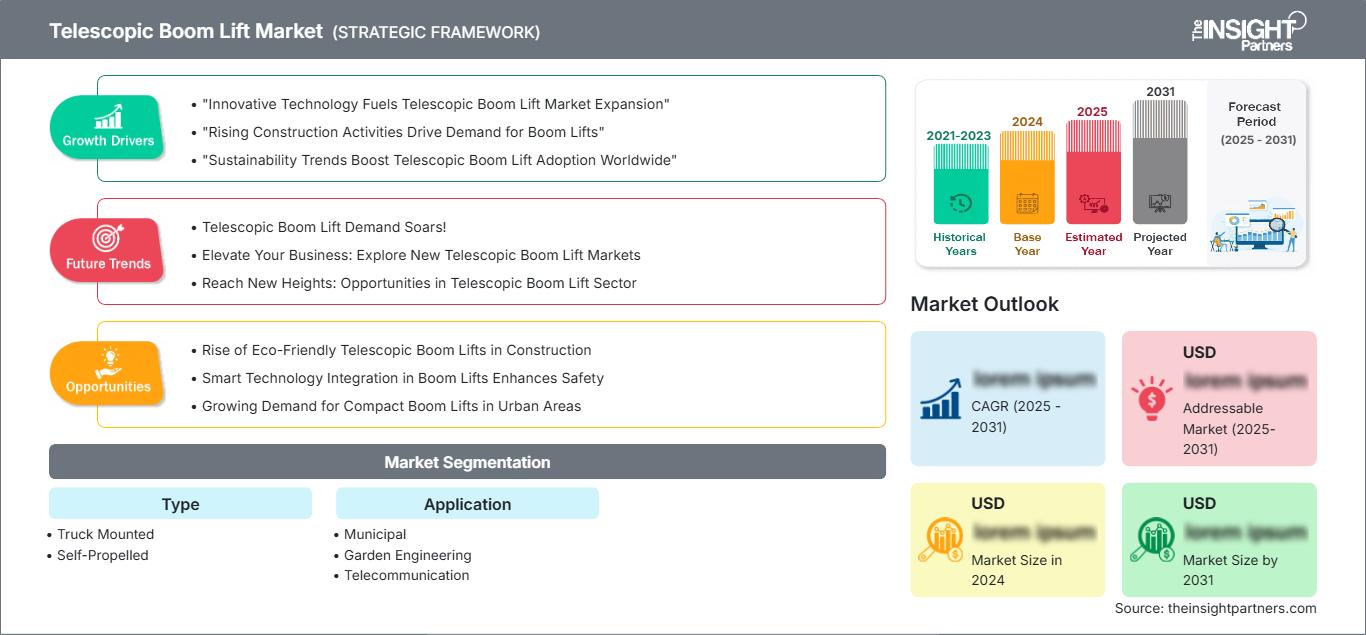
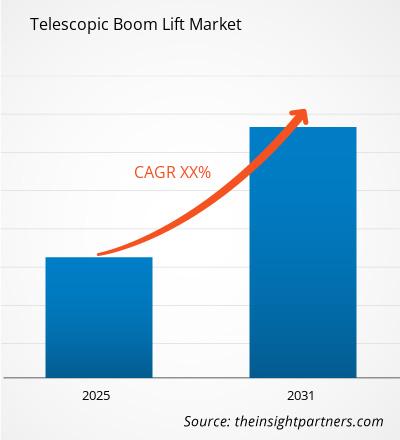
The Telescopic Boom Lift Market is undergoing structural expansion as contractors, rental fleets, utility operators, municipalities, and industrial users seek equipment that combines extended vertical reach, horizontal outreach, mobility, and increasingly efficient power systems. The market was valued at US$ 14.15 Billion in 2025 and is projected to reach US$ 29.41 Billion by 2034, registering a CAGR of 8.47% during 2026–2034. Demand is supported by construction activity, infrastructure renewal, telecommunications deployment, and replacement of aging access equipment.
The Telescopic Boom Lift Market size is increasingly influenced by North American fleet modernization, rental penetration, and demand for machines capable of working on complex construction and utility sites. North America is expected to expand at approximately ~8% CAGR through 2034, supported by infrastructure investment, fleet replacement, serviceability improvements, and rising availability of electric and hybrid access equipment.
Telescopic Boom Lift Market Assessment and Insights
Regional Outlook
- North America: ~32% of the global Telescopic Boom Lift Market share in 2025 | ~8% CAGR through 2034. Market position: North America remains a major regional market because of established rental fleets, extensive commercial construction activity, replacement demand, and strong participation by manufacturers serving contractors, utilities, infrastructure operators, and industrial facilities.
- US: ~78% of North American market revenue in 2025 | ~8% CAGR through 2034. Market position: The US represents the largest national market within North America, supported by construction equipment rental, infrastructure modernization, telecommunications deployment, and established OEM and dealer networks serving diverse access-equipment applications.
- Europe: ~24% of the global market in 2025 | ~7% CAGR through 2034. Market position: Europe is a mature market with established rental penetration and stringent equipment requirements. Germany is the leading country in Europe, followed by strong demand across France, the UK, Italy, and Spain from construction and industrial users.
- Asia Pacific: ~34% of the global market in 2025 | ~10% CAGR through 2034. Market position: Asia Pacific is the largest and fastest-growing regional market, supported by urban construction, industrial expansion, telecommunications infrastructure, equipment localization, and increasing adoption of powered access equipment in China, Japan, India, South Korea, and Australia.
Segment Outlook
- Self-Propelled: ~68% Share in 2025 | ~8% CAGR through 2034. Market position: Self-propelled equipment leads because contractors and rental companies require mobility, positioning flexibility, and rapid movement between work areas. The format also accommodates increasingly sophisticated electric, hybrid, and high-capacity configurations.
- Telecommunication: ~17% Share in 2025 | ~10% CAGR through 2034. Market position: Telecommunications is the high-growth application segment as network expansion, tower maintenance, fiber deployment, and upgrades to communication infrastructure require elevated access equipment with reliable outreach, maneuverability, and rapid deployment.
Competitive Coverage
Terex Corporation, JLG Industries, Aichi Corporation, Haulotte Group, Tadano Ltd., Handler Special, Altec Industries, TIME Manufacturing Company, RUTHMANN, Skyjack, Manitou Group, Niftylift.
Methodology
The Insight Partners follows Data Collection & Secondary Research, Primary Research, Data Analysis, and Data Triangulation & Final Review to validate market estimates and insights.
Source: The Insight Partners' analysis based on proprietary research, government publications, company annual reports, investor presentations, industry databases, and expert interviews.
Equipment design is evolving from legacy diesel-based machinery to electronic, hybrid, and battery-powered designs. In addition, manufacturers are optimizing boom designs, load control, operator interfaces, servicability, and telematics. Such evolution is especially pertinent for rental fleets, because usage rates, downtime, residual values, and maintenance costs will factor into purchase decisions. Meanwhile, production planning has increasingly become regional, with OEMs developing global platform designs but adapting the powertrain, size, emissions configuration, and attachments to suit particular regions. The general access equipment cycle is dependent on investments in construction and replacement of rental fleets.
The future scenario is driven by infrastructure investment in the Asia Pacific region, modernization programs in North America, European emissions regulations, and investment in telecommunication and industrial infrastructure. Markets in emerging economies are progressively progressing from basic access equipment to greater reach and specialization of equipment. On the other hand, manufacturers are increasing their capability to develop fleet management solutions digitally as well as electric-powered products. This will expand the market opportunity for the company while promoting replacement of less efficient machines.
Telescopic Boom Lift Market Report Scope
| Report Attribute | Details |
|---|---|
| Market size in 2025 | US$ 14.15 Billion |
| Market Size by 2034 | US$ 29.41 Billion |
| Global CAGR (2026 - 2034) | 8.47% |
| Historical Data | 2021-2024 |
| Forecast period | 2026-2034 |
Telescopic Boom Lift Market Analysis
Growth of the Telescopic Boom Lift Market is heavily dependent on the intensity of construction, infrastructure investment, penetration of equipment rental, and the need to conduct operations from a height without fixed scaffolding. Construction firms are relying more and more on mobile access equipment due to the necessity of quick transfer between different worksites. Telecommunication companies and utilities increase repetitive maintenance requirements, while municipalities use mobile lifts for lighting purposes, landscaping, municipal infrastructures, and building maintenance. Rental businesses continue to act as intermediaries, allowing small firms access to expensive equipment without the need for full fleet purchase.
The chain of supply includes suppliers of steel and hydraulic system components, engines and batteries, electronic control suppliers, OEMs, dealers, rental firms, maintenance firms, and secondary market players. The availability of supply then depends on the availability of components and manufacturing capacity. Suppliers with a wide distribution network have an opportunity to maintain high utilization rates due to parts availability and preventive maintenance. Equipment users tend to look at total lifecycle costs rather than the equipment purchase cost only.
The competitive landscape includes global OEM operations alongside specialized machine makers focusing on particular types of application or machine configuration. Terex Corporation and JLG Industries have comprehensive access equipment ranges whereas Aichi Corporation, Haulotte Group, Skyjack, Tadano Ltd., and Manitou Group have different combinations of geographic and product criteria. The relevance of Altec Industries and TIME Manufacturing Company is seen with regard to equipment used for utility purposes, whereas RUTHMANN and Niftylift deal with specialized access solutions. Differentiation includes electric platforms, machine connectivity, operator assistance, machine durability, and aftermarket operations.
More investment capital is being spent on product electrification, digital fleet solutions, manufacturing, and geographic distribution. JLG continues working on the development of connected and service-oriented boom lift machines, whereas Tadano extends its range of aerial work platform equipment through acquisitions and integration of products. Skyjack expands electric and hybrid machines into new regions. In this competitive landscape, the suppliers which will be able to offer not only equipment specifications but also reliable parts, dealerships, rentals, and life cycle support have a competitive advantage.
● REPORT CUSTOMIZATION
Tailor This Report To Align With Your Specific Business Requirements
This report can be customized to align precisely with your business objectives, scope, and target markets. Customization options include tailored segmentation, geography, competitive analysis, and strategic insights to support informed decision-making.
Customize This Report →WHAT YOU CAN ADJUST
- ● Segmentations
- ● Geography
- ● Competitive Analysis
- ● Language Preferences
Telescopic Boom Lift Market: Strategic Insights
Regional Insights
North America Telescopic Boom Lift Market
North America accounted for approximately ~32% of the global market in 2025 and is projected to expand at ~8% CAGR through 2034. The area enjoys a mature powered access ecosystem, equipment rental network, and high replacements. Commercial construction, industrial maintenance, utilities, warehousing, and telecommunication make up some of the factors that increase equipment usage. The significance of rental fleets is brought about by the ability of contractors to rent specialized machines for temporary use without bearing the burden of owning such equipment.
North America is made up of the US market, which constitutes about ~78% of total revenue and is the main source of demand. Innovation is directed towards electrical drive systems, fleet connectivity, operator productivity, and simpler servicing in the field. Among other players, JLG, Terex Corporation, Altec Industries, TIME Manufacturing Company, Skyjack, and Tadano Ltd. enjoy market presence in the various applications. Additional demand is sourced from Canada through construction, utility, and infrastructure maintenance.
U.S. Telescopic Boom Lift Market
The US represented approximately ~78% of North American revenue in 2025 and is expected to grow at ~8% CAGR through 2034. It is facilitated by large-scale equipment rental facilities, capital investment in construction, industrial facilities, and the renewal of older equipment. The need for increased productivity out of each unit of machinery drives demand for greater reach, better load capacity of the work platform, and improved mobility.
The range of applications covers commercial buildings, industrial facilities, telecoms infrastructure, utilities, municipalities, and specialty construction. JLG and Terex have comprehensive access equipment lines, whereas Altec and TIME Manufacturing Company cater to the needs of the utility and specialty lifts segment. Recent product developments show increasing trends toward electric/hybrid solutions, connectivity, maintenance, and fleet management systems. These trends will help improve the efficiency of equipment use while eliminating operational restrictions at environmentally or noise-sensitive sites.
Europe Telescopic Boom Lift Market
The Telescopic Boom Lift Market forecast shows that Europe represented approximately ~24% of the global market in 2025 and is projected to grow at ~7% CAGR through 2034. The region has a mature rental culture, established access-equipment standards, and a large installed base requiring periodic replacement. Germany is the leading country in Europe, supported by industrial facilities, construction activity, infrastructure maintenance, and a strong machinery ecosystem. France also has substantial demand, while the UK, Italy, and Spain contribute through construction, rental, utilities, and public infrastructure applications.
European demand is increasingly shaped by emissions reduction requirements and operating restrictions in urban areas. This creates opportunities for electric and hybrid boom lifts, although diesel and hybrid systems remain relevant for demanding outdoor and rough-terrain applications. Haulotte Group has a significant European presence, while RUTHMANN and other specialized manufacturers serve applications requiring high reach or truck-mounted configurations. Rental companies remain central to procurement, making machine reliability, residual value, service coverage, and standardized fleet specifications important purchasing criteria.
APAC Telescopic Boom Lift Market
Asia Pacific held approximately ~34% of the global market in 2025 and is expected to record approximately ~10% CAGR through 2034, making it the fastest-growing region. China is the leading country in Asia Pacific, supported by large construction activity, manufacturing capacity, infrastructure development, and domestic access-equipment production. Japan contributes through established machinery users and industrial applications, while South Korea, India, and Australia provide additional demand.
Urbanization, telecommunications expansion, industrial construction, logistics infrastructure, and government-backed infrastructure programs support equipment adoption. Local manufacturing and distribution capabilities are also improving, reducing procurement barriers in developing markets. India is becoming increasingly relevant as construction, warehousing, utilities, and telecommunications infrastructure expand. Australia has strong rental and mining-related demand, while Japan and South Korea emphasize equipment reliability, safety, and productivity.
Middle East & Africa Telescopic Boom Lift Market
Middle East and Africa is projected to grow at approximately ~9% CAGR through 2034. Saudi Arabia is the leading country in the Middle East and Africa region where evidence supports higher demand, reflecting major construction programs, tourism infrastructure, urban development, industrial projects, and utility investment. The UAE is also an important market because of commercial construction, logistics infrastructure, and large-scale developments.
South Africa represents a key African demand center, particularly for construction, mining-related facilities, industrial maintenance, and infrastructure. Across the wider region, equipment requirements are influenced by climate, project scale, rental availability, and the need for machines capable of operating in challenging outdoor conditions. Energy infrastructure and large construction projects can support higher utilization, while dealer and service coverage remains an important determinant of equipment adoption.
Segmentation Analysis
Type
Self-Propelled
Self-propelled equipment represents the largest type category, supported by its ability to combine elevated reach with independent movement around construction and industrial sites. The segment is expected to expand at approximately ~8% CAGR through 2034. Rental fleets favor these machines because a single platform can support multiple work phases, reducing equipment changes. Electrification, improved controls, higher platform capacities, and telematics are strengthening the value proposition for contractors seeking productivity and lower lifecycle costs.
- Truck Mounted: Truck-mounted units combine elevated access with road mobility and are particularly useful for utilities, telecommunications, municipal maintenance, vegetation management, and service operations. Their ability to travel between locations without dedicated transport can improve fleet utilization where work is geographically dispersed.
Application
- Municipal: Municipal demand is supported by maintenance of street infrastructure, lighting systems, public buildings, vegetation, and other assets requiring elevated access. Procurement often emphasizes reliability, safe operation, transport flexibility, and lifecycle maintenance because equipment may be used across multiple departments and locations. The segment benefits from recurring public-service requirements rather than dependence on a single construction cycle.
- Garden Engineering: Garden engineering applications include tree maintenance, landscaping, vegetation management, and elevated outdoor work. Demand is typically distributed among municipalities, landscaping contractors, and specialist service providers, with equipment selection influenced by mobility, working height, terrain access, and transport requirements.
- Telecommunication: Telecommunications is becoming increasingly important as towers, wireless infrastructure, fiber networks, and associated facilities require installation and maintenance. Equipment users prioritize reliable positioning, reach, transportability, and fast setup because service interruptions and access delays can directly affect network maintenance schedules.
- Construction: Construction represents a broad application base covering commercial buildings, industrial facilities, infrastructure projects, and specialized construction activities. Buyers typically evaluate reach, platform capacity, terrain capability, rental availability, operating cost, and service support. Large construction fleets can also accelerate adoption of connected and electric equipment.
Opportunity Snapshot
| Application | Revenue Contribution | Trend Tag | Adoption Stage |
|---|---|---|---|
| Municipal | Medium | Public Maintenance | Mature |
| Garden Engineering | Low | Vegetation Access | Scaling |
| Telecommunication | High | Tower Maintenance | Scaling |
| Construction | High | Jobsite Access | Mature |
Telescopic Boom Lift Market Growth Drivers and Impact Analysis
Infrastructure Renewal and Elevated Construction Requirements
Infrastructure renewal is expanding the number of projects that require temporary elevated access rather than fixed platforms or scaffolding. Roads, bridges, industrial plants, commercial buildings, logistics facilities, utilities, and telecommunications infrastructure all require maintenance at different elevations and locations. Boom lifts provide a combination of reach, mobility, and positioning that can shorten setup time and allow crews to work across multiple areas. For rental companies, broader infrastructure activity can increase utilization and improve fleet replacement visibility. For OEMs, the implication is a greater need for machines spanning different working heights, terrain conditions, and power configurations. Equipment designed for frequent relocation and intensive utilization is particularly relevant because project schedules increasingly emphasize labor productivity and shorter completion cycles.
Rental Fleet Expansion and Lifecycle Economics
Rental penetration changes purchasing economics by shifting equipment decisions from initial acquisition cost toward utilization, maintenance, residual value, and availability. A rental provider can deploy a boom lift across several customers during its useful life, increasing the importance of reliability and standardized servicing. This dynamic supports demand for equipment with common parts, accessible service points, diagnostic capabilities, and strong resale potential. Fleet operators also benefit when manufacturers provide digital monitoring that identifies maintenance requirements and equipment utilization patterns. The resulting procurement model encourages OEMs to develop platforms that can serve multiple customer types without extensive configuration changes. Over time, higher rental penetration can broaden access to advanced machines among small and medium-sized contractors that would otherwise defer purchases.
Electrification and Operating-Site Emission Requirements
Electrification is changing the product-development pathway for access equipment, particularly in urban construction, indoor facilities, warehouses, and projects with noise or emissions restrictions. Battery-electric systems can reduce local emissions and noise while simplifying certain maintenance requirements. Hybrid configurations remain relevant where operators require extended operating time or demanding outdoor performance. The commercial impact extends beyond powertrain selection because electric machines require changes in charging infrastructure, battery management, service training, and fleet scheduling. Manufacturers therefore increasingly need to offer different power options within comparable machine classes. Rental operators can use these alternatives to match equipment to site requirements, while contractors gain flexibility where project specifications restrict conventional engine-powered equipment.
Telescopic Boom Lift Market Future Trends
Connected Fleet Intelligence and Predictive Service
The Telescopic Boom Lift Market trends indicate that connected equipment is expected to become more deeply embedded in fleet-management processes through telematics, remote diagnostics, utilization tracking, service alerts, and digital documentation. Instead of treating connectivity as an optional feature, manufacturers and fleet operators are increasingly using machine data to understand operating hours, fault conditions, location, and maintenance requirements. This can improve fleet allocation and reduce avoidable downtime when information reaches service teams before a machine is removed from a project. The next stage is likely to involve more integrated analytics across mixed fleets, allowing rental companies to compare utilization and maintenance performance across equipment types. For OEMs, connected services can also create stronger relationships with customers after the initial equipment sale.
Multi-Power Platforms for Diverse Worksite Requirements
Future product portfolios are likely to offer greater flexibility among diesel, hybrid, and battery-electric configurations within comparable operating classes. This approach allows rental companies and contractors to select powertrains according to terrain, operating duration, indoor or outdoor use, emissions restrictions, and charging availability. The trend is particularly relevant in markets where construction projects differ significantly in environmental requirements. Product standardization across power options can also simplify spare-parts management and operator training. Manufacturers that combine common chassis architecture with differentiated power systems may improve production efficiency while allowing regional customization. As battery technology develops, higher-capacity machines could increasingly address applications that have traditionally required combustion engines, although demanding terrain and long operating cycles will continue to sustain demand for hybrid and diesel configurations.
Telescopic Boom Lift Market Opportunities
Specialized Equipment for Telecommunications and Utilities
Telecommunications and utilities provide an opportunity for manufacturers and rental providers to develop application-specific equipment packages rather than selling standardized machines alone. Tower maintenance, powerline work, lighting infrastructure, vegetation management, and distributed network assets require combinations of reach, stability, transportability, and rapid deployment. Equipment can be differentiated through specialized attachments, insulated configurations where applicable, compact transport dimensions, remote monitoring, and service packages. Rental companies can also establish dedicated fleets for recurring utility and telecommunications work, improving utilization and maintenance planning. Suppliers with strong dealer coverage in emerging infrastructure markets can use these applications to build recurring relationships with contractors and network operators. The opportunity therefore extends beyond equipment sales into specialized fleet management and aftermarket services.
Regional Manufacturing and Service Network Expansion
Asia Pacific, the Middle East, and selected developing markets offer opportunities for localized assembly, distribution, parts warehousing, technical training, and refurbishment services. Customers in these markets often evaluate equipment availability and after-sales support alongside purchase price because extended downtime can delay projects. Establishing regional service capabilities can shorten parts lead times and improve customer confidence, particularly for rental operators building larger fleets. Manufacturers can also adapt machines to local road conditions, climate, power availability, and regulatory requirements. Partnerships with established distributors and rental companies can accelerate market access while reducing the need for wholly owned commercial infrastructure. Over the longer term, localized service ecosystems can support both new equipment sales and the secondary market.
Recent Developments
- April 2026: JLG Industries, Inc. previewed the new 600AJ+ articulating boom lift, incorporating redesigned boom engineering, increased working performance, improved serviceability, and intelligent connectivity. The machine provides a 60-ft platform height, 38-ft horizontal outreach, and 27-ft 3-in up-and-over height, reflecting continued development toward productivity and connected fleet requirements.
- January 2026: Tadano Ltd. appointed Tyler Brown as national business manager for its aerial work platform business in the US and Canada as it expanded support for its AWP portfolio. Tadano stated that the North American offering followed its acquisitions of Nagano Industry and Manitex International and includes diesel and electric self-propelled tracked and wheeled models.
- December 2025: Skyjack introduced the SJ28 TE+, a battery-powered rough-terrain telescopic boom developed for Chinese and Southeast Asian markets. The 28-m working-height machine is designed for indoor and outdoor use and emphasizes zero-emission operation, lower operating costs, and rental-fleet utilization.
Frequently Asked Questions

- Comprehensive Market Sizing and Forecast Analysis
- Detailed Segmentation Analysis
- In-Depth Market Dynamics Assessment
- Regional and Country-Level Insights
- Competitive Landscape and Company Benchmarking
- Strategic Business Intelligence
Recent Reports
Testimonials

The Insight Partners provided valuable market intelligence that supported our global go-to-market strategy. Their team was professional, responsive, and attentive to our feedback, providing thoughtful analysis and helpful methodological clarifications throughout the project.
Junmo Kim Chief Financial Officer (CFO), Enertech Co., Ltd.
The Insight Partners' SCADA System Market report is comprehensive, with valuable insights on current trends and future forecasts. The team was highly professional, responsive, and supportive throughout. We are very satisfied and highly recommend their services.
RAN KEDEM Partner, Reali Technologies LTDs
I requested a report on a very specific software market and the team produced the report in a few days. The information was very relevant and well presented. I then requested some changes and additions to the report. The team was again very responsive and I got the final report in less than a week.
JEAN-HERVE JENN Chairman, Future Analytica
We worked with The Insight Partners for an important market study and forecast. They gave us clear insights into opportunities and risks, which helped shape our plans. Their research was easy to use and based on solid data. It helped us make smart, confident decisions. We highly recommend them.
PIYUSH NAGPAL Sr. Vice President, High Beam Global
The Insight Partners delivered insightful, well-structured market research with strong domain expertise. Their team was professional and responsive throughout. The user-friendly website made accessing industry reports seamless. We highly recommend them for reliable, high-quality research services
YUKIHIKO ADACHI CEO, Deep Blue, LLC.
This is the first time I have purchased a market report from The Insight Partners.While I was unsure at first, I visited their web site and felt more comfortable to take the risk and purchase a market report.I am completely satisfied with the quality of the report and customer service. I had several questions and comments with the initial report, but after a couple of dialogs over email with their analyst I believe I have a report that I can use as input to our strategic planning process.Thank you so much for taking the extra time and making this a positive experience.I will definitely recommend your service to others and you will be my first call when we need further market data.
JOHN SUZUKI President and Chief Executive Officer, Board Director, BK Technologies
I wish to appreciate your support and the professionalism you displayed in the course of attending to my request for information regarding to infectious disease IVD market in Nigeria. I appreciate your patience, your guidance, and the fact that you were willing to offer a discount, which eventually made it possible for us to close a deal. I look forward to engaging The Insight Partners in the future, all thanks to the impression you have created in me as a result of this first encounter.
DR CHIJIOKE ONYIA MANAGING DIRECTOR, PineCrest Healthcare Ltd.Reason to Buy
- Informed Decision-Making
- Understanding Market Dynamics
- Competitive Analysis
- Identifying Emerging Markets
- Customer Insights
- Market Forecasts
- Risk Mitigation
- Boosting Operational Efficiency
- Strategic Planning
- Investment Justification
- Tracking Industry Innovations
- Aligning with Regulatory Trends





 Get Free Sample for