
Ester for Synthetic and Bio-Based Lubricants Market Size, Share, and Forecast to 2031
Coverage: By Ester Type [Monoesters, Diesters, Polyol Esters (Trimethylolpropane Esters, Pentaerythritol Esters, Neopentyl Glycol Esters, Trimethylol Ethane Esters, and Dipentaerythritol Esters), Trimellitate Esters, Complex Esters, and Others], Lubricant Type (Synthetic Lubricants and Biobased Lubricants), Application [Engine Oil (MCO, PCMO, HDEO, and Other Engines), Compressor Oil, (Refrigeration, Air Compressors, Natural Gas Compressors, and Others Compressors), Hydraulic Fluids, Gear Oil, Transmission Oil, Coolants, and Others], and End Use [Automotive (Conventional Vehicles and Electric Vehicles), Textile, Marine, Mining and Metallurgy, Aviation, Energy and Power, and Others]
- Status : Published
- Report Code : TIPRE00042039
- Category : Chemicals and Materials
- No. of Pages : 540
- Available Report Formats :


- Last update date : December 15, 2025


2024 Market Size
US$ 6.85 Bn
Base year value
2031 Forecast
US$ 9.54 Bn
Projected by 2031
CAGR 2025-2031
5.0 %
Growth rate
Addressable Market
US$ 58.56 Bn
(2025-2031)
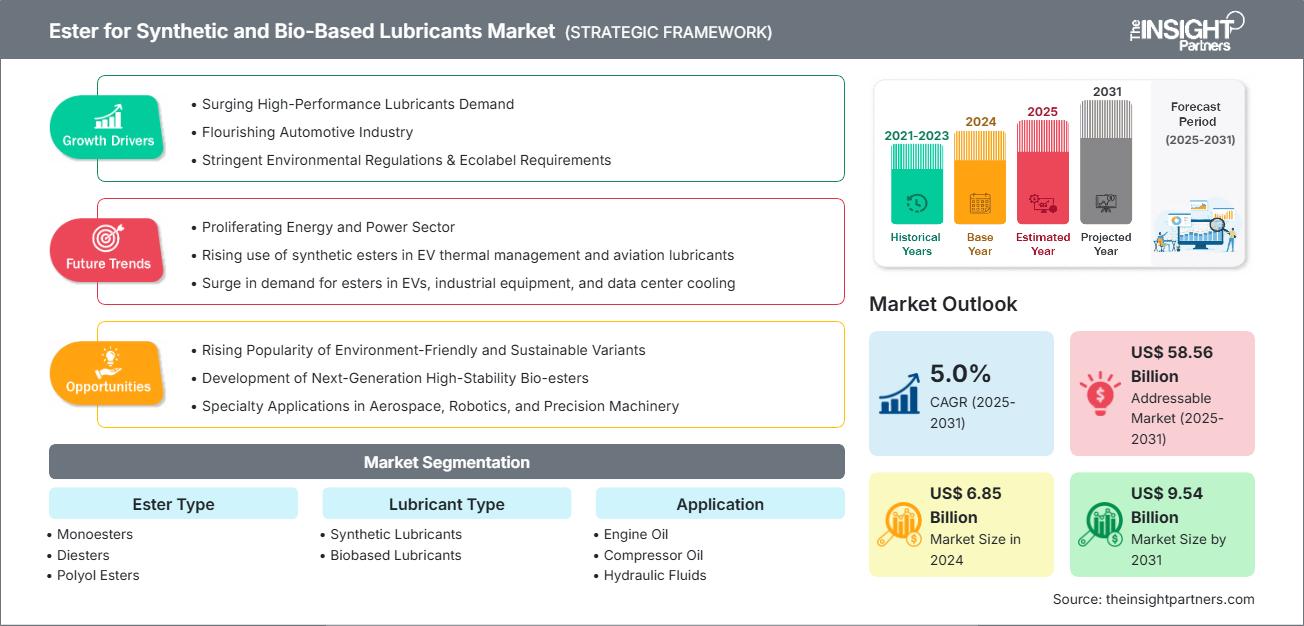
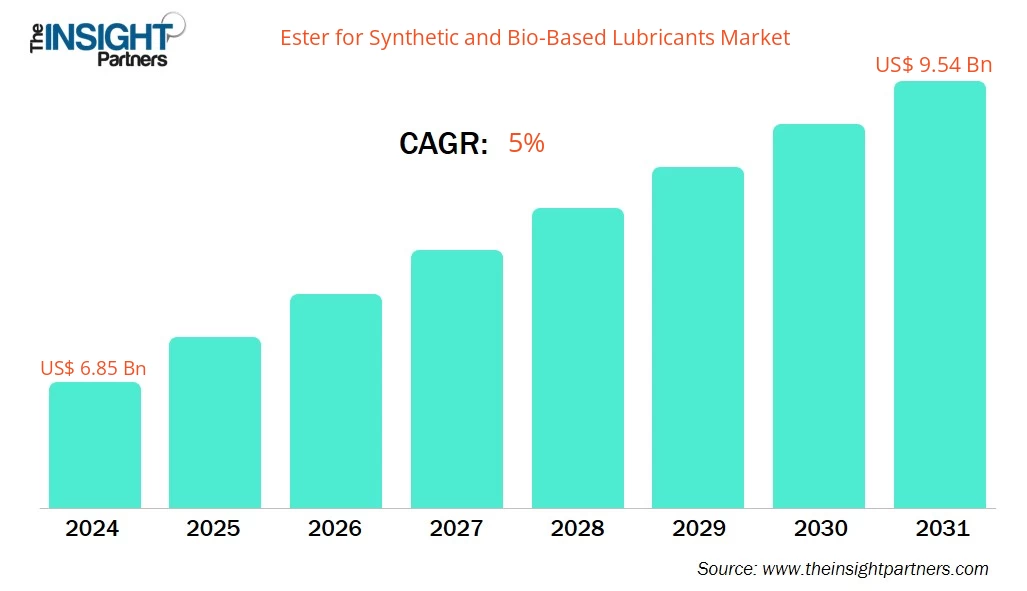
The ester for synthetic and bio-based lubricants market size is projected to reach US$ 9.54 billion by 2031 from US$ 6.85 billion in 2024. The market is expected to register a CAGR of 5.0% during 2025–2031.
Ester for Synthetic and Bio-based Lubricants Market Analysis
The automotive industry often requires specialized lubricants to ensure efficient power transfer, cooling, and long-term durability of electric motor components. Therefore, the burgeoning demand for lubricants from the automotive industry bolsters the global ester for synthetic and bio-based lubricants market. Furthermore, the ongoing expansion of the renewable sectors in the world is generating significant growth opportunities for the global ester for synthetic and bio-based lubricants market.
Ester for Synthetic and Bio-based Lubricants Market Overview
The global esters market for synthetic and bio-based lubricants is growing significantly. This growth is largely influenced by a rising need for high-performing and environmentally friendly lubricants used in various industries. Esters are compounds that are made by the reaction of acids and alcohols. They are stable thermally, can be biodegraded easily, have low volatility, and have enhanced lubrication properties. Thus, they are perfect base stocks for the preparation of synthetic and bio-based lubricants that are subsequently used in automotive, aerospace, industrial machinery, marine, and power generation sectors. The most significant product groups in this market are esters: monoesters, diesters, polyol esters, and complex esters. Each one of them is designed for different performance features. For example, monoesters deliver biodegradability and oxidative stability, whereas polyol and complex esters impart extraordinary high-temperature performance and load-carrying capacity. Sufficient environmental laws implemented mainly in North America and Europe are the reasons behind the reduction of carbon emissions, which have compelled the adoption of lubricants that are least harmful to ecosystems.
Market Assessment and Insights
- Asia Pacific dominated the market with 33.4% share in 2024.
- North America is poised to grow at a CAGR of 5.5% over the forecast period.
- United States market is projected to grow at a CAGR of 5.7% over the forecast period.
- By Ester Type, the Diesters segment accounted for the largest market share of 25.9% in 2024.
- By Lubricant Type, the Synthetic Lubricants segment is anticipated to witness the fastest growth, registering a CAGR of 5.1% over the forecast period
- By Application, the Compressor Oil segment accounted for the largest market share of 19.6% in 2024.
- By End Use, the Electric Vehicles segment is anticipated to witness the fastest growth, registering a CAGR of 6% over the forecast period
- The report profiles key industry players such as BASF SE, Evonik Industries AG, Cargill Inc, Zschimmer & Schwarz Chemie GmbH, Exxon Mobil Corp, Kao Corp, Lanxess, Emery Oleochemicals, Polynt SpA, IOI Corporation Berhad, while also analyzing key developments in novel ideas, disruptive products, and innovative services that could reshape the future market and reveal emerging themes across the industry.
Source: The Insight Partners' analysis based on proprietary research, government publications, company annual reports, investor presentations, industry databases, and expert interviews.
● REPORT CUSTOMIZATION
Tailor This Report To Align With Your Specific Business Requirements
This report can be customized to align precisely with your business objectives, scope, and target markets. Customization options include tailored segmentation, geography, competitive analysis, and strategic insights to support informed decision-making.
Customize This Report →WHAT YOU CAN ADJUST
- ● Segmentations
- ● Geography
- ● Competitive Analysis
- ● Language Preferences
Ester for Synthetic and Bio-Based Lubricants Market: Strategic Insights
-
Get Top Key Market Trends of this report.This FREE sample will include data analysis, ranging from market trends to estimates and forecasts.
Ester for Synthetic and Bio-based Lubricants Market Drivers and Opportunities
Market Drivers:
- Stringent Environmental Regulations & Ecolabel Requirements: Global mandates such as the EU Ecolabel, US Vessel General Permit, and IMO standards are driving the implementation of readily biodegradable, low-toxicity esters in environmentally sensitive applications, mainly in marine and hydraulic fluids.
- Rising demand for high-performance and energy-efficient lubricants: Automakers and industrial OEMs also need lubricants with superior thermal stability, low volatility, high viscosity index, and extended drain intervals, in which polyol esters and diesters outperform traditional base stocks.
- Renewable and Bio-based Feedstocks: Expansion of the availability of bio-derived polyol esters derived from renewable vegetable oils and fats, along with new synthetic routes, will support the transition to sustainable high-performance Group V base oils.
Market Opportunities:
- Development of Next-Generation High-Stability Bio-esters: Development of novel genetically modified oilseeds, catalytic processes, and additives to reach oxidative stability similar to synthetic esters while maintaining full biodegradability.
- Rapid growth in Asia Pacific and Emerging Economies: The fast industrialization, expanding automotive production, and increasing environmental awareness in China, India, and Southeast Asia drive the demand for premium synthetic and bio-lubricants.
- Specialty Applications in Aerospace, Robotics, and Precision Machinery: The demands on ultra-clean, low-outgassing, and wide-temperature-range ester-based fluids are in aviation hydraulics, wind turbine gear oils, and high-speed robotics.
Ester for Synthetic and Bio-based Lubricants Market Report Segmentation Analysis
The ester for synthetic and bio-based lubricants market is divided into different segments to give a clearer view of its growth potential and the latest trends. Below is the standard segmentation approach used in industry reports:
By Ester Type:
- Monoesters
- Diesters
- Polyol Esters
- Trimethylolpropane Esters
- Pentaerythritol Esters
- Neopentyl Glycol Esters
- Trimethylol Ethane Esters
- Dipentaerythritol Esters
- Trimellitate Esters
- Complex Esters
- Others
By Lubricant Type:
- Synthetic Lubricants
- Biobased lubricants
By Application:
- Engine Oil: The demand for engine oil is increasing globally due to the rising vehicle ownership and the need for high-performing, fuel-efficient lubricants.
- MCO (Motorcycle Oil): The MCO segment is experiencing steady growth due to the increasing motorcycle usage across the world.
- PCMO (Passenger Car Motor Oil): PCMO is the leading segment in the engine oil market due to the rise in the number of passenger vehicles and the need for fuel-efficient and low-emission lubricants.
- HDEO (Heavy-Duty Engine Oil): HDEO is also seeing strong demand from commercial transport and logistics sectors that require performance oils for long intervals and engine protection.
- Others: This includes specialty engine oils for off-road vehicles, racing engines, and hybrid vehicles, addressing diverse performance needs.
- Compressor Oil: The demand for engine oil is increasing globally due to the rising vehicle ownership and the need for high-performing, fuel-efficient lubricants.
- Refrigeration: High-performance esters for low-GWP refrigerants and energy-efficient cooling systems.
- Air Compressors: Synthetic esters provide extended drain intervals and cleaner operation in rotary compressors.
- Natural Gas Compressors: Thermally stable polyol esters prevent gas dilution in high-pressure applications.
- Others: Others include hydraulic fluid, grease, turbine, and metalworking specialty esters with superior lubricity and biodegradability.
- Hydraulic Fluid: Hydraulic oil is still a major application area for high-pressure and anti-wear lubrication.
- Gear Oil: Gear oil demand is driven by automotive and industrial gear systems requiring extreme pressure performance and long-term durability.
- Transformer Oil: Transformer oil is experiencing a steady demand due to the growth within the power generation and distribution segment, which focuses on thermal stability and electrical insulation performance.
- Coolant: High-thermal-conductivity dielectric esters for EV battery cooling, immersion cooling in data centers, and hybrid/ICE engine coolants with superior heat transfer and material compatibility.
- Others: This category includes niche applications like compressor oils, textile lubricants, and biodegradable specialty fluids tailored for unique industrial needs.
By End-Use:
- Automotive
- Conventional Vehicles
- Electric Vehicles
- Textile
- Marine
- Mining and Metallurgy
- Aviation
- Energy and Power
- Others
By Geography:
- North America
- Europe
- Asia Pacific
- Middle East & Africa
- South & Central America
Ester for Synthetic and Bio-Based Lubricants Market Report Scope
| Report Attribute | Details |
|---|---|
| Market size in 2024 | US$ 6.85 Billion |
| Market Size by 2031 | US$ 9.54 Billion |
| Global CAGR (2025 - 2031) | 5.0% |
| Historical Data | 2021-2023 |
| Forecast period | 2025-2031 |
| Segments Covered |
By Ester Type
|
| Regions and Countries Covered |
North America
|
| Market leaders and key company profiles |
|
Ester for Synthetic and Bio-Based Lubricants Market Players Density: Understanding Its Impact on Business Dynamics
The Ester for Synthetic and Bio-Based Lubricants Market is growing rapidly, driven by increasing end-user demand due to factors such as evolving consumer preferences, technological advancements, and greater awareness of the product's benefits. As demand rises, businesses are expanding their offerings, innovating to meet consumer needs, and capitalizing on emerging trends, which further fuels market growth.
Ester for Synthetic and Bio-based Lubricants Market Share Analysis by Geography
The ester for synthetic and bio-based lubricants market in Asia Pacific is witnessing the fastest growth, driven by rapid industrialization, rising demand for high-performance lubricants, increasing adoption in electric vehicles, and supportive environmental regulations promoting the use of biodegradable and sustainable lubricants.
The ester for synthetic and bio-based lubricants market varies across regions due to differences in industrial development, automotive and aviation demand, environmental regulations, technological advancements in lubricant formulations, growing adoption of electric vehicles, and the push for sustainable and biodegradable solutions. Below is a summary of the synthetic ester lubricants market share and trends by region:
1. North America
- Market Share: Moderate share driven by demand for high-performance lubricants in automotive and aerospace sectors
- Key Drivers:
- Stringent environmental regulations promote biodegradable lubricants
- High adoption of electric vehicles and industrial automation
- Advanced technological infrastructure supporting lubricant innovation
- Trends: Rising use of synthetic esters in EV thermal management and aviation lubricants
2. Europe
- Market Share: Strong market share supported by strict sustainability mandates and advanced manufacturing
- Key Drivers:
- EU regulations on emissions and biodegradable fluids
- High demand in the automotive, marine, and wind energy sectors
- Focus on circular economy and low-toxicity formulations
- Trends: Shift toward ester-based lubricants in renewable energy and electric mobility applications
3. Asia Pacific
- Market Share: Fastest-growing market due to industrialization and expanding automotive production
- Key Drivers:
- Rapid EV adoption in China, India, and Southeast Asia
- Increasing use of high-performance lubricants in manufacturing
- Supportive government policies for clean technology
- Trends: Surge in demand for esters in EVs, industrial equipment, and data center cooling
4. Middle East and Africa
- Market Share: Emerging market with growing interest in industrial and energy applications
- Key Drivers:
- Need to enhance food security in arid and semi-arid regions
- Government incentives for sustainable farming and water-efficient practices
- Investments in agricultural infrastructure and technology
- Trends: Gradual adoption of esters in turbines, compressors, and heavy-duty equipment
5. South and Central America
- Market Share: Moderate growth with increasing focus on industrial efficiency and environmental safety
- Key Drivers:
- Growing automotive and mining activities in Brazil, Argentina, and Chile
- Need for cost-effective, durable lubricants in remote operations
- Government efforts to reduce the environmental impact of industrial fluids
- Trends: Rising interest in biodegradable and long-drain interval ester lubricants
Ester for Synthetic and Bio-based Lubricants Market Players Density: Understanding Its Impact on Business Dynamics
High Market Density and Competition
Competition is intense due to the presence of established players such as Exxon Mobil Corp, BP Plc, Chevron Corp, TotalEnergies SE, and BASF SE.
This high level of competition urges companies to stand out by offering:
- High-performance lubrication solutions
- Innovative delivery systems and application technologies
- Eco-friendly and sustainable formulations
- Competitive pricing models
Opportunities and Strategic Moves
- Growing Demand for High-Performance Lubricants.
- Shift Toward Bio-based and Environmentally Friendly Lubricants
- Addressing Performance Challenges in Extreme Conditions
- Strengthen Technical Support and Customer Education
- Expand and Diversify Product Portfolio
Major companies operating in the ester for synthetic and bio-based lubricants market are:
- China Petroleum & Chemical Corp (Sinopec)
- Exxon Mobil Corp
- BP Plc
- Chevron Corp
- AMSOIL Inc
- Phillips 66
- TotalEnergies SE
- Valvoline Inc
- Matrix Specialty Lubricants
- BASF SE
Disclaimer: The companies listed above are not ranked in any particular order.
Other companies analyzed during research:
- Cargill Inc
- Idemitsu Kosan Co Ltd
- ENEOS Corp
- APAR Industries Ltd
- Fuchs SE
- Repsol SA
- NYCO
- SAVITA OIL TECHNOLOGIES LIMITED
- Perstorp Holding AB
- Suniso Lubricants Inc
- Shell Plc
- International Lubricant Inc
Ester for Synthetic and Bio-based Lubricants Market News and Recent Developments
- Chevron Expands Supply Of Marine Lubricants To Include Port Elizabeth, South Africa
Chevron Marine Lubricants (a subsidiary of Chevron Corporation) has extended its global supply capacity to include Port Elizabeth, South Africa. This expansion enhances the company's ability to serve vessels taking the longer route to avoid current conflict areas. It also represents a strategically important addition to Chevron's distribution network in the southern region. - BASF to increase production capacity for synthetic ester base stocks in Jinshan, China.
BASF SE announced that it will double its production capacity for its synthetic ester base stocks at its site in Jinshan, China. This strategic decision was made owing to the rising demand for high-performance lubricants in Asia Pacific and to strengthen the company's position as a reliable supplier that strongly supports customers' growth in the region.
Ester for Synthetic and Bio-based Lubricants Market Report Coverage and Deliverables
The " Ester for Synthetic and Bio-based Lubricants Market Size and Forecast (2021–2031)" report provides a detailed analysis of the market covering the following areas:
- Ester for synthetic and bio-based lubricants market size and forecast at global, regional, and country levels for all market segments covered under the scope
- Ester for synthetic and bio-based lubricants market trends, as well as market dynamics such as drivers, restraints, and key opportunities
- Detailed Porter's five forces analysis and SWOT analysis
- Ester for synthetic and bio-based lubricants market analysis covering market trends, global and regional framework, major players, regulations, and recent market developments
- Industry landscape and competition analysis covering market concentration, heat map analysis, prominent players, and recent developments for the Ester for synthetic and bio-based lubricants market
- Detailed company profiles
Frequently Asked Questions

- Comprehensive Market Sizing and Forecast Analysis
- Detailed Segmentation Analysis
- In-Depth Market Dynamics Assessment
- Regional and Country-Level Insights
- Competitive Landscape and Company Benchmarking
- Strategic Business Intelligence
Recent Reports
Testimonials

The Insight Partners provided valuable market intelligence that supported our global go-to-market strategy. Their team was professional, responsive, and attentive to our feedback, providing thoughtful analysis and helpful methodological clarifications throughout the project.
Junmo Kim Chief Financial Officer (CFO), Enertech Co., Ltd.
The Insight Partners' SCADA System Market report is comprehensive, with valuable insights on current trends and future forecasts. The team was highly professional, responsive, and supportive throughout. We are very satisfied and highly recommend their services.
RAN KEDEM Partner, Reali Technologies LTDs
I requested a report on a very specific software market and the team produced the report in a few days. The information was very relevant and well presented. I then requested some changes and additions to the report. The team was again very responsive and I got the final report in less than a week.
JEAN-HERVE JENN Chairman, Future Analytica
We worked with The Insight Partners for an important market study and forecast. They gave us clear insights into opportunities and risks, which helped shape our plans. Their research was easy to use and based on solid data. It helped us make smart, confident decisions. We highly recommend them.
PIYUSH NAGPAL Sr. Vice President, High Beam Global
The Insight Partners delivered insightful, well-structured market research with strong domain expertise. Their team was professional and responsive throughout. The user-friendly website made accessing industry reports seamless. We highly recommend them for reliable, high-quality research services
YUKIHIKO ADACHI CEO, Deep Blue, LLC.
This is the first time I have purchased a market report from The Insight Partners.While I was unsure at first, I visited their web site and felt more comfortable to take the risk and purchase a market report.I am completely satisfied with the quality of the report and customer service. I had several questions and comments with the initial report, but after a couple of dialogs over email with their analyst I believe I have a report that I can use as input to our strategic planning process.Thank you so much for taking the extra time and making this a positive experience.I will definitely recommend your service to others and you will be my first call when we need further market data.
JOHN SUZUKI President and Chief Executive Officer, Board Director, BK Technologies
I wish to appreciate your support and the professionalism you displayed in the course of attending to my request for information regarding to infectious disease IVD market in Nigeria. I appreciate your patience, your guidance, and the fact that you were willing to offer a discount, which eventually made it possible for us to close a deal. I look forward to engaging The Insight Partners in the future, all thanks to the impression you have created in me as a result of this first encounter.
DR CHIJIOKE ONYIA MANAGING DIRECTOR, PineCrest Healthcare Ltd.Reason to Buy
- Informed Decision-Making
- Understanding Market Dynamics
- Competitive Analysis
- Identifying Emerging Markets
- Customer Insights
- Market Forecasts
- Risk Mitigation
- Boosting Operational Efficiency
- Strategic Planning
- Investment Justification
- Tracking Industry Innovations
- Aligning with Regulatory Trends





 Get Free Sample for