
Plumbing Fixtures and Fittings Manufacturing Market Size, Share & Growth by 2034
Coverage: By Material (Vitreous China, Metal, Plastics); Product (Bathtub and Shower Fixtures and Fittings, Sink Fixtures and Fittings, Toilet Fixtures and Fittings); Application (Residential, Commercial) , and Geography (North America, Europe, Asia Pacific, and South and Central America)
- Status : Data Released
- Report Code : TIPRE00021338
- Category : Manufacturing and Construction
- No. of Pages : 150
- Available Report Formats :


- Last update date : October 13, 2026


2025 Market Size
US$ 19.22 Bn
Base year value
2034 Forecast
US$ 30.02 Bn
Projected by 2034
CAGR 2026-2034
5.08 %
Growth rate
Addressable Market
US$ 223.43 Bn
(2026-2034)
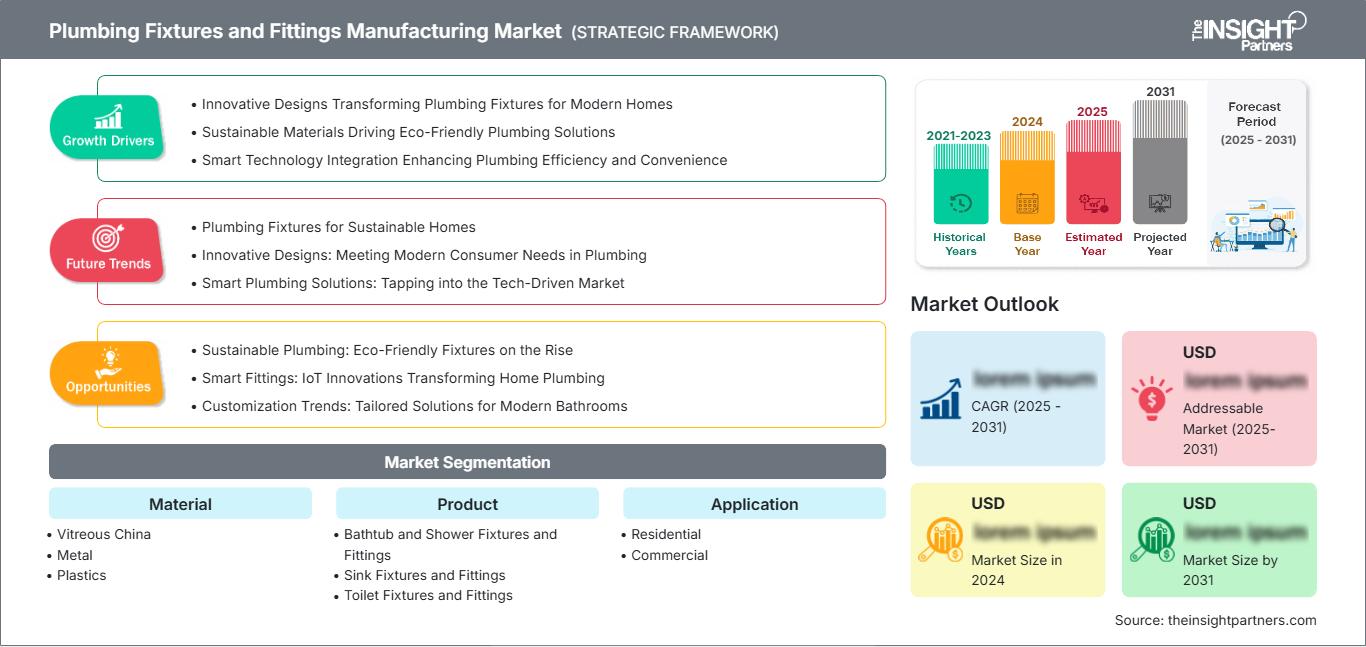
The plumbing fixtures and fittings manufacturing market size was valued at US$ 19.22 Billion in 2025 and is projected to reach US$ 30.02 Billion by 2034, registering a CAGR of 5.08% from 2026 to 2034. The market covers manufactured plumbing products across vitreous china, metal, and plastics, with product demand spanning bathtub and shower fixtures and fittings, sink fixtures and fittings, and toilet fixtures and fittings for residential and commercial applications.
North America represented an estimated 28% of the global market in 2025 and is expected to register a 4.65% CAGR from 2026 to 2034, supported by renovation activity, replacement of aging plumbing systems, water-efficiency requirements, and sustained residential construction. US housing-permit data remained a key demand signal in 2025, while manufacturers increasingly emphasize water-efficient faucets, showerheads, toilets, and specification-ready commercial products.
Plumbing Fixtures and Fittings Manufacturing Market Assessment and Insights
- North America: The region accounted for an estimated 28% global plumbing fixtures and fittings manufacturing market share in 2025 and is projected to grow at a 4.65% CAGR from 2026 to 2034. Replacement demand, remodeling, water-efficiency standards, and commercial construction support relatively stable fixture consumption.
- U.S.: The U.S. represented an estimated 78% of North America's market in 2025 and is expected to expand at a 4.55% CAGR. Residential remodeling, commercial specification activity, and water-efficient product adoption underpin demand.
- Europe: Europe held an estimated 27% global market share in 2025 and is projected to grow at a 4.20% CAGR. Germany, the UK, France, Italy, and Spain anchor demand, with water efficiency, renovation, building standards, and sophisticated sanitary-product distribution differentiating the region.
- Asia Pacific: APAC accounted for an estimated 30% global market share in 2025 and is forecast to grow at a 6.25% CAGR. China, Japan, South Korea, and India lead regional demand, supported by urban housing, hospitality, infrastructure development, domestic manufacturing, and bathroom modernization.
- Largest Segment: Residential is the largest main segment and is expected to register a 4.72% CAGR from 2026 to 2034, reflecting its broad installed base, replacement requirements, household construction, remodeling, and recurring demand for complete bathroom and kitchen plumbing packages.
- High Growth Segment: Commercial is the fastest-growing main segment, with a projected 5.86% CAGR from 2026 to 2034, driven by hospitality, healthcare, offices, retail, institutional construction, water-efficiency specifications, and procurement of standardized high-durability fixtures.
- Key companies analyzed in detail: Elkay Manufacturing Company; Fortune Brands Innovations, Inc.; Geberit AG; GWA Group Limited; Hindware Limited; Kohler Co.; LIXIL Corporation; Masco Corporation; Roca Sanitario, S.A.; TOTO LTD.
Source: The Insight Partners' analysis based on proprietary research, government publications, company annual reports, investor presentations, industry databases, and expert interviews.
There is an ongoing transition in the market from the traditional fixture manufacturing to a product range that emphasizes water efficiency, durability, design flexibility, installation efficiency, and material optimization. Metal fixtures use more sophisticated processes of precision machining and finishing, and there remains a strong focus in vitreous china manufacturing on dimensional consistency, glazing, and production efficiency. In 2025, the manufacturers continued to introduce water-efficient products and sustainability ranges with additional offerings for the WaterSense program and products with recycled content. Commercial customers have also become more focused on specification compliance, accessibility, longevity, and installation standardization.
Looking forward, the factors driving the market include urbanization in developing countries, renovation spending in developed countries, and investments in hotel buildings, healthcare facilities, office buildings, and residential buildings. The regulations aimed at water consumption lead the manufacturers to improve their flow control and flushing system designs without compromising user performance. There is also a growing trend of supply chain localization that is caused by a need to balance between material availability such as ceramic, metal, polymer, valve, cartridge, and finishing components versus transportation costs.
Plumbing Fixtures and Fittings Manufacturing Market Report Scope
| Report Attribute | Details |
|---|---|
| Market size in 2025 | US$ 19.22 Billion |
| Market Size by 2034 | US$ 30.02 Billion |
| Global CAGR (2026 - 2034) | 5.08% |
| Historical Data | 2021-2024 |
| Forecast period | 2026-2034 |
Plumbing Fixtures and Fittings Manufacturing Market Analysis
Demand is now more driven by replacement cycles and renovations apart from new construction. There are repeat purchases of faucets, sinks, toilets, showers, and bathtubs associated with residential renovations while there are specifications-driven demand for standardized fixtures in case of commercial construction. Demand driver has implications on architects, builders, plumbers, wholesalers, and retailers, which means there are requirements of reliable dimension, certification, consistency in finish, installation compatibility, and replacement part availability.
According to the Plumbing Fixtures and Fittings Manufacturing Market report, the supply chain starts from suppliers of materials such as vitreous china, brass, stainless steel, polymer, cartridge, valve, coating, and components to manufacturers, wholesalers, plumbing contractors, designers, builders, and customers. Supply dynamics vary according to the products: ceramics are supply constrained by kiln availability and material quality whereas metals are more susceptible to input costs and component availability. Manufacturers who integrate their procurement, manufacturing, logistics, and services can minimize installation problems and retain their specifications.
There are competing manufacturers of sanitary ware globally, regional specialists in sanitary ware, plumbing components manufacturers, and fixture brands. Differentiation is becoming more complicated, integrating design, water performance, installation ease, durability, channel presence, and specification. Geberit has a strong competitive positioning in sanitary systems, Kohler merges bathroom products with water efficiency and material circularity programs. Masco enters the competition through the wide range of plumbing products and LIXIL with plumbing and housing-related products.
The Plumbing Fixtures and Fittings Manufacturing Market forecast shows that investments are being made in manufacturing efficiencies, product development, sustainability characteristics, specification tools, and local distribution. Corporate portfolios reflect different strategic choices; large diversified corporations are able to combine fixtures with other building products, while specialized sanitary ware producers can invest in ceramic product development, bathroom design, installation technology, and professional sales channels. The competitive advantage lies not only in manufacturing the fixtures but also in servicing architects, builders, distributors, retail customers, and institutions in providing the products.
● REPORT CUSTOMIZATION
Tailor This Report To Align With Your Specific Business Requirements
This report can be customized to align precisely with your business objectives, scope, and target markets. Customization options include tailored segmentation, geography, competitive analysis, and strategic insights to support informed decision-making.
Customize This Report →WHAT YOU CAN ADJUST
- ● Segmentations
- ● Geography
- ● Competitive Analysis
- ● Language Preferences
Plumbing Fixtures and Fittings Manufacturing Market: Strategic Insights
Regional Insights
North America Plumbing Fixtures and Fittings Manufacturing Market
North America accounted for an estimated 28% global market share in 2025 and is expected to grow at a 4.65% CAGR through 2034. Demand is supported by residential replacement, remodeling, commercial renovation, and plumbing-system modernization. Aging housing stock creates recurring opportunities for fixture replacement, while water-efficiency requirements encourage adoption of lower-flow faucets, showerheads, and toilets.
The United States continues to be the main market for this product, aided by both building and remodeling efforts. Canada adds value in the residential, commercial, and renovation sectors. The companies producing the products are companies like Elkay, Kohler, and Masco, who provide their products to the residential and commercial markets, each with different offerings of fixtures. Current product strategies tend to focus on water efficiency, recycled content, certifications, and environmental product information.
U.S. Plumbing Fixtures and Fittings Manufacturing Market
The U.S. represented an estimated 78% of North America's market in 2025 and is projected to register a 4.55% CAGR. The demand includes new construction, replacement, kitchen and bathroom remodelling, multifamily, hospitality, healthcare and institutional building. The residential applications are still diverse, whereas the commercial procurement gives more importance to longevity, standard installation and maintenance, and regulatory compliance.
What sets the country apart is the combination of a sizeable existing installation of fixtures and an established network of professional distribution channels. Elkay installs sinks and faucets, whereas Kohler and Masco have diverse plumbing portfolios. The building permits give a continuous indication of the residential fixture demand, while remodelling and water efficiency programs drive the replacement demand even in tough new construction conditions.
Europe Plumbing Fixtures and Fittings Manufacturing Market
Europe represented an estimated 27% global market share in 2025 and is forecast to grow at a 4.20% CAGR. Germany is one of the key regional markets due to sophisticated plumbing facilities, professional distribution networks, and sanitary system production capacity. UK is characterized by high potential for replacements and renovations, while France and Italy offer residential renovations combined with stylish bathrooms. Spain has an opportunity to benefit from residential renovations, hospitality segment, and sanitaryware manufacturing.
There are specific needs of European market related to resource efficiency, building performance, longevity of the product, and increasing environmental awareness. Geberit and Roca have high regional relevance, while existing distribution and installation networks play an important role in choosing brands. Building stock of the region implies the need for replacement segment, and renovations may partly compensate low dynamics of construction. Germany offers well-developed manufacturing cluster with an engineering base, while Italy and Spain have design and ceramic production capacity.
APAC Plumbing Fixtures and Fittings Manufacturing Market
APAC held an estimated 30% global market share in 2025 and is expected to grow at a 6.25% CAGR, making it the largest regional market and a major source of incremental demand. China leads the region because of its manufacturing scale, urban housing base, construction ecosystem, and extensive domestic sanitaryware supply chain. Japan emphasizes high-performance bathroom technology and water efficiency, while South Korea has strong demand for design-led residential and smart bathroom products.
The support factors for India include urban housing, sanitation facilities, hospitality, and increased modernization of bathrooms. The Australia market is smaller but more regulated and focuses on water-efficient plumbing fittings. The local suppliers gain from being close to sources of ceramics, metals, polymers, and components. Local suppliers also have the advantage of catering to different installation requirements, pricing, distribution channels, and weather in APAC.
Middle East & Africa Plumbing Fixtures and Fittings Manufacturing Market
Middle East and Africa demand is supported by construction of hotels, residential developments, healthcare facilities, airports, commercial properties, and large urban projects. Saudi Arabia and the UAE provide significant project-driven demand, with specifications increasingly emphasizing water efficiency, durability, aesthetics, and reliable installation. South Africa has a more replacement-oriented market with demand linked to residential construction and infrastructure maintenance.
Regional growth is also influenced by localization initiatives and large-scale infrastructure programs. The Middle East has greater concentration of premium commercial and hospitality projects, while African markets generally show stronger sensitivity to affordability, distribution access, and imported product availability. Manufacturers able to combine certified water performance with durable materials and dependable regional supply can address both project specifications and replacement channels.
South & Central America Plumbing Fixtures and Fittings Manufacturing Market
South and Central America accounted for an estimated 8% global market share in 2025 and is expected to expand at a 5.35% CAGR. Brazil is the principal regional demand center because of its large residential base, construction ecosystem, and domestic sanitaryware manufacturing capabilities. Argentina contributes through residential renovation and replacement demand, while the rest of the region is influenced by tourism construction, urbanization, and imported fixture availability.
Brazil's localized manufacturing distinguishes it from smaller neighboring markets that depend more heavily on imports and distributor networks. Water availability, construction standards, housing investment, and hospitality development influence product selection. Manufacturers that adapt product portfolios to local price points, installation practices, and distribution requirements are better positioned to capture replacement and project demand across the region.
Segmentation Analysis
Material
The material segment covers vitreous china, metal, and plastics used across sanitary fixtures and fittings. Metal is expected to register a 5.15% CAGR from 2026 to 2034, supported by demand for faucets, valves, fittings, durability, surface finishes, and precision-engineered components. Vitreous china remains central to toilets and sinks because of hygiene, durability, and established manufacturing infrastructure. Plastics benefit from corrosion resistance, lightweight construction, design flexibility, and cost-sensitive applications.
- Vitreous China: Provides durable, hygienic surfaces for sanitaryware and remains important in toilets and sinks, particularly where established ceramic production and design consistency influence procurement.
- Metal: Supports faucets, fittings, valves, and premium fixtures where durability, finish quality, corrosion resistance, and mechanical performance influence buyer selection.
- Plastics: Enable lightweight, corrosion-resistant components and cost-efficient designs, with adoption supported by polymer processing flexibility and suitability for selected fixture and fitting applications.
Product
The product segment comprises bathtub and shower fixtures and fittings, sink fixtures and fittings, and toilet fixtures and fittings. Sink Fixtures and Fittings are projected to grow at a 5.35% CAGR from 2026 to 2034, supported by residential remodeling, kitchen and bathroom modernization, commercial wash areas, and broad replacement requirements. Product competition increasingly centers on installation compatibility, water efficiency, finish options, and integrated functionality.
- Bathtub and Shower Fixtures and Fittings: Serve bathing and showering installations, with adoption influenced by water control, spray performance, design preferences, accessibility requirements, and renovation patterns.
- Sink Fixtures and Fittings: Address kitchen, bathroom, utility, and commercial wash areas, with replacement demand supported by remodeling and the need for coordinated faucets, sinks, valves, and accessories.
- Toilet Fixtures and Fittings: Include products associated with toilet installation and operation, where flushing performance, water consumption, hygiene, durability, and maintenance requirements shape procurement.
Application
The application segment consists of residential and commercial demand. Commercial applications are projected to register a 5.86% CAGR from 2026 to 2034, supported by hospitality, healthcare, offices, retail, education, and institutional construction. Residential demand remains larger because fixtures are installed across a broad housing base and are repeatedly replaced during bathroom and kitchen renovations. Commercial buyers place greater weight on lifecycle cost, standardized installation, durability, maintenance, and water performance.
- Residential: Represents the broad household installation base and is driven by new housing, remodeling, replacement, bathroom upgrades, kitchen renovations, and consumer preference for coordinated fixture designs.
- Commercial: Covers hospitality, healthcare, offices, retail, education, institutional facilities, and other nonresidential environments where durability, standardized specification, maintenance access, water efficiency, and procurement reliability are important.
Opportunity Snapshot
| Application | Revenue Contribution | Trend Tag | Adoption Stage |
|---|---|---|---|
| Residential | High | Renovation-led | Mature |
| Commercial | Medium | Project-led | Scaling |
Plumbing Fixtures and Fittings Manufacturing Market Growth Drivers and Impact Analysis
Water-Efficiency Requirements Reshape Product Design
Water-efficiency requirements are shifting competition from basic fixture availability toward measurable flow, flushing, and consumption performance. Manufacturers increasingly engineer faucets, showerheads, toilets, cartridges, valves, and associated components to reduce water use while maintaining pressure, spray quality, flushing reliability, and user comfort. Kohler's portfolio illustrates this direction through water-efficient products and expanded WaterSense-labeled offerings. The mechanism is direct: tighter resource constraints and efficiency specifications influence architects, utilities, builders, and consumers, increasing preference for certified or demonstrably efficient products. This favors manufacturers with engineering capability, testing infrastructure, certification expertise, and established professional channels. It also increases the value of product redesign and component innovation across both replacement and new-construction applications.
Renovation and Replacement Sustain Fixture Demand
Renovation and replacement provide a structural demand base because plumbing fixtures have to be renewed independently of complete building replacement. Bathroom remodeling can trigger coordinated purchases of toilets, sinks, faucets, shower fittings, and bathtub products, while commercial refurbishments often require standardized fixture packages across multiple rooms or facilities. The mechanism is renovation spending leading to specification activity, distributor orders, installer purchases, and replacement sales. This reduces dependence on new construction alone and creates recurring demand for manufacturers with broad product portfolios. In mature markets, the installed housing and commercial building base therefore becomes a strategic asset for fixture suppliers. Companies with strong distribution, replacement-part availability, and installer recognition can capture demand throughout the maintenance cycle.
Commercial Construction Raises Specification Complexity
Commercial construction increases demand for fixtures designed around durability, water performance, installation consistency, and lifecycle maintenance. Hotels, healthcare facilities, offices, schools, airports, and retail properties often require coordinated products that meet project specifications and can be serviced efficiently after installation. The mechanism begins with project requirements established by owners, architects, engineers, and contractors, which then influence approved product lists and distributor procurement. Manufacturers with specification support, technical documentation, broad product compatibility, and dependable supply can improve their position in these projects. Commercial demand also creates opportunities for premium materials, touchless functionality, specialized flushing systems, and products engineered for high-use environments. Consequently, commercial construction can raise both product complexity and the strategic importance of professional specification channels.
Plumbing Fixtures and Fittings Manufacturing Market Future Trends
Connected and Water-Intelligent Fixtures Become More Integrated
The Plumbing Fixtures and Fittings Manufacturing Market trends show that bathroom products are increasingly moving toward integrated functionality, including sensor-based operation, electronic controls, improved flushing systems, and more precise water management. The change is enabled by compact electronics, improved sensors, connectivity, and growing attention to hygiene and resource efficiency. Commercial facilities are particularly affected because high-use environments can benefit from touchless operation, controlled water delivery, and maintenance-oriented product features. Residential buyers are also exposed to these technologies through premium bathroom upgrades. The likely implication is greater convergence between conventional fixture manufacturing and electronics, controls, software-enabled diagnostics, and data-oriented building management. Manufacturers will therefore need capabilities beyond ceramic, metal, and polymer fabrication, particularly for products positioned in premium residential and commercial installations.
Circular Materials and Product Transparency Enter Mainstream Specification
Sustainability is shifting from an operational consideration toward a product-selection criterion. Manufacturers are increasingly incorporating recycled content, environmental product declarations, material transparency, water-saving design, and waste-reduction practices into product portfolios. This trend is particularly relevant to architects, commercial developers, and institutional buyers facing sustainability requirements in building projects. The change is occurring because procurement teams increasingly evaluate product-level environmental characteristics alongside price, appearance, and performance. Manufacturers affected by this transition must document materials, manufacturing impacts, water performance, and product durability more consistently. The implication is a competitive environment in which environmental attributes can influence specification decisions, while manufacturing efficiency and waste reduction can simultaneously improve cost resilience and strengthen product differentiation.
Plumbing Fixtures and Fittings Manufacturing Market Opportunities
Localized Production for Fast-Growing APAC Demand
Localized manufacturing in APAC offers an opportunity to reduce logistics exposure while adapting fixtures to regional installation practices, price points, and building requirements. India and Southeast Asia are particularly relevant for manufacturers targeting residential construction, hospitality, and bathroom modernization, while China provides an extensive component and sanitaryware ecosystem. The unmet need is consistent access to quality products across fragmented channels without excessive lead times or import dependence. Manufacturers can address this by establishing regional production, supplier partnerships, modular product architectures, and local distribution. Beneficiaries include fixture producers, component suppliers, distributors, and professional installers. Strategic localization can also improve responsiveness to changing water-efficiency requirements and country-specific product standards.
Specification-Led Commercial Fixture Platforms
Commercial projects create an opportunity for integrated fixture platforms that combine toilets, sinks, faucets, shower products, accessories, and replacement components under standardized specification systems. Target customers include hotels, healthcare operators, developers, facility managers, architects, and contractors that value consistent installation and maintenance. The barrier is fragmented procurement, where different fixture categories can be sourced from multiple suppliers, increasing coordination requirements and lifecycle complexity. Manufacturers can address this gap through coordinated product families, digital specification libraries, technical support, and dependable replacement-part availability. The strongest beneficiaries are suppliers capable of serving entire project requirements rather than individual fixture categories, particularly in hospitality and institutional construction where standardized performance can reduce maintenance complexity.
Frequently Asked Questions

- Comprehensive Market Sizing and Forecast Analysis
- Detailed Segmentation Analysis
- In-Depth Market Dynamics Assessment
- Regional and Country-Level Insights
- Competitive Landscape and Company Benchmarking
- Strategic Business Intelligence
Recent Reports
Testimonials

The Insight Partners provided valuable market intelligence that supported our global go-to-market strategy. Their team was professional, responsive, and attentive to our feedback, providing thoughtful analysis and helpful methodological clarifications throughout the project.
Junmo Kim Chief Financial Officer (CFO), Enertech Co., Ltd.
The Insight Partners' SCADA System Market report is comprehensive, with valuable insights on current trends and future forecasts. The team was highly professional, responsive, and supportive throughout. We are very satisfied and highly recommend their services.
RAN KEDEM Partner, Reali Technologies LTDs
I requested a report on a very specific software market and the team produced the report in a few days. The information was very relevant and well presented. I then requested some changes and additions to the report. The team was again very responsive and I got the final report in less than a week.
JEAN-HERVE JENN Chairman, Future Analytica
We worked with The Insight Partners for an important market study and forecast. They gave us clear insights into opportunities and risks, which helped shape our plans. Their research was easy to use and based on solid data. It helped us make smart, confident decisions. We highly recommend them.
PIYUSH NAGPAL Sr. Vice President, High Beam Global
The Insight Partners delivered insightful, well-structured market research with strong domain expertise. Their team was professional and responsive throughout. The user-friendly website made accessing industry reports seamless. We highly recommend them for reliable, high-quality research services
YUKIHIKO ADACHI CEO, Deep Blue, LLC.
This is the first time I have purchased a market report from The Insight Partners.While I was unsure at first, I visited their web site and felt more comfortable to take the risk and purchase a market report.I am completely satisfied with the quality of the report and customer service. I had several questions and comments with the initial report, but after a couple of dialogs over email with their analyst I believe I have a report that I can use as input to our strategic planning process.Thank you so much for taking the extra time and making this a positive experience.I will definitely recommend your service to others and you will be my first call when we need further market data.
JOHN SUZUKI President and Chief Executive Officer, Board Director, BK Technologies
I wish to appreciate your support and the professionalism you displayed in the course of attending to my request for information regarding to infectious disease IVD market in Nigeria. I appreciate your patience, your guidance, and the fact that you were willing to offer a discount, which eventually made it possible for us to close a deal. I look forward to engaging The Insight Partners in the future, all thanks to the impression you have created in me as a result of this first encounter.
DR CHIJIOKE ONYIA MANAGING DIRECTOR, PineCrest Healthcare Ltd.Reason to Buy
- Informed Decision-Making
- Understanding Market Dynamics
- Competitive Analysis
- Identifying Emerging Markets
- Customer Insights
- Market Forecasts
- Risk Mitigation
- Boosting Operational Efficiency
- Strategic Planning
- Investment Justification
- Tracking Industry Innovations
- Aligning with Regulatory Trends





 Get Free Sample for