
Patient-Derived Xenograft Model Market Size & Forecast 2031
Coverage: By Model Type (Mice Models and Rats Models), Tumor Type (Gastrointestinal Tumor Models, Gynecological Tumor Models, Respiratory Tumor Models, and Other Tumor Models), Application (Preclinical Drug Development, Biomarker Analysis, Translational Research, and Biobanking), End User (Pharmaceutical and Biotechnology Companies, Contract Research Organizations, and Academic and Government Research Institutions), and Geography (North America, Europe, Asia Pacific, Middle East & Africa, and South & Central America)
- Status : Published
- Report Code : TIPRE00021693
- Category : Life Sciences
- No. of Pages : 256
- Available Report Formats :


- Last update date : November 10, 2025


2024 Market Size
US$ 468.75 Mn
Base year value
2031 Forecast
US$ 1,119.36 Mn
Projected by 2031
CAGR 2025-2031
13.5 %
Growth rate
Addressable Market
US$ 5,621.59 Mn
(2025-2031)
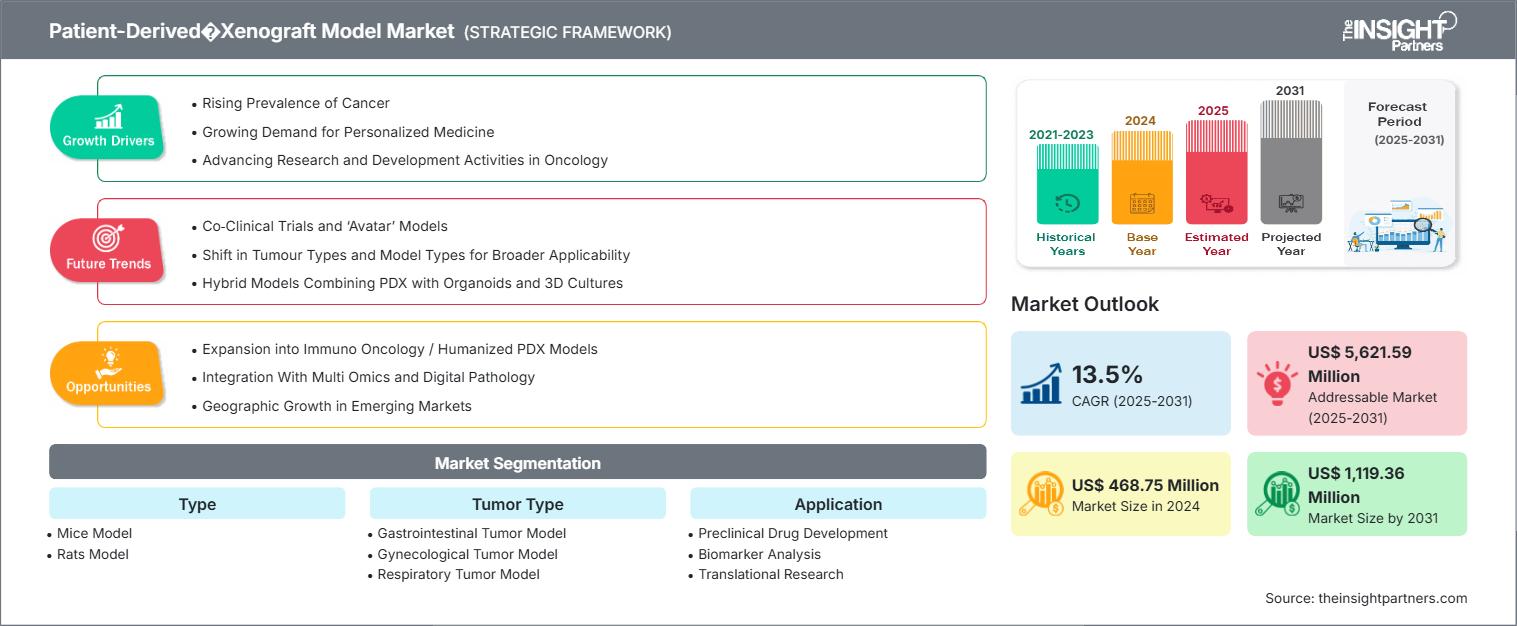
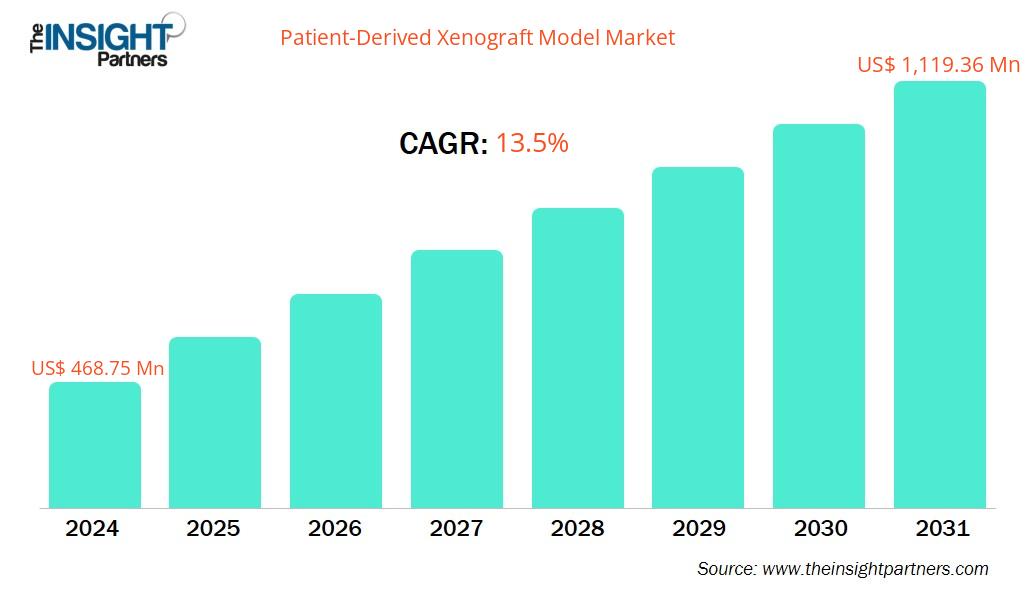
The patient-derived xenograft model market size is projected to reach US$ 1,119.36 million by 2031 from US$ 468.75 million in 2024. The market is expected to register a CAGR of 13.5% during 2025–2031.
Patient-Derived Xenograft Model Market Analysis
The need for patient-derived xenograft (PDX) models worldwide is largely influenced by the increasing number of oncology pipelines that require more predictive in vivo platforms, the fast development of personalized medicine, which in turn needs patient-specific tumor models, and the growing outsourcing of preclinical testing to specialized CROs offering PDX services on a scalable basis.
Patient-Derived Xenograft Model Market Overview
The global patient-derived xenograft model market is undergoing a significant transformation. Pharmaceutical and biotechnology companies are progressively implementing human-tumor-derived platforms that are more representative. These platforms preserve genetic and microenvironmental features that are not present in traditional cell lines. Coupled with the rise in cancer cases, the demand for precision therapies and regulatory bodies recognizing more translational models, PDX platforms have become indispensable in preclinical drug discovery, biomarker identification, and studying therapy resistance. Their expansion is also supported by the breakthroughs in genomic profiling, use of human-immune-competent hosts, and large patient-tumor tissue repositories.
Market Research Highlights
- North America dominated the market with 48.6% share in 2024.
- Asia Pacific is poised to grow at a CAGR of 14.8% over the forecast period.
- United States market is projected to grow at a CAGR of 13.9% over the forecast period.
- By Type, the Mice Model segment accounted for the largest market share of 78% in 2024.
- By Tumor Type, the Other Tumor Model segment is anticipated to witness the fastest growth, registering a CAGR of 14.2% over the forecast period
- By Application, the Preclinical Drug Development segment accounted for the largest market share of 66.2% in 2024.
- By End User, the Academics and Research Institutes segment is anticipated to witness the fastest growth, registering a CAGR of 13.9% over the forecast period
- The report profiles key industry players such as Charles River Laboratories International Inc, Crown Bioscience Inc, WuXi AppTec Co Ltd, BioDuro LLC, Oncodesign Services, Noble Life Sciences, Experimental Pharmacology & Oncology Berlin-Buch GmbH, Hera Biolabs, XenTech SAS, Shanghai LIDE Biotech. Co. Ltd, while also analyzing key developments in novel ideas, disruptive products, and innovative services that could reshape the future market and reveal emerging themes across the industry.
Source: The Insight Partners' analysis based on proprietary research, government publications, company annual reports, investor presentations, industry databases, and expert interviews.
● REPORT CUSTOMIZATION
Tailor This Report To Align With Your Specific Business Requirements
This report can be customized to align precisely with your business objectives, scope, and target markets. Customization options include tailored segmentation, geography, competitive analysis, and strategic insights to support informed decision-making.
Customize This Report →WHAT YOU CAN ADJUST
- ● Segmentations
- ● Geography
- ● Competitive Analysis
- ● Language Preferences
Patient-Derived Xenograft Model Market: Strategic Insights
-
Get Top Key Market Trends of this report.This FREE sample will include data analysis, ranging from market trends to estimates and forecasts.
Patient-Derived Xenograft Model Market Drivers and Opportunities
Market Drivers:
- Rising Prevalence of Cancer: The increasing number of cancer cases worldwide is a major factor driving the demand for effective preclinical models, such as PDX. Such preclinical models are useful to understand tumor behavior and to test new therapies.
- Growing Demand for Personalized Medicine: The need for personalized treatment methods entails the use of models that are accurate and represent the patient's specific tumor, thus leading to increased utilization of PDX models in drug development and therapy optimization.
- Advancing Research and Development Activities in Oncology: The growing oncology research and development initiatives at a global scale mainly fuel the use of PDX models in the testing of new drugs and gaining a deeper understanding of cancer biology.
Market Opportunities:
- Expansion into Immuno Oncology / Humanized PDX Models: The insertion of a human immune system into PDX models enables the testing of immunotherapies. This represents a newly developing area in the immuno-oncology sector. As a result, it creates the potential for a significant increase in turnover in this field.
- Integration with Multi Omics and Digital Pathology: The integration of PDX models with genomic, proteomic, and digital pathology data serves to enhance tumor profiling and speed up precision medicine research opportunities.
- Geographic Growth in Emerging Markets: Increasing healthcare infrastructure and cancer research investments in emerging regions create significant market expansion opportunities for PDX model adoption.
Patient-Derived Xenograft Model Market Report Segmentation Analysis
The patient-derived xenograft model market is segmented into distinct categories to provide a clearer understanding of its operations, growth potential, and current trends. Below is the standard segmentation approach used in industry reports:
By Type:
- Rats Model: The rat PDX model segment is gaining increased attention, as rats offer larger tissue volumes, enhanced anatomical complexity, and suitability for longer-term studies. These factors are very useful for complex tumor types as well as for surgical/pharmacokinetic research.
- Mice Model: The mice segment holds a major share of the market. It is influenced by the availability of well-established immunodeficient mouse strains, easier to manipulate genetic information, cost-effectiveness of the process, and wide use of these models in oncology drug development.
By Tumor Type:
- Gastrointestinal Tumor Model: This segment includes PDX models for digestive tract tumors, such as colorectal, gastric, and pancreatic. Their proliferations are largely due to the high incidence rates in these areas and the pressing need for targeted therapies in the treatment of complex GI malignancies.
- Gynecological Tumor Model: It comprises PDX models for tumors of female reproductive organs, such as ovarian and endometrial. Its expansion is a result of the increased research focus on women's cancers and the need for more predictive pre-clinical models.
- Respiratory Tumor Model: Respiratory tumor model refers to PDX models of lung and other respiratory-tract tumors. This segment is growing rapidly because of a rise in lung cancer incidence and a substantial investment in respiratory oncology research.
- Other Tumor Model: It is a collection of the PDX models representing less common or the ones that have been indifferently tumored, such as sarcoma, head & neck, and melanoma. Their growth has been aided by the deepening of the niche oncology areas, the diversification of PDX applications, and the widening of research pipelines.
By Application:
- Preclinical Drug Development
- Biomarker Analysis
- Translating Research
- Biobanking
By End User:
- Pharmaceutical and Biotechnology Companies
- Academics and Research Institutes
- Contract Research Organizations
By Geography:
- North America
- Europe
- Asia Pacific
- South & Central America
- Middle East & Africa
Patient-Derived Xenograft Model Market Report Scope
Report Attribute Details Market size in 2024 US$ 468.75 Million Market Size by 2031 US$ 1,119.36 Million Global CAGR (2025 - 2031) 13.5% Historical Data 2021-2023 Forecast period 2025-2031 Segments Covered By Type - Mice Model
- Rats Model
- Gastrointestinal Tumor Model
- Gynecological Tumor Model
- Respiratory Tumor Model
- Other Tumor Model
- Preclinical Drug Development
- Biomarker Analysis
- Translational Research
- Biobanking
- Pharmaceutical and Biotechnology Companies
- Academics and Research Institutes
- Contract Research Organizations
Regions and Countries Covered North America - US
- Canada
- Mexico
- UK
- Germany
- France
- Spain
- Italy
- Rest of Europe
- China
- India
- Japan
- Australia
- South korea
- Rest of Asia-Pacific
- Brazil
- Argentina
- Rest of South and Central America
- South Africa
- Saudi Arabia
- UAE
- Rest of Middle East and Africa
Market leaders and key company profiles - Noble Life Sciences
- Charles River Laboratories International Inc
- Crown Bioscience Inc
- Experimental Pharmacology & Oncology Berlin-Buch GmbH
- Hera BioLabs
- Oncodesign Services
- WuXi AppTec Co. Ltd.
- BioDuro LLC
- XenTech SAS
- Shanghai LIDE Biotech. Co. Ltd
Patient-Derived Xenograft Model Market Players Density: Understanding Its Impact on Business Dynamics
The Patient-Derived Xenograft Model Market is growing rapidly, driven by increasing end-user demand due to factors such as evolving consumer preferences, technological advancements, and greater awareness of the product's benefits. As demand rises, businesses are expanding their offerings, innovating to meet consumer needs, and capitalizing on emerging trends, which further fuels market growth.
Patient-Derived Xenograft Model Market Share Analysis by Geography
Asia Pacific is expected to grow the fastest in the next few years. Emerging markets in South America, the Middle East, and Africa have untapped opportunities for PDX providers to expand.
The growth of the patient-derived xenograft model market varies across regions due to factors such as the rising cancer incidence and expanding pharma research and development, combined with government support for precision medicine and cost‑effective CRO services. Below is a summary of market share and trends by region:
1. North America
- Market Share: Holds a significant portion of the global market
- Key Drivers: Cancer research has been heavily funded, the biotech/PHARMA industry is mature, and PDX has been broadly adopted.
- Trends: Humanized mouse PDX models are being used increasingly, AI/biomarker workflows are becoming integrated, and CRO outsourcing is expanding.
2. Europe
- Market Share: Substantial market share
- Key Drivers: Rising use of precision medicine, collaboration among translational oncology networks, and an established academic research base.
- Trends: Standardization of PDX protocols across countries, an increase in biobanking initiatives, and regulatory focus on reproducibility and ethics.
3. Asia Pacific
- Market Share: Fastest-growing region with a rising market share every year
- Key Drivers: Rapidly increasing cancer incidence, growing investments in healthcare research and development, and the expansion of pharmaceutical and biotech sectors.
- Trends: Newly developed CRO hubs providing PDX services at low prices, local biobank progress, and multinational collaborations for novel cancers.
4. South and Central America
- Market Share: Growing market with steady progress
- Key Drivers: The increasing cancer burden, coupled with improving research infrastructure, is driving a surge in the outsourcing of preclinical model development by global sponsors.
- Trends: Growing use of PDX services, cooperation with international model providers, and the regional tumor models getting more attention.
5. Middle East and Africa
- Market Share: Small market size, growing at a fast pace
- Key Drivers: Increased government investments in precision oncology, more research centers being set up, and a growing number of oncology clinical trials.
- Trends: Use of PDX models in niche projects (e.g., rare tumors, HIV-associated malignancies), regional biobank programs, and infrastructure expansion for translational research.
Patient-Derived Xenograft Model Market Players Density: Understanding Its Impact on Business Dynamics
High Market Density and Competition
Competition is strong due to the presence of established players such as Charles River Laboratories International Inc. and Crown Bioscience Inc. Regional and niche providers add to the competitive landscape across regions.
The high level of competition urges companies to stand out by offering:
- Product Innovation
- Product Approvals
- Compliance with Regulatory Guidelines
Opportunities and Strategic Moves
- Through targeted medicine, the PDX model market can expand in a very promising way. Targeted medicine allows for exact drug testing, and patients across the world can receive the best cancer treatment.
- By agreements, technology upgrades, and the extension of biobanks, companies invest in such models in order to improve the availability and the quality of the models, and to be competitive in the market.
Other companies analyzed during the course of research:
- Biocytogen Pharmaceuticals Co., Ltd
- Certis Oncology Solutions, Inc.
- Champions Oncology, Inc
- Altogen Labs
- Urosphere SAS
- Horizon Discovery Group plc
- Taconic Biosciences Inc.
- Creative Animodel
- Inotiv, Inc.
Patient-Derived Xenograft Model Market News and Recent Developments
- GemPharmatech entered a strategic licensing arrangement with Charles River Laboratories. The partnership involves the exclusive distribution rights for GemPharmatech's next-generation NOD CRISPR Prkdc Il2r gamma (NCG) mice lines within North America.
- Crown Bioscience, Inc., a JSR Life Sciences company, entered into a global licensing agreement with ERS Genomics Limited. This agreement provided Crown Bioscience full permission to operate globally using ERS's foundational CRISPR/Cas9 patent portfolio for genetic editing. Under the terms of the agreement, Crown Bioscience widened its genetic modification capabilities.
Patient-Derived Xenograft Model Market Report Coverage and Deliverables
The "Patient-Derived Xenograft Model Market Size and Forecast (2021–2031)" report provides a detailed analysis of the market covering below areas:
- Patient-Derived Xenograft Model Market size and forecast at global, regional, and country levels for all the key market segments covered under the scope
- Patient-Derived Xenograft Model Market trends, as well as market dynamics such as drivers, restraints, and key opportunities
- Detailed PEST and SWOT analysis
- Patient-Derived Xenograft Model Market analysis covering key market trends, global and regional framework, major players, regulations, and recent market developments
- Industry landscape and competition analysis covering market concentration, heat map analysis, prominent players, and recent developments for the Patient-Derived Xenograft Model Market
- Detailed company profiles
Frequently Asked Questions
The patient-derived xenograft model market is estimated to register a CAGR of 13.5% during the forecast period.The patient-derived xenograft model market is projected to reach a value of US$ 1,119.36 million by 2031.Noble Life Sciences, Charles River Laboratories International Inc, Crown Bioscience Inc, EPO Berlin-Buch GmbH, Hera BioLabs, Oncodesign Services, WuXi AppTec Co Ltd., XenTech SAS, and Shanghai LIDE Biotech. Co. Ltd. are among the key players operating in the patient-derived xenograft model market.North America dominated the market in 2024.The rising prevalence of cancer and growing demand for personalized medicine are noteworthy factors contributing to market growth.

- Comprehensive Market Sizing and Forecast Analysis
- Detailed Segmentation Analysis
- In-Depth Market Dynamics Assessment
- Regional and Country-Level Insights
- Competitive Landscape and Company Benchmarking
- Strategic Business Intelligence
Recent Reports
Testimonials

The Insight Partners provided valuable market intelligence that supported our global go-to-market strategy. Their team was professional, responsive, and attentive to our feedback, providing thoughtful analysis and helpful methodological clarifications throughout the project.
Junmo Kim Chief Financial Officer (CFO), Enertech Co., Ltd.
The Insight Partners' SCADA System Market report is comprehensive, with valuable insights on current trends and future forecasts. The team was highly professional, responsive, and supportive throughout. We are very satisfied and highly recommend their services.
RAN KEDEM Partner, Reali Technologies LTDs
I requested a report on a very specific software market and the team produced the report in a few days. The information was very relevant and well presented. I then requested some changes and additions to the report. The team was again very responsive and I got the final report in less than a week.
JEAN-HERVE JENN Chairman, Future Analytica
We worked with The Insight Partners for an important market study and forecast. They gave us clear insights into opportunities and risks, which helped shape our plans. Their research was easy to use and based on solid data. It helped us make smart, confident decisions. We highly recommend them.
PIYUSH NAGPAL Sr. Vice President, High Beam Global
The Insight Partners delivered insightful, well-structured market research with strong domain expertise. Their team was professional and responsive throughout. The user-friendly website made accessing industry reports seamless. We highly recommend them for reliable, high-quality research services
YUKIHIKO ADACHI CEO, Deep Blue, LLC.
This is the first time I have purchased a market report from The Insight Partners.While I was unsure at first, I visited their web site and felt more comfortable to take the risk and purchase a market report.I am completely satisfied with the quality of the report and customer service. I had several questions and comments with the initial report, but after a couple of dialogs over email with their analyst I believe I have a report that I can use as input to our strategic planning process.Thank you so much for taking the extra time and making this a positive experience.I will definitely recommend your service to others and you will be my first call when we need further market data.
JOHN SUZUKI President and Chief Executive Officer, Board Director, BK Technologies
I wish to appreciate your support and the professionalism you displayed in the course of attending to my request for information regarding to infectious disease IVD market in Nigeria. I appreciate your patience, your guidance, and the fact that you were willing to offer a discount, which eventually made it possible for us to close a deal. I look forward to engaging The Insight Partners in the future, all thanks to the impression you have created in me as a result of this first encounter.
DR CHIJIOKE ONYIA MANAGING DIRECTOR, PineCrest Healthcare Ltd.Reason to Buy
- Informed Decision-Making
- Understanding Market Dynamics
- Competitive Analysis
- Identifying Emerging Markets
- Customer Insights
- Market Forecasts
- Risk Mitigation
- Boosting Operational Efficiency
- Strategic Planning
- Investment Justification
- Tracking Industry Innovations
- Aligning with Regulatory Trends





 Get Free Sample for