
Panthenol Market Trends, Size & Growth by 2034
Coverage: By Form (Powder, Liquid, Others); End-Users (Food and Beverage Industry, Cosmetics, Personal Care Products, Pharmaceuticals, Animal Feed, Others), and Geography (North America, Europe, Asia Pacific, and South and Central America)
- Status : Data Released
- Report Code : TIPRE00016547
- Category : Chemicals and Materials
- No. of Pages : 150
- Available Report Formats :


- Last update date : September 15, 2026


2025 Market Size
US$ 119.25 Mn
Base year value
2034 Forecast
US$ 177.96 Mn
Projected by 2034
CAGR 2026-2034
4.55 %
Growth rate
Addressable Market
US$ 1,349.53 Mn
(2026-2034)
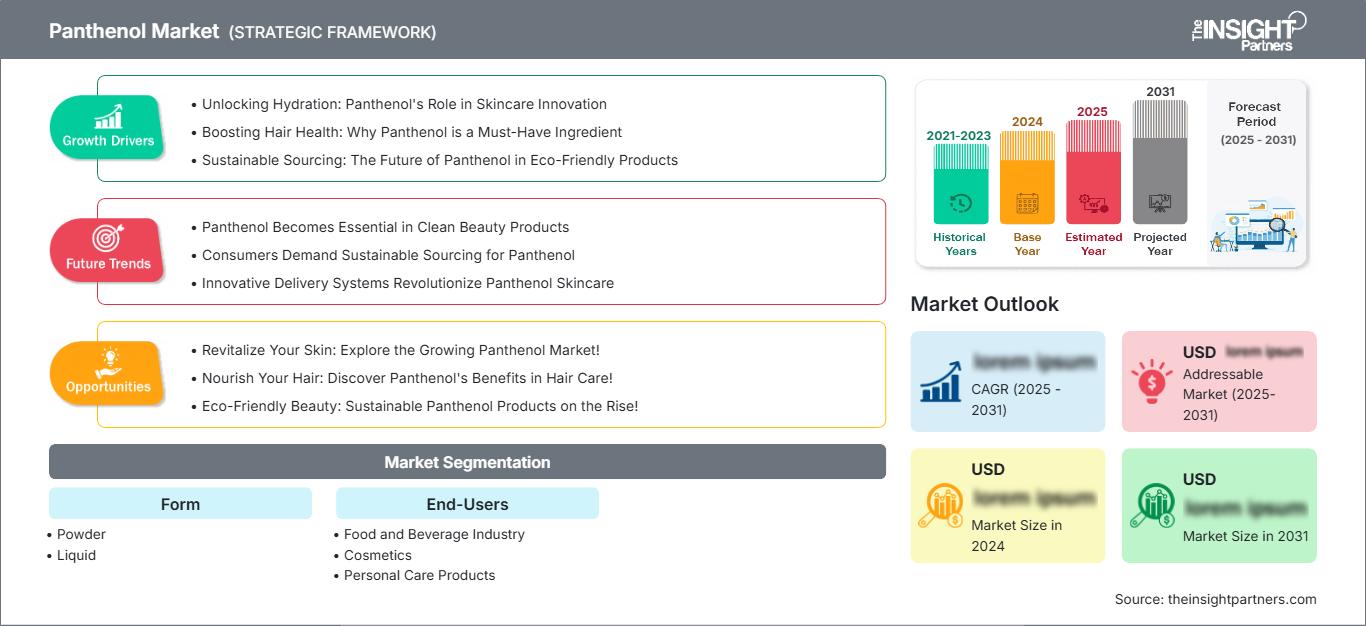
The Panthenol market was valued at US$ 119.25 Million in 2025 and is projected to reach US$ 177.96 Million by 2034, registering a CAGR of 4.55% from 2026 to 2034. Demand is supported by broad use in skin and hair care, topical pharmaceutical formulations, food applications, and animal nutrition. Its multifunctional profile as a humectant, conditioning ingredient, and provitamin B5 derivative supports continued adoption across formulation-intensive industries.
Across North America, the Panthenol Market size outlook is supported by premium skincare, dermatological products, and pharmaceutical formulations. Regional demand is estimated to expand at a 4.8–5.4% CAGR between 2026 and 2034, with growth reinforced by multifunctional ingredient development, established cosmetic manufacturing, and increasing preference for ingredients associated with skin hydration and barrier care.
Panthenol Market Assessment and Insights
- North America: North America represented a 27–30% Panthenol Market share in 2025 and is projected to grow at a 4.8–5.4% CAGR between 2026 and 2034, supported by premium personal care, dermatology, pharmaceutical formulations, and established specialty ingredient distribution.
- U.S.: The U.S. accounted for 77–80% of North America's 2025 share, expanding at a 4.9–5.5% CAGR between 2026–2034 as skincare, haircare, and topical pharmaceutical applications broaden.
- Europe: Europe held a 21–23% share in 2025 and is expected to grow at a 4.1–4.7% CAGR between 2026 and 2034, led by Germany, France, Italy, Spain, and the UK through sophisticated cosmetics and pharmaceutical manufacturing.
- Asia Pacific: Asia Pacific represented a 39–41% share in 2025 and is projected to register a 5.8–6.6% CAGR between 2026 and 2034, led by China, Japan, South Korea, and India, where cosmetics and pharmaceutical production remain substantial.
- Largest Segment: Cosmetics within end-users held a 42–47% market share in 2025 and is projected to record a 4.5–5.0% CAGR between 2026 and 2034, supported by skincare and haircare applications.
- High Growth Segment: Pharmaceuticals represented an 18–22% market share in 2025 and is expected to grow at a 5.0–5.6% CAGR between 2026 and 2034, supported by topical and dermatological formulations.
- Key companies analyzed in detail: Anhui Huaheng Biotechnology Co., Ltd., BASF SE, Jeen International Corporation, DSM-Firmenich AG, Kunshan Tongde Chemical Industry Co., Ltd., Merck KGaA, NS Chemicals, TRI-K Industries, Inc., Xinfa Pharmaceutical Co., Ltd., and Yifan Pharmaceutical Co., Ltd.
Source: The Insight Partners' analysis based on proprietary research, government publications, company annual reports, investor presentations, industry databases, and expert interviews.
From a starting point of simply supplying vitamin-derived raw materials, the industry has progressed to offer grade specific formulations for cosmetics, pharmaceuticals, food, and nutrition. Differentiation is being achieved based on purity, stereochemistry, formulation compatibility, and supply reliability. D-Panthenol is especially significant in high-value end uses, whereas liquid and powdered forms are useful depending on processing needs. Production facilities in China and Europe impact the global supply chain, whereas the multinationals focus more on technical support and regulatory compliance.
The future demand is likely to be impacted by new Asian markets in the cosmetics space, growth in pharmaceutical manufacturing, and regulations surrounding ingredient traceability. Sourcing decisions are also increasingly driven by sustainability concerns as multinational cosmetic companies look to regulate the manufacturing process. Innovation is taking place where panthenol is compared with peptides, plant active ingredients, and other skin barrier supporting ingredients.
Panthenol Market Report Scope
| Report Attribute | Details |
|---|---|
| Market size in 2025 | US$ 119.25 Million |
| Market Size by 2034 | US$ 177.96 Million |
| Global CAGR (2026 - 2034) | 4.55% |
| Historical Data | 2021-2024 |
| Forecast period | 2026-2034 |
Panthenol Market Analysis
The key drivers that support the Panthenol Market growth are its ability to perform several functional aspects without requiring any modification in current production procedures. It is used by personal care manufacturers in moisturizers, serums, shampoos, conditioners, scalp treatments, and skin protection formulations. Pharmaceutical manufacturers utilize dexpanthenol in topical products. The value chain includes chemical intermediates/synthesis, purification, formulation grade processings, packaging, distribution, and finished product manufacturing.
The Panthenol Market report shows that supply factors include the availability of precursors, manufacturing efficiency, purity standards, and geographical concentration of manufacturers. Manufacturers based in China have a significant contribution to volume availability, while those based in Europe and global ones focus more on specialty grades and documentation and pharmaceutical grade. BASF SE and DSM-Firmenich AG have a differentiated portfolio for cosmetics and pharmaceuticals manufacturers, respectively.
Positioning of products is now more likely to be based on quality, regulatory position, process reliability and customer specific technical support. According to the Panthenol Market, the market appears to be moderately diverse, with multinationals competing with specialists in Asia. In this context, BASF SE and DSM-Firmenich AG have global marketing and formulation expertise. Merck KGaA takes part in the market with pharmaceutical and specialty chemicals offerings. TRI-K Industries, Inc. adds a strong personal care bias.
Investments become more likely in terms of reliable capacity, purity production, regulation and sustainable process. Anhui Huaheng Biotechnology Co., Ltd., Kunshan Tongde Chemical Industry Co., Ltd., Xinfa Pharmaceutical Co., Ltd. and Yifan Pharmaceutical Co., Ltd. add depth to the manufacturing of Asia. Jeen International Corporation and NS Chemicals increase opportunities of special supplies.
● REPORT CUSTOMIZATION
Tailor This Report To Align With Your Specific Business Requirements
This report can be customized to align precisely with your business objectives, scope, and target markets. Customization options include tailored segmentation, geography, competitive analysis, and strategic insights to support informed decision-making.
Customize This Report →WHAT YOU CAN ADJUST
- ● Segmentations
- ● Geography
- ● Competitive Analysis
- ● Language Preferences
Panthenol Market: Strategic Insights
Regional Insights
North America Panthenol Market
North America accounted for a 27–30% Panthenol Market in 2025 and is expected to expand at a 4.8–5.4% CAGR from 2026 to 2034. United States is at the forefront of regional consumption driven by well-established cosmetics, dermatology, pharmaceuticals and health-related formulation industries. The consumer base is primarily focused on moisturizing skin care, hair care, baby care, and topical applications demanding ingredients with proven formulation history.
There are strong research infrastructure and high-level ingredient supply in the regional ecosystem. Regulatory environment favors the suppliers of the consistent specification, safety data and traceability. Canada and Mexico play an important role in personal care manufacturing and regional trade but their consumption level is much lower than that of the United States.
U.S. Panthenol Market
The U.S. represented 77–80% of North America's 2025 Panthenol Market and is forecast to grow at a 4.9–5.5% CAGR from 2026–2034. There is an advantage from the presence of sizeable cosmetic/personal care and pharmaceutical industries, innovations in branding, and wide availability of skin and hair care products. BASF SE, DSM-Firmenich AG, Merck KGaA, and TRI-K Industries, Inc. supply their customers using existing ingredient portfolios.
Development of applications focuses on products for sensitive skin, moisturizers, scalp care, wound treatment products, and luxury hair care. In the USA, distinction is made between cosmetics and drugs with regard to claims. Hence, position and labeling of formulations become important business aspects. FDA guidelines state that cosmetic ingredients do not need pre-market approval; however, producers have to ensure safety and compliance with regulations.
Europe Panthenol Market
Europe held a 21–23% share in 2025 and is projected to grow at a 4.1–4.7% CAGR from 2026 to 2034. The leading market demand is Germany, followed by the UK, France, Italy, and Spain. The region combines mature personal care manufacturing along with pharmaceutical manufacturing and strict compliance with ingredients.
The UK sustains demand due to advanced formulation of beauty products and pharmaceuticals, whereas Germany has its benefit due to chemical manufacturing as well as healthcare manufacturing. France, Italy, and Spain have their contribution due to cosmetic, dermocosmetic, and personal care products manufacturing. Formulation companies of Europe are increasingly focusing on provenance of ingredients, stability, and functionality with multi-functionality of formulations.
APAC Panthenol Market
APAC represented a 39–41% share in 2025 and is expected to register a 5.8–6.6% CAGR from 2026–2034. China still leads due to its presence in chemical manufacturing, cosmetic manufacturing, and export capabilities. Japan and South Korea help because of their advanced skin care innovations, whereas India contributes to the increase in pharmaceutical and personal care products manufacturing.
The well-integrated chemical industry of China helps sustain supply competition, whereas South Korea and Japan contribute towards premium formulation demand. India is gaining from an increase in pharmaceutical manufacturing and personal care products consumption. Australia is a small but established market. Growth of industrial investment, urbanization, innovation in beauty, and increasing quality demands will help APAC lead.
Middle East & Africa Panthenol Market
Middle East and Africa Panthenol Market accounted for approximately 3–4% of global demand in 2025 and is projected to expand at a 5.6–6.1% CAGR from 2026 to 2034. Saudi Arabia and the UAE lead regional demand through premium beauty, healthcare investment, and modern retail channels.
South Africa remains an important African market because of its developed personal care and pharmaceutical sectors. The UAE benefits from international brand distribution and high-value beauty consumption, while Saudi Arabia's healthcare and consumer-market investments support formulation demand. Infrastructure improvements and growing pharmaceutical capabilities across the wider region should gradually strengthen distribution beyond major Gulf markets.
Segmentation Analysis
Form
Form segment of the Panthenol Market influences processing, transportation, dosing, and formulation compatibility. The segment is projected to grow at a 4.2–4.8% CAGR from 2026 to 2034. Powder grades are attractive for dry blends and selected pharmaceutical or nutritional applications, while liquid grades provide handling advantages for aqueous personal care formulations and concentrated ingredient systems.
- Powder: Powder panthenol supports dry premixes, pharmaceutical preparations, nutritional formulations, and applications requiring controlled solid handling, offering storage and transportation advantages for manufacturers.
- Liquid: Liquid panthenol is important in aqueous formulations because it enables convenient incorporation, consistent dispersion, and efficient processing across skincare, haircare, pharmaceutical, and personal care products.
End-Users
End-Users segment in the Panthenol Market represent the principal demand interface between ingredient manufacturers and finished-product producers. This segment is projected to expand at a 4.5–5.1% CAGR from 2026 to 2034. Cosmetics and personal care remain the largest applications, while pharmaceuticals and animal feed provide diversification.
- Food and Beverage Industry: Food applications use panthenol and related vitamin B5 derivatives where permitted, particularly in nutritional formulations requiring controlled vitamin supplementation and standardized ingredient quality.
- Cosmetics: Cosmetics represent the largest demand area because panthenol supports moisturization, skin conditioning, soothing, and barrier-oriented positioning across creams, serums, lotions, and treatment products.
- Personal Care Products: Personal care products use panthenol extensively in shampoos, conditioners, scalp products, oral care, and body-care formulations where hydration and conditioning performance influence product positioning.
- Pharmaceuticals: Pharmaceuticals represent a high-value application base, particularly for topical products, dermatological formulations, wound-care preparations, and vitamin-related products requiring pharmaceutical-grade specifications.
- Animal Feed: Animal feed provides a diversified nutrition application where vitamin supplementation and standardized nutrient delivery support demand from livestock and other formulated-feed producers.
Opportunity Snapshot
| End-Users | Revenue Contribution | Trend Tag | Adoption Stage |
|---|---|---|---|
| Food and Beverage Industry | Medium | Vitamin Fortification | Scaling |
| Cosmetics | High | Barrier Care | Mature |
| Personal Care Products | High | Scalp Care | Mature |
| Pharmaceuticals | Medium | Topical Therapy | Scaling |
| Animal Feed | Medium | Vitamin Nutrition | Scaling |
Panthenol Market Growth Drivers and Impact Analysis
Expansion of Multifunctional Skincare and Haircare Formulations
The expansion of multifunctional beauty formulations is strengthening demand because manufacturers increasingly prefer ingredients capable of supporting several consumer claims within one formulation. Moisturizing, conditioning, soothing, and barrier properties make it possible to use Panthenol in formulations designed for sensitive skin, dry skin, scalp care, and hair repair. Such versatility makes it unnecessary to have different functional ingredients in each case. The premium skincare and dermocosmetic segments are especially important, since customers are more inclined to assess the functionality of ingredients along with the claims of the brand. In this situation, it is beneficial for manufacturers to provide higher-quality raw materials, formulate and document them. It also helps to satisfy the needs of smaller indie brands which look for functional ingredients with good formulation background.
Growing Pharmaceutical and Dermatological Formulation Demand
Pharmaceutical applications provide an important structural growth channel because panthenol can be incorporated into topical preparations and dermatological products. Dexpanthenol's relationship with pantothenic acid supports its use in formulations associated with skin care, repair, and protection. The expansion of pharmaceutical manufacturing capacity in Asia and the constant demand for dermatological formulations in industrialized countries ensure that there are other customers besides cosmetic clients. Regulations offer chances for differentiation because the material used in pharmaceuticals needs to be manufactured under tight quality control and specification standards. Quality maintenance over several batches allows suppliers to compete on grounds other than price alone. This demand is not cycle-sensitive and gives manufacturers a relatively stable formulation avenue, especially with topical and vitamin formulations.
Rising Demand for High-Purity and Traceable Specialty Ingredients
Ingredient buyers are increasingly evaluating quality consistency, traceability, regulatory documentation, and manufacturing transparency when selecting specialty chemicals. This shift benefits suppliers capable of maintaining standardized specifications across cosmetic, pharmaceutical, and nutrition grades. Panthenol producers with diversified quality systems can address customers operating under different regulatory regimes without requiring substantial reformulation. Traceable sourcing also supports multinational brands that increasingly require documented supplier information for internal compliance and sustainability programs. As procurement organizations consolidate qualified supplier lists, manufacturers with established certifications and reliable technical support can strengthen customer retention. The trend also encourages regional producers to improve laboratory capabilities, quality assurance systems, and documentation. Over time, competitive differentiation is likely to move further from simple availability toward dependable specification control and application-specific technical service.
Panthenol Market Future Trends
Greater Integration of Barrier-Care Ingredient Systems
The Panthenol Market trends outlook indicates increasing integration of panthenol with ceramides, peptides, humectants, botanical extracts, and other skin-barrier ingredients. Formulators are moving toward systems that combine immediate moisturization with longer-term skin comfort and barrier-support claims. Panthenol is well-positioned because it can function alongside many common cosmetic ingredients without requiring highly specialized processing conditions. This compatibility should encourage its inclusion in multifunctional serums, moisturizers, scalp treatments, and post-treatment products. Haircare is also moving toward skinification, with scalp products adopting concepts previously associated with facial skincare. Suppliers can benefit by developing formulation guides, compatibility data, and application-specific blends. Such technical differentiation may become increasingly important as brands seek ingredient combinations that offer measurable performance while maintaining acceptable sensory properties and simplified formulation workflows.
Expansion of Sustainable and Regionalized Ingredient Supply
Future supply strategies are likely to emphasize lower-impact manufacturing, regional inventory, and diversified sourcing. Cosmetic and pharmaceutical companies increasingly evaluate supply continuity alongside ingredient performance, particularly after disruptions exposed vulnerabilities in globally concentrated chemical supply chains. Producers may respond by improving energy efficiency, optimizing synthesis routes, increasing local warehousing, and expanding qualified manufacturing or distribution relationships. Regionalization is particularly relevant in Asia, where expanding cosmetics and pharmaceutical industries create great domestic demand while also supporting exports. European and North American customers are likely to place greater emphasis on documentation of manufacturing practices and responsible sourcing. Sustainability will therefore influence procurement decisions not only through environmental claims but also through operational resilience, transparency, and the ability to maintain consistent supply across different geographic markets.
Panthenol Market Opportunities
Development of Pharmaceutical-Grade and High-Purity Products
The Panthenol Market Forecasts indicate an opportunity for producers to expand pharmaceutical-grade and high-purity product portfolios rather than competing solely in standardized cosmetic applications. Pharmaceutical customers generally place greater emphasis on purity, batch consistency, regulatory documentation, and validated manufacturing processes. Suppliers can capture additional value by securing relevant quality certifications, strengthening analytical capabilities, and maintaining dedicated production controls. Opportunity also exists in supplying different concentration formats and packaging configurations suited to pharmaceutical manufacturers. Asian producers with established chemical infrastructure can use this strategy to move toward higher-value applications, while multinational suppliers can deepen relationships through technical and regulatory support. The approach may reduce exposure to commodity pricing pressure and create longer-term customer relationships with manufacturers that prioritize dependable qualification and compliance.
Regional Production and Distribution Partnerships
Regional supply partnerships can improve market access by reducing delivery times, inventory risk, and qualification barriers for local formulators. Distributors with established relationships across cosmetics, pharmaceuticals, food, and animal nutrition can help producers identify application-specific requirements and accelerate customer adoption. India and Southeast Asia offer particularly relevant opportunities because personal care and pharmaceutical manufacturing are expanding, while regional buyers increasingly seek reliable specialty ingredient supply. Partnerships can include local warehousing, technical formulation support, regulatory assistance, and smaller pack sizes for emerging brands. Producers can also use regional partnerships to test demand before committing to new manufacturing capacity. A flexible model combining direct sales for large accounts with specialized distribution for smaller customers can broaden reach while controlling commercial and logistics costs.
Recent Developments
- April 2026: Researchers in Taipei developed an experimental plant-based hair-growth serum containing panthenol, caffeine, and plant-derived compounds from Centella asiatica. In a randomized, double-blind, placebo-controlled trial involving 60 adults, participants applied the formulation daily for 56 days. The study reported improvements in hair density, thickness, growth length, and shedding, with the strongest formulation showing close to a 25% improvement in key hair-growth measurements versus placebo. The development highlights an emerging application of panthenol in advanced scalp-care and hair-growth formulations, although larger and longer-term studies are required to validate efficacy and safety.
- February 2026: PHD Beauty launched Panthenol Hydrating Gel Sunscreen SPF 60 PA++++, expanding panthenol applications into high-protection daily skincare. The dermatology-led formulation combines panthenol, Aquaxyl, and sodium hyaluronate for hydration and skin-barrier support, alongside broad-spectrum UVA and UVB protection. SPF and PA performance were validated through in-vitro and in-vivo testing. The lightweight, non-sticky gel format was developed for Indian skin and climate conditions, highlighting the growing use of panthenol in multifunctional skincare formulations.
- July 2025: Ildong Pharmaceutical launched Panthenol Care ointment in South Korea, expanding panthenol-based applications in dermatological and topical healthcare products. The product is positioned as an adjunctive treatment for acute and chronic dermatitis, eczema, diaper rash, burns, and sunburn. The launch demonstrates continued demand for panthenol formulations beyond cosmetic skincare, particularly in products targeting skin repair, moisturization, and barrier support.
Frequently Asked Questions

- Comprehensive Market Sizing and Forecast Analysis
- Detailed Segmentation Analysis
- In-Depth Market Dynamics Assessment
- Regional and Country-Level Insights
- Competitive Landscape and Company Benchmarking
- Strategic Business Intelligence
Recent Reports
Testimonials

The Insight Partners provided valuable market intelligence that supported our global go-to-market strategy. Their team was professional, responsive, and attentive to our feedback, providing thoughtful analysis and helpful methodological clarifications throughout the project.
Junmo Kim Chief Financial Officer (CFO), Enertech Co., Ltd.
The Insight Partners' SCADA System Market report is comprehensive, with valuable insights on current trends and future forecasts. The team was highly professional, responsive, and supportive throughout. We are very satisfied and highly recommend their services.
RAN KEDEM Partner, Reali Technologies LTDs
I requested a report on a very specific software market and the team produced the report in a few days. The information was very relevant and well presented. I then requested some changes and additions to the report. The team was again very responsive and I got the final report in less than a week.
JEAN-HERVE JENN Chairman, Future Analytica
We worked with The Insight Partners for an important market study and forecast. They gave us clear insights into opportunities and risks, which helped shape our plans. Their research was easy to use and based on solid data. It helped us make smart, confident decisions. We highly recommend them.
PIYUSH NAGPAL Sr. Vice President, High Beam Global
The Insight Partners delivered insightful, well-structured market research with strong domain expertise. Their team was professional and responsive throughout. The user-friendly website made accessing industry reports seamless. We highly recommend them for reliable, high-quality research services
YUKIHIKO ADACHI CEO, Deep Blue, LLC.
This is the first time I have purchased a market report from The Insight Partners.While I was unsure at first, I visited their web site and felt more comfortable to take the risk and purchase a market report.I am completely satisfied with the quality of the report and customer service. I had several questions and comments with the initial report, but after a couple of dialogs over email with their analyst I believe I have a report that I can use as input to our strategic planning process.Thank you so much for taking the extra time and making this a positive experience.I will definitely recommend your service to others and you will be my first call when we need further market data.
JOHN SUZUKI President and Chief Executive Officer, Board Director, BK Technologies
I wish to appreciate your support and the professionalism you displayed in the course of attending to my request for information regarding to infectious disease IVD market in Nigeria. I appreciate your patience, your guidance, and the fact that you were willing to offer a discount, which eventually made it possible for us to close a deal. I look forward to engaging The Insight Partners in the future, all thanks to the impression you have created in me as a result of this first encounter.
DR CHIJIOKE ONYIA MANAGING DIRECTOR, PineCrest Healthcare Ltd.Reason to Buy
- Informed Decision-Making
- Understanding Market Dynamics
- Competitive Analysis
- Identifying Emerging Markets
- Customer Insights
- Market Forecasts
- Risk Mitigation
- Boosting Operational Efficiency
- Strategic Planning
- Investment Justification
- Tracking Industry Innovations
- Aligning with Regulatory Trends





 Get Free Sample for