
Organic Personal Care Ingredients Market Size, Share & Trends by 2034
Coverage: by Type (Organic, Natural); Product (Natural surfactants, Emollients, Active ingredients, Sugar polymers); Application (Skin care, Oral care, Hair care, Cosmetics) , and Geography (North America, Europe, Asia Pacific, and South and Central America)
- Status : Data Released
- Report Code : TIPRE00009911
- Category : Chemicals and Materials
- No. of Pages : 150
- Available Report Formats :


- Last update date : September 28, 2026


2025 Market Size
US$ 5 Bn
Base year value
2034 Forecast
US$ 9.72 Bn
Projected by 2034
CAGR 2026-2034
7.65 %
Growth rate
Addressable Market
US$ 66.24 Bn
(2026-2034)
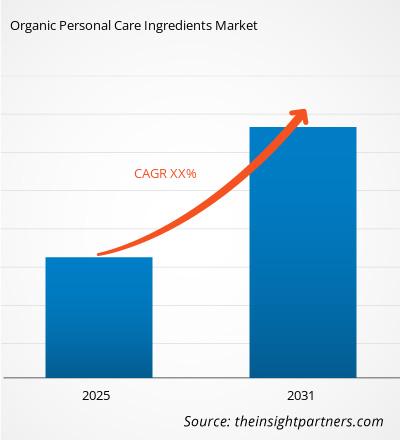
The organic personal care ingredients market was valued at US$ 5 Billion in 2025 and is projected to reach US$ 9.72 Billion by 2034, expanding at a 7.65% CAGR from 2026 to 2034. The market covers ingredient systems classified by Type into Organic and Natural; by Product into Natural surfactants, Emollients, Active ingredients, and Sugar polymers; and by Application into Skin care, Oral care, Hair care, and Cosmetics. The scope encompasses functional and performance ingredients used by personal care formulators to develop products positioned around natural sourcing, organic certification, biodegradability, skin compatibility, traceability, and sustainability.
North America represented an estimated ~27% of global market value in 2025 and is expected to expand at ~6.9% CAGR during 2026-2034. The region benefits from a mature natural and clean beauty ecosystem, established ingredient distributors, sophisticated formulation capabilities, and strong consumer interest in recognizable plant-derived materials. The organic personal care ingredients market size in North America is also influenced by the increasing documentation burden surrounding cosmetic products. In the US, the Modernization of Cosmetics Regulation Act requires applicable facilities to register and responsible persons to list marketed cosmetic products, increasing the importance of ingredient documentation, traceability, and formulation records across the supply chain.
Organic Personal Care Ingredients Market Assessment and Insights
- North America: The region accounted for ~27% of global market value in 2025 and is projected to grow at ~6.9% CAGR through 2034. High formulation sophistication, natural-product retail channels, and strong demand for transparent ingredient sourcing support its position, although its maturity limits growth relative to emerging Asian markets.
- U.S.: The US represented ~78% of the North American market in 2025 and is projected to grow at ~7.0% CAGR. Skin care and hair care formulators are increasingly balancing natural-origin positioning with performance, while MoCRA has strengthened requirements for cosmetic product documentation and facility oversight. The FDA reported active cosmetic facility registrations and product listings under the new framework, reinforcing the industry's shift toward more formal compliance processes.
- Europe: Europe accounted for ~25% of global market value in 2025 and is expected to grow at ~7.0% CAGR. France, Germany, the UK, Italy, and Spain form important demand and innovation centers, with certification, responsible sourcing, formulation sustainability, and ingredient traceability serving as major differentiators. COSMOS Version 4.2 became applicable in September 2025, raising the importance of certification-aligned raw material sourcing.
- Asia Pacific: APAC represented ~34% of global market value in 2025 and is projected to expand at ~8.69% CAGR, making it the fastest-growing major region. China, Japan, South Korea, and India combine large consumer markets with expanding local formulation and ingredient capabilities. Growth is reinforced by premium skin care, K-beauty and J-beauty formulation influences, botanical ingredient development, and increasing local production of specialty cosmetic materials.
- Largest Segment: Skin care is the largest main application segment, with an estimated ~8.0% CAGR from 2026 to 2034. Skin care uses the broadest combination of natural surfactants, emollients, active ingredients, and sugar polymers, allowing suppliers to participate across cleansing, moisturization, anti-aging, barrier support, and treatment-oriented formulations.
- High Growth Segment: Organic is the high-growth main Type segment, with an estimated ~8.1% CAGR. Its expansion is linked to stronger certification requirements, traceable agricultural sourcing, consumer demand for organic positioning, and the increasing availability of functional ingredients capable of delivering performance without weakening organic product claims.
- Key companies analyzed in detail: BASF SE; Cargill, Incorporated; Ciranda, Inc.; Croda International Plc.; Earth Supplied Products, LLC; Grain Millers, Inc.; Jedwards International, Inc.; Multiple Organics, Inc.; Provital, S.A.; The Hain Celestial Group, Inc.
Source: The Insight Partners' analysis based on proprietary research, government publications, company annual reports, investor presentations, industry databases, and expert interviews.
The market has moved on from simply providing plant-based raw materials to providing natural/organic ingredients that have performance capability, documentation, and formulation assistance. The suppliers are now able to distinguish themselves based on features like biodegradability, natural index, certification compliance, agricultural responsibility, biotechnology, fermentation, and upcycling. This can be illustrated by a recent activity within BASF’s portfolio, as its personal care line has launched products that are either biodegradable or renewable feedstock-based in categories ranging from polymers, opacifiers, surfactants, and actives instead of considering naturality a single feature.
The buyer needs have become more technically focused. The cosmetic companies now focus on origin, process used, certification, INCI name, documentation, performance, stability, compatibility with other natural ingredients, and substantiation of claims made on consumer benefits. Especially, for active ingredients, the formulators have to prove their effectiveness while maintaining naturality or organicity. An example in point is Provital, which offers botanical extracts and actives along with regulatory, toxicological, formulation, and certification support.
Standards evolution has also taken place. ISO 16128 continues to be a significant standard in relation to determining natural and organic origin index, although an updated version of ISO 16128-1 is currently under preparation. The COSMOS Version 4.2 was introduced as of September 2025 and reinforces the relevance of having raw materials and documentation that meet certification requirements.
For the period through 2034, growth will increasingly stem from Asia Pacific region, premium natural skin care, biotechnologically produced actives, organic agriculture inputs and multi-functional ingredients. Manufacturers of ingredients will increase their regional laboratories and technical service facilities near to their customers rather than in one central location only.
Localization of the supply chain will continue to be important since agricultural feed stocks such as botanical oils, extracts, starches, gums, etc., may become vulnerable to the harvest conditions, climatic variations, interruptions in transportation and certification requirements. The competitive edge in the business will therefore increasingly rely on dual sourcing, traceability, supplier audits and specification of harvest cycles.
Organic Personal Care Ingredients Market Report Scope
| Report Attribute | Details |
|---|---|
| Market size in 2025 | US$ 5 Billion |
| Market Size by 2034 | US$ 9.72 Billion |
| Global CAGR (2026 - 2034) | 7.65% |
| Historical Data | 2021-2024 |
| Forecast period | 2026-2034 |
Organic Personal Care Ingredients Market Analysis
The Organic Personal Care Ingredients Market will be driven by a series of processes, which start with consumer demand for natural and transparent beauty products and continue through claims made by brands and reformulations up to changes in ingredient procurement. Increasingly, brands need raw materials that meet both their claims and formulation needs. This is where providers who can offer not only commoditized raw materials but also a consistent supply of natural ingredients, certified documentation, and formulation assistance will win.
The value chain starts from agricultural and biological raw materials such as plant oils, seeds, plant extracts, starches, algae, fermentation raw materials, and others. These materials are processed via extraction, purification, fractionation, fermentation, chemical/ enzymatic transformation, compounding and formulation until they reach cosmetic manufacturers. Traceability becomes crucial if there are claims about organic certification or ethical sourcing in the product offer.
The natural surfactant/emollient category continues to be significant as it replaces and reduces the use of traditional petrochemically-based formulation components while maintaining performance attributes such as cleaning, emulsifying, spreadability, conditioning, and sensory benefits. Natural rheology and emollient systems in the personal care offering from Cargill are good examples as they are designed to match the performance of traditional formulation components. This highlights how competition is moving from "natural versus synthetic" to "natural with equal or superior performance."
According to the Organic Personal Care Ingredients Market Report, there is a different competition model in the active ingredients category where suppliers are competing based on biological mode of action, proof of efficacy, story of origin, delivery mechanism, and ability to make premium claims. Recent launches by Givaudan, Croda, BASF, and dsm-firmenich are illustrative of these trends.
Thus, competitive positioning has become increasingly dependent on technology. BASF is a company that integrates its formulation expertise in chemistry with natural ingredients; Croda's emphasis is on biotechnology and sustainability; Cargill's expertise lies in agriculture and nature-based function; Provital's expertise is in botanical extraction and active systems; and niche suppliers like Jedwards International and Earth Supplied Products compete through the range of their natural raw materials. Earth Supplied Products' specialization is in natural and organic raw materials for personal care; while Jedwards supplies natural oils, extracts, waxes and other materials to personal care companies.
● REPORT CUSTOMIZATION
Tailor This Report To Align With Your Specific Business Requirements
This report can be customized to align precisely with your business objectives, scope, and target markets. Customization options include tailored segmentation, geography, competitive analysis, and strategic insights to support informed decision-making.
Customize This Report →WHAT YOU CAN ADJUST
- ● Segmentations
- ● Geography
- ● Competitive Analysis
- ● Language Preferences
Organic Personal Care Ingredients Market: Strategic Insights

Regional Insights
North America Organic Personal Care Ingredients Market
North America accounted for about 27% of the Organic Personal Care Ingredients Market share in 2025, and is expected to witness growth at ~6.9% CAGR. The dominance of North America is attributed to maturity of the natural beauty industry in the region, strong specialty retail distribution channel and e-commerce, contract manufacturing capabilities, and preference for clean label and identifiable ingredients. The United States leads demand in the region, whereas Canada represents a mature market for natural and specialty personal care products.
The regulatory landscape of the US becomes a more critical supply chain issue. The MoCRA requires registration of cosmetic facilities, along with listing of all the products that are marketed by responsible persons, and hence makes it strategically vital to know the true identity of the ingredient and the compliance documentations of the supplier and the product itself.
U.S. Organic Personal Care Ingredients Market
The USA held about 78% of North America consumption in 2025, with a growth forecast of about 7.0% CAGR. The market consists of mass market natural personal care along with premium clean beauty. This results in a combination of both scalable functional ingredients and highly specific botanical ingredients. Companies such as BASF, Earth Supplied Products, Jedwards International and more provide ingredients for all layers of this ecosystem – multifunctional formulation ingredients, as well as specific organic oils and botanicals.
The unique feature is the wide range of applications that can be covered through the USA formulation platform. Ingredient providers have to provide solutions for products that include facial cleansers and moisturizers, oral care, hair care, color cosmetics, and specialty products.
Europe Organic Personal Care Ingredients Market
Europe was responsible for ~25% of the world’s value in 2025 and is projected to grow at ~7.0% CAGR. Countries like Germany, France, Italy, and the UK have a crucial part to play in terms of formulation, cosmetics manufacturing capability, certification processes, and presence of ingredient providers.
France plays an important part in premium beauty and cosmetic innovation, whereas Germany has its unique specialty chemical capabilities along with an advanced natural cosmetics ecosystem. Italy plays an important part by way of formulation, contract manufacturing, and cosmetics manufacturing, whereas the UK holds importance due to its active ingredients and innovative independent beauty brands. The region’s key differentiator lies in the level of sustainability and certifications that have gone into formulation and procurement processes.
APAC Organic Personal Care Ingredients Market
APAC represented ~34% of global value in 2025 and is projected to grow at ~8.69% CAGR. China is a major demand and manufacturing center, while Japan and South Korea exert substantial influence through advanced skin care, functional formulation, and premium beauty innovation. India is increasingly important as both a consumer market and a source of botanical and specialty ingredient manufacturing.
China's scale supports local sourcing, formulation development, and rapid product commercialization. Japan emphasizes formulation quality, safety, and mature consumer expectations, while South Korea's skin-care innovation ecosystem accelerates adoption of multifunctional actives and sophisticated delivery systems. India provides an important combination of botanical resources, growing domestic beauty consumption, and expanding specialty chemical capabilities. The region's supply-chain advantage increasingly comes from proximity to feedstocks, manufacturing clusters, and fast-growing consumer markets.
Middle East & Africa organic personal care ingredients market
The Middle East & Africa organic personal care ingredients market is supported by rising consumer interest in clean-label, naturally derived, and ethically positioned personal care products. Demand is particularly visible in skin care, hair care, and cosmetics, where botanical extracts, natural emollients, surfactants, and active ingredients are increasingly incorporated into premium and wellness-oriented formulations. The region's expanding beauty and personal care sector, coupled with increasing availability of certified organic and natural ingredients, is creating opportunities for ingredient suppliers and formulators. Gulf countries are important demand centers because of premium beauty consumption and the expansion of modern retail and specialty beauty channels, while South Africa provides a relatively developed cosmetics manufacturing base. The regional market is estimated to expand at a CAGR of ~8.0% through 2034, supported by premiumization, natural product positioning, and growing interest in sustainable formulation practices.
South & Central America organic personal care ingredients market
The South & Central America organic personal care ingredients market is driven by the region's strong availability of agricultural and botanical raw materials, growing interest in natural beauty, and increasing consumer preference for products positioned around sustainability and plant-based formulation. Brazil represents a major demand and manufacturing center because of its large cosmetics industry, diverse botanical resources, and established use of natural ingredients in personal care formulations. Other markets in the region are gradually adopting clean-label and naturally derived formulations as premium personal care products gain wider distribution. Ingredient suppliers can benefit from demand for natural surfactants, emollients, active ingredients, and sugar polymers across skin care, hair care, and cosmetics applications. The regional market is expected to grow at approximately ~7.5% CAGR through 2034, with local biodiversity, beauty innovation, and expanding premium personal care consumption supporting market development.
Segmentation Analysis
Type
Organic ingredients are projected to grow at ~8.1% CAGR from 2026 to 2034. This segment is supported by brands seeking certified organic positioning, traceable agricultural inputs, and stronger differentiation in premium personal care. Organic sourcing is particularly relevant for botanical extracts, plant oils, specialty actives, and other ingredients where agricultural origin directly contributes to the consumer proposition. Certification compatibility and reliable documentation are increasingly important purchasing criteria.
Natural ingredients are projected to grow at ~7.4% CAGR. The segment benefits from its broader formulation flexibility because natural-origin ingredients can support clean-label positioning without always requiring the stricter agricultural and processing requirements associated with organic certification. Demand spans mass-market and premium personal care, allowing suppliers to serve a wider formulation base.
Product
Natural surfactants are projected to grow at ~7.5% CAGR. They are primarily used in cleansing formulations and must balance mildness, foam profile, detergency, biodegradability, and sensory properties. The replacement of conventional sulfate-heavy systems with milder alternatives creates opportunities for coconut-, sugar-, amino-acid-, and other naturally derived surfactant systems.
Emollients are projected to grow at ~7.3% CAGR. They contribute directly to moisturization, spreadability, skin feel, barrier support, and formulation aesthetics. Plant oils, natural esters, butters, and other renewable materials compete by delivering sensory performance without undermining natural-origin claims.
Active ingredients are projected to grow at ~8.6% CAGR and represent the fastest-growing Product segment. Growth is linked to the premiumization of skin care, demand for evidence-backed botanical benefits, skin longevity, microbiome-related concepts, and biotechnology-enabled actives. Suppliers increasingly differentiate through clinical evidence, mechanism-of-action research, sustainable sourcing, and delivery technologies.
Sugar polymers are projected to grow at ~7.9% CAGR. These materials support thickening, film formation, stabilization, texture, moisturization, and sensory modification. Their compatibility with natural formulation strategies makes them increasingly useful when brands seek alternatives to conventional synthetic polymers.
Application
Skin care is projected to grow at ~8.0% CAGR and remains the largest application. It uses all four Product categories across cleansing, hydration, barrier care, anti-aging, brightening, soothing, and protective formulations. The breadth of functionality gives skin care the strongest ability to absorb innovation in natural actives and multifunctional formulation systems.
Oral care is projected to grow at ~6.8% CAGR. Natural surfactants, polymers, botanical ingredients, and functional additives are used in toothpaste, mouthwash, and related products. Adoption depends heavily on maintaining cleaning, foaming, texture, stability, and sensory performance while supporting natural-positioned claims.
Hair care is projected to grow at ~7.2% CAGR. Demand is supported by sulfate-free cleansing, natural conditioning, scalp-care actives, and botanical formulations. The category also benefits from crossover between skin-barrier science and scalp health.
Cosmetics are projected to grow at ~7.7% CAGR. Natural emollients, polymers, actives, and texture modifiers are increasingly used in complexion, lip, eye, and multifunctional products. Formulators must maintain pigment dispersion, texture, wear, and stability while increasing natural-origin content.
Opportunity Snapshot
| Application | Revenue Contribution | Trend Tag | Adoption Stage |
| Skin care | High | Skin longevity | Mature |
| Oral care | Medium | Clean formulation | Scaling |
| Hair care | High | Scalp wellness | Scaling |
| Cosmetics | Medium | Natural textures | Scaling |
Organic Personal Care Ingredients Market Growth Drivers and Impact Analysis
Expansion of natural and certification-led formulation
Consumer preference for natural and organic beauty is translating into concrete formulation decisions. Brands increasingly need ingredients that can support natural-origin claims while maintaining performance, resulting in greater use of certified botanical materials, naturally derived surfactants, renewable emollients, and compatible functional polymers. COSMOS has continued to expand its certification footprint, while Version 4.2 introduced updated requirements for certified products and raw materials from September 2025.
The implication is that certification and documentation are becoming commercial differentiators rather than administrative afterthoughts. Suppliers with stable organic sourcing, traceability, documentation, and formulation support can become embedded earlier in customers' product-development processes.
Demand for performance-equivalent natural substitutes
Formulators are increasingly unwilling to sacrifice texture, stability, cleansing, sensory profile, or efficacy merely to increase natural-origin content. This is driving investment in ingredients designed as drop-in or near-drop-in alternatives to conventional materials. Cargill's naturally derived emollient and rheology technologies and BASF's biodegradable alternatives to conventional polymers and opacifiers illustrate the direction of product development.
This driver expands the addressable market beyond explicitly organic brands. Conventional personal care manufacturers can also adopt natural-origin ingredients when they improve sustainability credentials without requiring major reformulation.
Premiumization of functional and active ingredients
The shift from basic natural formulations toward targeted efficacy is increasing demand for active ingredients supported by biological research. Skin longevity, microbiome balance, barrier resilience, stress-related skin responses, and targeted brightening are becoming increasingly important innovation areas.
Suppliers therefore compete on scientific validation as well as natural sourcing. Givaudan's active ingredient pipeline and Croda's biotech-based skin ingredient developments demonstrate how biotechnology and biological mechanism are becoming important sources of differentiation.
Organic Personal Care Ingredients Market Future Trends
Biotechnology becomes a naturality enabler
Biotechnology is increasingly being used to produce or enhance ingredients while reducing dependence on resource-intensive conventional feedstocks. Fermentation, microbial production, enzymatic processing, and precision biotechnology can provide consistent molecules or actives with controlled quality and traceability.
The significance for the organic personal care ingredients market trends is that naturality is becoming less dependent on traditional agricultural extraction alone. Givaudan's biotechnology investment in Toulouse and dsm-firmenich's biotechnology collaborations illustrate the movement toward science-led natural ingredient development.
Upcycling and circular feedstocks gain commercial relevance
Ingredient developers are increasingly converting by-products or underused biological materials into premium cosmetic ingredients. This approach can reduce waste while providing a compelling sustainability story.
Givaudan's Evernityl, produced from upcycled marine algae, and dsm-firmenich's use of upcycled turpentine for Firsantol demonstrate how upcycling is moving from a conceptual sustainability theme toward commercially differentiated ingredient platforms.
Traceability becomes part of ingredient value
Ingredient buyers increasingly require evidence of agricultural origin, processing route, certification status, and responsible sourcing. Digital documentation and lifecycle information are therefore becoming part of supplier competitiveness.
The change affects both large suppliers and specialist distributors. Suppliers able to connect farm-level information with finished ingredient specifications can reduce qualification friction and help brands substantiate sustainability claims.
Organic Personal Care Ingredients Market Opportunities
Certified active ingredients for premium skin care
A major opportunity lies in developing certified or certification-compatible active ingredients that combine botanical or biological origin with measurable efficacy. Target customers include premium skin-care brands, dermocosmetic formulators, contract manufacturers, and specialty retailers seeking differentiated anti-aging, barrier, brightening, soothing, and longevity concepts.
The unmet need is not simply another botanical extract, but a documented ingredient with a defined mechanism, reproducible composition, formulation compatibility, and credible sustainability story. Suppliers combining extraction or biotechnology expertise with clinical testing and regulatory support can capture greater value than commodity raw-material providers. Asia Pacific and Europe are particularly attractive because premium skin care and certification-led formulation are both well established.
Natural performance substitutes for conventional formulation materials
Another opportunity in the Organic Personal Care Ingredients Market Forecast is the development of natural-origin substitutes for conventional surfactants, emollients, rheology modifiers, polymers, and texture agents. The strongest commercial potential is in formulations where brands need to reformulate existing products without materially changing consumer-perceived performance.
The opportunity extends beyond certified-organic brands because mainstream manufacturers increasingly seek lower-impact ingredients. Suppliers that provide formulation-ready alternatives, technical support, reliable supply, and scalable production can accelerate conversion and reduce the technical barrier to natural reformulation.
Recent Developments
- June 12, 2026: Avid Organics Pvt. Ltd. launched AviGa Bio HP70, a bio-based cosmetic-grade glycolic acid designed to provide a traceable alternative to conventional petroleum-based glycolic acid. The ingredient received COSMOS approval shortly after launch, strengthening its relevance to natural and organic skin-care formulations and illustrating the commercialization of bio-based active ingredients at industrial scale.
- May 21, 2026: Croda International Plc launched its Beauty of Zero program, integrating biotechnology-enabled ingredient innovation, renewable and responsibly sourced feedstocks, circularity, biodegradability, and lifecycle transparency into its beauty strategy. The initiative indicates that sustainability is increasingly being embedded into ingredient development and customer collaboration rather than treated solely as a product-level attribute.
Frequently Asked Questions

- Comprehensive Market Sizing and Forecast Analysis
- Detailed Segmentation Analysis
- In-Depth Market Dynamics Assessment
- Regional and Country-Level Insights
- Competitive Landscape and Company Benchmarking
- Strategic Business Intelligence
Recent Reports
Testimonials

The Insight Partners provided valuable market intelligence that supported our global go-to-market strategy. Their team was professional, responsive, and attentive to our feedback, providing thoughtful analysis and helpful methodological clarifications throughout the project.
Junmo Kim Chief Financial Officer (CFO), Enertech Co., Ltd.
The Insight Partners' SCADA System Market report is comprehensive, with valuable insights on current trends and future forecasts. The team was highly professional, responsive, and supportive throughout. We are very satisfied and highly recommend their services.
RAN KEDEM Partner, Reali Technologies LTDs
I requested a report on a very specific software market and the team produced the report in a few days. The information was very relevant and well presented. I then requested some changes and additions to the report. The team was again very responsive and I got the final report in less than a week.
JEAN-HERVE JENN Chairman, Future Analytica
We worked with The Insight Partners for an important market study and forecast. They gave us clear insights into opportunities and risks, which helped shape our plans. Their research was easy to use and based on solid data. It helped us make smart, confident decisions. We highly recommend them.
PIYUSH NAGPAL Sr. Vice President, High Beam Global
The Insight Partners delivered insightful, well-structured market research with strong domain expertise. Their team was professional and responsive throughout. The user-friendly website made accessing industry reports seamless. We highly recommend them for reliable, high-quality research services
YUKIHIKO ADACHI CEO, Deep Blue, LLC.
This is the first time I have purchased a market report from The Insight Partners.While I was unsure at first, I visited their web site and felt more comfortable to take the risk and purchase a market report.I am completely satisfied with the quality of the report and customer service. I had several questions and comments with the initial report, but after a couple of dialogs over email with their analyst I believe I have a report that I can use as input to our strategic planning process.Thank you so much for taking the extra time and making this a positive experience.I will definitely recommend your service to others and you will be my first call when we need further market data.
JOHN SUZUKI President and Chief Executive Officer, Board Director, BK Technologies
I wish to appreciate your support and the professionalism you displayed in the course of attending to my request for information regarding to infectious disease IVD market in Nigeria. I appreciate your patience, your guidance, and the fact that you were willing to offer a discount, which eventually made it possible for us to close a deal. I look forward to engaging The Insight Partners in the future, all thanks to the impression you have created in me as a result of this first encounter.
DR CHIJIOKE ONYIA MANAGING DIRECTOR, PineCrest Healthcare Ltd.Reason to Buy
- Informed Decision-Making
- Understanding Market Dynamics
- Competitive Analysis
- Identifying Emerging Markets
- Customer Insights
- Market Forecasts
- Risk Mitigation
- Boosting Operational Efficiency
- Strategic Planning
- Investment Justification
- Tracking Industry Innovations
- Aligning with Regulatory Trends





 Get Free Sample for