
Lithium-Ion Battery Recycling Market Size, Share & Trends by 2034
Coverage: By Technology (Lithium-Nickel Manganese Cobalt, Lithium-Iron Phosphate, Lithium-Manganese Oxide, Lithium-Titanate Oxide, and Lithium-Nickel Cobalt Aluminum Oxide) and Application (Automotive, Mining, Consumer Electronics, Industrial, and Power); and Geography
- Status : Data Released
- Report Code : TIPRE00009267
- Category : Energy and Power
- No. of Pages : 150
- Available Report Formats :


- Last update date : September 30, 2026


2025 Market Size
US$ 5.18 Bn
Base year value
2034 Forecast
US$ 32.84 Bn
Projected by 2034
CAGR 2026-2034
22.78 %
Growth rate
Addressable Market
US$ 149.11 Bn
(2026-2034)
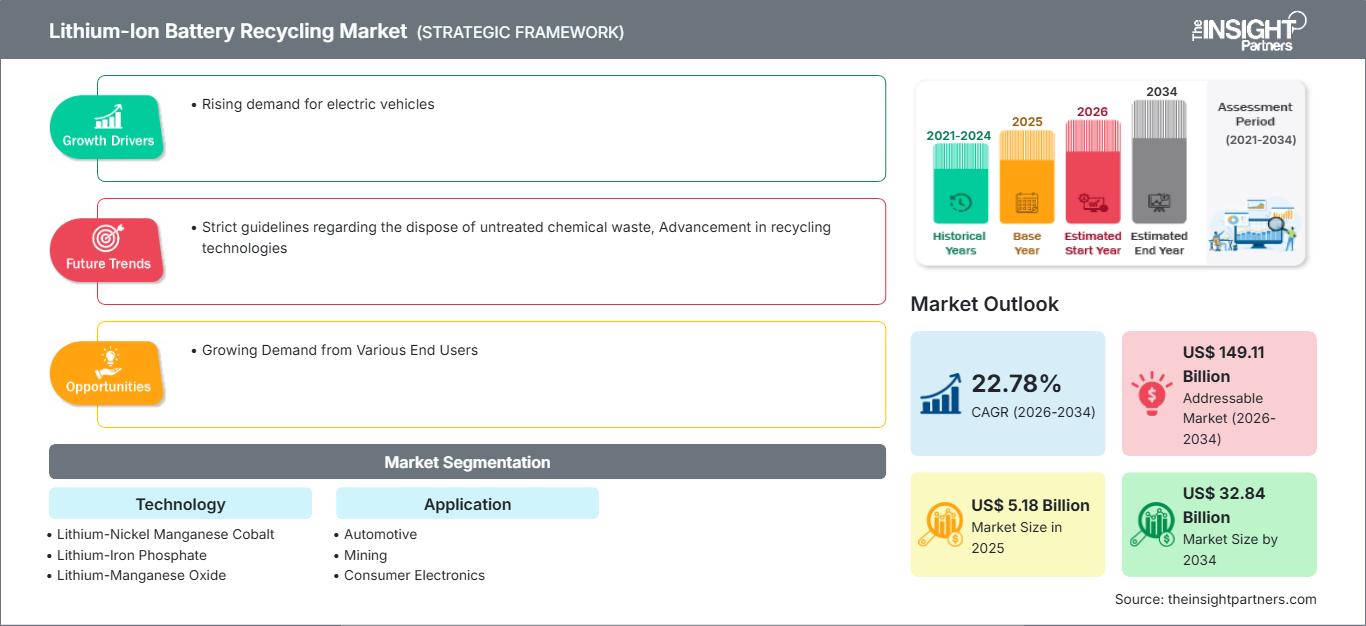
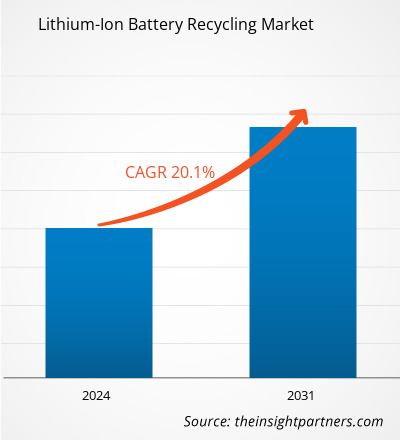
The Lithium-ion battery recycling market was valued at US$ 5.18 Billion in 2025 and is projected to reach US$ 32.84 Billion by 2034, expanding at a CAGR of 22.78% during 2026–2034. The rising uptake of electric vehicles, growth in battery production facilities, and increased focus on circular economy concepts have all fueled the need for effective recycling systems. Extraction of important materials like lithium, nickel, cobalt, and manganese has become a strategic goal, as companies attempt to secure access to these materials while minimizing their environmental impact.
In North America, favorable environmental laws, national mineral policies, and electric mobility advancements have all contributed towards boosting the growth of the industry. The Lithium-ion battery recycling market size of lithium-ion battery recycling will be boosted by factors such as growing collection infrastructure for batteries, investments in hydrometallurgical recycling plants, and collaboration between automobile companies and recyclers. Growth of the region is expected to be at a CAGR of 21.5% to 23.5%.
Lithium-Ion Battery Recycling Market Assessment and Insights
- North America: Accounted for 32–35% share in 2025 and is anticipated to expand at a CAGR between 21.5%–23.5% during 2026–2034, supported by EV production expansion, critical mineral strategies, and increasing commercial battery recycling investments.
- U.S.: Represented 75–79% of the North American market in 2025 and is projected to grow at a CAGR between 21.8%–23.8% owing to strong EV manufacturing activity, federal incentives, and expanding battery recovery infrastructure.
- Europe: Held 27–30% Lithium-ion battery recycling market share in 2025 and is forecast to grow at a CAGR between 22.0%–24.0%, with Germany, France, and the Nordic countries leading regulatory compliance and battery circularity initiatives.
- Asia Pacific: Accounted for 29–32% share in 2025 and is expected to record the highest regional CAGR between 23.5%–25.5%, driven by China, Japan, South Korea, and India through battery manufacturing expansion and government-backed recycling policies.
- Largest Segment: Application – Automotive represented 52–56% market share in 2025 and is projected to grow at a CAGR between 23.0%–25.0%, reflecting the rapidly expanding installed base of electric vehicle batteries reaching end-of-life.
- High Growth Segment: Technology – Lithium-Iron Phosphate accounted for 18–22% share in 2025 and is projected to expand at a CAGR between 25.0%–27.0%, supported by increasing deployment of LFP batteries across passenger vehicles and energy storage systems.
- Key companies analyzed in detail: Ecobat Technologies Ltd., RecycLiCo Battery Materials Inc., Fortum Corporation, GEM Co., Ltd., International Metals Reclamation Company (INMETCO), Li-Cycle Holdings Corp., Neometals Ltd., Retriev Technologies Inc., Recupyl Battery Solutions SAS, TES-AMM Pte. Ltd.
Source: The Insight Partners' analysis based on proprietary research, government publications, company annual reports, investor presentations, industry databases, and expert interviews.
The growing electrification of transportation and stationary energy storage has shifted the focus from the management of battery waste to a more complex and strategic industry ecosystem. Advances in the field of hydrometallurgy, direct battery recycling technologies, and automation of battery disassembly processes have improved the efficiency of material recovery while decreasing costs. Battery manufacturers use recycled batteries more often to build new batteries, in order to decrease their reliance on mined materials, increase supply chain stability, and meet new sustainability regulations in automotive and electronics sectors.
In the coming years, business opportunities will move beyond developed EV markets towards rapidly industrialized countries that have an increasing number of batteries in their inventories. New efforts in building collection systems, introduction of battery passports, and development of local capacity for battery refinement will increase material recoverability. Governments' support for domestic critical mineral production along with new producer responsibility legislation will stimulate investment in battery recycling and cooperation between battery manufacturers, automobile manufacturers, and recycling technology developers.
Lithium-Ion Battery Recycling Market Report Scope
| Report Attribute | Details |
|---|---|
| Market size in 2025 | US$ 5.18 Billion |
| Market Size by 2034 | US$ 32.84 Billion |
| Global CAGR (2026 - 2034) | 22.78% |
| Historical Data | 2021-2024 |
| Forecast period | 2026-2034 |
Lithium-Ion Battery Recycling Market Analysis
Increased production of electric vehicles, renewable energy applications, and use of consumer electronics has continued to fuel the market growth of lithium-ion battery recycling in developed economies. Batteries at the end of their lifecycle are seen as valuable secondary resources since they consist of critical metals that are needed in the manufacturing of new batteries. Governments are setting up extended producer responsibility regimes and recycling policies that drive battery collection and facilitate the development of modern recycling technologies. At the same time, increased price fluctuations of critical metals have forced manufacturers to diversify their sources of raw materials by using recycled feedstock.
The value chain in the industry has been altered due to the closer collaboration of battery manufacturers, automobile manufacturers, recycling companies, logistics companies, and metal processors. Identification technology for batteries, AI-powered sorting, and hydrometallurgy contribute to the efficient recovery of lithium, nickel, cobalt, copper, and graphite. The collaboration of all the players involved will ensure access to material streams and lower emissions of greenhouse gases during virgin metals' mining.
As per the Lithium-ion battery recycling market report, the competitive dynamics will further escalate owing to the capacity augmentation of the existing recycling experts as well as integrated materials recovery firms via mergers, joint ventures, and technology licencing agreements. This lithium-ion battery recycling industry analysis suggests that companies are now concentrating on geographic expansion, recovery technology ownership, and signing supply contracts with electric vehicles' manufacturers to ensure a steady feedstock supply along with commercial competitiveness.
The top players such as Ecobat Technologies Ltd., Li-Cycle Holdings Corp., Fortum Corporation, GEM Co., Ltd., Neometals Ltd., RecycLiCo Battery Materials Inc., TES-AMM Pte. Ltd., Retriev Technologies Inc., International Metals Reclamation Company (INMETCO), and Recupyl Battery Solutions SAS keep on making investments in process innovation and geographic expansion. The priorities of their business strategies include battery grade materials recovery, environmentally friendly processing solutions, digital traceability, and recycling ecosystems supporting the sustainable battery production globally.
● REPORT CUSTOMIZATION
Tailor This Report To Align With Your Specific Business Requirements
This report can be customized to align precisely with your business objectives, scope, and target markets. Customization options include tailored segmentation, geography, competitive analysis, and strategic insights to support informed decision-making.
Customize This Report →WHAT YOU CAN ADJUST
- ● Segmentations
- ● Geography
- ● Competitive Analysis
- ● Language Preferences
Lithium-Ion Battery Recycling Market: Strategic Insights
Regional Insights
North America Lithium-ion Battery Recycling Market
North America has captured 32%-35% of the lithium-ion battery recycling market share in 2025 and is estimated to grow at a CAGR ranging from 21.5% to 23.5% over the period 2026-2034. The region is supported by robust electric vehicle production, increasing battery collection facilities, and favorable federal and provincial regulations that promote the circular economy approach. Financial support for critical mineral independence and battery production has resulted in investments in commercial lithium-ion battery recycling facilities, while collaborations between car manufacturers and recyclers are enhancing closed-loop material recovery along the battery supply chain.
Increasing deployment of energy storage systems and higher numbers of end-of-life batteries create steady access to feedstock for recyclers. Technological developments in hydrometallurgy, automation, and battery disassembly processes are enhancing recovery rates while lowering operating expenses. Leading players in recycling industry, strong compliance to environmental regulations, and increasing sustainability focus are likely to increase the competitiveness of the region. Domestic production of battery-grade lithium, nickel, cobalt, and graphite from recycled batteries is set to become more widespread during the forecast period.
U.S. Lithium-ion Battery Recycling Market
The United States accounted for 75-79% of the North American market in 2025 and is expected to witness a CAGR ranging from 21.8% to 23.8% in 2026-2034. Incentives from the government encouraging domestic production of battery cells and investments in clean energy infrastructure projects are driving the development of battery recycling capacities. Automakers, battery makers, and battery recyclers are entering into strategic partnerships to recover valuable metals and to develop a robust chain of supplies for electric mobility and stationary energy storage solutions.
Investments in battery recycling plants continue to grow by many companies in several states to recycle batteries used in electric vehicles, industrial applications, and consumer electronics. Enhanced use of innovative sorting methods, digital battery tracking systems, and efficient processes to recover materials is increasing efficiency levels. Several recycling firms and research institutes have developed state-of-the-art technologies for the future. Growth in demand for battery-grade materials is expected to enhance domestic production while ensuring long-term supply security of the resources.
Europe Lithium-ion Battery Recycling Market
Europe accounted for 27–30% of the market in 2025 and is estimated to grow at a CAGR ranging from 22.0% to 24.0% in 2026–2034. Germany is the leader in the region owing to its high-level development of the automotive industry, large investments in battery production, and enforcement of thorough recycling laws. The United Kingdom is enhancing its network of collections centers and promoting innovation through research funding, whereas the Nordics are advocating for sustainable battery supply chains and low-carbon recycling technology.
France, Italy, and Spain have been boosting their battery recycling capacity amid the rising demand for electric vehicles in Southern Europe. France has focused on circular manufacturing policies aided by industrial policies, while Italy has been increasing its capacity for battery recycling amid efforts to manufacture batteries domestically. Spain is promoting the collection and recycling of batteries via environmental policies and increased renewables capacity. These countries have been improving the regional material security, allowing companies to meet the rising sustainability demands of battery production and disposal in Europe.
APAC Lithium-ion Battery Recycling Market
In 2025, Asia Pacific constituted 29–32% of the world market and is expected to grow with a CAGR of 23.5% and 25.5% from 2026 to 2034. China is the key market in the region owing to its vast ecosystem of battery manufacturing. Japan and South Korea are continuously making investments in advanced battery recycling technology. India has been enhancing its policies on battery waste management, whereas Australia has been developing its capabilities of critical mineral recovery via battery recycling.
Government policies, growth in electric vehicles manufacturing, and battery manufacturing investments have continued to drive growth in the region. Partnership among battery manufacturers, automobile makers, and recyclers is also boosting battery collection and recycling efficiencies in the region.
Middle East & Africa Lithium-ion Battery Recycling Market
Middle East & Africa’s battery recycling market is forecasted to post a CAGR of 19.0% to 21.0% in the period 2026–2034 due to the implementation of waste battery management systems by respective governments. The Kingdom of Saudi Arabia and the United Arab Emirates have been focusing on sustainable industrial growth, whereas South Africa enjoys experienced mining sectors and growing attention towards battery material recycling.
Investments in battery collection and recycling infrastructure have become popular because of the growth of renewable energy projects, electric vehicles, and circular economy policies. Although the market is relatively small compared to others, it is anticipated to gain from expanding clean energy projects and environmental laws.
Segmentation Analysis
Technology
The Technology segment is expected to register a CAGR between 22.5% and 24.5% during 2026–2034. The lithium-ion battery recycling market scope continues to expand as recycling companies invest in advanced recovery methods that maximize extraction efficiency while minimizing processing costs and environmental impact. Hydrometallurgical and direct recycling innovations are improving recovery rates for lithium, nickel, cobalt, manganese, and graphite, enabling manufacturers to reintroduce battery-grade materials into new production cycles and strengthen supply chain resilience.
- Lithium-Nickel Manganese Cobalt (NMC): Widely recycled because of its high nickel and cobalt content, making it commercially attractive for material recovery. Demand remains strong as automotive manufacturers continue using NMC batteries across premium electric vehicle platforms.
- Lithium-Iron Phosphate (LFP): Growing adoption in passenger vehicles and stationary energy storage is increasing recycling demand. Although lower in cobalt value, rising battery volumes are creating significant long-term commercial opportunities for specialized recovery technologies.
- Lithium-Manganese Oxide (LMO): Commonly used in consumer electronics and selected mobility applications. Recycling activities focus on recovering manganese and lithium while supporting environmentally responsible disposal of aging battery systems.
- Lithium-Titanate Oxide (LTO): Used in specialized industrial and transportation applications requiring long cycle life. Recycling remains relatively niche but is expected to expand as industrial battery installations mature.
- Lithium-Nickel Cobalt Aluminum Oxide (NCA): High-energy-density batteries used extensively in premium electric vehicles are encouraging sophisticated recovery solutions capable of extracting valuable nickel and cobalt with high purity levels.
Application
The Application segment is projected to grow at a CAGR between 23.0% and 25.0% during 2026–2034. Automotive batteries continue generating the largest recycling volumes because electric vehicle adoption is accelerating worldwide. Increasing industrial electrification, battery-powered equipment deployment, and consumer electronics replacement cycles are also expanding feedstock availability for recyclers. Diversified application demand supports stable capacity utilization while encouraging investments in flexible recycling facilities capable of processing multiple battery chemistries.
- Automotive: The dominant application due to rapidly increasing electric vehicle sales and growing volumes of end-of-life traction batteries requiring efficient recovery of valuable critical minerals.
- Mining: Battery-powered mining vehicles and equipment are creating specialized recycling requirements. Operators increasingly prioritize sustainable material management to reduce environmental impacts and improve operational efficiency.
- Consumer Electronics: Smartphones, laptops, tablets, and wearable devices generate a continuous stream of smaller lithium-ion batteries, supporting stable recycling demand and efficient collection network development.
- Industrial: Material handling equipment, robotics, backup power systems, and manufacturing facilities are expanding industrial battery deployment, creating consistent opportunities for commercial recycling providers.
- Power: Grid-scale energy storage systems and renewable energy installations are increasing battery utilization, establishing a future pipeline of recyclable batteries that will strengthen secondary material availability.
Opportunity Snapshot
| Application | Revenue Contribution | Trend Tag | Adoption Stage |
| Automotive | High | EV Recycling | Mature |
| Mining | Medium | Electric Mining | Scaling |
| Consumer Electronics | High | Device Recovery | Mature |
| Industrial | Medium | Factory Storage | Scaling |
| Power | Medium | Grid Storage | Emerging |
Lithium-Ion Battery Recycling Market Growth Drivers and Impact Analysis
Expanding Electric Vehicle Fleet Creates Long-Term Recycling Feedstock
The rapid expansion of electric vehicle production worldwide is significantly increasing the future volume of end-of-life lithium-ion batteries entering the recycling ecosystem. Governments continue introducing emission reduction policies, zero-emission vehicle targets, and financial incentives that encourage EV adoption across passenger and commercial transportation. As first-generation electric vehicles gradually reach battery replacement cycles, recycling companies are investing in automated collection, safe transportation, and advanced material recovery technologies to process larger battery volumes efficiently. This transition is improving the availability of secondary lithium, nickel, cobalt, and manganese for battery manufacturers while reducing dependence on newly mined materials. Strong collaboration between automotive manufacturers, battery producers, logistics providers, and recyclers is expected to strengthen supply security, lower lifecycle emissions, and support a more resilient global battery value chain throughout the forecast period.
Critical Mineral Supply Security Accelerates Circular Economy Investments
Growing concerns regarding the availability and price volatility of critical minerals are encouraging governments and manufacturers to increase investments in battery recycling infrastructure. Lithium, nickel, cobalt, and graphite remain essential inputs for advanced battery production, making recycled materials increasingly valuable as demand continues to rise. National strategies focused on domestic resource security are supporting funding for commercial recycling facilities, research programs, and innovative recovery technologies capable of producing battery-grade materials. Manufacturers are also establishing long-term agreements with recycling companies to secure reliable supplies while improving sustainability performance. These developments reduce exposure to geopolitical supply disruptions, strengthen regional manufacturing capabilities, and create economically attractive alternatives to primary mineral extraction as battery production expands globally.
Advancements in Recycling Technologies Improve Commercial Viability
Continuous innovation in recycling technologies is enhancing operational efficiency and improving the commercial attractiveness of battery recycling. Hydrometallurgical processing, direct recycling approaches, robotic battery dismantling, and artificial intelligence-enabled sorting systems are increasing recovery rates while lowering processing costs and energy consumption. Modern facilities are capable of recovering high-purity lithium, nickel, cobalt, copper, manganese, and graphite suitable for reuse in battery manufacturing. Improved automation also enhances workplace safety by minimizing manual handling of damaged battery packs. As technology providers continue refining scalable processing methods, recycling companies are expected to achieve higher profitability, expand processing capacity, and support closed-loop manufacturing models that reduce waste generation and environmental impacts across the battery industry.
Lithium-Ion Battery Recycling Market Future Trends
Expansion of Closed-Loop Battery Manufacturing Ecosystems
Closed-loop manufacturing is expected to become a defining feature of future battery supply chains as manufacturers increasingly integrate recycled materials into new battery production. The lithium-ion battery recycling market trends indicate growing collaboration between battery producers, automotive companies, material refiners, and recycling specialists to establish traceable circular supply networks. Digital battery passports, standardized collection systems, and improved material certification processes will enhance transparency while enabling higher utilization of recovered metals. These integrated ecosystems are anticipated to reduce raw material procurement risks, lower carbon emissions, and improve long-term supply chain resilience across global battery manufacturing industries.
Artificial Intelligence and Digital Tracking Transform Recycling Operations
Digital technologies are expected to reshape battery recycling through intelligent identification, automated sorting, predictive diagnostics, and lifecycle traceability. Artificial intelligence can improve battery chemistry recognition and optimize dismantling processes, while Internet of Things-enabled monitoring systems support safer transportation and storage of used batteries. Blockchain-based traceability solutions are also emerging to verify recycled material origin and regulatory compliance. As battery volumes continue increasing, these digital capabilities are expected to improve operational efficiency, reduce material losses, enhance recovery accuracy, and support greater transparency throughout the global battery recycling value chain.
Lithium-Ion Battery Recycling Market Opportunities
Scaling Automotive Recycling Infrastructure Across Emerging Markets
Expanding electric vehicle adoption in emerging economies presents substantial investment opportunities for battery collection, dismantling, and material recovery infrastructure. Lithium-ion battery recycling market Forecasts indicate that countries in Asia Pacific, Latin America, and parts of the Middle East will witness significant increases in end-of-life battery volumes over the next decade. Investors are focusing on regional recycling hubs, automated processing facilities, and strategic partnerships with automotive manufacturers to secure long-term feedstock supplies. Companies that establish localized recycling ecosystems can reduce logistics costs, strengthen domestic critical mineral availability, and comply with evolving environmental regulations while supporting sustainable battery manufacturing and circular economy objectives across rapidly developing markets.
Commercialization of High-Purity Battery Material Recovery
Advancements in refining technologies are creating opportunities to recover battery-grade lithium, nickel, cobalt, manganese, and graphite with increasingly high purity. Manufacturers are seeking dependable secondary material sources to reduce exposure to volatile raw material prices and geopolitical supply risks. Companies investing in advanced hydrometallurgical and direct recycling technologies can establish premium supply agreements with battery cell manufacturers while lowering lifecycle carbon emissions. Continued improvements in recovery efficiency, automation, and process scalability are expected to enhance profitability, support closed-loop manufacturing, and strengthen long-term competitiveness across the global battery materials ecosystem.
Recent Developments
- June 2026: Li-Cycle Holdings Corp. announced progress in advancing strategic financing initiatives and optimization activities for its integrated Spoke & Hub recycling network, reinforcing its focus on recovering battery-grade critical materials while improving long-term operational efficiency.
- October 2025: Fortum Corporation expanded collaboration with European battery value chain participants to strengthen sustainable lithium-ion battery recycling capacity and increase the recovery of strategic raw materials supporting electric vehicle manufacturing.
- May 2024: Neometals Ltd. reported continued advancement of its lithium-ion battery recycling technology commercialization program through its joint venture activities, supporting the development of sustainable battery material recovery solutions.
Frequently Asked Questions

- Comprehensive Market Sizing and Forecast Analysis
- Detailed Segmentation Analysis
- In-Depth Market Dynamics Assessment
- Regional and Country-Level Insights
- Competitive Landscape and Company Benchmarking
- Strategic Business Intelligence
Recent Reports
Testimonials

The Insight Partners provided valuable market intelligence that supported our global go-to-market strategy. Their team was professional, responsive, and attentive to our feedback, providing thoughtful analysis and helpful methodological clarifications throughout the project.
Junmo Kim Chief Financial Officer (CFO), Enertech Co., Ltd.
The Insight Partners' SCADA System Market report is comprehensive, with valuable insights on current trends and future forecasts. The team was highly professional, responsive, and supportive throughout. We are very satisfied and highly recommend their services.
RAN KEDEM Partner, Reali Technologies LTDs
I requested a report on a very specific software market and the team produced the report in a few days. The information was very relevant and well presented. I then requested some changes and additions to the report. The team was again very responsive and I got the final report in less than a week.
JEAN-HERVE JENN Chairman, Future Analytica
We worked with The Insight Partners for an important market study and forecast. They gave us clear insights into opportunities and risks, which helped shape our plans. Their research was easy to use and based on solid data. It helped us make smart, confident decisions. We highly recommend them.
PIYUSH NAGPAL Sr. Vice President, High Beam Global
The Insight Partners delivered insightful, well-structured market research with strong domain expertise. Their team was professional and responsive throughout. The user-friendly website made accessing industry reports seamless. We highly recommend them for reliable, high-quality research services
YUKIHIKO ADACHI CEO, Deep Blue, LLC.
This is the first time I have purchased a market report from The Insight Partners.While I was unsure at first, I visited their web site and felt more comfortable to take the risk and purchase a market report.I am completely satisfied with the quality of the report and customer service. I had several questions and comments with the initial report, but after a couple of dialogs over email with their analyst I believe I have a report that I can use as input to our strategic planning process.Thank you so much for taking the extra time and making this a positive experience.I will definitely recommend your service to others and you will be my first call when we need further market data.
JOHN SUZUKI President and Chief Executive Officer, Board Director, BK Technologies
I wish to appreciate your support and the professionalism you displayed in the course of attending to my request for information regarding to infectious disease IVD market in Nigeria. I appreciate your patience, your guidance, and the fact that you were willing to offer a discount, which eventually made it possible for us to close a deal. I look forward to engaging The Insight Partners in the future, all thanks to the impression you have created in me as a result of this first encounter.
DR CHIJIOKE ONYIA MANAGING DIRECTOR, PineCrest Healthcare Ltd.Reason to Buy
- Informed Decision-Making
- Understanding Market Dynamics
- Competitive Analysis
- Identifying Emerging Markets
- Customer Insights
- Market Forecasts
- Risk Mitigation
- Boosting Operational Efficiency
- Strategic Planning
- Investment Justification
- Tracking Industry Innovations
- Aligning with Regulatory Trends






 Get Free Sample for