
Language Translating Device Market Demand, Share & Growth by 2034
Coverage: by Type (Wearable Devices, Handheld Devices); Operation Mode (Online, Offline); Distribution Channel (E-commerce, Retail Stores) , and Geography (North America, Europe, Asia Pacific, and South and Central America)
- Status : Data Released
- Report Code : TIPRE00008055
- Category : Electronics and Semiconductor
- No. of Pages : 150
- Available Report Formats :


- Last update date : October 22, 2026


2025 Market Size
US$ 1.31 Bn
Base year value
2034 Forecast
US$ 2.63 Bn
Projected by 2034
CAGR 2026-2034
8.05 %
Growth rate
Addressable Market
US$ 17.71 Bn
(2026-2034)
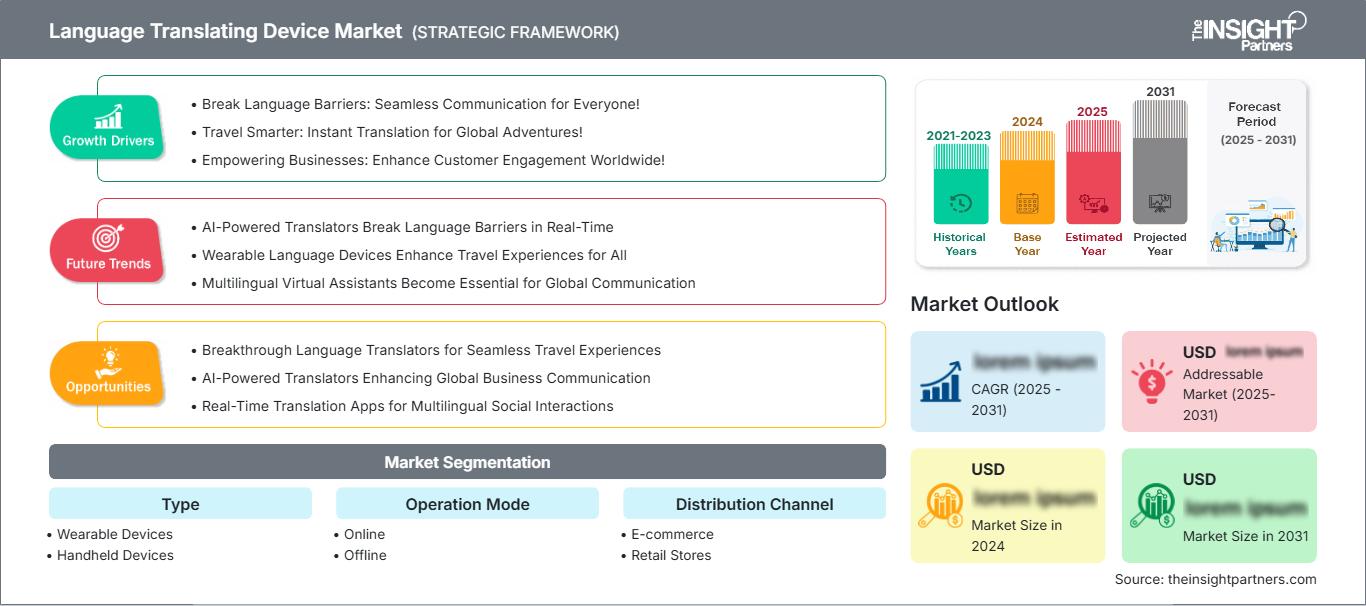
The Language Translating Device Market was valued at US$ 1.31 Billion in 2025 and is projected to reach US$ 2.63 Billion by 2034, registering a CAGR of 8.05% during 2026–2034. Expansion is supported by increasing demand for real-time multilingual communication across travel, business, education, hospitality, and consumer applications. AI-enabled speech recognition, neural translation, compact hardware, and improving offline capabilities are reshaping product functionality and broadening addressable use cases.
North America is expected to remain an important technology and commercialization center, supported by enterprise adoption, international travel, and demand for hands-free communication. The regional Language Translating Device Market Size is estimated to expand at a 7.6–8.3% CAGR during 2026–2034, with increasing integration of translation capabilities into earbuds, smart devices, and portable communication equipment. Language Translating Device size is also influenced by premium consumer-electronics adoption and enterprise experimentation.
Language Translating Device Market Assessment and Insights
- North America: North America is estimated to hold a 27–31% share in 2025 and grow at a 7.6–8.3% CAGR between 2026–2034, supported by international travel, enterprise communication, multilingual customer service, and rapid adoption of AI-enabled consumer electronics.
- US: The US is estimated to represent 72–76% of North America share in 2025, expanding at a 7.5–8.2% CAGR between 2026–2034, supported by technology adoption, travel, education, and business communication.
- Europe: Europe is estimated to account for 24–28% share in 2025 and expand at a 7.4–8.1% CAGR between 2026–2034, with Germany, the UK, France, Italy, and Spain supporting demand through tourism, trade, education, and multilingual services.
- Asia Pacific: Asia Pacific is estimated to represent 30–34% share in 2025 and grow at a 9.0–9.8% CAGR between 2026–2034, led by China, Japan, South Korea, India, and Australia, where electronics manufacturing and international travel support adoption.
- Largest Segment: Handheld Devices are estimated to hold a 54–58% market share in 2025, growing at a 7.4–8.0% CAGR during 2026–2034 because of dedicated functionality and portability.
- High Growth Segment: Wearable Devices are estimated to hold a 42–46% market share in 2025, expanding at a 9.0–9.8% CAGR during 2026–2034 as hands-free translation gains adoption.
- Key companies analyzed in detail: Fujitsu Limited, IBM Corporation, LOGBAR Inc., Misway Technology Co., Ltd., Mymanu CEH Tech Ltd., Sogou Inc., Shenzhen Timekettle Technologies Ltd., Travis B.V., Waverly Labs, Inc., and Xiaomi Corporation.
Source: The Insight Partners' analysis based on proprietary research, government publications, company annual reports, investor presentations, industry databases, and expert interviews.
Language Translating Device Market is moving away from the conventional electronic translators towards advanced technology devices that have speech recognition abilities and can translate text and transcribe audio. The hand-held versions are still relevant due to having dedicated screens and microphones and also being standalone devices while the earbuds and other wearables have become more pertinent due to hands-free technology. The manufacturing is becoming increasingly linked to smartphones, edge computing AI, cloud computing, and language models.
Further development will take place not only in the sphere of tourism but also in international business, hospitality, learning, health care, and public service spheres. Asia should be beneficial due to increased manufacturing of electronics and multilingual consumer base while Europe and North America present prospects for luxury goods. Investors are paying more attention to contextual translation, accent recognition, processing privacy, and language packs that do not require internet. Compliance with the laws regarding privacy and consent will also have an effect on the product design.
Language Translating Device Market Report Scope
| Report Attribute | Details |
|---|---|
| Market size in 2025 | US$ 1.31 Billion |
| Market Size by 2034 | US$ 2.63 Billion |
| Global CAGR (2026 - 2034) | 8.05% |
| Historical Data | 2021-2024 |
| Forecast period | 2026-2034 |
Language Translating Device Market Analysis
Language Translating Device Market growth is driven by growing cross-border movement, international business activity, and demand for instant communication, not dependent on mobile phone applications only. The supply chain involves semiconductor manufacturers, microphone/audio component manufacturers, developers of artificial intelligence models, manufacturers of the device itself, software developers, distributors, retailers, and operators of platforms. Added value will arise from integration of voice recognition, translation, noise suppression, network connectivity, and user-friendly interfaces in portable products.
Supply trends have been changing as manufacturers start incorporating translation capabilities into their earbuds, smartphones, glasses, and special portable devices. Specialized devices will continue differentiating by optimized microphones, cameras, batteries, displays, and offline mode, while wearables will utilize existing audio technologies. Cloud connectivity enables wider language coverage, but edge computing improves response time and privacy. These trends will motivate manufacturers to develop hybrid architectures that are capable of switching between online and offline modes based on available connectivity, language support, and user needs.
As per the Language Translating Device Market Report, positioning is becoming more technological due to differentiation in terms of translation quality, latency, language coverage, hardware design, and ecosystem integration. Language Translating Device analysis shows a growing trend of convergence between dedicated translators and consumer electronics devices. Fujitsu and IBM provide more AI and computing power, but LOGBAR, Misway Technology, Mymanu, Timekettle, Travis, and Waverly Labs have more specialized relevance. Sogou and Xiaomi provide more competition through language technologies and consumer devices ecosystem.
Investments include the following: wearable translation technology, edge artificial intelligence, multilingual speech models, and context-oriented communications. For instance, the Timekettle W4 Pro can translate conversations in real time through phone conversations and meetings. This is an indication of the move from translators to communication accessories. In addition, Xiaomi wireless earbuds have been integrated with translation and transcription functionalities. It implies that positioning should be balanced with both translation functionality and usability of the device.
● REPORT CUSTOMIZATION
Tailor This Report To Align With Your Specific Business Requirements
This report can be customized to align precisely with your business objectives, scope, and target markets. Customization options include tailored segmentation, geography, competitive analysis, and strategic insights to support informed decision-making.
Customize This Report →WHAT YOU CAN ADJUST
- ● Segmentations
- ● Geography
- ● Competitive Analysis
- ● Language Preferences
Language Translating Device Market: Strategic Insights
Regional Insights
North America Language Translating Device Market
North America is projected to hold 27-31% of the Language Translating Device Market Share in 2025 and grow at a rate of 7.6-8.3% CAGR up to 2034. US will be leading the region owing to the high consumer electronics penetration, international tourists, technologically advanced companies, and multi-lingual customer engagements. Canada offers demand in terms of tourism, education, immigration services, and international businesses. Advanced devices with advanced speech processing capabilities and connectivity are highly relevant.
Adoption of the devices is now shifting towards wearable and hybrid devices with added functionalities such as translation with calling, transcribing, navigation, and audio functionalities. Enterprises look into devices on the basis of their privacy aspects, language coverage, compatibility, and ease of deployments apart from translation capability. Device providers can leverage existing distribution channels and advanced AI platforms. North America thus becomes a key market for premium devices, enterprise pilots, and novel engagement models through hands-free communications.
U.S. Language Translating Device Market
US is estimated to account for 72-76% Language Translating Device Market share of North America and grow at a 7.5-8.2% CAGR up to 2034. The demand is driven by global travel, education, hospitality, health care communications, and enterprise collaborations. Specialty players compete with consumer electronics players adding translation capabilities in earbuds and other devices.
Application products incorporating translation along with transcription, calling, recording, and accessibility features have gained considerable interest. Wearable devices are particularly useful to professionals who need hands-free communication, while the handheld devices retain their advantage in travel and face-to-face meetings. The multi-language AI capability of IBM enhances the technology ecosystem as a whole, while Xiaomi and specialized players raise the profile among consumers. Offline capability, microphone efficiency, battery life, and connectivity with smartphones and web conferencing systems matter more.
Europe Language Translating Device Market
The Europe market is expected to be 24-28% share in 2025 and grow at a 7.4-8.1% CAGR between 2025 and 2034. The multi-language structure of the region creates structural demand, and Germany takes the lead in industrial and commercial uses. The United Kingdom, France, Italy, and Spain play an important role in creating the demand through tourism, education, international trade, and hospitality. Germany keeps the lead country status.
The United Kingdom is benefited by the international business activities, tourism, education and adoption of technology and creates demand for pocket-sized translating devices both in professional and personal lives. Germany has an interesting mix of industry-level trade as well as international travels which help in adopting the handheld and wearable devices. France, Italy, and Spain have good tourism and hospitality infrastructure where multilingual communication will improve visitor experience.
APAC Language Translating Device Market
The APAC region is expected to have market share of 30-34% in 2025 and grow at CAGR of 9.0-9.8% till 2034, driven by China. Japan and South Korea provide great electronics ecosystems, India is driven by linguistic diversity and use of technology, whereas Australia provides support through tourism, education and international business.
China leads in the region due to manufacturing capability, consumer-electronics scale and AI development. Premium electronics in Japan and South Korea, multilingual demand in India and usage in traveling in Australia drive the demand for translation technology in the region. Policies supporting electronics and AI will support the ecosystem of the region. Growth in adoption of smartphones and wearables should motivate integration of translation technology into personal-device platforms.
Middle East & Africa Language Translating Device Market
Middle East and Africa adoption is smaller but supported by tourism, aviation, international business, education, and infrastructure development. Saudi Arabia and the UAE are leading markets, while South Africa contributes through tourism and multilingual communication. The region is estimated to grow at a 6.8–7.5% CAGR, with the UAE leading premium adoption.
Saudi Arabia's tourism and diversification programs increase requirements for multilingual visitor engagement, while the UAE benefits from international business and aviation activity. South Africa provides opportunities across tourism, education, and public services, while Rest of MEA demand remains concentrated in travel, hospitality, and commercial environments. Connectivity availability makes hybrid online-offline products particularly relevant, especially for users moving between well-connected urban centers and less connected locations.
Segmentation Analysis
Type
Type comprises Wearable Devices and Handheld Devices. The segment is projected to grow at a 7.8–8.5% CAGR during 2026–2034, with product development increasingly focused on reducing interaction friction. The Language Translating Device scope is expanding as manufacturers move from dedicated screens toward earbuds and other compact interfaces capable of translating speech while users remain engaged in conversations.
- Wearable Devices: Wearable translators provide hands-free interaction through earbuds and emerging smart-device formats. Their strategic importance is increasing as users seek discreet, continuous translation integrated with calls, meetings, transcription, and everyday communication.
- Handheld Devices: Handheld products retain strong demand because dedicated screens, cameras, microphones, and batteries support independent operation. They remain particularly useful for travelers, field personnel, and users requiring visible text or image translation.
Operation Mode
Operation Mode includes Online and Offline solutions. The segment in the Language Translating Device Market is projected to register a 7.9–8.6% CAGR during 2026–2034 as manufacturers develop hybrid architectures combining cloud-based language breadth with local processing. Online functionality remains central for broad language coverage, while offline capabilities address connectivity limitations and privacy requirements.
- Online: Online devices benefit from cloud-based processing, frequent model updates, and broader language coverage. They are suited to connected urban environments, international business, hospitality, and applications requiring continuously improving translation models.
- Offline: Offline solutions provide greater independence from cellular or Wi-Fi availability. They are strategically important for travel, remote locations, privacy-sensitive interactions, and scenarios where low latency is required without depending on network quality.
Distribution Channel
Distribution Channel consists of E-commerce and Retail Stores. The segment in the Language Translating Device Market is expected to grow at a 7.7–8.4% CAGR during 2026–2034, reflecting increased consumer awareness and wider availability of translation-enabled electronics. Digital purchasing supports rapid international reach, while physical stores remain relevant where customers prefer product demonstrations.
- E-commerce: E-commerce provides broad geographic reach, direct product comparison, customer reviews, and rapid access to specialist devices. It is strategically important for emerging brands seeking international customers without extensive physical retail infrastructure.
- Retail Stores: Retail stores remain relevant for premium devices where consumers value demonstrations of translation quality, microphone performance, comfort, and interface design. Physical availability also supports impulse purchases in travel-oriented locations.
Opportunity Snapshot
| Application | Revenue Contribution | Trend Tag | Adoption Stage |
| Consumer | High | Travel Translation | Mature |
| Commercial | Medium | Business Meetings | Scaling |
| Education | Medium | Classroom Access | Scaling |
Language Translating Device Market Growth Drivers and Impact Analysis
Increasing International Travel and Multilingual Interaction
The factor of international travel continues to be an essential driver of demand as travelers need to communicate in real-time at airports, hotels, restaurants, means of transportation, and tourist spots. Translation gadgets will allow the travelers not to use their smartphones for translation of speech, texts, and pictures. The business significance of translation devices is even more significant as hospitality companies and tourism companies can use them to communicate with people of different nationalities. Furthermore, wearable technologies will make the process of communicating smoother as there would be no need to give phones to people all the time. Companies that produce translation devices will have to focus on light and long-lasting gadgets that have good microphones and support different languages. The demand for such technology may appear due to growing international travel and service providers' need to differentiate their visitors.
Rapid Improvement in Generative AI and Speech Recognition
Generative AI and neural speech models are enhancing the capability of devices to understand natural speech, accents, context, and partial speech. The innovation is adding value to the hardware by making it possible for translation to go past simple phrase translation into conversation. Noise filtering and processing of microphones make it possible for devices to work even in environments such as airports, conference rooms, streets, and hospitality areas. Differentiation can be achieved through unique models, edge AI, context understanding, and tuning of languages to specific applications. The business impact is huge since enhancements to software will make it possible for the device to remain relevant after purchase and also provide avenues for premium services. With advancements in AI models, it is expected that companies will battle on factors such as accuracy, latency, privacy, and language performance.
Expansion of Wearable and Connected Consumer Electronics
The translation feature will gradually start forming part of the wearables ecosystem, with examples including earbuds, smart glasses, and other wearable devices. This trend means that consumers no longer need to have a dedicated translator device, and it opens up possibilities for companies that have already developed products in the field of hearing aids, smartphones, and artificial intelligence. The case study involving Xiaomi and its implementation of a translation/transcription feature in compatible earbuds shows how translation could be developed as another feature of everyday use consumer electronics. Additionally, wearables can also be used for accessibility purposes, meeting, calls, and transcriptions, hence increased usage for non-travel purposes. From a business point of view, the more features a product has, the better value for money it offers.
Language Translating Device Market Future Trends
Context-Aware Multimodal Translation
Language Translating Device Market trends are moving toward context-aware systems capable of combining speech, text, images, tone, and conversational history. Future devices will increasingly interpret the broader communication context rather than translating isolated sentences. This development should improve performance for business meetings, travel conversations, education, and customer-service interactions where meaning depends on previous statements or visual information. Large language models can help resolve ambiguous phrases and adapt outputs to conversational context. Hardware manufacturers are likely to integrate cameras, microphone arrays, motion sensors, and edge processors to support multimodal inference. The result should be more natural interaction with fewer manual commands. Competitive differentiation will increasingly depend on contextual accuracy, response latency, privacy controls, and the ability to operate reliably across noisy or unpredictable environments.
Edge AI and Privacy-Preserving Translation
Future translation tools will have to give priority to local reasoning as people become increasingly aware about privacy and limited connectivity issues. The edge AI will cut down dependency on cloud processing, provide improved response time and enable translation even if there is no network connectivity. This technology will be especially relevant in cases of travel, business meetings, hospitals and government institutions where sensitive discussions take place. In the coming days, such devices will have to integrate local language packs along with option of cloud support and make automatic selection of mode of processing based on connectivity and user choices. Efficiency of semiconductors will also become an important issue since continuous AI processing has an impact on battery efficiency and heat generation.
Language Translating Device Market Opportunities
Enterprise Communication and Professional Collaboration
Enterprise communication represents an expanding opportunity as multinational organizations conduct meetings, site visits, training sessions, customer interactions, and cross-border operations involving employees who speak different languages. Vendors can target this opportunity through devices optimized for conferences, telephone calls, video meetings, and field communication. Products with speaker identification, transcription, meeting summaries, terminology customization, and secure processing can command stronger enterprise relevance than travel-focused products. The Language Translating Device Market Forecasts should increasingly account for recurring enterprise use rather than one-time travel purchases. Manufacturers can strengthen monetization through software subscriptions, language packs, device management, and enterprise support. Partnerships with conferencing platforms, travel operators, hospitality groups, and corporate training providers could accelerate adoption while creating channels for larger-volume procurement.
Emerging-Market Localization and Regional Language Coverage
There is a big chance of success because there are often many languages, dialects, and regional pronunciations within the same market and they are not supported properly by standard translation mechanisms. Opportunities are especially promising for India, Southeast Asia, Africa, and certain parts of the Middle East because of the specific language models and inexpensive hardware available in those regions. The vendors could work with regional developers, universities, telecommunication companies, and electronics manufacturers to create products that meet the needs of those markets. It will be beneficial for increasing demand and building trust in products since they will be relevant to their consumers. Flexibility in pricing will also play an important role as there are many consumer groups in emerging markets.
Recent Developments
- September 2025: International Business Machines Corporation collaborated with BharatGen to support development of AI models for India's linguistic diversity. BharatGen had developed initial models covering 14 major Indic languages and planned broader support. The initiative demonstrates growing emphasis on regionally relevant AI language capabilities and provides an important technology foundation for future multilingual communication applications.
- September 2025: Shenzhen Timekettle Technologies Ltd. introduced the W4 AI Interpreter Earbuds at IFA 2025, combining bone-voiceprint sensing with LLM-powered context-aware translation. The company reported 98% translation accuracy and approximately 0.2-second latency, positioning the product around hands-free, real-time multilingual conversations and demonstrating continued movement toward wearable AI interpretation.
- June 2025: Xiaomi Corporation launched its first-generation Xiaomi AI Glasses in mainland China, incorporating AI capabilities including 10-language translation. The product demonstrates the integration of translation into broader wearable ecosystems and reinforces the shift from dedicated translation hardware toward multifunctional smart devices combining communication, AI assistance, and visual interaction.
Frequently Asked Questions

- Comprehensive Market Sizing and Forecast Analysis
- Detailed Segmentation Analysis
- In-Depth Market Dynamics Assessment
- Regional and Country-Level Insights
- Competitive Landscape and Company Benchmarking
- Strategic Business Intelligence
Recent Reports
Testimonials

The Insight Partners provided valuable market intelligence that supported our global go-to-market strategy. Their team was professional, responsive, and attentive to our feedback, providing thoughtful analysis and helpful methodological clarifications throughout the project.
Junmo Kim Chief Financial Officer (CFO), Enertech Co., Ltd.
The Insight Partners' SCADA System Market report is comprehensive, with valuable insights on current trends and future forecasts. The team was highly professional, responsive, and supportive throughout. We are very satisfied and highly recommend their services.
RAN KEDEM Partner, Reali Technologies LTDs
I requested a report on a very specific software market and the team produced the report in a few days. The information was very relevant and well presented. I then requested some changes and additions to the report. The team was again very responsive and I got the final report in less than a week.
JEAN-HERVE JENN Chairman, Future Analytica
We worked with The Insight Partners for an important market study and forecast. They gave us clear insights into opportunities and risks, which helped shape our plans. Their research was easy to use and based on solid data. It helped us make smart, confident decisions. We highly recommend them.
PIYUSH NAGPAL Sr. Vice President, High Beam Global
The Insight Partners delivered insightful, well-structured market research with strong domain expertise. Their team was professional and responsive throughout. The user-friendly website made accessing industry reports seamless. We highly recommend them for reliable, high-quality research services
YUKIHIKO ADACHI CEO, Deep Blue, LLC.
This is the first time I have purchased a market report from The Insight Partners.While I was unsure at first, I visited their web site and felt more comfortable to take the risk and purchase a market report.I am completely satisfied with the quality of the report and customer service. I had several questions and comments with the initial report, but after a couple of dialogs over email with their analyst I believe I have a report that I can use as input to our strategic planning process.Thank you so much for taking the extra time and making this a positive experience.I will definitely recommend your service to others and you will be my first call when we need further market data.
JOHN SUZUKI President and Chief Executive Officer, Board Director, BK Technologies
I wish to appreciate your support and the professionalism you displayed in the course of attending to my request for information regarding to infectious disease IVD market in Nigeria. I appreciate your patience, your guidance, and the fact that you were willing to offer a discount, which eventually made it possible for us to close a deal. I look forward to engaging The Insight Partners in the future, all thanks to the impression you have created in me as a result of this first encounter.
DR CHIJIOKE ONYIA MANAGING DIRECTOR, PineCrest Healthcare Ltd.Reason to Buy
- Informed Decision-Making
- Understanding Market Dynamics
- Competitive Analysis
- Identifying Emerging Markets
- Customer Insights
- Market Forecasts
- Risk Mitigation
- Boosting Operational Efficiency
- Strategic Planning
- Investment Justification
- Tracking Industry Innovations
- Aligning with Regulatory Trends





 Get Free Sample for