
Interconnect and Passive Component Market Size, Growth & Trends by 2034
Interconnect and Passive Component Market Size and Forecasts (2021–2034), Global and Regional Share, Trends, and Growth Opportunity Analysis Report Coverage : By Type [Passive Components (Resistor, Capacitor, Inductor, Transformer, Diode), Interconnect Components (PCB, Connector, Switch, Relay, Adapter, Terminal, Others)], Application (Consumer Electronics, Telecommunication, Aerospace and Defense, Automotive, Industrial, Healthcare, Others)
- Status : Data Released
- Report Code : TIPRE00039491
- Category : Electronics and Semiconductor
- No. of Pages : 150
- Available Report Formats :


- Last update date : September 21, 2026


2025 Market Size
US$ 226.86 Bn
Base year value
2034 Forecast
US$ 353.23 Bn
Projected by 2034
CAGR 2026-2034
5.04 %
Growth rate
Addressable Market
US$ 2,631.89 Bn
(2026-2034)
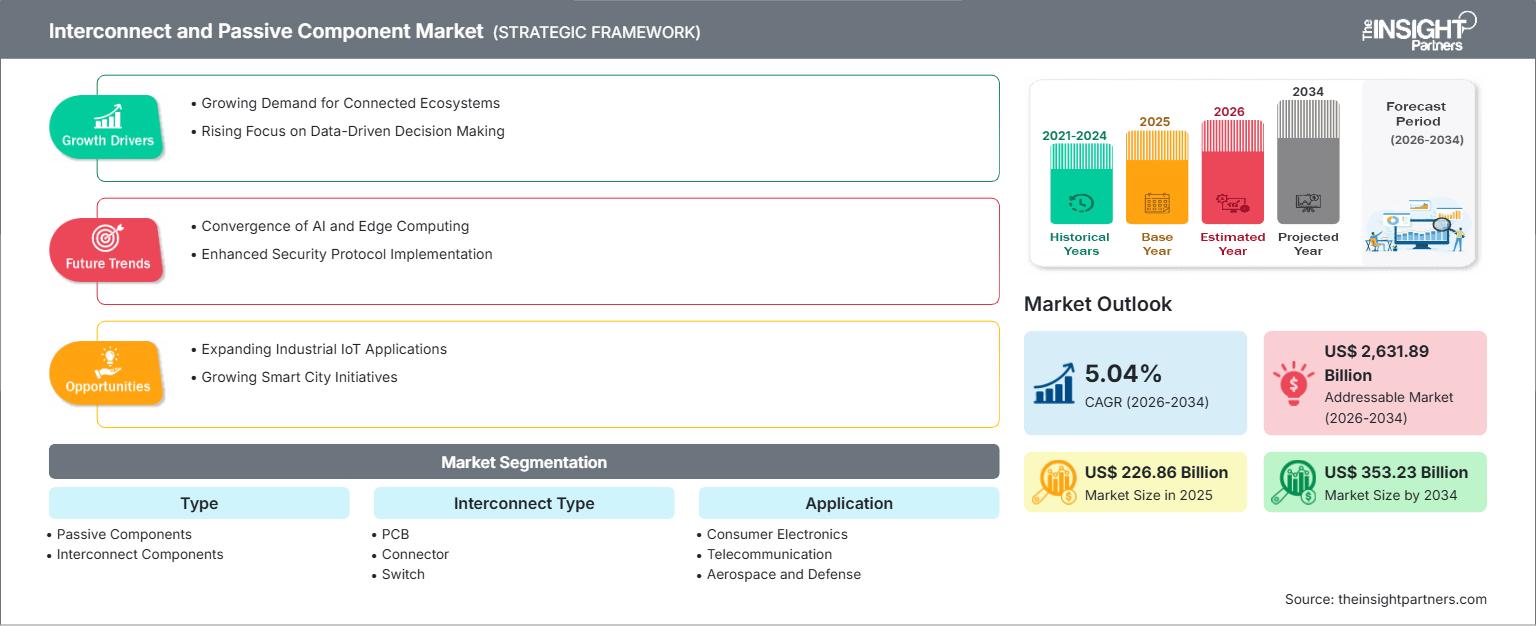
The Interconnect and Passive Component Market is valued at US$ 226.86 Billion in 2025 and is projected to reach US$ 353.23 Billion by 2034, registering a CAGR of 5.04% during 2026–2034. The market encompasses components that enable electrical connectivity, signal integrity, power management, switching, and circuit stability across increasingly complex electronic systems. Its expansion is closely linked with rising electronic content in automotive, telecommunications, industrial equipment, consumer devices, healthcare systems, and aerospace platforms.
North American demand is supported by advanced electronics manufacturing, data-center infrastructure, vehicle electrification, and defense modernization. The Interconnect and Passive Component Market size is expected to benefit from replacement of legacy components, higher component density, and requirements for reliable high-speed connectivity. These structural drivers support a regional CAGR of 4.7–5.1% through 2034, with demand increasingly favoring high-reliability and high-performance components.
Interconnect and Passive Component Market Assessment and Insights
- North America: North America maintains a high-value position, supported by automotive electronics, aerospace and defense programs, telecommunications infrastructure, and data-center investment. Interconnect and Passive Component Market share in 2025 is estimated at 23–26%, with CAGR between 2026–2034 of 4.7–5.1%.
- US: The US represents the dominant North American market, supported by advanced computing, defense electronics, automotive systems, and industrial automation. Share in 2025 is estimated at 72–76% of North America, with CAGR of 4.8–5.2% during 2026–2034.
- Europe: Europe retains significant demand across Germany, France, the UK, Italy, and Spain, supported by automotive electrification, industrial automation, aerospace, and telecommunications. Share in 2025 is estimated at 20–23%, with CAGR between 2026–2034 of 4.3–4.7%.
- Asia Pacific: Asia Pacific is the largest regional manufacturing and consumption base, led by China, Japan, South Korea, India, and Taiwan. Share in 2025 is estimated at 43–46%, with CAGR between 2026–2034 of 5.7–6.1%.
- Largest Segment: Interconnect Components hold the leading market share at 42–46% in 2025 and are projected to grow at a CAGR of 5.2–5.6% through 2034.
- High Growth Segment: Passive Components represent 38–42% share in 2025 and are projected to register a CAGR of 5.5–5.9%, driven by higher electronic content and miniaturization.
- Key companies analyzed in detail: TE Connectivity plc, Amphenol Corporation, Molex, LLC, Murata Manufacturing Co., Ltd., TDK Corporation, YAGEO Corporation, KYOCERA AVX Components Corporation, Vishay Intertechnology, Inc., Samtec, Inc., and Hirose Electric Co., Ltd.
Source: The Insight Partners' analysis based on proprietary research, government publications, company annual reports, investor presentations, industry databases, and expert interviews.
The Interconnect and Passive Components Market is transitioning from traditional commodities to customized engineering, higher density, better thermal characteristics, and tighter electrical specifications. Miniature multi-layer passive components, fast connectors, small terminals, advanced switches, and high-performance printed circuit board (PCB) interface solutions will enable increasingly sophisticated electronic systems. The manufacturing processes will become more automated, where process and materials engineering will increase the consistency, while regional manufacturing facilities will allow manufacturers to balance volume and qualifications.
Future growth will need to come from demands for electrified cars, artificial intelligence hardware, next-generation telecommunications, renewable energy products, and industrial automation. The Asia-Pacific region will continue to dominate manufacturing, while North America and Europe will focus on high-reliability applications and local manufacturing capabilities. Government regulations regarding automotive safety, electromagnetic compatibility, environmental materials, and traceability will drive investments in quality components with proven performance.
Interconnect and Passive Component Market Report Scope
| Report Attribute | Details |
|---|---|
| Market size in 2025 | US$ 226.86 Billion |
| Market Size by 2034 | US$ 353.23 Billion |
| Global CAGR (2026 - 2034) | 5.04% |
| Historical Data | 2021-2024 |
| Forecast period | 2026-2034 |
Interconnect and Passive Component Market Analysis
The Interconnect and Passive Components Market is driven by higher electronic content per system in vehicles, telecommunications gear, industrial controls, medical devices, and computer systems. Passive components condition voltages and currents, and interconnects transfer power and signals from one board or module to another or between other systems. Players include raw material suppliers, passive component suppliers, contract electronics manufacturers, distributors, original equipment manufacturers (OEMs), and system integrators. Higher design complexity makes component certification and electrical performance increasingly important buying criteria.
Supply considerations relate to ceramic, metal, plastic, magnetic, semi-conductor adjacent manufacturing and precision assembly. Component suppliers are increasing the emphasis on manufacturing considerations associated with miniaturization, automated inspection, tighter tolerances, and application specific reliability. Component certification and qualification can take a long time in automotive, aerospace, medical and industrial markets, thereby locking customers into their bill of material (BOM). Standard components require distribution networks but custom and highly reliable components require strategic OEM relationships.
Interconnect & Passive Component Market Analysis involves competition between diverse interconnect manufacturers and component manufacturers specializing in capacitors, resistors, inductors, connectors and high frequency interfaces. TE Connectivity plc and Amphenol Corporation have a wide-ranging interconnect product line covering transportation, industrial, aerospace and data infrastructure. Molex, LLC and Hirose Electric Co., Ltd. offer advanced connector designs whereas Murata Manufacturing Co., Ltd., TDK Corporation, YAGEO Corporation, KYOCERA AVX Components Corporation and Vishay Intertechnology, Inc. offer extensive passive components product line.
The investment is increasingly oriented to capacity expansion, advanced materials, high frequency transmission, automotive robustness and artificial intelligence (AI) power infrastructure. Samtec, Inc. has a competitive position in high-speed and board level interconnect solutions whereas diversified interconnect manufacturers have the benefit of leveraging their scale and applications engineering for relationship building. Strategic positioning has increasingly been driven by OEM co-development, qualification expertise, regional manufacturing and reliable provision of components for multiple manufacturing programs.
● REPORT CUSTOMIZATION
Tailor This Report To Align With Your Specific Business Requirements
This report can be customized to align precisely with your business objectives, scope, and target markets. Customization options include tailored segmentation, geography, competitive analysis, and strategic insights to support informed decision-making.
Customize This Report →WHAT YOU CAN ADJUST
- ● Segmentations
- ● Geography
- ● Competitive Analysis
- ● Language Preferences
Interconnect and Passive Component Market: Strategic Insights
Regional Insights
North America Interconnect and Passive Component Market
North America represents 23–26% of the Interconnect and Passive Component Market share in 2025 and is projected to expand at a CAGR of 4.7–5.1% through 2034. The region benefits from sophisticated automotive electronics, aerospace and defense programs, data-center construction, telecommunications investment, and industrial automation. Demand increasingly favors high-speed, high-reliability, thermally robust components.
The US makes up 72-76% of North America by 2025, with strong support from leading electronics original equipment manufacturers and demanding applications. Canada’s contribution comes through transportation, communication, industrial machinery, and automation in the extractive industries. Resilience of the supply chain is being enhanced through localized manufacturing and government-sponsored development of semiconductors and electronics. The aerospace, automotive, and computing domains will continue to be very important.
U.S. Interconnect and Passive Component Market
The U.S. Interconnect and Passive Component Market accounts for 72–76% of North America in 2025 and is expected to grow at a CAGR of 4.8–5.2% through 2034. Demand is shared by all data infrastructures, defense electronics, automotive technologies, industrial control mechanisms, telecommunication, and medical applications. Qualified suppliers and reliable delivery are becoming more prominent in procurement efforts.
Among the suppliers whose products have application exposure in US electronics industries include TE Connectivity plc, Amphenol Corporation, Molex, LLC, Samtec, Inc., and Vishay Intertechnology, Inc. Modern computing will need high-speed interconnects and power management modules, while the increased use of vehicles that use electricity will necessitate the use of high-voltage and high-temperature resistant components. The same case applies to defense programs.
Europe Interconnect and Passive Component Market
Europe holds 20–23% of the Interconnect and Passive Component Market share in 2025 and is expected to grow at a CAGR of 4.3–4.7% through 2034. Germany leads the region, followed by the UK, France, Italy, and Spain, with automotive electronics and industrial engineering forming important demand foundations.
There are advantages for the UK in terms of aerospace, defense, telecommunications, and advanced manufacturing. Germany is still considered the number one country in Europe on account of its automotive manufacturing capacity, industrial automation, and its vast network of suppliers. The contributions from France include aerospace, transportation, defense, and industrial electronics, while those of Italy and Spain are due to demands from automotive supply chains, industrial equipment, energy systems, telecommunications, and transportation.
APAC Interconnect and Passive Component Market
APAC represents 43–46% of the Interconnect and Passive Component Market share in 2025 and is projected to grow at a CAGR of 5.7–6.1%. China leads, followed by Japan, South Korea, India, and Australia. The region combines extensive electronics manufacturing with expanding automotive and communications demand.
China is enabled by large-scale electronics manufacturing, Japan by precision components, South Korea by consumer electronics and telecommunication, India by localized manufacturing, and Australia by industrial and infrastructural uses. Semiconductors investment, automotive electrification, telecommunications expansion, and government manufacturing policy help to enable the region. China continues to lead the pack due to large electronics manufacturing and component supply chains.
Middle East & Africa Interconnect and Passive Component Market
The Middle East & Africa market is projected to register a CAGR of 4.8–5.3% through 2034. Saudi Arabia and the UAE lead demand through infrastructure modernization, telecommunications, industrial diversification, transportation projects, and data infrastructure, while South Africa provides the strongest established electronics and industrial base.
Energy diversification is encouraging investment in electrical infrastructure, automation, and connected industrial systems. The UAE leads the region through technology-intensive infrastructure and smart-city development, while Saudi Arabia is expanding industrial and digital capacity. South Africa remains an important market for industrial automation and communications, whereas the rest of MEA is more project-led and dependent on imported components and regional distribution networks.

Segmentation Analysis
Type
Type segmentation comprises Passive Components and Interconnect Components. The segment is expected to grow at a CAGR of 5.1–5.5% during 2026–2034. Increasing circuit density and system complexity support demand for both categories, while application-specific qualification, miniaturization, thermal performance, and electrical reliability increasingly influence component selection across automotive, telecommunications, industrial, and consumer electronics.
- Passive Components: Passive devices support filtering, energy storage, impedance control, voltage stabilization, and signal conditioning. Their strategic importance is increasing as electronic systems become denser and require smaller components with higher capacitance, voltage tolerance, temperature stability, and reliability.
- Interconnect Components: Interconnect products provide mechanical and electrical interfaces between boards, modules, cables, and systems. Demand centers on high-speed transmission, compact form factors, higher current capacity, environmental durability, and reliable mating performance across complex electronic architectures.
Interconnect Type
Interconnect Type comprises PCB, Connector, Switch, Relay, Adapter, Terminal, Splice, Socket. The segment is projected to grow at a CAGR of 5.0–5.4% during 2026–2034. Increasing board density, electrification, high-speed communications, and industrial automation are broadening requirements for reliable electrical and mechanical interfaces across equipment categories.
- PCB: PCB interconnect solutions enable dense board-level signal and power routing, with demand influenced by miniaturization, higher frequencies, thermal constraints, and increasingly complex electronic architectures.
- Connector: Connectors remain fundamental to removable electrical interfaces, with purchasing increasingly focused on bandwidth, current capacity, durability, miniaturization, shielding, and application-specific environmental resistance.
- Switch: Switches support controlled circuit activation across industrial, automotive, consumer, and telecommunications equipment, with demand favoring compact designs, reliable actuation, and application-specific electrical performance.
- Relay: Relays provide controlled switching and electrical isolation, remaining important in automotive, industrial, energy, and control systems where dependable switching under defined voltage and current conditions is required.
- Adapter: Adapters facilitate compatibility between interfaces and system architectures, supporting equipment integration where mechanical configuration, electrical characteristics, or connection standards differ between components.
- Terminal: Terminals provide dependable wire-to-device interfaces, with strategic importance in power distribution, automotive wiring, industrial controls, and equipment requiring secure mechanical retention and electrical continuity.
- Splice: Splices enable permanent or semi-permanent joining of conductors, particularly in wiring-intensive applications where vibration resistance, insulation integrity, and long-term electrical reliability are critical.
- Socket: Sockets provide serviceable interfaces between devices and boards, supporting replacement, testing, configuration, and maintenance requirements across computing, industrial, communications, and specialized electronic systems.
Application
Application segmentation comprises Consumer Electronics, Telecommunication, Aerospace and Defense, Automotive, Industrial, Healthcare. The segment is forecast to grow at a CAGR of 5.3–5.7% during 2026–2034. Automotive and telecommunications increasingly demand higher-performance components, while healthcare and aerospace applications prioritize reliability, qualification, miniaturization, and long operating lifecycles.
- Consumer Electronics: Compact devices require dense, low-profile components that support high functionality within constrained spaces. Demand is closely linked to device refresh cycles, connectivity features, and increasingly sophisticated power-management architectures.
- Telecommunication: Network equipment requires high-speed connectors, filtering components, and reliable signal paths. Fiber, wireless, edge infrastructure, and high-density computing increase requirements for signal integrity and thermal performance.
- Aerospace and Defense: These applications prioritize qualified components capable of operating under vibration, temperature, pressure, and electromagnetic constraints. Traceability and long-term availability are important because replacement qualification can be costly.
- Automotive: Electrification, ADAS, connectivity, and software-defined architectures increase component content and raise requirements for high-voltage, high-temperature, vibration-resistant, and compact electrical interfaces.
- Industrial: Automation, robotics, energy equipment, and control systems require components optimized for continuous operation, electrical stability, mechanical durability, and compatibility with increasingly connected industrial architectures.
- Healthcare: Medical electronics demand highly reliable components for imaging, monitoring, diagnostics, patient equipment, and laboratory systems. Procurement emphasizes consistency, qualification, electrical performance, and long product availability.
Opportunity Snapshot
| Application | Revenue Contribution (High/Medium/Low) | Trend Tag | Adoption Stage |
| Consumer Electronics | High | Device Miniaturization | Mature |
| Telecommunication | High | High-Speed Links | Scaling |
| Aerospace and Defense | Medium | Rugged Connectivity | Mature |
| Automotive | High | Vehicle Electrification | Scaling |
| Industrial | High | Factory Automation | Scaling |
| Healthcare | Medium | Medical Digitization | Scaling |
Interconnect and Passive Component Market Growth Drivers and Impact Analysis
Rising electronic content across electrified vehicles
The increased use of electric vehicles is driving up the need for capacitors, inductors, relays, terminals, connectors, and high voltage interfaces. Battery technology, power electronics, chargers, ADAS, infotainment, and connectivity subsystems add electrical functions that will need dependable passive components and interconnect solutions. The commercial implications range across original equipment manufacturers and Tier 1 suppliers due to qualification considerations that make existing product platforms very attractive. Resistant to high temperatures and vibrations is critical in powertrain and safety related applications. As the 48 volt and higher voltage architectures grow, suppliers who have the capability to handle insulation, heat management, high current density, and small form factor can get access to better value opportunities.
Accelerating data infrastructure and high-speed connectivity requirements
AI, cloud computing, and high-performance computing are leading to rising demands for fast electronic interfaces and power delivery. There is a need for connectors, sockets, switches, capacitors, inductors, and other similar components that are capable of providing high bandwidth and high power density in the data center architecture. In other words, the market effect is that the demand will be moving towards low loss interconnects, higher signal integrity, higher current handling, and better thermal management. There is already a report by TDK stating that there is rising demand for passive components for AI data center infrastructure, while TE Connectivity points out that data centers for artificial intelligence is one such application for connectivity.
Expansion of industrial automation and connected equipment
Industrial automation is increasing the number and sophistication of electronic control points embedded in factories, machines, energy systems, and logistics equipment. Robots, programmable controllers, sensors, drives, industrial networking devices, and monitoring platforms all require reliable power and signal interfaces. The market impact is strongest for components capable of continuous operation under vibration, temperature variation, dust, moisture, and electromagnetic interference. Manufacturers are consequently developing ruggedized connectors, high-reliability terminals, compact passive devices, and application-specific switching solutions. Industrial customers also value lifecycle availability because equipment often remains deployed for many years. This favors suppliers with stable product portfolios and strong qualification support. Increasing connectivity between machines further raises the importance of signal integrity and controlled impedance, supporting demand for technically differentiated components.
Interconnect and Passive Component Market Future Trends
Higher-density components for AI and edge architectures
The Interconnect and Passive Component Market trends are expected to increasingly favor components engineered for higher density, bandwidth, current handling, and thermal efficiency. AI accelerators and edge-computing equipment are creating tighter electrical and mechanical constraints, encouraging manufacturers to reduce parasitic losses while maintaining reliability. Passive components are being redesigned for higher capacitance, voltage capability, and smaller footprints, while connectors are evolving toward greater data rates and improved signal integrity. Advanced packaging will increasingly bring power, data, and thermal considerations together during component selection. Suppliers that can coordinate material science, electrical modeling, mechanical design, and automated manufacturing will be better positioned to meet these requirements. The resulting product development cycle will place greater emphasis on co-engineering with system designers before equipment reaches volume production.
Greater supply-chain regionalization and qualified alternatives
Component sourcing is expected to become more diversified as OEMs seek greater resilience against logistics disruptions, geopolitical restrictions, raw-material volatility, and capacity constraints. Manufacturers are likely to establish regional production, dual-source critical materials, and qualify alternative components earlier in product development. This approach can reduce dependency on a single manufacturing geography while preserving technical consistency. Automotive, aerospace, telecommunications, and medical customers are especially likely to maintain approved alternative sources because qualification costs and operational consequences are significant. Distribution networks will remain important for standard products, but strategic customers may increasingly negotiate capacity commitments directly with manufacturers. Over time, digital supply-chain visibility and component traceability should become more important procurement criteria, particularly where customers require documented origin, environmental compliance, and long-term product continuity.
Interconnect and Passive Component Market Opportunities
Localized manufacturing for automotive and industrial electronics
The Interconnect and Passive Component Market Forecasts indicate an opportunity for suppliers to expand localized manufacturing around automotive and industrial production clusters. Regional plants can shorten lead times, reduce logistics exposure, support engineering collaboration, and improve responsiveness to customer qualification requirements. Investment priorities should include automated assembly, precision inspection, high-temperature materials, and flexible production lines capable of serving multiple component families. India, Southeast Asia, Mexico, Eastern Europe, and selected North American locations can attract capacity where electronics manufacturing ecosystems are expanding. Strategic partnerships with contract manufacturers and Tier 1 suppliers can further improve access to production programs. Companies entering these regions should prioritize technologies with established qualification pathways and broad application potential, allowing new facilities to serve several end markets rather than relying on one customer segment.
Advanced passive solutions for high-voltage power systems
Power-intensive computing, electrified transportation, renewable-energy systems, and industrial equipment are creating opportunities for high-voltage capacitors, inductors, filters, relays, and related components. TDK's 2026 strategy identifies future data-center power systems moving toward higher voltages and highlights investment in high-voltage and high-current passive technologies. This creates an investment case for suppliers developing products with improved thermal stability, compact dimensions, and higher energy-handling capability. Companies can strengthen positions by combining component expertise with application engineering for power conversion and distribution systems. The opportunity extends beyond individual components because customers increasingly value validated assemblies and coordinated electrical performance. Suppliers able to demonstrate reliability under elevated voltage, temperature, and current conditions can address premium applications where qualification barriers support stronger customer retention.
Recent Developments
- August 2026: The Electronics Components Manufacturing Scheme (ECMS) has approved 106 projects with a projected investment of ₹69,548 crore, with 38 plants already operational. The scheme is driving domestic manufacturing of critical electronic components and is expected to generate around 75,000 direct jobs.
- February 2026: Smiths Interconnect announced an investment of more than £2 million in its Costa Rica manufacturing facility. The investment will support talent, automation, manufacturing and testing capabilities for high-reliability components serving aerospace, space and defence markets.
- March 2026: Keysight expanded its 1.6T Ethernet interconnect validation technology to support passive copper and low-power optical technologies. The enhanced AresONE and INPT platforms enable manufacturers and operators to validate next-generation interconnects for AI and high-performance computing networks.
Frequently Asked Questions

- Comprehensive Market Sizing and Forecast Analysis
- Detailed Segmentation Analysis
- In-Depth Market Dynamics Assessment
- Regional and Country-Level Insights
- Competitive Landscape and Company Benchmarking
- Strategic Business Intelligence
Recent Reports
Testimonials

The Insight Partners provided valuable market intelligence that supported our global go-to-market strategy. Their team was professional, responsive, and attentive to our feedback, providing thoughtful analysis and helpful methodological clarifications throughout the project.
Junmo Kim Chief Financial Officer (CFO), Enertech Co., Ltd.
The Insight Partners' SCADA System Market report is comprehensive, with valuable insights on current trends and future forecasts. The team was highly professional, responsive, and supportive throughout. We are very satisfied and highly recommend their services.
RAN KEDEM Partner, Reali Technologies LTDs
I requested a report on a very specific software market and the team produced the report in a few days. The information was very relevant and well presented. I then requested some changes and additions to the report. The team was again very responsive and I got the final report in less than a week.
JEAN-HERVE JENN Chairman, Future Analytica
We worked with The Insight Partners for an important market study and forecast. They gave us clear insights into opportunities and risks, which helped shape our plans. Their research was easy to use and based on solid data. It helped us make smart, confident decisions. We highly recommend them.
PIYUSH NAGPAL Sr. Vice President, High Beam Global
The Insight Partners delivered insightful, well-structured market research with strong domain expertise. Their team was professional and responsive throughout. The user-friendly website made accessing industry reports seamless. We highly recommend them for reliable, high-quality research services
YUKIHIKO ADACHI CEO, Deep Blue, LLC.
This is the first time I have purchased a market report from The Insight Partners.While I was unsure at first, I visited their web site and felt more comfortable to take the risk and purchase a market report.I am completely satisfied with the quality of the report and customer service. I had several questions and comments with the initial report, but after a couple of dialogs over email with their analyst I believe I have a report that I can use as input to our strategic planning process.Thank you so much for taking the extra time and making this a positive experience.I will definitely recommend your service to others and you will be my first call when we need further market data.
JOHN SUZUKI President and Chief Executive Officer, Board Director, BK Technologies
I wish to appreciate your support and the professionalism you displayed in the course of attending to my request for information regarding to infectious disease IVD market in Nigeria. I appreciate your patience, your guidance, and the fact that you were willing to offer a discount, which eventually made it possible for us to close a deal. I look forward to engaging The Insight Partners in the future, all thanks to the impression you have created in me as a result of this first encounter.
DR CHIJIOKE ONYIA MANAGING DIRECTOR, PineCrest Healthcare Ltd.Reason to Buy
- Informed Decision-Making
- Understanding Market Dynamics
- Competitive Analysis
- Identifying Emerging Markets
- Customer Insights
- Market Forecasts
- Risk Mitigation
- Boosting Operational Efficiency
- Strategic Planning
- Investment Justification
- Tracking Industry Innovations
- Aligning with Regulatory Trends





 Get Free Sample for