
Interactive Projector Market Trends, Size & Forecast by 2034
Coverage: by Dimension (2D and 3D); Distance (Ultra Short Throw, Short Throw, and Nomal Throw); Application (Education, Government, Resturants, Shopping Malls & Retail Stores, Hospitals, and Corporate) , and Geography (North America, Europe, Asia Pacific, and South and Central America)
- Status : Data Released
- Report Code : TIPTE00002198
- Category : Electronics and Semiconductor
- No. of Pages : 150
- Available Report Formats :


- Last update date : October 22, 2026


2025 Market Size
US$ 5.40 Bn
Base year value
2034 Forecast
US$ 23.16 Bn
Projected by 2034
CAGR 2026-2034
17.56 %
Growth rate
Addressable Market
US$ 118.90 Bn
(2026-2034)
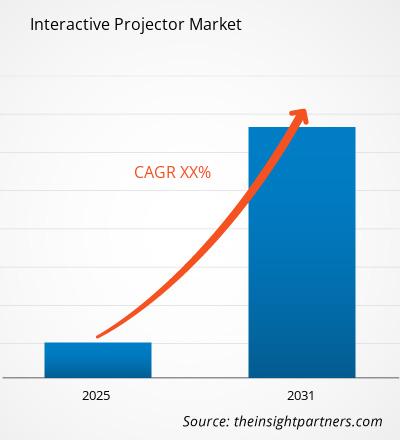
The Interactive Projector Market is valued at US$ 5.40 Billion in 2025 and is projected to reach US$ 23.16 Billion by 2034, registering a CAGR of 17.56% during 2026–2034. Expansion reflects broader deployment of interactive projection in classrooms, collaborative workplaces, public venues, and specialized visualization environments, with technology increasingly combining projection, touch or pen interaction, wireless connectivity, and software-enabled content management.
North America remains structurally attractive as institutions modernize classroom and meeting-room infrastructure and organizations prioritize collaborative visual communication. The regional outlook indicates a 15–17% CAGR through 2034, supported by replacement of aging projection systems, enterprise hybrid-work investment, and demand for flexible visual systems serving education, training, presentations, and immersive demonstrations. The Interactive Projector Market size is increasingly influenced by institutional replacement cycles and multifunctional deployments.
Interactive Projector Market Assessment and Insights
- North America: The region is expected to represent 35–39% share in 2025 and expand at a 15–17% CAGR between 2026–2034, supported by education modernization and enterprise collaboration spending. Its Interactive Projector Market share reflects mature AV infrastructure and established procurement channels.
- US: The US is expected to account for 78–82% of North American demand in 2025, with a 15.5–17.5% CAGR through 2034 as schools and businesses upgrade interactive visual infrastructure.
- Europe: Europe is projected to hold 25–29% share in 2025 and grow at a 16–18% CAGR, led by Germany, the UK, France, Italy, and Spain across education and corporate applications.
- Asia Pacific: Asia Pacific is projected to capture 28–32% share in 2025 and advance at a 19–21% CAGR, led by China, Japan, South Korea, India, and Australia.
- Largest Segment: 2D systems are expected to hold an 86–90% market share in 2025, with a 16–18% CAGR through 2034 because of broad classroom and meeting-room compatibility.
- High Growth Segment: 3D systems are expected to represent 10–14% share in 2025 and expand at a 20–22% CAGR, supported by simulation, design, medical training, and immersive visualization.
- Key companies analyzed in detail: BenQ Corporation, Panasonic Corporation, Seiko Epson Corporation, Dell Technologies Inc., Boxlight Corporation, NEC Display Solutions, Ltd., Hitachi Digital Media Group, Sony Corporation, Touchjet Inc., Optoma Technology, Inc.
Source: The Insight Partners' analysis based on proprietary research, government publications, company annual reports, investor presentations, industry databases, and expert interviews.
Technology trends involve evolving from lamp-illuminated to laser-powered projectors, miniaturization and integration of optical engines, higher resolutions, automatic calibration, wireless collaboration, and software-enabled interaction. The manufacturing environment increasingly involves vendors that incorporate optics, sensors, computing, and software applications into their products. Ultra-short-throw design eliminates shadows and reduces installation depth, and interactive pens and touch functionality make the product suitable for use in classrooms and business settings. Product development trends expand the addressable installed base because products can support both fixed room and collaborative environments. The Interactive Projector Market outlook thus depends on technology improvements and economic factors.
Investment over the outlook period will likely be made on Asia Pacific educational initiatives, North American classroom and corporate refresh cycles, and European energy-efficient audio visual upgrade initiatives. Legislation focusing on digital education, accessibility, energy efficiency, and connected learning infrastructure could contribute to replacement demand. Emerging markets would be able to leapfrog existing projection technologies and move towards laser-based interactive technologies where budgets and installation constraints enable multi-functional products. Vendors incorporating device management, wireless content sharing, annotation, and analytics functionality could benefit from public procurement and distribution channels.
Interactive Projector Market Report Scope
| Report Attribute | Details |
|---|---|
| Market size in 2025 | US$ 5.40 Billion |
| Market Size by 2034 | US$ 23.16 Billion |
| Global CAGR (2026 - 2034) | 17.56% |
| Historical Data | 2021-2024 |
| Forecast period | 2026-2034 |
Interactive Projector Market Analysis
The driver is based on education, wherein teachers are becoming more demanding with visual content that can be annotated, edited, and shared. Similarly, corporate customers are demanding interactive projectors in their workshops, design sessions, training, and virtual meeting rooms. Value chain comprises optical engines, light sources, sensing components, processors, software, installation, and after-sales services. Consumers evaluate whole systems instead of projectors per se, making integration skills important.
Conditions in supply are affected by availability of semiconductors, prices of optical components, lasers, and manufacturing volumes. Traditional Japanese and Taiwanese manufacturers have advantages in engineering of projectors and distribution channels, whereas software players compete through touch interfaces and collaboration services. Reduced demands for servicing of lasers and improvements in short-throw optics help satisfy consumer demand, but flat panels with touch screen interface remain a viable alternative.
However, the further positioning of the market participants will depend on the balance between optical and integration/service capabilities. For instance, Seiko Epson Corporation is positioning its strengths through projection technologies and educational marketing, while BenQ Corporation is using integration of DLP-based projection and education product line. Both Panasonic Corporation and NEC Display Solutions, Ltd. have strong competitive positions in professional audio-visual environments, while Dell Technologies Inc. and Sony Corporation use their enterprise relationships as their competitive advantage. Finally, Boxlight Corporation and Touchjet Inc. have collaborative application products, and Optoma Technology, Inc. positions its strengths in terms of projection diversity and installation capabilities. The presented Interactive Projector Market report demonstrates the transition to solution-based competition.
The investment will be allocated toward the laser-based light sources, wireless connectivity and cloud-based device management and application ecosystem, not only towards brightness improvements. Hitachi Digital Media Group will remain relevant for the existing professional display environments, but specialists will have the chance to capitalize on their niche positioning and to capitalize on niches that require high touch accuracy and immersive visualizations. Competitive positioning would be increasingly driven by integration, serviceability, interoperability and channel execution. Companies that have a good reach into education procurement processes will be able to grow.
● REPORT CUSTOMIZATION
Tailor This Report To Align With Your Specific Business Requirements
This report can be customized to align precisely with your business objectives, scope, and target markets. Customization options include tailored segmentation, geography, competitive analysis, and strategic insights to support informed decision-making.
Customize This Report →WHAT YOU CAN ADJUST
- ● Segmentations
- ● Geography
- ● Competitive Analysis
- ● Language Preferences
Interactive Projector Market: Strategic Insights

Regional Insights
North America Interactive Projector Market
According to the Interactive Projector Market forecast, North America is expected to account for 35–39% share in 2025 and expand at a 15–17% CAGR through 2034. The US is the major market of demand because of the upgrading of classrooms, business cooperation, investments in educational technologies, and places of professional training. Canada is the market of demand due to the upgrades of school technology and audiovisual purchases by business. Purchasers highly appreciate the use of laser lighting, maintenance, wireless presenting, and collaboration applications compatibility. The needs will be useful for the incumbents that have a wide distribution network.
The replacement cycles are quite important as institutions are changing old lamps to new light sources and small ultra-short throw solutions. There are several markets of demand – K-12 schools, universities, enterprises, government facilities, and places of professional training. Enterprise implementations need the compatibility with collaboration and conferencing applications, while the implementations in education need the annotation and low shadow solutions in the classroom. The purchasers care about the total cost of ownership, installation, services, and compatibility more than about brightness.
U.S. Interactive Projector Market Market
The U.S. is projected to contribute 78–82% of North American Interactive Projector Market in 2025 and grow at a 15.5–17.5% CAGR. The corporate organizations, universities, school districts, training centers for health care, and governments form important customer groups. There is a strong preference for laser projectors, wireless collaboration capabilities, and touch/pen-based interaction among buyers. BenQ Corporation, Seiko Epson Corporation, Panasonic Corporation, Sony Corporation, Dell Technologies Inc., and Optoma Technology, Inc. guarantee their presence in the market via professional and educational distribution channels.
The preferences of the application vary depending on the segment. The education market values interactivity, highlighting, and lower maintenance, while businesses are concerned about room versatility, document sharing, and collaboration. The universities also require greater projection capabilities for lecture halls and laboratories. The American market gets assistance from the higher AV integration skills available, even though the vendors must contend with the interactive panels and big displays. Thus, there is a need to offer installation benefits, software support, and services in order to safeguard the projectors with rising direct touch display capabilities.
Europe Interactive Projector Market Market
Europe is projected to hold 25–29% Interactive Projector Market in 2025 and grow at a 16–18% CAGR, with Germany leading regional demand. The UK continues to be a significant market for education and business sectors, whereas France, Italy, and Spain bring further possibilities through school digitalization, government sector modernization, and business AV investments. European customers tend to consider parameters like energy efficiency, total cost of ownership, compatibility, and product support when making decisions on projection solutions.
The Interactive Projector Market trends show that Germany experiences high demand from industrial education, universities, corporate presentation rooms, and visualization projects. The UK focuses on classroom integration and hybrid collaboration, while France unites modernization of public sector education and AV implementations at enterprises. Italy and Spain have needs connected to education modernization, hospitality, retail, and business meeting room projects. Laser solutions in the area may get advantage of lower maintenance needs and extended life span. Procurement process remains dependent on sustainability issues, installation standards, and system compatibility.
APAC Interactive Projector Market Market
APAC is expected to represent 28–32% Interactive Projector Market in 2025 and grow at a 19–21% CAGR, making it the fastest-growing major region. China dominates regional demand, followed by Japan, South Korea, India, and Australia. Programs for smart classrooms, development of higher education infrastructure, digitization in corporations and industries, and training programs are some of the primary catalysts. Local procurement eco-systems enable quick adoption as well.
India and China offer high volume prospects due to modernization of teaching facilities in institutions, while Japan and South Korea focus on visualization and applications in the workspace. Australia offers opportunities due to educational and professional AV demands. Digital learning policies, increased connectivity, and availability of laser projectors are driving adoption. Regional manufactures and international brands compete on price, distribution channels, and software compatibility.
Middle East & Africa Interactive Projector Market Market
Middle East and Africa demand is expected to grow at an 18–20% CAGR. The Saudi Arabia and UAE markets are leading the way regionally in terms of investment in education, smart cities, hospitality, and large scale corporate infrastructure projects. South Africa is the key market in Africa, but the remaining MEA markets are good markets due to the upgrade in facilities and technology within governments.
Energy and infrastructure projects add new venues for use cases in immersive visualization, training, and command center. The buyers are becoming increasingly interested in buying systems that are more robust because they would require minimal maintenance in places with poor infrastructure support. The key use cases continue to be in education, and retail, hospitality, health care, and corporate facilities add new markets.
Segmentation Analysis
Dimension
The Dimension segment is expected to grow at a 17–19% CAGR during 2026–2034. Two-dimensional systems remain the mainstream configuration because they align with standard classroom, presentation, training, and collaborative workflows. Three-dimensional projection addresses specialized applications where depth perception and immersive visualization justify additional system complexity. The Interactive Projector Market scope therefore combines a large established base with a smaller high-growth opportunity.
- 2D: 2D systems remain the mainstream configuration for classrooms, meeting rooms, training centers, and public presentations. Their compatibility with standard content and straightforward installation supports broad institutional procurement.
- 3D: 3D systems serve visualization-intensive environments such as medical education, engineering, simulation, architecture, and immersive experiences. Their strategic value increases where spatial understanding improves training or design communication.
Distance
The Distance segment is expected to advance at a 17–19% CAGR during 2026–2034. Projection distance directly affects room geometry, installation requirements, shadow interference, and user interaction. Ultra-short-throw products are particularly relevant where users stand close to the projected surface, while short-throw and normal-throw configurations remain useful in rooms with established mounting arrangements.
- Ultra Short Throw: Ultra-short-throw systems minimize projection distance and reduce presenter shadows, making them attractive for classrooms and constrained meeting rooms. Installation precision and wall compatibility remain important purchasing considerations.
- Short Throw: Short-throw systems balance installation flexibility and reduced shadowing, supporting education, corporate training, and smaller presentation spaces. They remain relevant where ultra-short-throw installation economics are less compelling.
- Nomal Throw: Nomal throw systems remain suitable for larger rooms and established ceiling installations where projection distance is available. Their installed base provides replacement opportunities where institutions prioritize continuity.
Application
The Application segment is expected to expand at an 18–20% CAGR during 2026–2034. Education remains the broadest demand pool, but government, restaurants, retail, healthcare, and corporate environments diversify the addressable base. Each setting has different requirements for brightness, content interaction, installation flexibility, maintenance, and software compatibility, encouraging vendors to tailor products and integration packages.
- Education: Schools and universities use interactive projection for digital lessons, annotation, collaborative exercises, and multimedia instruction. Procurement increasingly considers maintenance, teacher usability, device management, and compatibility with existing learning technologies.
- Government: Government agencies deploy interactive projection for training, public presentations, planning sessions, and collaborative command environments. Security, serviceability, interoperability, and procurement compliance influence vendor selection.
- Resturants: Restaurants can use interactive projection for themed experiences, menu visualization, entertainment, and customer engagement. Compact installation and reliable operation are strategically important where equipment coexists with active hospitality environments.
- Shopping Malls & Retail Stores: Retail venues use projection for interactive promotions, product demonstrations, experiential zones, and event installations. Demand depends on visual impact, flexible content management, and adaptability to changing layouts.
- Hospitals: Hospitals and training institutions apply interactive projection to medical education, simulation, collaborative case discussions, and patient-facing visualization. Image clarity, hygienic operation, reliability, and digital-content integration influence adoption.
- Corporate: Corporate users deploy interactive projectors for workshops, meeting rooms, training, design reviews, and hybrid collaboration. Wireless sharing, annotation, conferencing compatibility, and lifecycle support are central to enterprise specifications.
Opportunity Snapshot
| Application | Revenue Contribution (High/Medium/Low) | Trend Tag (MAX 2 words) | Adoption Stage |
| Education | High | Smart Classrooms | Scaling |
| Government | Medium | Digital Training | Scaling |
| Resturants | Low | Immersive Dining | Emerging |
| Shopping Malls & Retail Stores | Medium | Experiential Retail | Scaling |
| Hospitals | Medium | Medical Simulation | Emerging |
| Corporate | High | Hybrid Collaboration | Mature |
Interactive Projector Market Growth Drivers and Impact Analysis
Digital Classroom Modernization Expands Institutional Procurement
The evolution of education is generating a sustainable cycle of replacements that will occur for the more traditional boards, non-interactive projectors, and older AV equipment for classrooms. With interactive projection, it is possible to build on existing room infrastructure, in addition to having annotation capabilities and collaboration features that could be appealing in situations when the budget will not allow a replacement of the entire room display system. There are additional factors that affect procurement such as digitalized curriculum, teaching and learning programs. In emerging countries, the government-sponsored programs related to technology in education can generate institutional tenders. On the other hand, in private institutions, the use of interactive systems helps in distinguishing learning rooms.
Enterprise Collaboration and Training Requirements Broaden Use Cases
Companies in the Interactive Projector Market are seeing the need for visual collaboration in their meeting spaces, training rooms, design studios, and collaborative working spaces. Interactive projection offers a bigger canvas compared to individual screens, which allows annotation, brain-storming, demonstration, and reviews by groups. Collaborative working requires integration of people present physically with people not physically present, which calls for wireless sharing and interoperability in conferencing. Industries that involve a lot of training, including manufacturing, engineering, health-care, and professional services, will be able to offer demonstrations of complicated procedures using interactive projections rather than just presentations. It will help vendors when projectors are included in workplace systems as opposed to purchasing them individually.
Laser Illumination Improves Lifecycle Economics and Product Flexibility
The move towards the laser light source helps make interactive projection technology more economically viable as it reduces the frequency of changing lamps as well as providing a more constant level of brightness for a longer period of time. This is significant for educational establishments, government institutions, and corporate clients who have high utilization per day since access to them for maintenance may be expensive. Laser technology allows also to achieve compactness and quick start, which makes such solutions more suitable for room usage in several sessions. Companies can take advantage of this trend to introduce ultra-short-throw projectors with enhanced installation flexibility and good quality images. In terms of customer perception, the comparison of operating costs instead of just purchase cost becomes more common.
Interactive Projector Market Future Trends
Software-Centric Interaction Becomes a Core Differentiator
The future product could depend more on software capabilities rather than on the projector itself. Such functions as annotation, collaboration in the cloud, managing devices, analyzing and remote diagnostics, and collaboration with collaboration systems would make the projector a point in a managed office or classroom. Artificial intelligence can be applied to help the frame of picture to appear automatically, recognize content, calibrate the projector, and optimize it according to the conditions, reducing the configuration efforts of non-technical users. Another feature could be developing by the vendor the application programming interface enabling communication between other learning, conference, retail or simulation systems and projector system. This will transform the process of buying since besides optical characteristics, users will also estimate the updates, security, and subscriptions.
Immersive and Flexible Projection Expands Beyond Traditional Rooms
Projection is expected to evolve into environments that are flexible, allowing the use of walls, floors, screens, and even temporary constructions as interactive surfaces. Businesses can employ projection for dynamic layout design, while museums can use the technology for immersive learning, and health-care providers can use it for training via spatial visualization. Projections can be employed in companies and industries for design reviews, simulation, safety training, and facilities planning. Compact optical systems for ultra-short throw, enhanced sensing capabilities, and wireless technology can facilitate the ease of reconfiguration of installations. 3D content is also predicted to become relevant in areas where spatial visualization is of measurable benefit. This trend would put those vendors at an advantage who can provide comprehensive solutions including projection, interaction, content management, installation, and support.
Interactive Projector Market Opportunities
Integrated Education Platforms Create Higher-Value Deployment Models
Suppliers of education have an opportunity to bundle projectors with classroom management, content sharing, teachers' cooperation, device tracking, and technical support. Such bundles can simplify the purchasing process for school districts and private education institutions who are separately purchasing hardware and software. Regional bundlers can create standardized bundles including installation, calibration, networking, training of teachers, and maintenance. In developing countries, localization of language and compatibility with national education platforms can facilitate adoption. Providers need to concentrate on easy administration since schools generally do not have enough technical personnel. Collaboration with providers of educational technology will increase demand for the product without the need for the manufacturer to produce all the functionality. Greatest business potential is in recurring programs for institutional customers.
Experiential Retail and Specialized Visualization Enable New Demand Pools
Training in retail, hospitality, healthcare, and industry provide potential areas for solutions that go beyond traditional presentations. Shopping malls could make use of interactive projection to explore products and conduct promotional activities, while restaurants could use projection for themed settings and entertainment. Hospitals and simulation centers could benefit from interactive projection in training and visualization of procedures, while industrial companies could use this technology for design reviews, maintenance training, and safety simulations. Often times, such solutions need customized installations, development of the content, adaption to the environment, and connection with the sensors or control system. Consequently, the vendors should be able to switch to solution-oriented contracts with integration of hardware, professional services, and software. Local system integrators are important because special installations involve site surveying, calibration, and content projection.
Recent Developments
- June 2026: Panasonic Corporation hosted Panasonic Tech Summit 2026 in New Delhi, showcasing integrated display, projection, broadcast, and connected visual communication solutions across education, healthcare, retail, corporate, and other applications. The event highlighted immersive projection and broader connected technology ecosystems, demonstrating continued investment in professional visualization solutions.
- September 2025: Seiko Epson Corporation introduced its Lifestudio projector line, combining advanced 3LCD projection with Google TV, Sound by Bose technology, and the Epson Projection Studio application. The launch broadened its smart projection portfolio and demonstrated increased emphasis on integrated software and interactive experiences alongside core projection technology.
- June 2025: Panasonic Projector & Display Americas LLC announced product enhancements and partnerships at InfoComm 2025, emphasizing integrated workflows and visual experiences for education, corporate, and entertainment applications. The company positioned new projector and display solutions within broader technology ecosystems designed to simplify audiovisual workflows and support more connected deployments.
Frequently Asked Questions

- Comprehensive Market Sizing and Forecast Analysis
- Detailed Segmentation Analysis
- In-Depth Market Dynamics Assessment
- Regional and Country-Level Insights
- Competitive Landscape and Company Benchmarking
- Strategic Business Intelligence
Recent Reports
Testimonials

The Insight Partners provided valuable market intelligence that supported our global go-to-market strategy. Their team was professional, responsive, and attentive to our feedback, providing thoughtful analysis and helpful methodological clarifications throughout the project.
Junmo Kim Chief Financial Officer (CFO), Enertech Co., Ltd.
The Insight Partners' SCADA System Market report is comprehensive, with valuable insights on current trends and future forecasts. The team was highly professional, responsive, and supportive throughout. We are very satisfied and highly recommend their services.
RAN KEDEM Partner, Reali Technologies LTDs
I requested a report on a very specific software market and the team produced the report in a few days. The information was very relevant and well presented. I then requested some changes and additions to the report. The team was again very responsive and I got the final report in less than a week.
JEAN-HERVE JENN Chairman, Future Analytica
We worked with The Insight Partners for an important market study and forecast. They gave us clear insights into opportunities and risks, which helped shape our plans. Their research was easy to use and based on solid data. It helped us make smart, confident decisions. We highly recommend them.
PIYUSH NAGPAL Sr. Vice President, High Beam Global
The Insight Partners delivered insightful, well-structured market research with strong domain expertise. Their team was professional and responsive throughout. The user-friendly website made accessing industry reports seamless. We highly recommend them for reliable, high-quality research services
YUKIHIKO ADACHI CEO, Deep Blue, LLC.
This is the first time I have purchased a market report from The Insight Partners.While I was unsure at first, I visited their web site and felt more comfortable to take the risk and purchase a market report.I am completely satisfied with the quality of the report and customer service. I had several questions and comments with the initial report, but after a couple of dialogs over email with their analyst I believe I have a report that I can use as input to our strategic planning process.Thank you so much for taking the extra time and making this a positive experience.I will definitely recommend your service to others and you will be my first call when we need further market data.
JOHN SUZUKI President and Chief Executive Officer, Board Director, BK Technologies
I wish to appreciate your support and the professionalism you displayed in the course of attending to my request for information regarding to infectious disease IVD market in Nigeria. I appreciate your patience, your guidance, and the fact that you were willing to offer a discount, which eventually made it possible for us to close a deal. I look forward to engaging The Insight Partners in the future, all thanks to the impression you have created in me as a result of this first encounter.
DR CHIJIOKE ONYIA MANAGING DIRECTOR, PineCrest Healthcare Ltd.Reason to Buy
- Informed Decision-Making
- Understanding Market Dynamics
- Competitive Analysis
- Identifying Emerging Markets
- Customer Insights
- Market Forecasts
- Risk Mitigation
- Boosting Operational Efficiency
- Strategic Planning
- Investment Justification
- Tracking Industry Innovations
- Aligning with Regulatory Trends





 Get Free Sample for