$4450
$3560
The industrial rainscreen cladding market size is projected to reach US$ 8682.83 million by 2031 from US$ 5537.44 million in 2024. The market is expected to register a CAGR of 6.8% during 2025–2031.
Industrial Rainscreen Cladding Market Analysis
The industrial rainscreen cladding market growth is driven by the rising demand for energy-saving, environmentally friendly, and water-resistant building materials, supported by the trend of urbanization, infrastructure development, and the rapid pace of industrialization. Additionally, the market has been influenced by the need for long-lasting materials that protect against extreme weather conditions and moisture ingress, as well as enhance the visual appeal of buildings.
Industrial Rainscreen Cladding Market Overview
Industrial rainscreen cladding systems are exterior wall systems designed to protect building structures from wind-driven rain and environmental elements by creating a ventilated gap between the outer cladding and the building's structural wall. This gap enables moisture management and improved ventilation, reducing water penetration and enhancing thermal efficiency. The cladding serves as a weather-resistant outer layer, while the cavity helps to drain and evaporate moisture, protecting the underlying structure from water damage and enhancing energy efficiency.
Customize Research To Suit Your Requirement
We can optimize and tailor the analysis and scope which is unmet through our standard offerings. This flexibility will help you gain the exact information needed for your business planning and decision making.
Industial Rainscreen Cladding Market: Strategic Insights


Naveen
Have a question?
Naveen will walk you through a 15-minute call to present the report’s content and answer all queries if you have any.
 Speak to Analyst
Industrial Rainscreen Cladding Market and Opportunities
Speak to Analyst
Industrial Rainscreen Cladding Market and Opportunities
Customize Research To Suit Your Requirement
We can optimize and tailor the analysis and scope which is unmet through our standard offerings. This flexibility will help you gain the exact information needed for your business planning and decision making.
Industial Rainscreen Cladding Market: Strategic Insights
Naveen
Have a question?
Naveen will walk you through a 15-minute call to present the report’s content and answer all queries if you have any.
Speak to Analyst
Market Drivers:
Increasing demand for energy-efficient and weather-resistant building materials:
The stringent global energy efficiency requirements and environmental standards have prompted manufacturers to implement innovative rainscreen cladding systems that enhance insulation and reduce the facility's energy usage, among other benefits.Rising adoption of sustainable construction solutions and high-performance facade systems:
Such installations offer improved energy insulation, efficient water control, and enhanced decorative potential, making them the most suitable choice for contemporary industrial buildings.Growing urbanization and expansion of commercial and residential high-rise buildings:
Builders seek durable, fire-resistant, and aesthetically appealing materials to meet modern architectural and safety standards.
Market Opportunities:
Development and growth in sustainable and fire-resistant cladding solutions:
Innovations align with stricter building safety and energy efficiency regulations, driving adoption in the global industrial rainscreen cladding systems.Increasing investments in green building projects:
Systems are increasingly adopted for their ability to improve thermal efficiency, lower long-term maintenance expenses, and provide superior aesthetic and architectural value to modern construction projectsInnovation in advanced materials:
Technologies can enhance performance, sustainability, and aesthetics, driving competitive advantage and enabling market expansion.
Global Industrial Rainscreen Cladding Market Report Segmentation Analysis
The Industrial Rainscreen Cladding Market is segmented into:
By Material Type:
Ceramic:
Ceramic rainscreen cladding is gaining traction in industrial construction due to its durability, fire resistance, and aesthetic versatility.Timber:
Timber segment includes hardwoods (oak and teak), softwoods (cedar and pine), and engineered wood products (thermally modified timber).Composite Material:
Composite rainscreen cladding combines materials such as wood-plastic composites (WPC), fiber cement, and aluminum composite panels (ACP) to deliver high performance in industrial applications.Metal:
Metal rainscreen cladding remains a dominant force in industrial construction due to its strength, fire resistance, and sleek appearance.Others:
The others category includes alternative materials such as stone, glass, uPVC, and concrete, each serving specific industrial design and performance needs.
By Construction Type:
New Construction:
These systems offer superior thermal insulation, moisture control, and fire resistance, making them ideal for large-scale industrial facilities such as factories, logistics hubs, and data centers.Renovation:
Older industrial buildings often suffer from poor insulation, water infiltration, and outdated facades, which can result in high energy costs and maintenance issues.
By Geography:
- North America
- Europe
- Asia Pacific
- Middle East and Africa
- South America
Market Report ScopeIndustrial Rainscreen Cladding Market Share Analysis by Geography
The industrial rainscreen cladding market in North America is witnessing rapid expansion. Cleaner energy usage is influencing the demand for energy-efficient buildings, which have stricter building codes and an increasing number of people aware of sustainability matters. There are unexploited opportunities in the developing markets of South America, the Middle East, and Africa for industrial rainscreen cladding suppliers to penetrate these regions and expand their businesses.
The industrial rainscreen cladding market grows differently in each region due to rapid expansion. Below is a summary of market share and trends by region:
1. North America
Market Share:
Holds the largest portion of the market
Key Drivers:
The surge in new construction and renovation projects across residential, commercial, and institutional sectors, which demand durable and energy-efficient exterior solutions.Trends:
Growth driven by renovation of existing buildings and urban infrastructure
2. Europe
Market Share:
Growing share propelled by the region's progressive architectural standards and deep-rooted commitment to sustainable design.Key Drivers:
Increased demand for rainscreen cladding to protect buildings from environmental conditionsTrends:
Surging expansion of the construction industry in Europe
3. Asia Pacific
Market Share:
Substantial growth due to rapid urbanization, large-scale infrastructure investment.Key Drivers:
Increase in refurbishment projects and multifamily construction in large multi-story buildingsTrends:
Emphasis on sustainability and energy efficiency
4. South and Central America
Market Share:
Growing market as the construction sector in the region moves toward modernization and resilienceKey Drivers:
Demand for energy-efficient buildings, driven by regulatory standards and environmental
Trends:
Rising adoption of composite materials
5. Middle East and Africa
Market Share:
Although small, but growing quicklyKey Drivers:
Increasing focus on green building solutions and energy-efficient construction by governmentsTrends:
Increasing adoption of ventilated rainscreen systems.
Industrial Rainscreen Cladding Market Players Density: Understanding Its Impact on Business Dynamics
High Market Density and Competition
Competition is strong due to the presence of established players such as CGL Facades, Carea Ltd, Soprema Insulation Limited (Celotex), Kingspan Holdings (Ireland) Limited, Euramax, and Fundermax GmbH. Regional and niche providers such as Proteus Facades (UK), Terreal (France), and Bailey (US) are also adding to the competitive landscape across different regions.
This high level of competition urges companies to stand out by offering:
- Advanced products with Superior Moisture Management
- Designing systems that improve thermal performance
- Using materials and finishes that withstand extreme weather conditions, UV exposure, and mechanical stress
Opportunities and Strategic Moves
- Develop and innovate cladding systems that enhance the energy efficiency of a building by increasing insulation levels and reducing heat loss.
- Use technology of the future, such as built-in sensors and AI-driven building performance evaluation for on-the-spot energy efficiency tracking.
- Provide a complete range of services from the procurement of raw materials, personalization, and the installation of products.
Other companies analyzed during the course of research:
- VM Building Solutions
- RGB FACADES
- Shackerley (Holdings) Group Ltd
- Proteus Facades Limited
- RHEINZINK
- Genius Facades
- Ash & Lacy Holdings Ltd.
- SFS Group USA, Inc.
- Saint-Gobain Group
- Sto SE & Co.
Industrial Rainscreen Cladding Market News and Recent Developments
Nichiha Expands Concrete Series With New Concrete Board Panels:
Nichiha USA expanded its Concrete Series with the launch of ConcreteBoard, a new cladding option. Concrete Board adds a modern dimension to the classic industrial aesthetic.
Industrial Rainscreen Cladding Report Coverage and Deliverables
The "Industrial Rainscreen Cladding Market Size and Forecast (2021–2031)" report provides a detailed analysis of the market covering below areas:
- Industrial Rainscreen Cladding Market size and forecast at global, regional, and country levels for all the key market segments covered under the scope
- Industrial Rainscreen Cladding Market trends, as well as market dynamics such as drivers, restraints, and key opportunities
- Detailed PEST and SWOT analysis
- Industrial Rainscreen Cladding Market analysis covering key market trends, global and regional framework, major players, regulations, and recent market developments
- Industry landscape and competition analysis covering market concentration, heat map analysis, prominent players, and recent developments for the Industrial Rainscreen Cladding Market
- Detailed company profiles

Report Coverage
Revenue forecast, Company Analysis, Industry landscape, Growth factors, and Trends

Segment Covered
This text is related
to segments covered.

Regional Scope
North America, Europe, Asia Pacific, Middle East & Africa, South & Central America

Country Scope
This text is related
to country scope.
Frequently Asked Questions
The industrial rainscreen cladding market size is projected to reach US$ 4308.86 billion by 2031 from US$ 3028.32 billion in 2024. The market is expected to register a CAGR of 5.4% during 2025–2031.
The market is primarily driven by:
1. Growing Popularity of Sustainable Construction
2. Increasing Focus on Architectural Aesthetics and Flexible Design.
Ceramic rainscreen cladding continues to gain traction in industrial construction due to its durability, fire resistance, and aesthetic versatility. Comprising terracotta panels and porcelain tiles, ceramic systems are engineered to withstand extreme weather and mechanical stress.
Asia Pacific has the fastest-growing market for industrial rainscreen cladding, propelled by rapid urbanization, large-scale infrastructure investment, and robust industrialization across China, India, and Southeast Asia, among others.
In new industrial construction, rainscreen cladding is increasingly integrated from the design phase to meet modern performance and sustainability standards. These systems offer superior thermal insulation, moisture control, and fire resistance, making them ideal for large-scale industrial facilities such as factories, logistics hubs, and data centers.
Complexities in Design and Installation
The market’s emphasis on sustainability has led to increased adoption of timber cladding, especially in regions with strict environmental regulations. Timber’s role in achieving green building certifications is significant, as it contributes to carbon sequestration and energy efficiency. According to recent reports, the rainscreen cladding market is expanding rapidly due to urbanization and stricter building codes, with timber playing a key role in sustainable architecture
Major players include Merson Group, Trespa International B.V., Carea Ltd, Kingspan Holdings (Ireland) Limited, ROCKWOOL A/S, Soprema Insulation Limited, Fundermax North America Inc., Knauf Digital GmbH, James Hardie Building Products Inc.
The List of Companies - Industial Rainscreen Cladding Market
- CGL Facades
- Carea Ltd
- Soprema Insulation Limited (Celotex)
- Kingspan Holdings (Ireland) Limited
- Euramax
- Fundermax GmbH
- Sika Limited
- Alucoil S.A.U.
- Alpolic (Mitsubishi Chemical Group
- DANPAL
The Insight Partners performs research in 4 major stages: Data Collection & Secondary Research, Primary Research, Data Analysis and Data Triangulation & Final Review.
- Data Collection and Secondary Research:
As a market research and consulting firm operating from a decade, we have published many reports and advised several clients across the globe. First step for any study will start with an assessment of currently available data and insights from existing reports. Further, historical and current market information is collected from Investor Presentations, Annual Reports, SEC Filings, etc., and other information related to company’s performance and market positioning are gathered from Paid Databases (Factiva, Hoovers, and Reuters) and various other publications available in public domain.
Several associations trade associates, technical forums, institutes, societies and organizations are accessed to gain technical as well as market related insights through their publications such as research papers, blogs and press releases related to the studies are referred to get cues about the market. Further, white papers, journals, magazines, and other news articles published in the last 3 years are scrutinized and analyzed to understand the current market trends.
- Primary Research:
The primarily interview analysis comprise of data obtained from industry participants interview and answers to survey questions gathered by in-house primary team.
For primary research, interviews are conducted with industry experts/CEOs/Marketing Managers/Sales Managers/VPs/Subject Matter Experts from both demand and supply side to get a 360-degree view of the market. The primary team conducts several interviews based on the complexity of the markets to understand the various market trends and dynamics which makes research more credible and precise.
A typical research interview fulfils the following functions:
- Provides first-hand information on the market size, market trends, growth trends, competitive landscape, and outlook
- Validates and strengthens in-house secondary research findings
- Develops the analysis team’s expertise and market understanding
Primary research involves email interactions and telephone interviews for each market, category, segment, and sub-segment across geographies. The participants who typically take part in such a process include, but are not limited to:
- Industry participants: VPs, business development managers, market intelligence managers and national sales managers
- Outside experts: Valuation experts, research analysts and key opinion leaders specializing in the electronics and semiconductor industry.
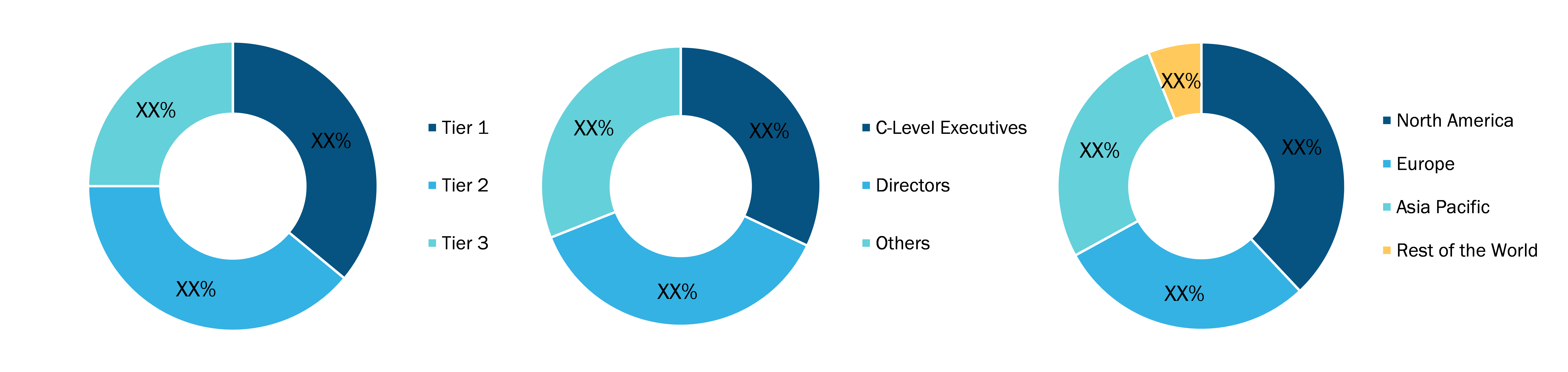
Below is the breakup of our primary respondents by company, designation, and region:
Once we receive the confirmation from primary research sources or primary respondents, we finalize the base year market estimation and forecast the data as per the macroeconomic and microeconomic factors assessed during data collection.
- Data Analysis:
Once data is validated through both secondary as well as primary respondents, we finalize the market estimations by hypothesis formulation and factor analysis at regional and country level.
- 3.1 Macro-Economic Factor Analysis:
We analyse macroeconomic indicators such the gross domestic product (GDP), increase in the demand for goods and services across industries, technological advancement, regional economic growth, governmental policies, the influence of COVID-19, PEST analysis, and other aspects. This analysis aids in setting benchmarks for various nations/regions and approximating market splits. Additionally, the general trend of the aforementioned components aid in determining the market's development possibilities.
- 3.2 Country Level Data:
Various factors that are especially aligned to the country are taken into account to determine the market size for a certain area and country, including the presence of vendors, such as headquarters and offices, the country's GDP, demand patterns, and industry growth. To comprehend the market dynamics for the nation, a number of growth variables, inhibitors, application areas, and current market trends are researched. The aforementioned elements aid in determining the country's overall market's growth potential.
- 3.3 Company Profile:
The “Table of Contents” is formulated by listing and analyzing more than 25 - 30 companies operating in the market ecosystem across geographies. However, we profile only 10 companies as a standard practice in our syndicate reports. These 10 companies comprise leading, emerging, and regional players. Nonetheless, our analysis is not restricted to the 10 listed companies, we also analyze other companies present in the market to develop a holistic view and understand the prevailing trends. The “Company Profiles” section in the report covers key facts, business description, products & services, financial information, SWOT analysis, and key developments. The financial information presented is extracted from the annual reports and official documents of the publicly listed companies. Upon collecting the information for the sections of respective companies, we verify them via various primary sources and then compile the data in respective company profiles. The company level information helps us in deriving the base number as well as in forecasting the market size.
- 3.4 Developing Base Number:
Aggregation of sales statistics (2020-2022) and macro-economic factor, and other secondary and primary research insights are utilized to arrive at base number and related market shares for 2022. The data gaps are identified in this step and relevant market data is analyzed, collected from paid primary interviews or databases. On finalizing the base year market size, forecasts are developed on the basis of macro-economic, industry and market growth factors and company level analysis.
- Data Triangulation and Final Review:
The market findings and base year market size calculations are validated from supply as well as demand side. Demand side validations are based on macro-economic factor analysis and benchmarks for respective regions and countries. In case of supply side validations, revenues of major companies are estimated (in case not available) based on industry benchmark, approximate number of employees, product portfolio, and primary interviews revenues are gathered. Further revenue from target product/service segment is assessed to avoid overshooting of market statistics. In case of heavy deviations between supply and demand side values, all thes steps are repeated to achieve synchronization.
We follow an iterative model, wherein we share our research findings with Subject Matter Experts (SME’s) and Key Opinion Leaders (KOLs) until consensus view of the market is not formulated – this model negates any drastic deviation in the opinions of experts. Only validated and universally acceptable research findings are quoted in our reports.
We have important check points that we use to validate our research findings – which we call – data triangulation, where we validate the information, we generate from secondary sources with primary interviews and then we re-validate with our internal data bases and Subject matter experts. This comprehensive model enables us to deliver high quality, reliable data in shortest possible time.
Trends and growth analysis reports related to Industial Rainscreen Cladding Market

Nov 2025
Industial Rainscreen Cladding Market
Size and Forecast (2021 - 2031), Global and Regional Share, Trend, and Growth Opportunity Analysis Report Coverage: By Cladding Material (Ceramic, Timber, Composite Materials, Metals, and Others), Construction Type (New Construction and Renovation), and Geography
Nov 2025
Commercial Rainscreen Cladding Market
Size and Forecast (2021 - 2031), Global and Regional Share, Trend, and Growth Opportunity Analysis Report Coverage: By Cladding Material (Ceramic, Timber, Composite Materials, Metals, and Others), Construction Type (New Construction and Renovation), and Geography (North America, Europe, Asia Pacific, Middle East and Africa, and South America)
Nov 2025
Residential Rainscreen Cladding Market
Size and Forecast (2021 - 2031), Global and Regional Share, Trend, and Growth Opportunity Analysis Report Coverage: By Cladding Material (Ceramic, Timber, Composite Materials, Metals, and Others), Construction Type (New Construction and Renovation), and Geography (North America, Europe, Asia Pacific, Middle East and Africa, and South America)
Nov 2025
Ring Cross Belt Sorter Market
Size and Forecast (2021 - 2031), Global and Regional Share, Trend, and Growth Opportunity Analysis Report Coverage: By Capacity (Below 5000 units/hr, 5000-15000 units/hr , and above 15000 units/hr), End-Use Industry (Airports, E-Commerce, Retail and Fashion, Food and Beverages, Manufacturing, Automotive, Logistics, and Others), and Geography (North America, Europe, Asia Pacific, Middle East and Africa, and South America)
Nov 2025
Linear Cross Belt Sorter Market
Size and Forecast (2021 - 2031), Global and Regional Share, Trend, and Growth Opportunity Analysis Report Coverage: By Capacity (Below 5000 Units/Hr, 5000-15000 Units/Hr, and Above 15000 Units/Hr), End-Use Industry (Airports, E-Commerce, Retail, and Fashion; Food and Beverages; Manufacturing; Automotive; Logistics; and Others), and Geography (North America, Europe, Asia Pacific, Middle East and Africa, and South and Central America)
Nov 2025
Coordinate Grinding Machinery Market
Size and Forecast (2021 - 2031), Global and Regional Share, Trend, and Growth Opportunity Analysis Report Coverage : By Industry (Medical, Mold and Die Industry, Aerospace and Defense, Automotive, Electronics and Electrics, Industrial Machinery and Others), Machine Technology (CNC or NC Machine and Conventional Machine), and Geography (North America, Europe, Asia Pacific, Middle East and Africa, and South America)
Nov 2025
Cylindrical Grinding Machine Market
Size and Forecast (2021 - 2031), Global and Regional Share, Trend, and Growth Opportunity Analysis Report Coverage:By Type (External, Internal, and Others), Industry (Medical, Mold and Die Industry, Aerospace and Defense, Automotive, Electrics and Electronics, Industrial Machinery, and Others), Machine Technology (CNC or NC Machine and Conventional Machines), and Geography
Nov 2025
Aluminium Formwork Market
Size and Forecast (2021 - 2031), Global and Regional Share, Trend, and Growth Opportunity Analysis Report Coverage: By Offering (Solution, Services), Type (Slab Formwork, Wall Formwork, Corner Formwork, Beam Formwork, Others), Application (Industrial, Commercial, Residential), and Geography (North America, Europe, Asia Pacific, Middle East and Africa, and South and Central America)