
Indoor Inspection Drone Market Trends & Growth Outlook 2031
Coverage: By Type (Fixed-wing Drones, Rotary-wing Drones, and Hybrid Drones), Operation Mode (Remotely Piloted, Semi-Autonomous, and Fully Autonomous), End-Use Industry (Energy and Power, Manufacturing, Government and Public Utilities, Agriculture and Real Estate, Oil and Gas, Transportation, Military and Defense, and Others), and Geography (North America, Europe, Asia Pacific, Middle East and Africa, and South and Central America)
- Status : Published
- Report Code : TIPRE00041702
- Category : Aerospace and Defense
- No. of Pages : 250
- Available Report Formats :


- Last update date : December 31, 2025


2024 Market Size
US$ 3.96 Bn
Base year value
2031 Forecast
US$ 11.57 Bn
Projected by 2031
CAGR 2025-2031
16.71 %
Growth rate
Addressable Market
US$ 53.92 Bn
(2025-2031)
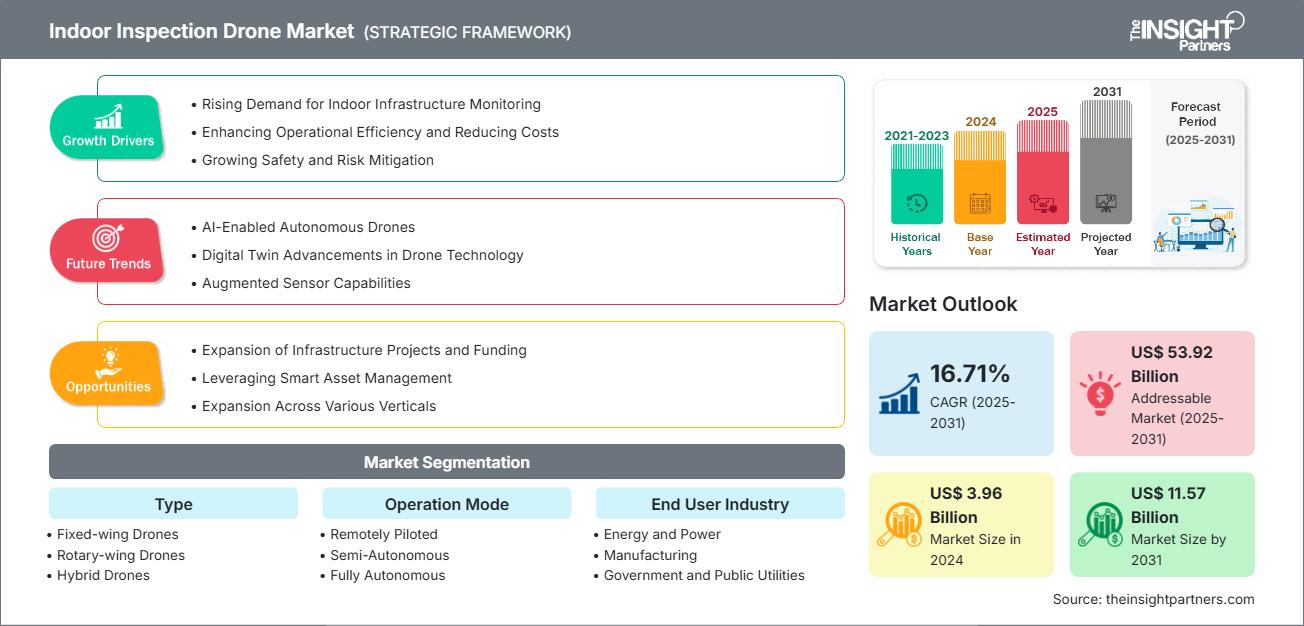
The indoor inspection drone market size is expected to reach US$11.57 billion by 2031 from US$3.96 billion in 2024. The market is anticipated to register a CAGR of 16.71% during 2025–2031.
Indoor Inspection Drone Market Analysis
Indoor inspection drones refer to a group of purpose-built aerial vehicles that can maneuver without harm in tightly-spaced or GPS-denied areas and are capable of visually and sensorily inspecting the indoor components of such assets as tanks, boilers, tunnels, warehouses, and production lines while employing the least human intervention The drones save lives and speed up the whole process by eliminating the need for scaffolding, rope access, and shutdowns.
Indoor Inspection Drone Market Overview
A droned used for indoor inspection is a flying robot designed to be stable and capable of handling a collision in a confined space where no GPS signal is available, and such places could be industrial plants, storage tanks, culverts, and big warehouses. Either of drones, i. e. outdoor or recreational drones, the indoor platforms put the obstacle avoidance, protective cages, accurate positioning (mostly through LiDAR or optical flow), and communication links as their main features in steel-dense, cluttered spaces.
Market Research Highlights
- North America dominated the market with 41.2% share in 2024.
- Asia Pacific is poised to grow at a CAGR of 17.1% over the forecast period.
- US market is projected to grow at a CAGR of 16.8% over the forecast period.
- By Type, the Rotary-wing Drones segment accounted for the largest market share of 61.1% in 2024.
- By Operation Mode, the Fully Autonomous segment is anticipated to witness the fastest growth, registering a CAGR of 16.9% over the forecast period
- By End User Industry, the Manufacturing segment accounted for the largest market share of 31.7% in 2024.
- The report profiles key industry players such as Terra Drone Corp., Drone Volt SA, Teledyne FLIR LLC, ScoutDI AS, Flybotix SA, Voliro AG, Skydio, Inc., Delair SAS, while also analyzing key developments in novel ideas, disruptive products, and innovative services that could reshape the future market and reveal emerging themes across the industry.
Source: The Insight Partners' analysis based on proprietary research, government publications, company annual reports, investor presentations, industry databases, and expert interviews.
● REPORT CUSTOMIZATION
Tailor This Report To Align With Your Specific Business Requirements
This report can be customized to align precisely with your business objectives, scope, and target markets. Customization options include tailored segmentation, geography, competitive analysis, and strategic insights to support informed decision-making.
Customize This Report →WHAT YOU CAN ADJUST
- ● Segmentations
- ● Geography
- ● Competitive Analysis
- ● Language Preferences
Indoor Inspection Drone Market: Strategic Insights
-
Get Top Key Market Trends of this report.This FREE sample will include data analysis, ranging from market trends to estimates and forecasts.
Indoor Inspection Drone Market Drivers and Opportunities
Market Drivers:
- Growth in confined-space and indoor asset inspection: Process industries, power generation, and heavy manufacturing are turning to internal inspections of tanks, silos, chimneys, boilers, and pressure vessels as a means of both meeting regulatory and reliability standards. Doing so with indoor drone technology, they perform these inspections by eliminating the need for manned entry, scaffolding, and prolonged shutdowns; thus, the time turnaround is reduced while inspection coverage is at least the same level, if not improved.
- Strong safety and compliance requirements: Confined spaces are mostly dangerous due to the presence of toxic gases, low oxygen levels, the possibility of falling, and structural instability, and many local regulations are becoming more stringent when it comes to entering such places and working at heights. As a result, replacing humans with drones can decrease the exposure to such risks, therefore, being helpful to asset owners to meet health and safety regulations as well as corporate ESG goals, and at the same time, facilitate the keeping of detailed inspection records.
- Advancements in indoor navigation and sensing: Progress in technology that has a major part played by features such as collision-tolerant frames, optical flow, LiDAR-based SLAM, and onboard lighting has opened up the route for flights to dark, dusty, GPS-denied, and generally inhospitable spaces while still maintaining good stability and autonomy. At the same time, improved camera, thermal sensor, and 3D mapping technology can produce more detailed inspection data that can be later uploaded to digital twins and asset-management platforms for further use.
Market Opportunities:
- Integration of AI and analytics for defect detection: Use of AI and machine learning on image, thermal, and point-cloud data leads to the automatic detection of faults in the form of cracks, corrosion, deposits, insulation damage, and so on in the indoor environment. Thus, vendors and service providers are expected to provide AI-powered analytics platforms that could turn raw drone data into easily understandable insights, as well as give predictive maintenance recommendations for process and manufacturing plants.
- Expansion in manufacturing, warehousing, and logistics: Indoor inspection drones are widely accepted as the most effective tools for the completion of the tasks of inventory monitoring, structural checks, and quality control in warehouses and manufacturing facilities.
- Adoption in oil & gas, power, and infrastructure interiors: The use of confined-space drones fans out gradually to the inspection of flare stacks, chimneys, boilers, heat recovery-steam generators, and storage tanks at oil-and-gas power plants. The same goes for transport infrastructures, where indoor drones may inspect tunnels, ventilation shafts, and enclosed sections of bridges and stations without giving away their presence to other operatives or halting the ongoing work.
Indoor Inspection Drone Market Report Segmentation Analysis
The indoor inspection drone market is segmented into:
By Type:
- Fixed-wing Drones: Fixed-wing drones hold a significant position in the inspection drones market due to their extended flight times, larger coverage areas, and higher energy efficiency compared to multi-rotor drones.
- Rotary-wing Drones: The rotary-wing drone segment holds a significant share in the inspection drones market, driven by its ability to hover, maneuver in tight spaces, and take off/land vertically.
- Hybrid Drones: Hybrid drones represent a rapidly growing segment in the inspection drones market due to their ability to combine the advantages of fixed-wing and rotary-wing designs.
By Operation Mode:
- Remotely Piloted
- Semi-Autonomous
- Fully Autonomous
By End User Industry:
- Energy and Power
- Manufacturing
- Government and Public Utilities
- Agriculture &Real Estate
- Oil and Gas
- Transportation
- Military &Defense
- Others
By Geography:
- North America
- Europe
- Asia Pacific
- South & Central America
- Middle East & Africa
Indoor Inspection Drone Market Report Scope
| Report Attribute | Details |
|---|---|
| Market size in 2024 | US$ 3.96 Billion |
| Market Size by 2031 | US$ 11.57 Billion |
| Global CAGR (2025 - 2031) | 16.71% |
| Historical Data | 2021-2023 |
| Forecast period | 2025-2031 |
| Segments Covered |
By Type
|
| Regions and Countries Covered |
North America
|
| Market leaders and key company profiles |
|
Indoor Inspection Drone Market Players Density: Understanding Its Impact on Business Dynamics
The Indoor Inspection Drone Market is growing rapidly, driven by increasing end-user demand due to factors such as evolving consumer preferences, technological advancements, and greater awareness of the product's benefits. As demand rises, businesses are expanding their offerings, innovating to meet consumer needs, and capitalizing on emerging trends, which further fuels market growth.
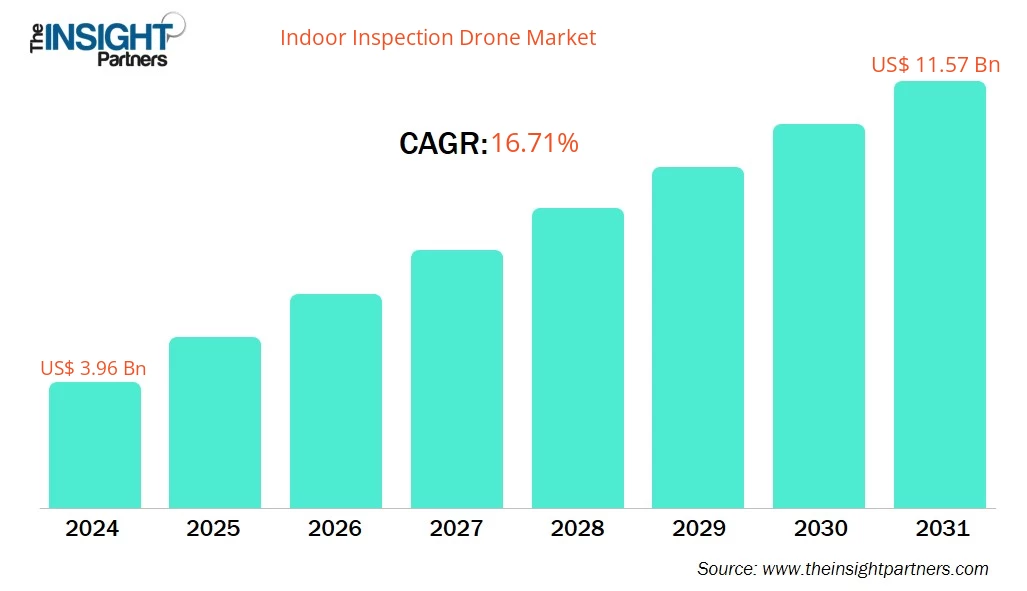
Indoor Inspection Drone Market Share Analysis by Geography
The indoor inspection drone market in Asia Pacific is witnessing the fastest growth due to rapid industrialization, infrastructure development, supportive government policies, rising investments, and increasing adoption across energy, agriculture and construction sectors. Emerging markets in South America, the Middle East & Africa have untapped opportunities for inspection drone providers to expand.
Below is a summary of market share and trends by region:
1. North America
- Market Share: Large share of the global indoor inspection drone market
- Key Drivers:
- Extensive adoption of state-of-the-art technology in infrastructure monitoring :The early use of technologically advanced indoor inspection drones for industrial inspections, supported by strong research and development and venture capital, is driving the market growth.
- Increasing application in the energy, manufacturing, and utilities sectors
- The Federal Aviation Administration (FAA) regulations are favorable for commercial indoor drone operations..
- Trends: The use of AI and ML for automated defect detection and predictive maintenance indoors.
2. Europe
- Market Share: Considerable, influenced by the presence of strict safety and inspection regulations
- Key Drivers:
- Regulatory rigor on infrastructure safety:The EU is imposing stringent regulations for safety in confined spaces, which in turn is fueling the demand for indoor inspection drones.
- Growing energy projects require frequent inspections.
- Dominant presence of drone startups and manufacturing.
- Trends: The growth of Beyond Visual Line of Sight (BVLOS) indoor drone operations
3. Asia Pacific
- Market Share: Leading region with the highest growth
- Key Drivers:
- Accelerating urbanization and infrastructure growth
- Urbanization and industrialization are happening rapidly, which drives the demand for indoor facility inspections..
- Government encouragement of smart city measures
- Growing telecom and power grid networks.
- Trends: Drone-as-a-service (DaaS) models for urban inspections surge.
4. Middle East and Africa
- Market Share: Although small, it is growing quickly
- Key Drivers:
- Increased investments in massive-scale infrastructure projects:The Middle East's oil and gas sector utilizes drones to survey pipelines and facilities under harsh conditions, improving safety and operation efficiency, and lessening manual labor and downtime
- Requirement of surveillance and examination in extreme environments
- Increased applications of indoor inspection drones in oil-producing nations
- Trends: Autonomous drone use for desert infrastructure and utility inspections.
5. South & Central America
- Market Share-Growing market with steady progress
- Key Drivers:
- Remote monitoring requirements in the oil & gas and mining industries: In far-flung regions with low accessibility, drones facilitate inexpensive surveillance of oil rigs and mining operations, minimizing the necessity for perilous physical examinations in the rugged landscapes of South America.
- Growth in industrial automation investment
- Lack of conventional infrastructure is impelling the use of drones.
- Trends: Increasing adoption of thermal drone imaging for environment and industrial inspections.
Indoor Inspection Drone Market Players Density: Understanding Its Impact on Business Dynamics
High Market Density and Competition
Competition is intense due to the presence of major global players such as Terra Drone Corp.; Flybotix SA; Voliro AG; Skydio, Inc.; Teledyne FLIR LLC; Delair SAS; Drone Volt SA; and ScoutDI AS
This high level of competition urges companies to stand out by offering:
- Innovative and reliable solutions
- Advanced Sensor Integration
- Autonomous and GPS-Free Navigation
- Durability and Specialized Design
- Industry-Specific Customization
Opportunities and Strategic Moves
- AI & Data Analytics Integration: AI-powered analytics, BVLOS operations, and drone-as-a-service models. Strategic moves include partnerships with infrastructure firms, regional expansions, and investing in regulatory compliance and autonomous inspection capabilities.
Other companies analyzed during the course of research:
- DJI
- Parrot
- Yuneec
- Skydio
- senseFly
- Delair
- Airobotics
- DroneDeploy
- PrecisionHawk
- Kespry
- Flyability
- Azur Drones
- Percepto
- Cyberhawk
- Terra Drone Corporation
Indoor Inspection Drone Market News and Recent Developments
- MODEC, Inc. announced that it has renewed its joint research and development agreement with Terra Drone Corporation, June 2025- MODEC, Inc. (MODEC) announced the renewal of its joint research and development agreement with Terra Drone Corporation (Terra Drone) for the non-destructive internal inspection of crude oil storage tanks on Floating Production, Storage, and Offloading systems (FPSOs) using Terra UT drones. This renewed agreement builds upon the joint research and development contract signed by both companies in 2024, following significant achievements in improving measurement accuracy, enhancing safety, and reducing inspection time.
- Flyability announced the launch of a new high-capacity battery for its Elios 3 drone, June 2025 - Flyability, a Swiss-based drone manufacturer specializing in indoor inspection technology, announced the launch of a new high-capacity battery for its Elios 3 drone. This upgraded battery delivers up to 50% additional flight time per charge, enabling extended inspection missions with reduced downtime and increased operational efficiency.
Indoor Inspection Drone Market Report Coverage and Deliverables
The "Indoor inspection drone market Size and Forecast (2021–2031)" report provides a detailed analysis of the market covering below areas:
- Indoor inspection drone market for Healthcare size and forecast at global, regional, and country levels for all the key market segments covered under the scope
- Indoor inspection drone market for Healthcare trends, as well as market dynamics such as drivers, restraints, and key opportunities
- Detailed PEST and SWOT analysis
- Indoor inspection drone market for Healthcare analysis covering key market trends, global and regional framework, major players, regulations, and recent market developments
- Industry landscape and competition analysis covering market concentration, heat map analysis, prominent players, and recent developments for the indoor inspection drone market
- Detailed company profiles
Frequently Asked Questions
1. Regulatory Restrictions: Complex and varying drone regulations across regions limit widespread commercial adoption and BVLOS operations.
2. Technical Limitations: Battery life and payload capacity constraints restrict flight time and sensor integration for comprehensive inspections.
1. Enhanced Data Analysis: AI and ML enable drones to quickly process large volumes of inspection data, improving accuracy and detecting anomalies automatically.
2. Autonomous Flight and Decision-Making: These technologies allow drones to navigate complex environments and make real-time inspection decisions without human intervention.`
1. AI and machine learning integration for sophisticated data analysis
2. Scaling of BVLOS operations
3. Increased use of drone-as-a-service (DaaS) business models
4. Application of thermal and multispectral imagery for intensified inspections
5. Autonomous and swarm drone technologies in development
6. Greater emphasis on cloud-based analytics and real-time data streaming
2. Cost-Efficiency and Increased Efficiency : Indoor inspection drones cut costs by reducing labor, scaffolding, and shutdown times, while accelerating inspections and improving data accuracy, increasing operational efficiency in confined-space asset management.

- Comprehensive Market Sizing and Forecast Analysis
- Detailed Segmentation Analysis
- In-Depth Market Dynamics Assessment
- Regional and Country-Level Insights
- Competitive Landscape and Company Benchmarking
- Strategic Business Intelligence
Recent Reports
Testimonials

The Insight Partners provided valuable market intelligence that supported our global go-to-market strategy. Their team was professional, responsive, and attentive to our feedback, providing thoughtful analysis and helpful methodological clarifications throughout the project.
Junmo Kim Chief Financial Officer (CFO), Enertech Co., Ltd.
The Insight Partners' SCADA System Market report is comprehensive, with valuable insights on current trends and future forecasts. The team was highly professional, responsive, and supportive throughout. We are very satisfied and highly recommend their services.
RAN KEDEM Partner, Reali Technologies LTDs
I requested a report on a very specific software market and the team produced the report in a few days. The information was very relevant and well presented. I then requested some changes and additions to the report. The team was again very responsive and I got the final report in less than a week.
JEAN-HERVE JENN Chairman, Future Analytica
We worked with The Insight Partners for an important market study and forecast. They gave us clear insights into opportunities and risks, which helped shape our plans. Their research was easy to use and based on solid data. It helped us make smart, confident decisions. We highly recommend them.
PIYUSH NAGPAL Sr. Vice President, High Beam Global
The Insight Partners delivered insightful, well-structured market research with strong domain expertise. Their team was professional and responsive throughout. The user-friendly website made accessing industry reports seamless. We highly recommend them for reliable, high-quality research services
YUKIHIKO ADACHI CEO, Deep Blue, LLC.
This is the first time I have purchased a market report from The Insight Partners.While I was unsure at first, I visited their web site and felt more comfortable to take the risk and purchase a market report.I am completely satisfied with the quality of the report and customer service. I had several questions and comments with the initial report, but after a couple of dialogs over email with their analyst I believe I have a report that I can use as input to our strategic planning process.Thank you so much for taking the extra time and making this a positive experience.I will definitely recommend your service to others and you will be my first call when we need further market data.
JOHN SUZUKI President and Chief Executive Officer, Board Director, BK Technologies
I wish to appreciate your support and the professionalism you displayed in the course of attending to my request for information regarding to infectious disease IVD market in Nigeria. I appreciate your patience, your guidance, and the fact that you were willing to offer a discount, which eventually made it possible for us to close a deal. I look forward to engaging The Insight Partners in the future, all thanks to the impression you have created in me as a result of this first encounter.
DR CHIJIOKE ONYIA MANAGING DIRECTOR, PineCrest Healthcare Ltd.Reason to Buy
- Informed Decision-Making
- Understanding Market Dynamics
- Competitive Analysis
- Identifying Emerging Markets
- Customer Insights
- Market Forecasts
- Risk Mitigation
- Boosting Operational Efficiency
- Strategic Planning
- Investment Justification
- Tracking Industry Innovations
- Aligning with Regulatory Trends




 Get Free Sample for