
Hospitality Workforce management Market Size, Trends & Growth by 2034
Coverage: By Component (Solution, Service); Deployment Type (On-Premises, Cloud); Organization Size (Large Enterprises, Small and Medium-sized Enterprises); Vertical (BFSI, Telecom, Government, Consumer Goods and Retail, Manufacturing, Energy and Utilities, Transportation and Logistics, Healthcare and Life Sciences, Information Technology enabled Services (ITeS), Others) , and Geography (North America, Europe, Asia Pacific, and South and Central America)
- Status : Data Released
- Report Code : TIPRE00020447
- Category : Technology, Media and Telecommunications
- No. of Pages : 150
- Available Report Formats :


- Last update date : September 30, 2026


2025 Market Size
US$ 5.75 Bn
Base year value
2034 Forecast
US$ 12.67 Bn
Projected by 2034
CAGR 2026-2034
9.18 %
Growth rate
Addressable Market
US$ 82.36 Bn
(2026-2034)
The hospitality workforce management market is projected to grow from US$ 5.75 Billion in 2025 to US$ 12.67 Billion by 2034, registering a CAGR of 9.18% during 2026–2034. Increasing labor optimization initiatives, rising adoption of cloud-based workforce solutions, and the growing need for real-time scheduling and compliance management are supporting market expansion. Hospitality businesses are increasingly investing in intelligent workforce platforms to improve employee productivity, control operational costs, and enhance guest service quality across diverse property formats.
Across North America, enterprises continue to accelerate investments in digital workforce technologies as hospitality operators address labor shortages, seasonal staffing fluctuations, and evolving employee expectations. The hospitality workforce management market size in the region is supported by widespread cloud adoption, strong software spending, and stringent labor compliance requirements. The regional market is anticipated to register a CAGR in the range of 8.5%–9.3% during the forecast period, supported by the continuous modernization of workforce operations.
Hospitality Workforce management Market Assessment and Insights
- North America: North America remained the leading regional market in 2025 with a share of 34–38% and is projected to expand at a CAGR of 8.5%–9.3% during 2026–2034, driven by advanced hospitality infrastructure, rapid cloud deployment, and increasing investment in workforce automation technologies.
- US: The US accounted for 79–83% of the North American market in 2025 and is expected to record a CAGR of 8.7%–9.5% through 2034, supported by large hotel chains, digital HR transformation, and strong enterprise software adoption.
- Europe: Europe represented 26–30% of the global market in 2025 and is forecast to grow at a CAGR of 8.8%–9.6% during 2026–2034. Germany, the UK, France, Italy, and Spain continue to lead regional demand through hospitality digitization and labor compliance initiatives.
- Asia Pacific: Asia Pacific held 24–28% market share in 2025 and is anticipated to register the fastest regional expansion at a CAGR of 10.1%–10.9% between 2026 and 2034. China, Japan, India, South Korea, and Australia are witnessing strong investments in hospitality technology and workforce optimization.
- Largest Segment: Solution accounted for 68–72% market share in 2025 and is projected to expand at a CAGR of 9.0%–9.8% through 2034, supported by increasing adoption of workforce scheduling, attendance management, and analytics platforms.
- High Growth Segment: Cloud deployment represented 44–48% market share in 2025 and is expected to record the highest CAGR of 10.2%–11.0% during 2026–2034, driven by scalability, lower implementation costs, remote accessibility, and continuous software innovation.
- Key companies analyzed in detail: Oracle Corporation, UKG Inc. (formerly Kronos Incorporated), ADP, Inc., SAP SE, Softworks Ltd., Ceridian HCM Holding Inc. (Dayforce, Inc.), Reflexis Systems, Inc. (Zebra Technologies Corporation), ATOSS Software SE, Infor Inc., Mitrefinch Ltd.
Source: The Insight Partners' analysis based on proprietary research, government publications, company annual reports, investor presentations, industry databases, and expert interviews.
Solutions for managing the hospitality workforce have shifted from simple scheduling solutions towards cloud-based solutions that offer an array of functions such as artificial intelligence, analytics, labor compliance, payroll integration, and employee self-service. Workforce management solutions continue to gain acceptance as hotels, resorts, restaurants, and entertainment venues seek to optimize labor efficiency without compromising their services. The availability of mobility, attendance, forecast, and automated shift planning are some of the capabilities offered by workforce solutions.
In terms of future growth opportunities, there is anticipation of high investment in workforce technologies as digital transformation efforts intensify in developing hospitality market segments. Resilience through the deployment of cloud solutions, the use of AI-driven workforce planning solutions, and integration with human capital management solutions will increase. Increased regulatory compliance needs, labor costs, and demand for flexible workforce models will drive innovation and adoption of modern workforce solutions.
Hospitality Workforce management Market Report Scope
| Report Attribute | Details |
|---|---|
| Market size in 2025 | US$ 5.75 Billion |
| Market Size by 2034 | US$ 12.67 Billion |
| Global CAGR (2026 - 2034) | 9.18% |
| Historical Data | 2021-2024 |
| Forecast period | 2026-2034 |
Hospitality Workforce management Market Analysis
The hospitality workforce management market growth is primarily driven by increasing labor shortages, higher employee turnover, and rising expectations for personalized guest experiences. The use of workforce management tools for intelligent scheduling, automated time and attendance management, labor forecasting and regulatory compliance is becoming common among hospitality companies. The ecosystem consists of software providers, cloud service providers, implementation partners, payroll solutions providers and technology integration partners within the hospitality sector.
Innovation on the supply side is becoming faster due to the adoption of cloud native computing, artificial intelligence, machine learning and mobile-based workforce management solutions. The vendors have been incorporating workforce analytics with payroll, recruitment, performance management, and ERP systems. This helps in gaining better insights about the workforce as well as making decisions. Subscription-based deployment options are becoming more available, thus making workforce management solutions available to medium-sized hospitality companies.
Competitive intensity within the hospitality workforce management market analysis is increasing as established enterprise software providers compete with specialized workforce technology companies through continuous product innovation, cloud migration strategies, and strategic acquisitions. Oracle Corporation, UKG Inc., SAP SE, Dayforce, Inc., Infor Inc., and ADP, Inc. are working hard to increase their market position through the expansion of artificial-intelligence-driven scheduling, analytics, and employee experience solutions. Providers specializing in specific industries, such as Softworks Ltd., ATOSS Software SE, and Mitrefinch Ltd., are working to enhance functionalities that make them unique.
Funding continues to be directed at artificial intelligence, predictive workforce planning, mobile workforce solutions, and cloud-based human capital management ecosystems. Companies operating in hospitality pay more attention to vendors that can offer scalable solutions that work well with the property management system, payroll solutions, CRM software, and financial management solutions. The above-listed strategy is expected to boost efficiency and help in digital transformation.n initiatives across the global hospitality industry.
● REPORT CUSTOMIZATION
Tailor This Report To Align With Your Specific Business Requirements
This report can be customized to align precisely with your business objectives, scope, and target markets. Customization options include tailored segmentation, geography, competitive analysis, and strategic insights to support informed decision-making.
Customize This Report →WHAT YOU CAN ADJUST
- ● Segmentations
- ● Geography
- ● Competitive Analysis
- ● Language Preferences
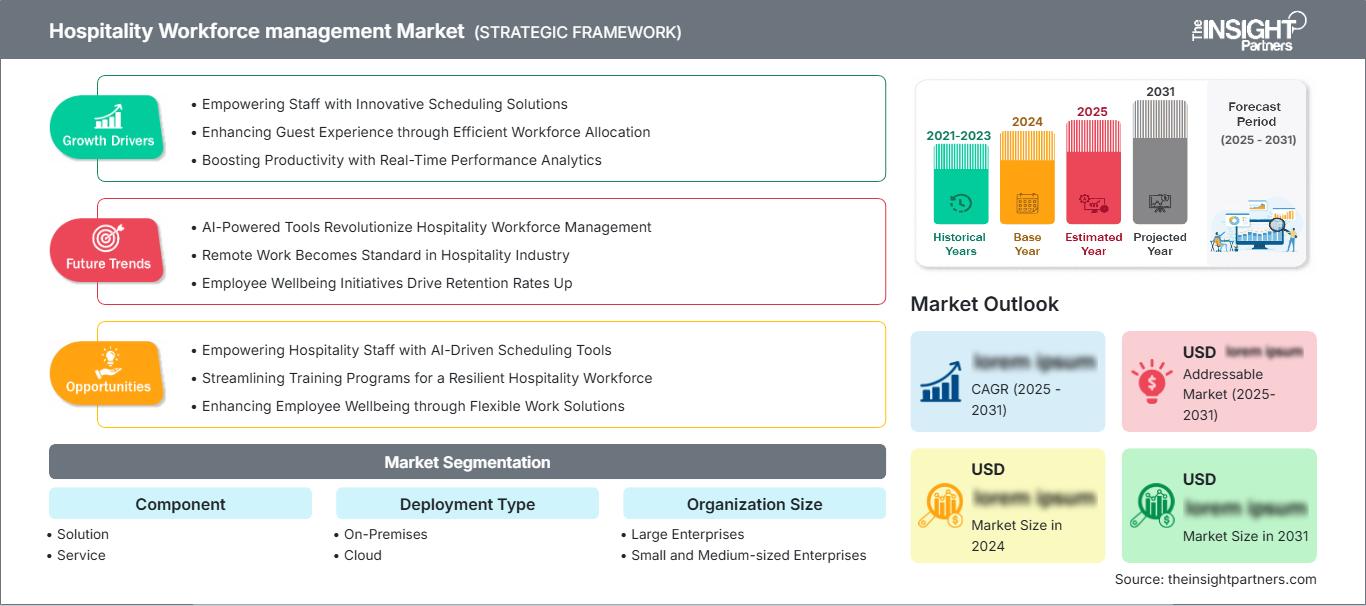
Hospitality Workforce management Market: Strategic Insights
Regional Insights
North America Hospitality Workforce Management Market
North America accounted for 34–38% of the hospitality workforce management market share in 2025 and is expected to expand at a CAGR of 8.5%–9.3% during 2026–2034. The area enjoys well-established facilities in the hospitality industry, significant cloud-based enterprise software adoption, and strict labor compliance requirements. Hotel companies, restaurants, casinos, and resort companies continue to invest in intelligent scheduling systems and workforce analysis and employee management systems to enhance productivity, taking into account the labor shortage problem and fluctuating guests’ demand.
The USA and Canada represent the main regions contributing to the development of the area, thanks to constant investments in digital transformation and modernization of the workforce. Workforce management applications are integrated more frequently with other systems such as payroll applications, property management systems, and human capital management systems to increase the efficiency of operations.
U.S. Hospitality Workforce Management Market
The U.S. represented 79–83% of the North American Hospitality Workforce Management Market in 2025 and is projected to register a CAGR of 8.7%–9.5% through 2034. The country's hospitality industry continues to embrace cloud-native workforce management solutions to optimize staffing, improve compliance with federal and state labor regulations, and reduce administrative overhead. Large hotel groups and restaurant chains increasingly deploy AI-powered scheduling and workforce analytics to enhance operational performance.
The presence of major technology providers, including Oracle Corporation, UKG Inc., ADP, Inc., Dayforce, Inc., and Infor Inc., supports continuous innovation in workforce management software. Growing adoption of mobile workforce applications, self-service employee portals, and predictive scheduling capabilities is improving workforce flexibility. Strong enterprise software investments and increasing focus on employee retention are expected to reinforce the country's leadership in the regional market.
Europe Hospitality Workforce Management Market
Europe held 26–30% of the global Hospitality Workforce Management Market in 2025 and is anticipated to grow at a CAGR of 8.8%–9.6% during the forecast period. Germany remains the leading regional market owing to widespread enterprise software adoption and strong labor compliance frameworks across hospitality businesses. The United Kingdom continues to experience steady demand as hotels, restaurants, and leisure operators invest in workforce automation to improve employee productivity and customer service quality.
France, Italy, and Spain collectively represent significant growth opportunities due to expanding tourism activity and increasing digitalization within the hospitality sector. Hospitality operators across these countries are adopting cloud-based workforce management platforms to improve scheduling efficiency, workforce visibility, and regulatory compliance. Continued investment in workforce analytics and employee engagement technologies is expected to strengthen regional market performance over the coming years.
APAC Hospitality Workforce Management Market
Asia Pacific accounted for 24–28% of the global Hospitality Workforce Management Market in 2025 and is projected to register the highest regional CAGR of 10.1%–10.9% through 2034. China leads the regional market, followed by Japan, India, South Korea, and Australia, supported by expanding hospitality infrastructure and increasing adoption of cloud technologies.
Rapid tourism growth, rising hotel construction, government support for digital transformation, and increasing labor optimization initiatives are encouraging hospitality organizations to invest in workforce management platforms. Growing demand from international hotel chains and regional hospitality groups continues to strengthen market prospects across the Asia Pacific.
Middle East & Africa Hospitality Workforce Management Market
The Middle East & Africa Hospitality Workforce Management Market is forecast to expand at a CAGR of 9.2%–10.0% during 2026–2034. Saudi Arabia and the United Arab Emirates continue to lead regional adoption as large-scale tourism projects, luxury hospitality developments, and smart city initiatives increase demand for advanced workforce management technologies.
South Africa and the Rest of MEA are gradually adopting cloud-based workforce platforms to improve labor productivity and operational efficiency. Investments in hospitality infrastructure, digital transformation strategies, and workforce optimization solutions are expected to support sustained regional market growth throughout the forecast period.
Segmentation Analysis
Component
The component segment is projected to expand at a CAGR of 9.1%–9.8% during 2026–2034. The hospitality workforce management market scope continues to broaden as organizations increasingly invest in integrated workforce platforms and professional implementation services. Growing demand for automation, compliance management, workforce analytics, and cloud-based operational efficiency is encouraging hospitality enterprises to deploy comprehensive workforce management ecosystems that support both operational excellence and long-term digital transformation.
- Solution – Workforce management software enables employee scheduling, attendance monitoring, labor forecasting, payroll integration, workforce analytics, and compliance management, making it the dominant revenue contributor among hospitality organizations seeking operational efficiency.
- Service – Professional services, including consulting, implementation, integration, training, and managed support, help organizations maximize workforce management platform performance while ensuring smooth deployment and long-term system optimization.
Deployment Type
The deployment type segment is anticipated to register a CAGR of 9.3%–10.0% between 2026 and 2034. Cloud adoption continues to accelerate as hospitality operators prioritize scalability, remote accessibility, automatic software updates, and lower infrastructure costs. However, on-premises deployments remain relevant among organizations requiring greater control over sensitive workforce and payroll information.
- On-Premises – On-premises deployments remain preferred by organizations with strict data governance requirements, legacy IT infrastructure, or internal compliance policies requiring greater control over workforce information and application environments.
- Cloud – Cloud-based deployments support flexible workforce operations through subscription pricing, mobile accessibility, rapid implementation, and seamless integration with payroll, human capital management, and property management systems.
Organization Size
The organization size segment is expected to grow at a CAGR of 9.0%–9.7% throughout the forecast period. Large hospitality enterprises continue to account for substantial software investments due to complex workforce structures, while small and medium-sized enterprises increasingly adopt cloud-based workforce platforms that reduce implementation costs and simplify employee management.
- Large Enterprises – Large hospitality organizations deploy enterprise-grade workforce management platforms to optimize staffing across multiple locations, improve labor compliance, and centralize workforce analytics for strategic operational planning.
- Small and Medium-sized Enterprises – SMEs increasingly adopt cloud-native workforce management solutions that provide affordable scheduling, attendance management, payroll integration, and employee self-service capabilities without requiring extensive IT resources.
Vertical
The vertical segment is forecast to record a CAGR of 9.2%–9.9% during 2026–2034 as workforce management platforms become increasingly adaptable across multiple industries. Vendors continue enhancing industry-specific functionality, compliance capabilities, and workforce analytics to address unique operational requirements while supporting digital workforce transformation initiatives.
- BFSI – Financial institutions utilize workforce management solutions to optimize staffing, strengthen compliance monitoring, improve workforce productivity, and enhance employee scheduling across customer service and operational functions.
- Telecom – Telecommunications companies deploy workforce management platforms to coordinate distributed field employees, customer support teams, shift planning, and workforce performance monitoring across geographically dispersed operations.
- Government – Government organizations adopt workforce management technologies to improve employee scheduling, attendance tracking, labor reporting, and workforce transparency while supporting regulatory compliance and operational accountability.
- Consumer Goods and Retail – Retail businesses leverage workforce management software to optimize store staffing, manage seasonal labor demand, improve workforce utilization, and enhance customer service during fluctuating sales cycles.
- Manufacturing – Manufacturing enterprises integrate workforce management platforms with production planning systems to improve shift allocation, monitor attendance, reduce overtime costs, and support labor compliance across production facilities.
- Energy and Utilities – Energy and utility providers use workforce management solutions to schedule field technicians, manage workforce availability, optimize maintenance operations, and ensure compliance with workforce safety regulations.
- Transportation and Logistics – Transportation and logistics organizations implement workforce management software to coordinate driver scheduling, warehouse staffing, workforce tracking, and labor optimization across complex supply chain operations.
- Healthcare and Life Sciences – Healthcare organizations deploy workforce management platforms to improve clinical staff scheduling, regulatory compliance, workforce forecasting, and employee availability while maintaining high-quality patient care standards.
- Information Technology enabled Services – IT-enabled service providers adopt workforce management solutions to manage distributed workforces, optimize project staffing, improve employee productivity, and support hybrid work environments through centralized workforce visibility.
Opportunity Snapshot
| Vertical | Revenue Contribution | Trend Tag | Adoption Stage |
| BFSI | Medium | Compliance Automation | Mature |
| Telecom | Medium | Mobile Workforce | Scaling |
| Government | Medium | Digital Governance | Scaling |
| Consumer Goods and Retail | High | Smart Scheduling | Mature |
| Manufacturing | Medium | Shift Optimization | Mature |
| Energy and Utilities | Medium | Field Mobility | Scaling |
| Transportation and Logistics | High | Workforce Visibility | Scaling |
| Healthcare and Life Sciences | High | Clinical Staffing | Emerging |
| Information Technology enabled Services | High | Hybrid Workforce | Mature |
Hospitality Workforce management Market Growth Drivers and Impact Analysis
Growing Digital Transformation Across the Global Hospitality Industry
Hospitality organizations are accelerating investments in digital technologies to improve workforce efficiency, reduce operating costs, and deliver consistent guest experiences across multiple properties. Hotels, restaurants, resorts, and entertainment venues increasingly deploy cloud-based workforce management platforms that automate employee scheduling, attendance monitoring, payroll integration, and labor forecasting. Artificial intelligence and analytics further enable managers to optimize staffing levels according to occupancy trends and seasonal demand. As hospitality businesses continue modernizing legacy workforce processes, demand for integrated workforce management solutions is expected to rise steadily, strengthening operational resilience while improving employee productivity, compliance management, and overall business performance throughout the forecast period.
Increasing Focus on Labor Compliance and Workforce Optimization
Evolving labor regulations, rising wage pressures, and persistent workforce shortages are encouraging hospitality operators to adopt advanced workforce management solutions. Organizations require automated systems that accurately monitor employee hours, overtime, leave management, and regulatory compliance while minimizing administrative complexity. Intelligent scheduling capabilities help managers allocate labor resources efficiently without compromising service quality. Workforce analytics also provide actionable insights into productivity, absenteeism, and staffing requirements, enabling data-driven decision-making. As compliance requirements become more stringent across developed and emerging markets, investment in comprehensive workforce management platforms is expected to increase significantly across the hospitality industry.
Expansion of Cloud-Based Human Capital Management Ecosystems
The rapid adoption of cloud computing has transformed workforce management by enabling scalable, subscription-based platforms that integrate seamlessly with payroll, human capital management, property management, and financial systems. Hospitality enterprises benefit from centralized workforce visibility, remote accessibility, faster software deployment, and lower infrastructure costs compared with traditional on-premises solutions. Cloud-native architectures also support continuous software updates, advanced cybersecurity, and mobile workforce applications that improve employee engagement. As organizations increasingly prioritize flexible and integrated digital ecosystems, cloud-based workforce management solutions will remain a major catalyst for long-term market expansion across global hospitality operations.
Hospitality Workforce management Market Future Trends
Artificial Intelligence Transforming Workforce Planning and Scheduling
Artificial intelligence is becoming a core capability within workforce management platforms as hospitality organizations seek greater operational precision. The hospitality workforce management market trends indicate increasing adoption of AI-powered scheduling, predictive labor forecasting, and intelligent workforce analytics that automatically align staffing with occupancy rates, reservations, seasonal demand, and guest preferences. Machine learning algorithms continuously improve scheduling accuracy by evaluating historical labor patterns and employee availability. These technologies also enhance compliance monitoring, reduce overtime expenses, and support better workforce engagement through personalized shift recommendations. As AI capabilities mature, vendors are expected to embed more autonomous workforce planning features into enterprise hospitality solutions.
Growing Adoption of Mobile-First Workforce Management Platforms
Mobile workforce management is emerging as a strategic priority for hospitality organizations operating distributed and shift-based workforces. Employees increasingly expect access to schedules, attendance records, leave requests, shift swaps, payroll information, and internal communication through smartphones. Mobile applications improve workforce flexibility while reducing administrative workloads for managers. Cloud-native platforms are expanding self-service capabilities that strengthen employee engagement and accelerate operational decision-making. Integration with biometric authentication, digital approvals, real-time notifications, and collaboration tools is expected to become standard functionality, supporting more responsive workforce operations and improving productivity across hotels, restaurants, resorts, and other hospitality establishments.
Hospitality Workforce management Market Opportunities
Expansion Opportunities Across Emerging Hospitality Markets
Emerging economies across Asia Pacific, the Middle East, Latin America, and parts of Africa are witnessing significant investments in hotels, resorts, quick-service restaurants, and tourism infrastructure. Hospitality workforce management market Forecasts indicate that expanding hospitality capacity will increase demand for scalable workforce management platforms capable of supporting multilingual operations, mobile employees, and region-specific labor compliance. Technology providers can strengthen their market presence by offering cloud-native, subscription-based solutions tailored to local operational requirements and regulatory environments. Strategic partnerships with hospitality groups, regional system integrators, and property management software vendors can further accelerate market penetration while enabling organizations to modernize workforce operations without substantial upfront infrastructure investments.
Integration with AI-Driven Human Capital and Guest Experience Platforms
The convergence of workforce management with artificial intelligence, human capital management, and hospitality operations presents substantial long-term investment opportunities. Vendors that deliver unified platforms combining workforce scheduling, payroll, employee engagement, learning management, and operational analytics will gain competitive advantages as hospitality businesses pursue enterprise-wide digital transformation. Increasing demand for predictive staffing, automated compliance monitoring, and real-time workforce intelligence creates opportunities to develop industry-specific solutions with advanced analytics and seamless interoperability. Organizations capable of integrating workforce management with customer experience, revenue management, and property management systems will be well-positioned to capture future enterprise software investments across the global hospitality sector.
Frequently Asked Questions

- Comprehensive Market Sizing and Forecast Analysis
- Detailed Segmentation Analysis
- In-Depth Market Dynamics Assessment
- Regional and Country-Level Insights
- Competitive Landscape and Company Benchmarking
- Strategic Business Intelligence
Recent Reports
Testimonials

The Insight Partners provided valuable market intelligence that supported our global go-to-market strategy. Their team was professional, responsive, and attentive to our feedback, providing thoughtful analysis and helpful methodological clarifications throughout the project.
Junmo Kim Chief Financial Officer (CFO), Enertech Co., Ltd.
The Insight Partners' SCADA System Market report is comprehensive, with valuable insights on current trends and future forecasts. The team was highly professional, responsive, and supportive throughout. We are very satisfied and highly recommend their services.
RAN KEDEM Partner, Reali Technologies LTDs
I requested a report on a very specific software market and the team produced the report in a few days. The information was very relevant and well presented. I then requested some changes and additions to the report. The team was again very responsive and I got the final report in less than a week.
JEAN-HERVE JENN Chairman, Future Analytica
We worked with The Insight Partners for an important market study and forecast. They gave us clear insights into opportunities and risks, which helped shape our plans. Their research was easy to use and based on solid data. It helped us make smart, confident decisions. We highly recommend them.
PIYUSH NAGPAL Sr. Vice President, High Beam Global
The Insight Partners delivered insightful, well-structured market research with strong domain expertise. Their team was professional and responsive throughout. The user-friendly website made accessing industry reports seamless. We highly recommend them for reliable, high-quality research services
YUKIHIKO ADACHI CEO, Deep Blue, LLC.
This is the first time I have purchased a market report from The Insight Partners.While I was unsure at first, I visited their web site and felt more comfortable to take the risk and purchase a market report.I am completely satisfied with the quality of the report and customer service. I had several questions and comments with the initial report, but after a couple of dialogs over email with their analyst I believe I have a report that I can use as input to our strategic planning process.Thank you so much for taking the extra time and making this a positive experience.I will definitely recommend your service to others and you will be my first call when we need further market data.
JOHN SUZUKI President and Chief Executive Officer, Board Director, BK Technologies
I wish to appreciate your support and the professionalism you displayed in the course of attending to my request for information regarding to infectious disease IVD market in Nigeria. I appreciate your patience, your guidance, and the fact that you were willing to offer a discount, which eventually made it possible for us to close a deal. I look forward to engaging The Insight Partners in the future, all thanks to the impression you have created in me as a result of this first encounter.
DR CHIJIOKE ONYIA MANAGING DIRECTOR, PineCrest Healthcare Ltd.Reason to Buy
- Informed Decision-Making
- Understanding Market Dynamics
- Competitive Analysis
- Identifying Emerging Markets
- Customer Insights
- Market Forecasts
- Risk Mitigation
- Boosting Operational Efficiency
- Strategic Planning
- Investment Justification
- Tracking Industry Innovations
- Aligning with Regulatory Trends





 Get Free Sample for