
Employment Screening Services Market Size, Trends & Growth by 2034
Coverage: By Services (Background Screening, Verification and Medical and Drug Testing); Background Screening Type (Criminal Record, Credit Check, Social Media Screening, Motor Vehicle Record (MVR) Check, and Others); Verification (Employment History Verification, Education and Credential Verification, Identity Verification, Reference Checks, and Others); Application (IT and Telecom, BFSI, Government Agencies, Travel and Hospitality, Manufacturing, Retail, Healthcare, and Others); Organization Size (SMEs and Large Enterprises); and Geography (North America, Europe, Asia Pacific, Middle East and Africa, and South and Central America)
- Status : Published
- Report Code : TIPTE100000748
- Category : Technology, Media and Telecommunications
- No. of Pages : 360
- Available Report Formats :


- Last update date : October 08, 2026


2025 Market Size
US$ 6.74 Bn
Base year value
2034 Forecast
US$ 12.64 Bn
Projected by 2034
CAGR 2026-2034
7.2 %
Growth rate
Addressable Market
US$ 87.27 Bn
(2026-2034)
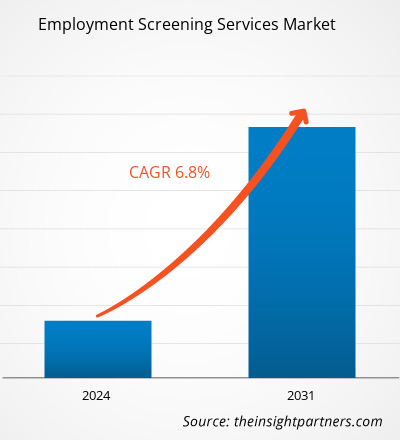
The Employment Screening Services Market was valued at US$ 6.74 Billion in 2025 and is expected to reach US$ 12.64 Billion by 2034; it is estimated to record a CAGR of 7.2% during 2026–2034. The market encompasses background screening, verification, and medical and drug testing services used by employers to manage workforce integrity, regulatory exposure, identity risk, and hiring decisions across diverse organizational and application environments.
North America remains a structurally important market, supported by established compliance practices, extensive employer adoption of digital hiring workflows, and demand for faster candidate verification. The region is expected to record a CAGR of 6.1% during 2026–2034, with technology-enabled screening, continuous monitoring, and identity verification strengthening service utilization across regulated and high-volume employment environments.
Employment Screening Services Market Assessment and Insights
- North America accounts for a 40.60% share in 2025 and is projected to grow at a CAGR of 6.1% during 2026–2034, supported by mature screening infrastructure and stringent workforce compliance requirements.
- US represents 76.42% of North America revenue in 2025 and is expected to expand at a CAGR of 6.3% during 2026–2034, led by automated screening and identity verification adoption.
- Europe holds a 28.01% share in 2025 and is forecast to register a CAGR of 7.8%, with the UK, Germany, France, Italy, and Spain supporting demand through regulated hiring practices and digital employment processes.
- Asia Pacific represents 24.25% of the market in 2025 and is expected to advance at a CAGR of 8.9%, led by China, India, Japan, South Korea, and Australia.
- Largest Segment: Background Screening holds a 31.81% market share in 2025 and is projected to grow at a CAGR of 5.8%, reflecting its foundational role in employment risk assessment.
- High Growth Segment: Verification holds a 53.65% share in 2025 and is forecast to grow at a CAGR of 7.5%, supported by digital identity and credential validation.
- Key companies analyzed in detail: First Advantage Corp, HireRight LLC, Accurate Background Holdings LLC, Checkr, Cisive, DISA Global Solutions, AuthBridge Research Services Pvt Ltd, Certn, DataFlow LLC, Verified Credentials, LLC, Capita Plc, Pinkerton Consulting & Investigations Inc, Triton Inc, Verity Screening Solutions LLC, eeCheck Ltd, Corra Group, Neeyamo Enterprise Solution Pvt Ltd, Acuity International, Reveal Background LLC and Veremark.
Source: The Insight Partners' analysis based on proprietary research, government publications, company annual reports, investor presentations, industry databases, and expert interviews.
The Employment Screening Services Market’s growth has moved away from a process that is heavily reliant on manual record searches to one which is a combination of data aggregation, automated adjudication, identity validation and user interfaces for candidates. Economies of scale have relied heavily on re-usable data sources, API’s, automated compliance rules and verification networks. As a result of such integration with screening, applicant tracking systems and human capital management, the operational fragmentation has become lessened while the importance of data quality, turn around time and auditability have become more strategic.
In the future, the Employment Screening Services Market will increasingly be characterized by digitization in new labor markets as well as investment in fraud resistant onboarding. Privacy, artificial intelligence, employment discrimination and data governance regulations will make providers who can integrate automation with explainable controls very successful. Cross border employment, contingent labor, platform employment and remote hiring should also drive identity, credentialing and continuous screening requirements.
Employment Screening Services Market Report Scope
| Report Attribute | Details |
|---|---|
| Market size in 2025 | US$ 6.74 Billion |
| Market Size by 2034 | US$ 12.64 Billion |
| Global CAGR (2026 - 2034) | 7.2% |
| Historical Data | 2021-2024 |
| Forecast period | 2026-2034 |
Employment Screening Services Market Analysis
Employment Screening Services Market Demand is driven by the need for ensuring safety, compliance, fraud prevention, and making informed hiring decisions. The ecosystem comprises employers, screening service providers, databases of public records, laboratories, educational institutions, previous employers, identity providers, and platforms. Service providers are building connections among these stakeholders via APIs and automated workflows, while employers look for custom packages tailored according to risks associated with certain roles, regions, and industries. Depth of verification will thus be significantly different for a software engineer, healthcare professional, financial services employee, and commercial driver.
In terms of supply, platforms that offer wide range of data sources, international presence, compliance know-how, and candidate communication capabilities are getting more competitive advantages. Automation could minimize the necessity of human reviews, yet there are cases when human review is required due to the lack of information in records, conflicting information about an individual’s identity, or specific jurisdictional regulations. International Labour Organization has noted how digitalization is impacting remote working, outsourcing, and platform working arrangements.
Positioning of competitive players will be driven more and more by broad screening coverage, process integration, international presence, speed, compliance, and investment in artificial intelligence. First Advantage Corporation expanded its product range as a result of Sterling acquisition, whereas HireRight LLC remains a competitor based on its global screening network. Accurate Background Holdings LLC, Checkr, and Cisive focus on technology-driven processes, whereas specialist companies such as AuthBridge Research Services Pvt Ltd, Certn, DataFlow LLC, and Veremark focus on different geographical and verification needs.
The areas of investment will be directed at identity verification, continuous monitoring, analytics, API connection, and automation rather than single database search. Big players are able to distribute technology and compliance costs over their multinational clients, whereas specialist companies rely on regional data or industry expertise. Strategic partnerships, mergers and acquisitions, and integration into HR software platforms will stay relevant scaling strategies. As a result, the emerging competition will reward companies that have wide data coverage and transparency, compliance configuration options, and candidate-friendly experience.
● REPORT CUSTOMIZATION
Tailor This Report To Align With Your Specific Business Requirements
This report can be customized to align precisely with your business objectives, scope, and target markets. Customization options include tailored segmentation, geography, competitive analysis, and strategic insights to support informed decision-making.
Customize This Report →WHAT YOU CAN ADJUST
- ● Segmentations
- ● Geography
- ● Competitive Analysis
- ● Language Preferences
Employment Screening Services Market: Strategic Insights

Regional Insights
North America Employment Screening Services Market
North America accounted for 40.60% of global revenue in 2025 and is forecasted to grow at a CAGR of 6.1% during 2034. The US continues to be the leading market, driven by widespread employer screening practices, complexity of regulations, and existing consumer reporting framework.
Canada helps via regulated recruitment practices in the healthcare, finance, transportation, and government sectors. Additional demand generation factors include remote recruiting and growing need for identity verification. Ongoing monitoring and automated adverse action workflows are increasingly becoming important for managing risks consistently after recruiting employees.
U.S. Employment Screening Services Market
US is projected to generate a revenue of 76.4% of the global market in 2025, corresponding to a sizeable share of North American demand and forecasted CAGR of 6.3%. Screening continues to be entrenched within technology, healthcare, BFSI, logistics, and retail recruitment.
Service providers include companies like First Advantage Corporation, HireRight LLC, Accurate Background Holdings LLC, Checkr, and Cisive among others. Application tendencies continue to shift towards identity verification, automated criminal checks, employment verification, drug testing, and continuous screening especially in companies with distributed or transient workforce..
Europe Employment Screening Services Market
Europe accounted for a 28.02% share in 2025, and its CAGR growth was expected to be 67.8 %. The top country in Europe was the UK. Issues concerning data protection, consent of candidates, cross-border recruiting and regulated sector recruiting determine needs in services.
The UK has a well-established digital recruiting system and right-to-work checking procedures, whereas Germany focuses on privacy, document checking, and compliance in regard to specific positions. France, Italy and Spain have growing demand driven by digital recruiting, multinational recruiting and the need to recruit regulated sectors..
APAC Employment Screening Services Market
APAC was estimated to have 24.25% market share in 2025 and is forecast to grow at the highest CAGR of 8.9%. The main drivers behind this growth include demand from China and India, as well as contributions from Japan, South Korea, and Australia.
Drivers include industrial growth, jobs in the technology sector, shared services for multinationals, and digital government efforts. India, in particular, is an important contributor to demand due to demands for structured verification by BFSI, IT, telecom, manufacturing, healthcare, and staffing employers..
Middle East & Africa Employment Screening Services Market
Demand from Middle East and Africa is driven by localization of workforce, infrastructure spending, energy development, aviation, hospitality, and multinational hiring. Saudi Arabia and UAE emerge as key countries, while South Africa continues to be the lead screening center in Africa.
This market is expected to exhibit a CAGR of 5.1%. Major infrastructure and energy developments lead to greater need for credentialing, identification, and employment screening services due to increased mobility of the workforce.
Segmentation Analysis
Services
The background Services segment is projected to grow at a CAGR of 5.8% during 2026–2034. Background screening remains foundational, while verification and medical and drug testing broaden service packages. Employers increasingly prefer integrated providers that can combine several checks through a single workflow, reducing vendor fragmentation and improving compliance visibility.
- Background Screening remains the core service because employers use criminal, identity, employment, education, and related checks to establish baseline workforce risk controls. Demand is strongest in regulated, customer-facing, and safety-sensitive roles.
- Verification is gaining strategic importance as organizations validate employment history, education, credentials, identity, and work authorization. Digital data connections increasingly shorten verification cycles while improving consistency across geographically distributed recruitment.
- Medical & Drug Testing supports workplace safety and role-specific compliance, particularly in healthcare, transportation, manufacturing, and other safety-sensitive environments. Mobile scheduling and expanded testing networks are improving candidate accessibility and administrative efficiency.
Application
The IT and telecom segment is projected to grow at a CAGR of 10.4% during 2026–2034. Demand varies by workforce scale, regulatory exposure, hiring velocity, and role sensitivity, creating different screening package requirements across industries.
- IT & Telecom requires identity, employment, education, and credential verification because remote and distributed technical work increases the importance of authenticating candidate information and access eligibility.
- BFSI has high screening intensity because financial institutions manage sensitive information, regulated functions, fraud exposure, and fiduciary responsibilities, increasing demand for comprehensive and auditable checks.
- Government Agencies require rigorous identity, credential, employment, and role-specific verification, with procurement and security requirements shaping provider selection and screening depth.
- Travel & Hospitality benefits from scalable, fast screening because seasonal and high-volume recruitment can make turnaround time and candidate completion especially important.
- Manufacturing emphasizes workforce safety, employment history, identity validation, and drug testing, particularly for operational, technical, and equipment-related positions.
- Retail requires scalable screening workflows capable of handling large applicant volumes, seasonal recruitment, decentralized hiring, and varying role-risk profiles.
- Healthcare has stringent requirements for credentials, licenses, sanctions, identity, employment history, and health-related screening, making compliance integration strategically important.
- Others includes sectors with role-specific workforce risks and regulatory requirements, where modular screening packages allow employers to align checks with job responsibilities.
Organization Size
The large enterprises segment is projected to grow at a CAGR of 5.5% during 2026–2034. Large enterprises retain substantial demand because of workforce scale and compliance complexity, while SMEs increasingly adopt cloud-based screening through simplified interfaces and subscription-oriented models.
- SMEs increasingly use outsourced screening to access compliance expertise without maintaining internal investigation infrastructure, with automated ordering and standardized packages reducing administrative burden.
- Large Enterprises require broad geographic coverage, workflow integration, configurable policies, audit trails, and centralized reporting, making enterprise-grade screening platforms strategically important for complex workforces.
Opportunity Snapshot
| Application | Revenue Contribution (High/Medium/Low) | Trend Tag (MAX 2 words) | Adoption Stage (Emerging/Scaling/Mature) |
| IT & Telecom | High | Identity Assurance | Scaling |
| BFSI | High | Risk Controls | Mature |
| Government Agencies | Medium | Credential Checks | Mature |
| Travel & Hospitality | Medium | Fast Onboarding | Scaling |
| Manufacturing | High | Safety Screening | Mature |
| Retail | High | Volume Hiring | Scaling |
| Healthcare | High | License Monitoring | Mature |
| Others | Medium | Modular Checks | Scaling |
Employment Screening Services Market Growth Drivers and Impact Analysis
Expansion of digital and distributed employment models
Remote, hybrid, outsourced, and platformized jobs are driving up the separation between employers and applicants and thus diminishing the effectiveness of the old system of in-person validation. The International Labour Organization defines remote working, outsourcing, and platform working as key effects of the digitalization of the labor market and stresses the importance of data protection and fairness. Such a structural change makes the identity verification, digital credential validation, and automation of the process that works in all jurisdictions highly valuable for the employer. Employers also need consistent processes of vetting of contractors, temps, and remote workers. The market effect is a steady movement from fragmented pre-employment screenings to an interconnected screening ecosystem that will validate candidates anywhere.
Rising exposure to identity and hiring fraud
The rise of generative artificial intelligence, synthetic identities, false credentials, and improved document tampering adds up to the risks of having incorrect candidate information. Screening companies are adapting by offering solutions that include identity verification, biometric controls, liveness detection, data matching, and sources verification. Such developments influence buying decisions since companies look at not only the extent of background checks but also the accuracy of the identity behind every check. This development is especially important in remote recruiting when physical interaction before hire is not possible. Identity verification will likely become part of the overall screening package in the future, and not a standalone solution. Thus, identity verification providers who link together identities and employment, education, criminal, and credential information would gain more strategic advantage.
Regulatory complexity across jurisdictions and industries
Job screening is performed under a variety of overlapping privacy, consumer reporting, employment, discrimination, transfer of data, and industry-related regulations. Divergences in regulation across jurisdictions make it hard to develop universal processes, and regulated industries need extra verification to validate licenses, sanctions, health, or suitability for safety-sensitive positions. It is clear that businesses need platforms which allow them to configure order, disclosure, adjudication, and notification processes according to particular regulations. Compliance has a wider commercial implication than just being regulatory because of the delays it may cause as well as inconsistent treatment of job seekers. Screening firms with knowledge of local jurisdictions, configurable process workflow, and policy engine will benefit as multinationals strive for consistent governance but not universal processes.
Employment Screening Services Market Future Trends
AI-assisted screening with stronger human oversight
The future for AI technology is expected to evolve past simple automation to include decision support around identity verification, record matching, document verification, exception handling, and task prioritization. In the future, the expectation is that systems would be able to detect inconsistencies before a full investigation process commences, thus helping companies direct their human labor towards difficult cases. Explainability would also play a larger role as companies consider the automated guidance involved in making employment decisions. It is more likely that service providers would develop technologies that are auditable, rule-configurable, score confidence in decisions and offer human in the loop controls compared to autonomous decision-making. Seamless integration with applicant tracking and human capital management systems would eliminate duplicate data entry.
Portable credentials and continuous workforce assurance
Hiring screening is expected to shift towards portable credentials that allow job candidates to verify themselves across various hiring processes. Identity, educational, licensing, employment, and criminal record credentials would help avoid duplicating verification efforts and give individuals control over personal data. On the employer side, monitoring is likely to go further than criminal record checks to cover license status, sanctions, driver eligibility, and other position-specific checks. Such an approach transforms screening into a continuous workforce validation practice rather than an individual process at hire. Interoperability, consent management, up-to-date information, and well-defined limits of post-hire monitoring will define the success of adoption. Service providers able to build trustful credentialing systems and stay compliant in various jurisdictions could introduce a subscription-based business model and improve customer retention.
Employment Screening Services Market Opportunities
Expansion of integrated verification platforms in emerging economies
New markets provide the chance to develop screening infrastructure based on digital identity, employment history, education databases, and mobile-oriented applicant experiences. India is an especially promising market because leading employers from sectors such as tech, BFSI, staffing, manufacturing, and services have high recruiting numbers and are adopting more verification. Companies can satisfy their demands through the integration of local data systems with international processes and not through imitation of Western screening solutions. Cooperation with HR technology companies, education establishments, payroll companies, and identity networks can help in increasing coverage while decreasing manual verification efforts. Service providers and investors need to focus on markets that combine formalization of workforces, digital public infrastructure, multinational employment, and cross-border hiring.
Premium services for regulated and safety-sensitive workforces
There is a possibility to design screening packages of higher value in the healthcare, aviation, transportation, energy, manufacturing and governmental employment industries since hiring mistakes here may lead to disproportional losses in operational, financial and safety terms. A provider will be able to offer differentiating solutions such as credential monitoring, licensing verification, coordination of medical and drug testing, sanctions screening, driver check and continuous monitoring. It is not just about the initial screening since many organizations in these industries need to have evidence of continued eligibility. Through the integration of dashboards, compliance officers will receive notifications, documentation and audit trail instead of standalone reports. It is better to invest in platforms that link together various specialized screening into role-based processes.
Recent Developments
- In April 2026, Accurate Background, the largest privately held provider of compliant background checks, drug and health screening, and monitoring solutions, announced another step in the company’s global expansion with two new office openings in Thane and Hyderabad, India. This strategic expansion accommodates growing demand for its global background screening services and enables the development and deployment of new technologies to advance the screening experience
- In April 2026, AuthBridge announced a strategic partnership with Redacto to address consent governance under India's Digital Personal Data Protection framework. The partnership combines identity intelligence with consent management and automated data redaction, helping organizations manage personal information throughout the data lifecycle. This is strategically important because employee screening involves handling substantial amounts of personal data.
- In July 2026, DataFlow Group announced a strategic MOU with Saudi German Health – UAE to strengthen healthcare workforce credentialing. The partnership establishes a streamlined verification pathway for healthcare practitioners joining the hospital network. This development demonstrates DataFlow’s continued expansion of employer and healthcare-sector partnerships and reinforces its strength in primary-source credential verification.
Frequently Asked Questions

- Comprehensive Market Sizing and Forecast Analysis
- Detailed Segmentation Analysis
- In-Depth Market Dynamics Assessment
- Regional and Country-Level Insights
- Competitive Landscape and Company Benchmarking
- Strategic Business Intelligence
Recent Reports
Testimonials

The Insight Partners provided valuable market intelligence that supported our global go-to-market strategy. Their team was professional, responsive, and attentive to our feedback, providing thoughtful analysis and helpful methodological clarifications throughout the project.
Junmo Kim Chief Financial Officer (CFO), Enertech Co., Ltd.
The Insight Partners' SCADA System Market report is comprehensive, with valuable insights on current trends and future forecasts. The team was highly professional, responsive, and supportive throughout. We are very satisfied and highly recommend their services.
RAN KEDEM Partner, Reali Technologies LTDs
I requested a report on a very specific software market and the team produced the report in a few days. The information was very relevant and well presented. I then requested some changes and additions to the report. The team was again very responsive and I got the final report in less than a week.
JEAN-HERVE JENN Chairman, Future Analytica
We worked with The Insight Partners for an important market study and forecast. They gave us clear insights into opportunities and risks, which helped shape our plans. Their research was easy to use and based on solid data. It helped us make smart, confident decisions. We highly recommend them.
PIYUSH NAGPAL Sr. Vice President, High Beam Global
The Insight Partners delivered insightful, well-structured market research with strong domain expertise. Their team was professional and responsive throughout. The user-friendly website made accessing industry reports seamless. We highly recommend them for reliable, high-quality research services
YUKIHIKO ADACHI CEO, Deep Blue, LLC.
This is the first time I have purchased a market report from The Insight Partners.While I was unsure at first, I visited their web site and felt more comfortable to take the risk and purchase a market report.I am completely satisfied with the quality of the report and customer service. I had several questions and comments with the initial report, but after a couple of dialogs over email with their analyst I believe I have a report that I can use as input to our strategic planning process.Thank you so much for taking the extra time and making this a positive experience.I will definitely recommend your service to others and you will be my first call when we need further market data.
JOHN SUZUKI President and Chief Executive Officer, Board Director, BK Technologies
I wish to appreciate your support and the professionalism you displayed in the course of attending to my request for information regarding to infectious disease IVD market in Nigeria. I appreciate your patience, your guidance, and the fact that you were willing to offer a discount, which eventually made it possible for us to close a deal. I look forward to engaging The Insight Partners in the future, all thanks to the impression you have created in me as a result of this first encounter.
DR CHIJIOKE ONYIA MANAGING DIRECTOR, PineCrest Healthcare Ltd.Reason to Buy
- Informed Decision-Making
- Understanding Market Dynamics
- Competitive Analysis
- Identifying Emerging Markets
- Customer Insights
- Market Forecasts
- Risk Mitigation
- Boosting Operational Efficiency
- Strategic Planning
- Investment Justification
- Tracking Industry Innovations
- Aligning with Regulatory Trends





 Get Free Sample for