
Fire Resistant Lubricants Market Share, Size & Demand by 2034
Fire Resistant Lubricants Market Size and Forecasts (2021–2034), Global and Regional Share, Trends, and Growth Opportunity Analysis Report Coverage : by Type (Water-Oil Emulsion, Oil-Water Emulsion, Water Glycol, Polyol Ester); End-Use Industry (Mining, Metallurgy, Power Generation, Aerospace, Marine, Construction); and Geography (North America, Europe, Asia Pacific, and South and Central America)
- Status : Data Released
- Report Code : TIPRE00040449
- Category : Chemicals and Materials
- No. of Pages : 150
- Available Report Formats :


- Last update date : October 23, 2026


2025 Market Size
US$ 2.84 Bn
Base year value
2034 Forecast
US$ 4.85 Bn
Projected by 2034
CAGR 2026-2034
6.92 %
Growth rate
Addressable Market
US$ 36.25 Bn
(2026-2034)
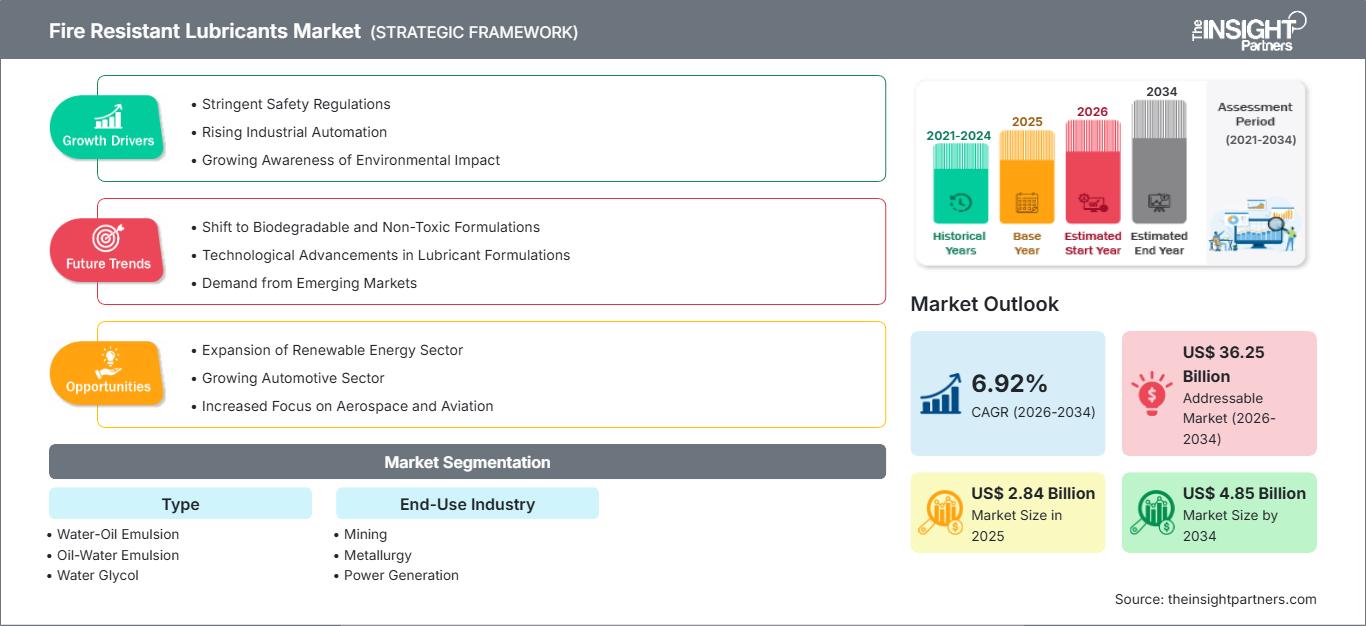
The Fire Resistant Lubricants Market was valued at US$ 2.84 Billion in 2025 and is projected to reach US$ 4.85 Billion by 2034, registering a 6.92% CAGR during 2026–2034. The market covers lubricating and hydraulic fluid solutions formulated to reduce ignition and combustion risks in equipment exposed to elevated temperatures, flames, hot surfaces, or combustible materials. The scope is segmented by Type, including Water-Oil Emulsion, Oil-Water Emulsion, Water Glycol, and Polyol Ester, and by End-Use Industry, including Mining, Metallurgy, Power Generation, Aerospace, Marine, and Construction.
North America represents a mature demand center, supported by established industrial safety practices, replacement of conventional mineral-oil fluids in high-risk hydraulic systems, and continued investment in mining, metals processing, power infrastructure, and construction equipment. The regional Fire Resistant Lubricants Market size is expected to expand at approximately ~7% CAGR through 2034, with demand increasingly influenced by fluid compatibility, equipment reliability, environmental considerations, and the adoption of higher-performance synthetic formulations in applications where hydraulic-fluid ignition can create significant operational and personnel risks.
Fire Resistant Lubricants Market Assessment and Insights
Regional Outlook
- North America: ~31% of the Fire Resistant Lubricants Market share in 2025 | ~7% CAGR through 2034. Market position: North America maintains a leading mature position because mining, metallurgy, power generation, and construction operations use substantial hydraulic equipment in environments where fire exposure creates operational and safety risks. Established fluid standards and replacement demand support sustained consumption.
- US: ~78% of North American market revenue in 2025 | ~7% CAGR through 2034. Market position: The US anchors North American demand through its broad industrial equipment base, mining operations, metalworking facilities, power infrastructure, and construction activity. Demand also benefits from established OEM specifications and technical-service networks supporting fluid conversion and equipment compatibility.
- Europe: ~26% of the global market in 2025 | ~6% CAGR through 2034. Market position: Europe represents a mature market shaped by industrial safety requirements, environmental considerations, and advanced manufacturing. Germany and the UK are leading countries within Europe, while France, Italy, and Spain contribute through industrial machinery, metallurgy, energy, marine, and construction applications.
- Asia Pacific: ~30% of the global market in 2025 | ~9% CAGR through 2034. Market position: Asia Pacific is the fastest-growing region, supported by expanding industrial capacity, mining and metals production, infrastructure investment, and localization of lubricant manufacturing. China leads the region, with Japan, South Korea, India, and Australia providing significant specialized demand.
Segment Outlook
- Water Glycol: ~34% Share in 2025 | ~7% CAGR through 2034. Market position: Water Glycol leads the type landscape because its high water content provides an effective balance between fire resistance, hydraulic performance, and cost for industrial systems operating around hot metal, mining equipment, and other ignition hazards.
- Polyol Ester: ~24% Share in 2025 | ~8% CAGR through 2034. Market position: Polyol Ester has a high-growth position because synthetic ester formulations combine fire resistance with lubrication performance, oxidation stability, and compatibility with demanding hydraulic equipment. Adoption is supported by conversion from conventional fluids in safety-critical industrial applications.
Competitive Coverage
TotalEnergies SE, Quaker Houghton, Shell plc, Exxon Mobil Corporation, BP p.l.c., Sinopec Group, Phillips 66, LANXESS AG, Croda International Plc, Fuchs Petrolub SE
Methodology
The Insight Partners follows Data Collection & Secondary Research, Primary Research, Data Analysis, and Data Triangulation & Final Review to validate market estimates and insights.
Source: The Insight Partners' analysis based on proprietary research, government publications, company annual reports, investor presentations, industry databases, and expert interviews.
The history of the Fire Resistant Lubricants Market can be attributed to the shift from traditional oil-based hydraulic fluids to aqueous and synthetic hydraulic fluids that inhibit fire propagation while at the same time providing lubrication. The innovation process has centered on improving the thermal stability, oxidation, corrosion protection, control of pump wear, bio-degradation, and compatibility with seals and other system parts. There have also been developments in the variety of formulations available for both water and anhydrous products, depending on pressure, temperature, and machinery considerations. This has made it possible for manufacturers to supply both stationary industrial facilities and mobile equipment that face higher risks of fire hazard.
In the future, the market will benefit from industrial transformation in the Asia Pacific region, local manufacturing of specialty fluids, as well as investments in energy, metal, mining, and infrastructure projects. Awareness of both regulations and consumers concerning workplace safety and environmental performance will push consumers to take into consideration the risk of operation while making the choice of hydraulic fluids, and not only their cost. Those suppliers who possess experience in formulating fluids, application engineering, relationships with OEMs and technical support in their regions will have the opportunity to benefit.
Fire Resistant Lubricants Market Report Scope
| Report Attribute | Details |
|---|---|
| Market size in 2025 | US$ 2.84 Billion |
| Market Size by 2034 | US$ 4.85 Billion |
| Global CAGR (2026 - 2034) | 6.92% |
| Historical Data | 2021-2024 |
| Forecast period | 2026-2034 |
Fire Resistant Lubricants Market Analysis
Growth in the market for fire resistant lubricants has much more to do with the risks associated with the hydraulic and lubrication systems than simply the volume of lubricants used. Equipment used in mining, metallurgy, power generation, marine, aerospace and construction is often subjected to proximity to hot surfaces, molten materials, electrical systems or flammable materials and therefore fire resistant properties become one of the factors influencing lubricant selection. The supply chain includes suppliers of base fluids and additives, formulators, lubricant producers, distributors, equipment OEMs, equipment maintenance organizations and industrial users. Hence the supply situation is a function of both the formulation availability and qualification capability for specific equipment.
Increasingly, product selection reflects a trade-off between fire resistance, viscosity characteristics, lubrication properties, material compatibility, environmental considerations, longevity and conversion considerations. Where fire resistance and cost-efficiency are critical factors, water glycols can still be a solution, while polyol ester products cater for applications which have requirements for operations without water and more efficient lubrication performance. Water-oil emulsions and oil-water emulsions cater to different operating conditions in hydraulic systems.
Competitive positioning is based on a combination of formulating portfolios, application engineering capabilities, and geographical reach. TotalEnergies SE and Shell plc feature wide geographical coverage of industrial lubricants distribution channels, whereas Quaker Houghton offers significant market coverage in relation to steel, mining, metalworking, and industrial process applications. LANXESS AG operates via phosphate-ester fire-resistant fluids, while Fuchs Petrolub SE and BP p.l.c. provide wider industrial lubrication offerings. Exxon Mobil Corporation, Sinopec Group, and Phillips 66 enjoy extensive lubricants infrastructures, while Croda International Plc specializes in specialty chemicals and esters.
Increasingly, investments are being made into regional manufacturing facilities, sustainable products, technical services, and formulation capabilities. In such competitive conditions, the suppliers will be rewarded for their ability to assist with fluid conversions, systems compatibility, monitoring, and performance through life cycle. Positioning also benefits from access to industrial customers, distributors, and OEM specifications. Instead of offering a wide portfolio of products, major players distinguish themselves by reliability, safety information, environmental properties, and fluid formulation capability.
● REPORT CUSTOMIZATION
Tailor This Report To Align With Your Specific Business Requirements
This report can be customized to align precisely with your business objectives, scope, and target markets. Customization options include tailored segmentation, geography, competitive analysis, and strategic insights to support informed decision-making.
Customize This Report →WHAT YOU CAN ADJUST
- ● Segmentations
- ● Geography
- ● Competitive Analysis
- ● Language Preferences
Fire Resistant Lubricants Market: Strategic Insights
Regional Insights
North America Fire Resistant Lubricants Market
North America represented ~31% of the global Fire Resistant Lubricants Market in 2025 and is projected to record approximately ~7% CAGR through 2034. The region benefits from a large installed base of hydraulic equipment used in mining, metallurgy, power generation, construction, and industrial processing. Demand is particularly relevant where hydraulic lines operate near hot surfaces, furnaces, molten metals, underground mining equipment, or other ignition sources. Replacement of conventional mineral-oil fluids provides an additional demand mechanism.
The US represents roughly 78% of North American revenues and continues to be the major regional demand base. Contributions from Canada include mining, metals, energy, construction, and processing of resources, whereas Mexico provides demand through its manufacturing and industrial machinery. The suppliers providing support to the regional market include Quaker Houghton, Shell plc, Exxon Mobil Corporation, and TotalEnergies SE. The presence of established industrial facilities along with the replacement of equipment is expected to stabilize demand in North America while also promoting the shift towards high-performance fluids.
U.S. Fire Resistant Lubricants Market
The U.S. represented ~78% of North American Fire Resistant Lubricants Market revenue in 2025 and is expected to expand at approximately ~7% CAGR through 2034. The country has extensive mining, steel, metal processing, power-generation, aerospace, marine, and construction equipment bases. Hydraulic applications in these industries require fluids that can reduce fire risk without compromising pump protection, corrosion control, viscosity behavior, and system reliability.
The conversion economic analysis is becoming more and more prevalent among industrial customers along with considerations for safety and equipment lifecycle. Quaker Houghton is a key player in industrial process fluids, whereas Shell plc, Exxon Mobil Corporation, TotalEnergies SE, and other leading lubricant producers offer a competitive line of hydraulic and specialty fluids. In terms of market needs, mining/metallurgy and construction equipment continue to play a significant role, providing opportunities in both static and mobile systems applications.
Europe Fire Resistant Lubricants Market
Europe accounted for ~26% of the global Fire Resistant Lubricants Market in 2025 and is forecast to register approximately ~6% CAGR through 2034. Germany is the leading country in Europe, supported by its industrial machinery, metallurgy, automotive manufacturing, power equipment, and specialty chemicals base. The UK contributes through industrial processing, marine activities, power infrastructure, and engineering services, while France has demand from aerospace, energy, construction, and heavy industrial applications.
Italy and Spain also offer additional consumption opportunities in terms of manufacturing, construction, energy, marine equipment, and industrial machinery. European buyers typically have a keen focus on equipment efficiency, environmental properties, personnel safety, and fluids’ lifecycle management, promoting the development of more eco-friendly and durable fluids on the part of manufacturers. Synthetic esters and water-based fluids may come handy for those buyers who wish to replace traditional mineral oils with other substances in dangerous hydraulic systems.
Market participants in the region include such companies as TotalEnergies SE, Shell plc, BP p.l.c., LANXESS AG, Fuchs Petrolub SE, and Croda International Plc. In turn, LANXESS is notable because of its products based on fire-resistant phosphate ester technologies. At the same time, leading players in the lubricants industry employ more comprehensive industrial networks to distribute their products. Market growth is therefore associated more with fluid and equipment substitution than with increased lubricant consumption per se.
APAC Fire Resistant Lubricants Market
Asia Pacific represented ~30% of the global Fire Resistant Lubricants Market in 2025 and is projected to grow at approximately ~9% CAGR through 2034, making it the fastest-growing region. China is the leading country in Asia Pacific, supported by large metallurgy, mining, manufacturing, power, and construction equipment bases. Japan and South Korea contribute through advanced industrial machinery, shipbuilding, power equipment, and high-specification manufacturing.
India and Australia add demand through infrastructure, mining, metallurgy, power generation, and construction. Industrial localization and investment in domestic manufacturing capacity are strengthening regional supply availability, while customers increasingly evaluate fire resistance alongside equipment efficiency and environmental performance. Growth is therefore supported by both expansion of industrial assets and conversion of existing hydraulic systems where fire-risk reduction is becoming a stronger procurement criterion.
Middle East & Africa Fire Resistant Lubricants Market
The Middle East & Africa Fire Resistant Lubricants Market is expected to register approximately ~8% CAGR through 2034. Saudi Arabia represents a major demand center in the region because of its energy, metals, construction, and industrial diversification projects. The UAE contributes through infrastructure, marine activity, power systems, and industrial facilities, while South Africa has demand linked to mining, metallurgy, power generation, and heavy equipment.
Energy-intensive operations create specific requirements for hydraulic fluids used around elevated temperatures and combustible materials. Infrastructure development further expands equipment utilization in construction and material handling. Rest of MEA markets remain more fragmented, with demand concentrated around mining, energy, ports, industrial facilities, and large construction projects. Supplier success depends on regional distribution, technical support, fluid availability, and the ability to meet equipment-specific specifications in challenging operating environments.
Segmentation Analysis
Type
The Type segment includes Water-Oil Emulsion, Oil-Water Emulsion, Water Glycol, and Polyol Ester formulations. The segment is expected to expand at approximately ~7% CAGR during 2026–2034. Product selection depends on water content, fire resistance, lubrication requirements, viscosity behavior, equipment compatibility, environmental considerations, and operating temperature. The Fire Resistant Lubricants Market scope therefore spans formulations serving substantially different hydraulic architectures rather than a single standardized fluid category.
- Water-Oil Emulsion: Water-Oil Emulsion formulations provide fire-resistant characteristics while retaining an oil-continuous structure suited to selected hydraulic applications. Their strategic importance lies in balancing lubrication performance with reduced flammability where equipment operates near heat sources and industrial ignition hazards.
- Oil-Water Emulsion: Oil-Water Emulsion fluids provide a water-rich formulation approach for applications where fire risk reduction is important. Adoption depends on equipment design, corrosion management, temperature conditions, and the ability of users to maintain fluid concentration and system cleanliness.
- Water Glycol: Water Glycol fluids are widely relevant to industrial hydraulic systems requiring strong fire resistance and dependable operation. Their positioning is supported by applications in steel, mining, metallurgy, and other environments where hydraulic equipment can encounter hot surfaces or combustible hazards.
- Polyol Ester: Polyol Ester formulations provide water-free operation with strong lubrication and thermal characteristics. They are strategically important for users seeking higher-performance alternatives to conventional mineral oils, particularly where equipment reliability, oxidation stability, and fire resistance must be addressed together.
End-Use Industry
The End-Use Industry segment is projected to grow at approximately ~8% CAGR during 2026–2034 and comprises Mining, Metallurgy, Power Generation, Aerospace, Marine, and Construction. Demand differs according to equipment configuration, fire exposure, operating pressure, fluid replacement cycles, and application-specific performance requirements. Heavy industrial sectors generally require closer fluid qualification because lubricant failure can result in equipment downtime, maintenance costs, or heightened safety exposure.
- Mining: Mining uses fire-resistant fluids in hydraulic equipment operating underground and around combustible materials. Demand is linked to long equipment duty cycles, hydraulic systems on mobile and fixed machinery, fluid contamination control, and the need to reduce ignition risk during continuous production.
- Metallurgy: Metallurgy applications include hydraulic systems operating around furnaces, molten metals, rolling equipment, presses, and other high-temperature processes. Fire-resistant lubrication is strategically important because fluid exposure to hot surfaces can create significant operational and worker-safety consequences.
- Power Generation: Power-generation facilities use specialized hydraulic and control fluids in systems where reliability, thermal stability, and fire resistance are important. Demand varies by turbine technology, hydraulic architecture, maintenance practices, and requirements for electrohydraulic control equipment.
- Aerospace: Aerospace applications require highly controlled fluid performance because hydraulic-system reliability is directly connected to aircraft functionality. Qualification requirements, material compatibility, thermal behavior, and stringent safety specifications make this a technically demanding but strategically specialized application.
- Marine: Marine equipment uses hydraulic systems across propulsion support, steering, deck machinery, offshore systems, and other applications. Fire-resistant formulations are valuable where hydraulic equipment operates near engines, hot machinery, fuel systems, or confined spaces with elevated fire consequences.
- Construction: Construction equipment creates demand for fire-resistant fluids in hydraulic systems used for lifting, excavation, material handling, and other heavy-duty operations. Adoption depends on equipment duty cycles, fire exposure, fluid conversion requirements, and customer emphasis on maintenance and operational reliability.
Opportunity Snapshot
| End-Use Industry | Revenue Contribution | Trend Tag | Adoption Stage |
| Mining | High | Underground Hydraulics | Mature |
| Metallurgy | High | Hot Metal Safety | Mature |
| Power Generation | Medium | Turbine Controls | Scaling |
| Aerospace | Medium | High-Spec Fluids | Mature |
| Marine | Medium | Offshore Hydraulics | Scaling |
| Construction | High | Mobile Hydraulics | Scaling |
Fire Resistant Lubricants Market Growth Drivers and Impact Analysis
Stronger Industrial Fire-Risk Management
Industrial users increasingly treat hydraulic-fluid fire performance as part of equipment risk management rather than as a narrow lubricant specification. Mining, metallurgy, power, and heavy manufacturing facilities can expose hydraulic systems to hot metal, flames, high-temperature surfaces, and other ignition sources. Selecting a less-flammable formulation can reduce the consequences of hose failures or fluid leakage in these environments. This mechanism supports replacement of conventional mineral-oil products where operating conditions justify a higher-safety formulation. Suppliers that combine fire resistance with wear protection, corrosion control, thermal stability, and equipment compatibility can address the broader lifecycle requirements of industrial customers. The resulting demand is less dependent on lubricant volume growth alone and more closely linked to risk reduction, maintenance strategy, and the modernization of hydraulic equipment.
Expansion of Mining and Metals Processing Equipment
Growth in mining and metals processing equipment creates a direct demand pathway for fire-resistant hydraulic fluids because these industries operate substantial hydraulic systems in environments where ignition risk can be elevated. Longwall mining equipment, heavy material-handling machinery, metal presses, rolling systems, and related equipment require dependable fluid performance under demanding operating conditions. Expansion of production capacity increases the installed equipment base, while maintenance and replacement cycles create recurring fluid demand. Metallurgy is particularly relevant because hydraulic systems can operate close to furnaces, hot metal, and high-temperature process areas. Suppliers with application-specific formulations and technical support can benefit from customer requirements for improved reliability and reduced downtime. This driver also favors manufacturers capable of supplying multiple fluid categories because equipment owners may require different solutions across plants and hydraulic architectures.
Industrial Equipment Modernization and Fluid Conversion
Modernization of industrial equipment creates opportunities for fire-resistant lubricant adoption during hydraulic-system upgrades, component replacement, and maintenance programs. Customers evaluating pumps, valves, seals, hoses, filters, and control systems increasingly consider fluid compatibility at the same time as equipment performance. Conversion projects can shift demand toward synthetic ester, water glycol, or emulsion formulations where the operating environment creates a clear fire-safety requirement. The commercial impact extends beyond initial fluid sales because successful conversions can establish recurring replacement demand and technical-service relationships. Suppliers can strengthen this mechanism by providing compatibility guidance, monitoring services, fluid analysis, and application engineering. As industrial operators seek to reduce unplanned downtime, fire-resistant formulations that provide stable lubrication and long service life can gain preference over products selected solely on acquisition cost.
Fire Resistant Lubricants Market Future Trends
Shift Toward Lower-Impact Fire-Resistant Formulations
The Fire Resistant Lubricants Market trends are increasingly influenced by demand for formulations that combine fire resistance with improved environmental characteristics. Industrial customers are evaluating biodegradability, toxicity profile, renewable feedstock content, fluid longevity, and disposal requirements alongside traditional performance metrics. This is encouraging development of synthetic ester and other formulations designed to reduce environmental burden without sacrificing hydraulic-system protection. The trend is particularly relevant to mining, marine, offshore, and environmentally sensitive industrial locations where accidental releases can create additional operational or compliance concerns. Over time, procurement specifications are likely to place greater emphasis on lifecycle attributes, creating differentiation between products that merely satisfy fire-resistance requirements and formulations that combine safety, performance, environmental profile, and service-life advantages.
Higher-Performance Fluids for Advanced Hydraulic Systems
Future product development is likely to focus on fluids capable of supporting higher operating pressures, elevated temperatures, tighter component tolerances, and more sophisticated hydraulic control systems. Industrial equipment is becoming more automated, increasing the importance of predictable viscosity behavior, oxidation stability, cleanliness, and compatibility with modern seals and components. Fire resistance will therefore increasingly be evaluated alongside the broader performance envelope of the hydraulic system. Synthetic formulations can benefit where users need water-free operation and stronger lubrication characteristics, while water-containing fluids will remain relevant where fire protection is the primary requirement. This trend may also increase demand for condition monitoring and fluid analysis because users seek to extend service intervals while controlling degradation. Suppliers with formulation and diagnostic capabilities can respond to this shift by combining lubricant products with technical lifecycle services.
Fire Resistant Lubricants Market Opportunities
Localized Production and Technical Service in Asia Pacific
Asia Pacific provides an opportunity for lubricant manufacturers to expand local production and technical-service capabilities alongside industrial equipment growth. China, India, Japan, South Korea, and Australia have distinct industrial structures, creating demand for localized formulations, application support, distribution, and equipment-specific recommendations. Local manufacturing can reduce supply-chain complexity and improve responsiveness for large industrial customers, while regional laboratories can accelerate product qualification and troubleshooting. The opportunity extends beyond volume expansion because customers in mining, metallurgy, power generation, and construction increasingly require technical guidance during fluid selection and conversion. Companies that combine regional production with application engineering can develop stronger relationships with OEMs, distributors, and large industrial users. This approach can also support adaptation of global product platforms to local equipment requirements and operating environments.
Premium Fluids for Safety-Critical Industrial Applications
The Fire Resistant Lubricants Market Forecasts indicate an opportunity to capture premium demand by targeting applications where fluid failure carries substantial operational or safety consequences. Aerospace, power generation, metallurgy, mining, offshore marine equipment, and specialized construction systems can justify higher-performance formulations when fire resistance must be combined with thermal stability, wear control, corrosion protection, and long service life. Suppliers can pursue this opportunity through application-specific grades, OEM qualification, condition monitoring, and technical support rather than competing solely on lubricant price. Product differentiation can also extend to low-environmental-impact formulations and fluids designed for easier conversion from conventional mineral oils. As customers increasingly evaluate total cost of ownership, suppliers able to quantify maintenance, downtime, equipment protection, and conversion benefits can strengthen their position in technically demanding accounts.
Recent Developments
- June 2026: Quaker Houghton – The company opened a new manufacturing facility and expanded laboratory capabilities in Zhangjiagang, China, strengthening local production capacity for customers across Asia Pacific. The site supports industries including steel, aluminum, automotive, mining, and wind power and expands Quaker Houghton's regional manufacturing network. The investment is relevant to fire-resistant lubricant supply because local production and technical capabilities can improve responsiveness to industrial customers requiring specialized hydraulic-fluid solutions.
- January 2025: TotalEnergies SE – TotalEnergies Lubrifiants acquired fire-resistant hydraulic-fluid product lines from German specialty manufacturer Fluid Competence. The transaction added water-based and water-glycol products classified under relevant hydraulic-fluid categories and strengthened TotalEnergies' mineral-oil-free offering for safety-critical applications in steel, mining, and tunnelling. The development expanded the company's fire-resistant fluid portfolio while supporting its strategy around safer and lower-VOC lubricant solutions.
Frequently Asked Questions

- Comprehensive Market Sizing and Forecast Analysis
- Detailed Segmentation Analysis
- In-Depth Market Dynamics Assessment
- Regional and Country-Level Insights
- Competitive Landscape and Company Benchmarking
- Strategic Business Intelligence
Recent Reports
Testimonials

The Insight Partners provided valuable market intelligence that supported our global go-to-market strategy. Their team was professional, responsive, and attentive to our feedback, providing thoughtful analysis and helpful methodological clarifications throughout the project.
Junmo Kim Chief Financial Officer (CFO), Enertech Co., Ltd.
The Insight Partners' SCADA System Market report is comprehensive, with valuable insights on current trends and future forecasts. The team was highly professional, responsive, and supportive throughout. We are very satisfied and highly recommend their services.
RAN KEDEM Partner, Reali Technologies LTDs
I requested a report on a very specific software market and the team produced the report in a few days. The information was very relevant and well presented. I then requested some changes and additions to the report. The team was again very responsive and I got the final report in less than a week.
JEAN-HERVE JENN Chairman, Future Analytica
We worked with The Insight Partners for an important market study and forecast. They gave us clear insights into opportunities and risks, which helped shape our plans. Their research was easy to use and based on solid data. It helped us make smart, confident decisions. We highly recommend them.
PIYUSH NAGPAL Sr. Vice President, High Beam Global
The Insight Partners delivered insightful, well-structured market research with strong domain expertise. Their team was professional and responsive throughout. The user-friendly website made accessing industry reports seamless. We highly recommend them for reliable, high-quality research services
YUKIHIKO ADACHI CEO, Deep Blue, LLC.
This is the first time I have purchased a market report from The Insight Partners.While I was unsure at first, I visited their web site and felt more comfortable to take the risk and purchase a market report.I am completely satisfied with the quality of the report and customer service. I had several questions and comments with the initial report, but after a couple of dialogs over email with their analyst I believe I have a report that I can use as input to our strategic planning process.Thank you so much for taking the extra time and making this a positive experience.I will definitely recommend your service to others and you will be my first call when we need further market data.
JOHN SUZUKI President and Chief Executive Officer, Board Director, BK Technologies
I wish to appreciate your support and the professionalism you displayed in the course of attending to my request for information regarding to infectious disease IVD market in Nigeria. I appreciate your patience, your guidance, and the fact that you were willing to offer a discount, which eventually made it possible for us to close a deal. I look forward to engaging The Insight Partners in the future, all thanks to the impression you have created in me as a result of this first encounter.
DR CHIJIOKE ONYIA MANAGING DIRECTOR, PineCrest Healthcare Ltd.Reason to Buy
- Informed Decision-Making
- Understanding Market Dynamics
- Competitive Analysis
- Identifying Emerging Markets
- Customer Insights
- Market Forecasts
- Risk Mitigation
- Boosting Operational Efficiency
- Strategic Planning
- Investment Justification
- Tracking Industry Innovations
- Aligning with Regulatory Trends





 Get Free Sample for