
Ethylene Vinyl Acetate Resins Market Growth, Trends & Demand by 2034
Coverage: by Type (Vinyl acetate-modified polyethylene, Thermoplastic ethylene vinyl acetate, Ethylene vinyl acetate rubber); Applications (Film, Foam, Hot melt adhesives, Wire and cables, Extrusion coating, Solar cell encapsulation, Others); End-Use Industry (Automotive, Packaging and paper, Paints, coatings, and adhesives, Electronic and electrical, Pharmaceutical, Footwear, Photovoltaic panels, Others) , and Geography (North America, Europe, Asia Pacific, and South and Central America)
- Status : Data Released
- Report Code : TIPRE00006402
- Category : Chemicals and Materials
- No. of Pages : 150
- Available Report Formats :


- Last update date : September 17, 2026


2025 Market Size
US$ 4.17 Bn
Base year value
2034 Forecast
US$ 5.74 Bn
Projected by 2034
CAGR 2026-2034
3.61 %
Growth rate
Addressable Market
US$ 45.00 Bn
(2026-2034)
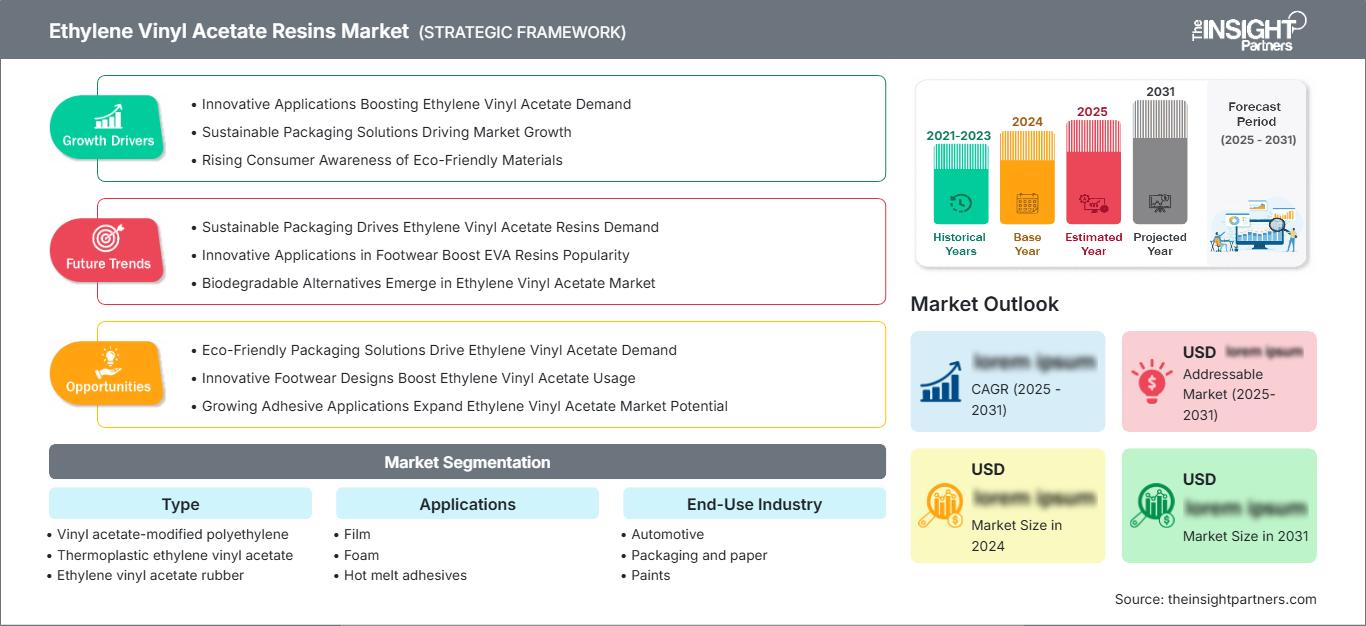
The Ethylene Vinyl Acetate Resins Market size is valued at US$ 4.17 Billion in 2025 and is projected to reach US$ 5.74 Billion by 2034, registering a CAGR of 3.61% during 2026–2034. The market encompasses resin grades engineered through ethylene and vinyl acetate copolymerization, supporting flexibility, adhesion, clarity, toughness, low-temperature sealing, cushioning, and encapsulation across packaging, footwear, photovoltaic, electrical, automotive, and industrial applications.
North America is expected to maintain steady expansion, with an estimated CAGR of 3.1–3.5% during 2026–2034. Structural demand is supported by flexible packaging conversion, medical and pharmaceutical packaging, wire and cable applications, and continued solar-module manufacturing. Regional producers also benefit from integrated ethylene and vinyl acetate supply chains, while recyclability requirements encourage higher-performance formulations that preserve sealing, adhesion, and mechanical properties without substantially increasing processing complexity.
Ethylene Vinyl Acetate Resins Market Assessment and Insights
- North America: The region is estimated to represent a 18–21% Ethylene Vinyl Acetate Resins Market share in 2025 and is expected to grow at a CAGR of 3.1–3.5% during 2026–2034, supported by packaging, photovoltaic, medical, and cable applications.
- US: The US accounts for an estimated 72–76% share of North American demand in 2025 and is expected to expand at a CAGR of 3.0–3.4% through 2034.
- Europe: Europe represents an estimated 16–19% share in 2025 and is projected to register a CAGR of 3.0–3.4%, led by Germany, Italy, Spain, France, and the UK, where packaging regulation and solar deployment influence material selection.
- Asia Pacific: Asia Pacific holds an estimated 48–52% share in 2025 and is expected to advance at a CAGR of 4.0–4.4%, led by China, Japan, South Korea, and India through packaging, footwear, photovoltaic, and electronics manufacturing.
- Largest Segment: Film is estimated to hold a 35–39% market share in 2025 and is expected to register a 3.4–3.8% CAGR during 2026–2034, supported by packaging and lamination demand.
- High Growth Segment: Solar cell encapsulation is estimated at a 13–17% market share in 2025 and is expected to grow at a 5.8–6.5% CAGR during 2026–2034.
- Key companies analyzed in detail: Arkema S.A.; Braskem S.A.; Celanese Corporation; Dow Inc.; Exxon Mobil Corporation; Fajr Kerman Petrochemical Complex (FKPC); Hanwha Solutions Corporation; Lotte Chemical Corporation; LyondellBasell Industries N.V.; Sinopec Corporation.
Source: The Insight Partners' analysis based on proprietary research, government publications, company annual reports, investor presentations, industry databases, and expert interviews.
Product development in the Ethylene Vinyl Acetate Resins Market is moving towards differentiated vinyl acetate content, melt processability stability, enhanced optical clarity, greater adhesion, and grade-specific applications. Product economics will continue to be determined by ethylene and vinyl acetate feedstock availability, cost of energy, utilization rates, and regional trade flow patterns. Portfolio development is increasingly focused on film, foam, hot melt, wire and cable compound, and photovoltaic encapsulant, where product performance is matched against the costs of feedstock and process economics.
Moving forward, investments in the Ethylene Vinyl Acetate Resins Market will likely emphasize grades for specific applications, resilience of regional supply chains, circular feedstock, and formulations that meet changing packaging needs. Solar installations offer another route of demand growth, especially in the Asia-Pacific region, Europe, India, and some Middle Eastern countries. Global additions to the renewable capacity in the period from 2025 to 2030 will total close to 4,600 GW, and solar PV will account for about 80% of the additions.
Ethylene Vinyl Acetate Resins Market Report Scope
| Report Attribute | Details |
|---|---|
| Market size in 2025 | US$ 4.17 Billion |
| Market Size by 2034 | US$ 5.74 Billion |
| Global CAGR (2026 - 2034) | 3.61% |
| Historical Data | 2021-2024 |
| Forecast period | 2026-2034 |
Ethylene Vinyl Acetate Resins Market Analysis
The Ethylene Vinyl Acetate Resins Market report shows that demand drivers for the material include the combination of the processing ease that is comparable to polyethylene but with additional flexibility, adhesiveness, toughness, and cold seal capabilities. EVA is used in multi-layer films, sealant layers, coating applications, and specialized materials by packaging converters, while the footwear industry utilizes cushioning and flexibility capabilities. Photovoltaic module manufacturing becomes another technically challenging application with optical clarity and performance during encapsulation being required. Therefore, the value chain consists of ethylene and vinyl acetate suppliers, resin producers, compounding companies, film and sheet converters, adhesive makers, module makers, footwear companies, and distributors.
Conditions in supply continue to be affected by feedstock integration, utilization of facilities, capacity additions in different regions, and freight costs. While integrated resin producers have at least some control over the raw material prices, non-integrated participants are still more exposed to fluctuations of monomer prices. The need for qualification of applications also provides switching costs due to the necessity for testing processing characteristics, adhesion, sealing, optical properties, and performance.
The competitive positioning of the Ethylene Vinyl Acetate Resins Market is comprised of the following elements: scale, geographic reach, product portfolio, technical services and feedstock. Dow Inc. enjoys wide ELVAX distribution in terms of packaging, footwear, industrial, wire and cable, and photovoltaics applications, whereas Celanese Corporation provides Ateva grades for co-extrusion, extrusion coatings, adhesives, and photovoltaic products. LyondellBasell Industries N.V. offers Ultrathene grades for films, flexible packaging, wire and cable, and other conversion applications.
Strategic investments in the Ethylene Vinyl Acetate Resins Market are focused on the development of differentiated and low-footprint materials rather than undifferentiated capacities only. Braskem S.A. has developed a bio-based EVA within its sustainable portfolio, while Arkema S.A. is developing EVA-based performance solutions for footwear industry. Hanwha Solutions Corporation, Lotte Chemical Corporation, Sinopec Corporation, Exxon Mobil Corporation, and Fajr Kerman Petrochemical Complex (FKPC) enhance the competitive environment by offering regional production capacity and downstream relationships.
● REPORT CUSTOMIZATION
Tailor This Report To Align With Your Specific Business Requirements
This report can be customized to align precisely with your business objectives, scope, and target markets. Customization options include tailored segmentation, geography, competitive analysis, and strategic insights to support informed decision-making.
Customize This Report →WHAT YOU CAN ADJUST
- ● Segmentations
- ● Geography
- ● Competitive Analysis
- ● Language Preferences
Ethylene Vinyl Acetate Resins Market: Strategic Insights
Regional Insights
North America Ethylene Vinyl Acetate Resins Market
North America is estimated to hold an 18–21% Ethylene Vinyl Acetate Resins Market in 2025 and is projected to register a 3.1–3.5% CAGR during 2026–2034. The US holds sway over regional consumption, backed by flexible packaging, medical usage, footwear, wire & cable, adhesives, and photovoltaics materials. Integrated petrochemical value chain ensures relatively good availability of ethylene-based raw materials.
In addition, demand is influenced by investments made in domestic manufacturing as well as the requirement for consistent specialty grades. Deployment of solar continues to be an important factor despite changing policy scenarios, while sophisticated recycling technologies could enlarge the total market for circular resins. The diversified application landscape of the region makes it less dependent on any one particular end-use industry.
U.S. Ethylene Vinyl Acetate Resins Market
The US represents an estimated 72–76% share of North American Ethylene Vinyl Acetate Resins Market in 2025 and is expected to grow at a 3.0–3.4% CAGR through 2034. Applications include flexible films, sealants, adhesives, footwear, medical packaging, wire & cable, and photovoltaics. Dow Inc. and ExxonMobil Corporation are among those companies which offer critical competitive advantages within the nation.
Current application trends favor low temperature sealing, multi-layer films, optical properties, and durable insulation. Photovoltaic production and renewable power installation are critical factors driving demand for this material, although economics and government policies may affect annual purchases. The country’s extensive conversion base ensures ongoing demand for proven grades and tested process parameters.
Europe Ethylene Vinyl Acetate Resins Market
Europe is estimated to account for a 16–19% share in 2025 and is projected to grow at a 3.0–3.4% CAGR through 2034. Germany is followed by Italy, Spain, France, and the UK, which drive regional demand. Packaging applications, solar production, footwear, adhesives, and specialty films continue to be the major applications.
Demand is sustained in the UK due to packaging conversion applications, healthcare, and specialty adhesives, where recycling and efficient use of materials have become an important aspect of procurement. Germany is a combination of packaging and industrial manufacturing applications along with extensive solar applications for films and encapsulation needs.
APAC Ethylene Vinyl Acetate Resins Market
Asia Pacific is estimated at a 48–52% share in 2025 and is expected to register a 4.0–4.4% CAGR through 2034. China takes the lead, aided by the production of photovoltaics, packaging, footwear, and resins. On the other hand, Japan and South Korea focus on high-quality materials, whereas India invests in packaging, footwear, and solar energy applications.
Australia provides support through the use of packaging and building materials, while policies promoting renewables across the region enhances encapsulation material demand. In 2025, China commissioned a total of 370 GW of solar PV installation capacity, while India commissioned 50 GW of solar PV capacity.
Middle East & Africa Ethylene Vinyl Acetate Resins Market
Middle East and Africa demand is smaller but increasingly linked to energy diversification, infrastructure investment, packaging, and photovoltaic development. Saudi Arabia leads regional momentum, with the UAE and South Africa representing important downstream markets. Regional demand is expected to grow at a 4.5–5.0% CAGR through 2034.
Saudi Arabia's solar additions nearly quadrupled in 2025 to almost 7 GW, while South Africa installed more than 3 GW of solar PV for the first time. These developments support encapsulation and electrical-material demand, while packaging and industrial projects provide a broader base.
Segmentation Analysis
Type
Type segment in the Ethylene Vinyl Acetate Resins Market is projected to expand at a 3.4–3.8% CAGR during 2026–2034. Product selection depends on vinyl acetate content, crystallinity, melt behavior, flexibility, adhesion, and end-use requirements. Producers increasingly differentiate grades by processing stability and application performance, allowing converters to optimize films, foams, adhesives, and electrical materials without extensive equipment changes.
- Vinyl acetate-modified polyethylene: This established material family remains important for films, coatings, and flexible structures where controlled flexibility, toughness, clarity, and sealing are required. Its polyethylene-compatible processing supports broad converter adoption.
- Thermoplastic ethylene vinyl acetate: Thermoplastic grades provide balanced flexibility, impact performance, and processability across packaging, footwear, adhesives, and molded products. Their formulation range supports application-specific performance and efficient conversion.
- Ethylene vinyl acetate rubber: EVA rubber serves applications requiring elasticity, resilience, flexibility, and resistance to repeated deformation. Its strategic relevance is strongest in specialized footwear, industrial, and flexible rubber formulations.
Applications
Applications are projected to grow at a 3.7–4.1% CAGR during 2026–2034. Demand is diversified across packaging, adhesives, electrical products, coatings, foams, and solar materials. Film remains the largest application because of broad packaging and lamination use, while encapsulation provides stronger incremental growth potential.
- Film: Film applications benefit from strong sealability, flexibility, clarity, and puncture resistance, supporting food, consumer, industrial, and specialty packaging structures. Converter compatibility remains a central purchasing consideration.
- Foam: Foam applications use EVA for cushioning, resilience, low density, and energy absorption, particularly in footwear and sports products. Performance-oriented formulations create opportunities for differentiated compounds.
- Hot melt adhesives: EVA provides adhesion, flexibility, melt processability, and tunable viscosity, supporting packaging, woodworking, bookbinding, hygiene, and assembly applications. Demand follows industrial production and adhesive formulation trends.
- Wire and cables: Electrical applications require controlled flexibility, insulation performance, mechanical durability, and processing stability. EVA grades support specialized insulation, jacketing, and semiconductive structures in selected cable designs.
- Extrusion coating: EVA improves adhesion, flexibility, toughness, and heat-seal performance in coated paper, films, foils, and multilayer structures. Processing behavior and substrate compatibility guide grade selection.
- Solar cell encapsulation: Encapsulation uses optical clarity, adhesion, flexibility, and durability to protect photovoltaic cells from moisture and mechanical stresses. Solar deployment makes this application strategically important for future resin demand.
End-Use Industry
End-Use Industry segment in the Ethylene Vinyl Acetate Resins Market is projected to register a 3.5–3.9% CAGR during 2026–2034. Packaging and paper provide broad recurring consumption, while photovoltaic panels offer a higher-growth pathway. Automotive, electronics, footwear, pharmaceutical, and coatings industries create diversified demand through specialized performance requirements and regulatory specifications.
- Automotive: EVA supports flexible components, adhesives, coatings, insulation, and selected protective structures where low weight and resilience are important. Vehicle electrification creates additional opportunities for specialized polymer systems.
- Packaging and paper: Packaging remains a major consumption base because EVA provides sealing, adhesion, flexibility, and multilayer compatibility. Regulatory pressure is encouraging converters to optimize material efficiency and recyclability.
- Paints, coatings, adhesives: EVA contributes flexibility, adhesion, toughness, and formulation versatility across coatings and adhesive systems. Demand is connected to construction, industrial manufacturing, packaging, and consumer-product production.
- Electronic and electrical: Electrical and electronic uses prioritize insulation, dimensional stability, flexibility, and reliable processing. Growth follows cable, consumer-electronics, power infrastructure, and renewable-energy equipment requirements.
- Pharmaceutical: Pharmaceutical applications rely on controlled material performance, sealing, flexibility, and regulatory compliance. Demand is supported by healthcare packaging and specialized medical-product manufacturing.
- Footwear: Footwear uses EVA extensively for cushioning, lightweight construction, flexibility, and resilience. Premium performance compounds increasingly combine EVA processing with other polymers to improve durability and energy return.
- Photovoltaic panels: Photovoltaic panels require encapsulation materials that maintain adhesion, clarity, and durability over long service periods. Rapid solar deployment increases the strategic importance of qualified encapsulant grades.
Opportunity Snapshot
| End-Use Industry | Revenue Contribution | Trend Tag | Adoption Stage |
|---|---|---|---|
| Automotive | Medium | Lightweight Parts | Scaling |
| Packaging and paper | High | Recyclable Films | Mature |
| Paints, coatings, adhesives | Medium | Hot-Melt Systems | Mature |
| Electronic and electrical | Medium | Cable Insulation | Scaling |
| Pharmaceutical | Low | Medical Films | Scaling |
| Footwear | High | Performance Foams | Mature |
| Photovoltaic panels | High | Solar Encapsulation | Scaling |
Ethylene Vinyl Acetate Resins Market Growth Drivers and Impact Analysis
Expansion of photovoltaic manufacturing and module deployment
Fast solar growth drives increased need for encapsulation materials that ensure transparency, bonding, flexibility, and protection from the environment. Global solar PV installations surpassed 600 GW in 2025, and China added nearly 370 GW, while India commissioned almost 50 GW. Such volumes increase the need for encapsulation films and respective high-performance resin grades. The effect is most noticeable for suppliers that are able to meet the demands of qualification of modules and to provide constant optical and thermal characteristics. Competition among polyolefin elastomers will force EVA manufacturers to enhance their products' longevity, minimize degradation, and adjust formulations to new cell types. Therefore, demand from photovoltaics will increasingly influence resin blends, especially in Asia Pacific and other emerging centers of solar production.
Flexible packaging performance and regulatory-driven material optimization
The low-temperature sealing capabilities, flexibility, toughness, adhesion, and transparency properties of EVA enable the manufacture of multilayer packaging designs where reliable processability is crucial. The European Packaging and Packaging Waste Directive became applicable in February 2025 and generally effective from August 2026, putting pressure on the converters to assess recyclability, material efficiency, and packaging design. Such an environment does not necessarily promote the use of one polymer, but it puts the emphasis on development by resin producers of materials that would give required functionality with material efficiency. Such a trend leads to increased demand for technically advanced sealant layers, extrusion coatings, and packaging designs suitable for new recycling technologies.
Growth of lightweight footwear and performance-oriented consumer products
The industry has been actively looking for materials that will be capable of combining the required characteristics, such as cushioning, flexibility, lightness, durability, and cost-effectiveness in manufacturing. In this regard, EVA is still applicable in terms of its capabilities for creating foam structures that will have varying densities. Modern innovations are about the combination of EVA material with thermoplastic elastomers for the purpose of enhancing resilience and energy restitution without making major changes to existing manufacturing technologies. This provides opportunities for producing high-end materials instead of using traditional commodity materials. The result of this approach will be a more diverse product range, starting from basic footwear compounds and going up to specific performance systems.
Ethylene Vinyl Acetate Resins Market Future Trends
Greater adoption of circular and bio-attributed resin pathways
The Ethylene Vinyl Acetate Resins Market trends show that sustainability mandate is anticipated to drive EVA innovation from the traditional formulation approach based on fossil fuels towards bio-attributed, recycled content, and mass balance solutions. The transition will begin with uses where end-users have an economic incentive for material premiums driven by sustainability goals, brand policies, and regulations. The continued development of bio-based EVA by Braskem S.A. demonstrates that renewable sources can be used in existing resin product lines without having to develop an entirely different production process. Eventually, traceability, lifecycle assessment, recycling content validation, and performance consistency will be among the key factors driving buying decisions.
Application-specific grades for advanced solar and electrical systems
The future formulation development would have an increasing trend toward meeting specific application needs instead of a generic performance criterion. Photovoltaic encapsulation will need better resistance to heat, UV, moisture, and long-term degradation due to module design changes. The electrical applications, on the other hand, will have a growing emphasis on insulation reliability, flexibility, and processability. This trend will benefit resin systems with more limited performance envelopes, custom vinyl acetate levels, and specific additives. It would also facilitate technical cooperation among resin makers, film converters, module makers, cable compounders, and machinery makers. This would eventually lead to the gradual move in value creation from the resin itself to its qualification capabilities and application performance.
Ethylene Vinyl Acetate Resins Market Opportunities
Regionalized production and resilient specialty-grade supply
There are possibilities for investment in production and compounding of material near high-growth downstream clusters. The Asia Pacific region continues to be the largest consumer, while there are opportunities for localized production and technical service in India, Southeast Asia, Middle East, and some parts of Europe. Regionalization could help in minimizing risk from freight, reducing qualification time, and being more responsive to converter needs. Companies can also consider running small specialty lines in order to cater to customers in applications such as footwear, medical packaging, cables, adhesives, and photovoltaics without competing on purely economic terms.
Premium encapsulation and sustainable material portfolios
The strongest strategic opportunity lies in combining solar encapsulation expertise with lower-footprint material alternatives. Solar deployment is expanding across China, India, Europe, the United States, and the Middle East, creating a broad customer base for qualified encapsulant materials. Producers can pursue premium grades offering improved optical stability, adhesion, moisture resistance, and processing efficiency while simultaneously developing bio-attributed or circular-feedstock variants. Partnerships with film converters and module manufacturers can accelerate qualification and reduce adoption barriers. In parallel, lifecycle data and traceability can help customers satisfy sustainability reporting requirements. Ethylene Vinyl Acetate Resins Market Forecasts therefore point toward a more differentiated competitive structure in which technical validation and environmental credentials increasingly influence procurement decisions.
Recent Developments
- February 2026: Arkema S.A. presented its Pebax EVA+ materials at PLASTINDIA2026, highlighting compounds designed for EVA-based footwear midsoles. The grades are engineered to run through standard EVA processing workflows while adding performance characteristics associated with Pebax materials, extending EVA-based compound development into running, trail, hiking, and safety footwear.
- January 2026: Braskem S.A. showcased its I'm green bio-based portfolio at Pharmapack Europe 2026, emphasizing renewable-feedstock polymer solutions for healthcare packaging. The development reinforces the company's broader strategy of integrating lower-footprint materials into established polymer applications and demonstrates continued commercial investment in bio-attributed alternatives for regulated end markets.
Frequently Asked Questions

- Comprehensive Market Sizing and Forecast Analysis
- Detailed Segmentation Analysis
- In-Depth Market Dynamics Assessment
- Regional and Country-Level Insights
- Competitive Landscape and Company Benchmarking
- Strategic Business Intelligence
Recent Reports
Testimonials

The Insight Partners provided valuable market intelligence that supported our global go-to-market strategy. Their team was professional, responsive, and attentive to our feedback, providing thoughtful analysis and helpful methodological clarifications throughout the project.
Junmo Kim Chief Financial Officer (CFO), Enertech Co., Ltd.
The Insight Partners' SCADA System Market report is comprehensive, with valuable insights on current trends and future forecasts. The team was highly professional, responsive, and supportive throughout. We are very satisfied and highly recommend their services.
RAN KEDEM Partner, Reali Technologies LTDs
I requested a report on a very specific software market and the team produced the report in a few days. The information was very relevant and well presented. I then requested some changes and additions to the report. The team was again very responsive and I got the final report in less than a week.
JEAN-HERVE JENN Chairman, Future Analytica
We worked with The Insight Partners for an important market study and forecast. They gave us clear insights into opportunities and risks, which helped shape our plans. Their research was easy to use and based on solid data. It helped us make smart, confident decisions. We highly recommend them.
PIYUSH NAGPAL Sr. Vice President, High Beam Global
The Insight Partners delivered insightful, well-structured market research with strong domain expertise. Their team was professional and responsive throughout. The user-friendly website made accessing industry reports seamless. We highly recommend them for reliable, high-quality research services
YUKIHIKO ADACHI CEO, Deep Blue, LLC.
This is the first time I have purchased a market report from The Insight Partners.While I was unsure at first, I visited their web site and felt more comfortable to take the risk and purchase a market report.I am completely satisfied with the quality of the report and customer service. I had several questions and comments with the initial report, but after a couple of dialogs over email with their analyst I believe I have a report that I can use as input to our strategic planning process.Thank you so much for taking the extra time and making this a positive experience.I will definitely recommend your service to others and you will be my first call when we need further market data.
JOHN SUZUKI President and Chief Executive Officer, Board Director, BK Technologies
I wish to appreciate your support and the professionalism you displayed in the course of attending to my request for information regarding to infectious disease IVD market in Nigeria. I appreciate your patience, your guidance, and the fact that you were willing to offer a discount, which eventually made it possible for us to close a deal. I look forward to engaging The Insight Partners in the future, all thanks to the impression you have created in me as a result of this first encounter.
DR CHIJIOKE ONYIA MANAGING DIRECTOR, PineCrest Healthcare Ltd.Reason to Buy
- Informed Decision-Making
- Understanding Market Dynamics
- Competitive Analysis
- Identifying Emerging Markets
- Customer Insights
- Market Forecasts
- Risk Mitigation
- Boosting Operational Efficiency
- Strategic Planning
- Investment Justification
- Tracking Industry Innovations
- Aligning with Regulatory Trends





 Get Free Sample for