$4450
$3560
The differential-pressure mass flow controller market size is projected to reach US$ 177.38 million by 2031, up from US$ 135.49 million in 2024. The market is expected to register a CAGR of 4.1% during 2025–2031.
Differential-Pressure Mass Flow Controller Market AnalysisOne of the major factors contributing to the increase in demand for differential-pressure mass flow controllers is the need for precise flow measurement in semiconductor manufacturing, pharmaceuticals, and chemical processing, where control of gas delivery must be extremely tight. The market growth is being propelled by the increasing use of automation and IoT-enabled process control, more stringent regulatory requirements for safety and emissions monitoring, as well as the expansion of high-purity gas applications. Improvements in sensor accuracy, miniaturization, and digital calibration technologies make these controllers more reliable and less expensive, which increases their usage in industrial and research sectors.
Differential-Pressure Mass Flow Controller Market OverviewA differential-pressure mass flow controller (MFC) determines and manages gas flow by measuring the pressure drop across a calibrated restriction and then adjusting the control valve to maintain the setpoint at a fixed value. The MFC is an indispensable component in applications that require a stable gas supply, such as in the semiconductor industry, laboratory equipment, and industrial automation. Its quick response, control stability, and accuracy are some of the notable features.
Customize Research To Suit Your Requirement
We can optimize and tailor the analysis and scope which is unmet through our standard offerings. This flexibility will help you gain the exact information needed for your business planning and decision making.
Differential-Pressure Mass Flow Controller Market: Strategic Insights


Naveen
Have a question?
Naveen will walk you through a 15-minute call to present the report’s content and answer all queries if you have any.
 Speak to Analyst
Differential-Pressure Mass Flow Controller Market Drivers and OpportunitiesCustomize Research To Suit Your Requirement
We can optimize and tailor the analysis and scope which is unmet through our standard offerings. This flexibility will help you gain the exact information needed for your business planning and decision making.
Differential-Pressure Mass Flow Controller Market: Strategic Insights
Naveen
Have a question?
Naveen will walk you through a 15-minute call to present the report’s content and answer all queries if you have any.
Speak to Analyst
Market Drivers:
- High-Precision Flow Control: Concentration on differential pressure mass flow meters is a trend in various processes, such as semiconductor, pharmaceutical, and chemical, where product quality, safety, and operational efficiency are maintained through stable gas delivery.
- Advancements in Sensor and Digital Technology: Innovations in pressure sensors, along with the size of components and digital control interface solutions, make it possible to achieve very fast reactions, high precision, and easy integration with automation and IoT systems for monitoring.
- Expansion of High-Purity and Industrial Gas Applications: The large variety of electronics manufacturing, research labs, and clean energy applications utilizing specialty gases is the reason for the increasing demand for mass flow control solutions.
Market Opportunities:
- Smart and IoT-Enabled Controllers: The creation of connected, differential-pressure MFCs with the capability of real-time diagnostics, predictive maintenance, and seamless integration into Industry 4.0 environments indicates potential for expansion.
- Energy-Efficient and Environmentally-Friendly Designs: A growing concern for energy savings and operations with low emissions is driving the demand for low-power, high-accuracy controllers that facilitate sustainability initiatives among manufacturers.
- User-Specific Features and Modular Design: The provision of configurable, application-specific differential-pressure MFCs, such as those used in industrial applications such as semiconductors, pharmaceuticals, or advanced materials, can deepen customer loyalty and extend the duration of the partnerships.
The differential-pressure mass flow controller market is segmented into distinct categories to provide a clearer understanding of its operation, growth potential, and current trends. Below is the standard segmentation approach used in industry reports:
By Flow Rate:
- Low: A low flow rate is used for precise control of a very small volume of a gas or liquid in applications such as laboratory research, biotechnology, and semiconductor fabrication, where high accuracy and sensitivity are required.
- Medium: Mid-range flow rates are typical for industrial and process applications, such as chemical processing and environmental monitoring, where a balance between moderate accuracy and flow capacity is required.
- High: High flow rate is suitable for large-scale works in various industries, such as oil & gas, energy, and bulk chemical production, where handling large volumes of gas or fluid is of great importance.
By Application:
- Semiconductors
- Food and Beverage Industry
- Chemicals
- Pharmaceutical and Healthcare Industry
- Oil and Gas
- Others
By Geography:
- North America
- Europe
- Asia Pacific
- Latin America
- Middle East & Africa
Market Report Scope
Differential-Pressure Mass Flow Controller Market Share Analysis by GeographyAsia Pacific is witnessing the fastest growth. Emerging markets in Latin America, the Middle East, and Africa offer numerous untapped opportunities for differential-pressure mass flow controller providers.
The differential-pressure mass flow controller market experiences varying growth rates across different regions. Below is a summary of market share and trends by region:
1. North America
- There is a growing demand for these devices in semiconductor fabrication, biotechnological research, and advanced pharmaceutical manufacturing. Market growth in the region is accelerated by high investments in research and development, rapid adoption of automation, and integration of IoT-enabled process control systems.
2. Europe
- Strict environmental regulations, a focus on energy efficiency, and the adoption of industrial automation are driving market development in Europe. Additionally, the increasing instrumentation and flow standards in the production of chemicals, clean energy, and environmental monitoring are major factors driving demand.
3. Asia Pacific
- The Asia Pacific market is influenced by rapid industrialization, the surge in semiconductor and electronics manufacturing, and substantial investments in clean energy. China, Japan, and South Korea are the major contributors, as they have advanced manufacturing ecosystems and high-tech infrastructure.
4. South and Central America
- The region's market development is supported by the growth of industrial automation, the maturation of local manufacturing sectors, and the increasing adoption of efficient process technologies, primarily in the chemicals, food processing, and energy sectors.
5. Middle East and Africa
- The growing investments in oil & gas, petrochemicals, renewable energy, and environmental monitoring are fueling market expansion in the region. The transition to sustainable and digitally enhanced industrial processes is pushing the demand for differential-pressure mass flow controllers.
High Market Density and Competition
The differential-pressure mass flow controller market is characterized by intense competition globally, where the top few giants - Bronkhorst, Horiba, MKS Instruments, and Alicat Scientific - are setting the benchmarks in the industry. Besides these heavyweights, a plethora of regional and niche players are providing the semiconductor, pharmaceutical, chemical, and lab-scale industries with application-specific solutions.
This high level of competition urges companies to stand out by offering:
- Designing compact, durable, and energy-efficient controllers
- Offering high levels of customization, technical support, and turnkey system packages
- Integrating advanced digital, IoT, and automation capabilities
Opportunities and Strategic Moves
- Increasing investment in research and development to innovate high-accuracy sensors and intelligent control algorithms that meet evolving industrial requirements
- Expanding market presence through strategic alliances, technology partnerships, and global distribution networks
- Adopting service-centric models such as cloud-based diagnostics, predictive maintenance, and remote performance monitoring to add long-term customer value
Other companies analyzed during the course of research:
- Rheonik Messtechnik GmbH
- Oval Corporation
- TRICOR (TASI Flow / KEM Küppers)
- Malema Engineering Corporation
- Endress+Hauser
- Siemens AG
- Yokogawa Electric Corporation
- ABB Group
- GE Measurement & Control (Baker Hughes)
- Christian Bürkert GmbH & Co. KG
- Siargo Ltd.
- Tokyo Keiso Co., Ltd.
- Shanghai Yinuo Instrument Co., Ltd.
- Shanghai Cixi Instrument Co., Ltd.
- Fuji Electric Co., Ltd.
- Aister Instruments
- MTS Engineers Pvt. Ltd.
- KROHNE Messtechnik GmbH
- Omega Engineering
- AW-Lake / KEM
Disclaimer: The companies listed above are not ranked in any particular order.
Differential-Pressure Mass Flow Controller Market News and Recent Developments- New VS6 electronic differential pressure sensor expands Eaton’s range of clogging indicators ? In September 2024, the Filtration Division of power management company Eaton launched its new VS6 electronic differential pressure sensor. This advanced clogging indicator continuously measures the differential pressure within hydraulic and lubrication oil filters for users to evaluate the status of the filter elements easily. The VS6 sensor features a dust and splash-proof stainless steel housing and is suitable for operating pressures of up to 6,000 psi (420 bar).
- Alicat Scientific Releases Extended Flow Range for Hydrogen Applications - In January 2024, Alicat Scientific, a leading manufacturer of mass flow and pressure instrumentation, introduced an extension to its standard mass flow line: hydrogen mass flow meters & controllers with a full-scale flow of 10,000 SLPM. This expansion addresses the growing demand for precise and efficient control in critical hydrogen-related applications, including electrolysis and fuel cell testing.
The "Differential-Pressure Mass Flow Controller Market Size and Forecast (2021–2031)" report provides a detailed analysis of the market covering below areas:
- Differential-Pressure Mass Flow Controller Market size and forecast at global, regional, and country levels for all the key market segments covered under the scope
- Differential-Pressure Mass Flow Controller Market trends, as well as market dynamics such as drivers, restraints, and key opportunities
- Detailed PEST and SWOT analysis
- Differential-Pressure Mass Flow Controller Market analysis covering key market trends, global and regional framework, major players, regulations, and recent market developments
- Industry landscape and competition analysis covering market concentration, heat map analysis, prominent players, and recent developments for the Differential-Pressure Mass Controller Market
- Detailed company profiles

Report Coverage
Revenue forecast, Company Analysis, Industry landscape, Growth factors, and Trends

Segment Covered
This text is related
to segments covered.

Regional Scope
North America, Europe, Asia Pacific, Middle East & Africa, South & Central America

Country Scope
This text is related
to country scope.
Frequently Asked Questions
The global differential-pressure mass flow controller market was valued at US$135.49 million in 2024 and is projected to reach US$177.38 million by 2031.
Key end-users include:
1. Semiconductors
2. Food and Beverage Industry
3. Chemicals
4. Pharmaceutical and Healthcare Industry
5. Oil and Gas
6. Others
The market is projected to register a CAGR of 4.1% from 2025 to 2031, depending on the region and subsegment.
Digital transformation through IoT connectivity, cloud-ready diagnostics, and AI-enabled predictive analytics is reshaping the industry.
APAC, especially China, India, Japan, and South Korea, is experiencing rapid growth due to:
1. Rapid expansion of semiconductor, electronics, and advanced materials manufacturing
2. Increasing investment in renewable energy, hydrogen production, and clean technology infrastructure
3. Accelerated adoption of industrial automation, smart factories, and digitally integrated process control systems
The main trends include:
1. Growing adoption of IoT-enabled, smart controllers that support real-time diagnostics, remote access, and predictive maintenance
2. Advancements in miniaturized, low-power, and high-accuracy pressure sensor technologies
3. Deeper integration with Industry 4.0 platforms, automation systems, and digital control architectures for seamless process optimization
1. Increasing need for precise gas and fluid flow measurement in high-tech industries such as semiconductors, biotechnology, and pharmaceuticals
2. Rising emphasis on energy savings and compliance with stricter environmental and safety regulations
3. Expansion of renewable energy, hydrogen technologies, and clean industrial processes requires highly stable and accurate flow control.
- Horiba Ltd.
- Sensirion Holding AG
- Teledyne Technologies Inc.
- Brooks Instrument
- Parker Hannifin Corp.
- Azbil Corp.
- Axetris AG
- Dwyer Instruments, Inc.
- Avantor Inc.
- MKS Instruments Inc.
The Insight Partners performs research in 4 major stages: Data Collection & Secondary Research, Primary Research, Data Analysis and Data Triangulation & Final Review.
- Data Collection and Secondary Research:
As a market research and consulting firm operating from a decade, we have published many reports and advised several clients across the globe. First step for any study will start with an assessment of currently available data and insights from existing reports. Further, historical and current market information is collected from Investor Presentations, Annual Reports, SEC Filings, etc., and other information related to company’s performance and market positioning are gathered from Paid Databases (Factiva, Hoovers, and Reuters) and various other publications available in public domain.
Several associations trade associates, technical forums, institutes, societies and organizations are accessed to gain technical as well as market related insights through their publications such as research papers, blogs and press releases related to the studies are referred to get cues about the market. Further, white papers, journals, magazines, and other news articles published in the last 3 years are scrutinized and analyzed to understand the current market trends.
- Primary Research:
The primarily interview analysis comprise of data obtained from industry participants interview and answers to survey questions gathered by in-house primary team.
For primary research, interviews are conducted with industry experts/CEOs/Marketing Managers/Sales Managers/VPs/Subject Matter Experts from both demand and supply side to get a 360-degree view of the market. The primary team conducts several interviews based on the complexity of the markets to understand the various market trends and dynamics which makes research more credible and precise.
A typical research interview fulfils the following functions:
- Provides first-hand information on the market size, market trends, growth trends, competitive landscape, and outlook
- Validates and strengthens in-house secondary research findings
- Develops the analysis team’s expertise and market understanding
Primary research involves email interactions and telephone interviews for each market, category, segment, and sub-segment across geographies. The participants who typically take part in such a process include, but are not limited to:
- Industry participants: VPs, business development managers, market intelligence managers and national sales managers
- Outside experts: Valuation experts, research analysts and key opinion leaders specializing in the electronics and semiconductor industry.
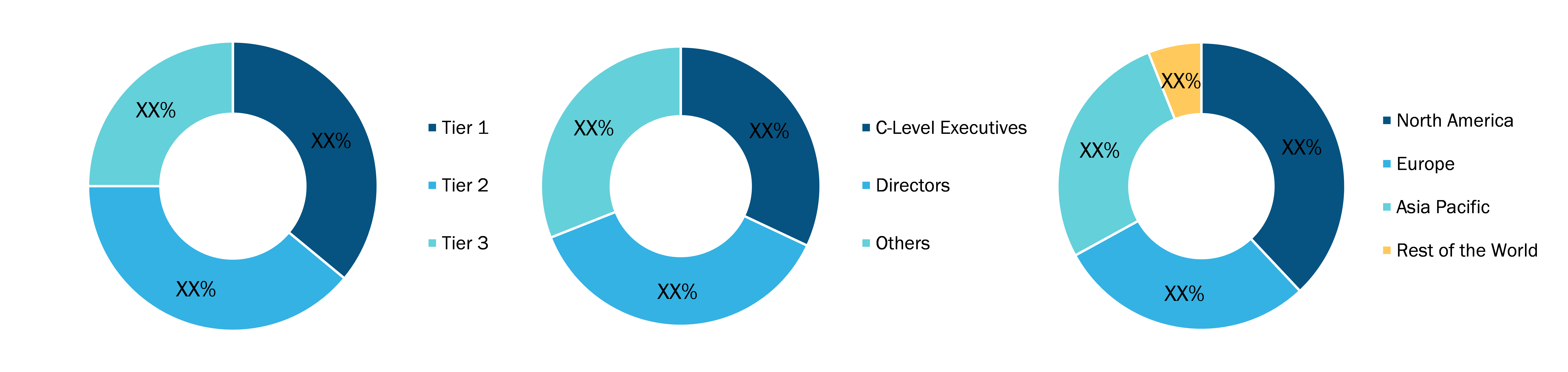
Below is the breakup of our primary respondents by company, designation, and region:
Once we receive the confirmation from primary research sources or primary respondents, we finalize the base year market estimation and forecast the data as per the macroeconomic and microeconomic factors assessed during data collection.
- Data Analysis:
Once data is validated through both secondary as well as primary respondents, we finalize the market estimations by hypothesis formulation and factor analysis at regional and country level.
- 3.1 Macro-Economic Factor Analysis:
We analyse macroeconomic indicators such the gross domestic product (GDP), increase in the demand for goods and services across industries, technological advancement, regional economic growth, governmental policies, the influence of COVID-19, PEST analysis, and other aspects. This analysis aids in setting benchmarks for various nations/regions and approximating market splits. Additionally, the general trend of the aforementioned components aid in determining the market's development possibilities.
- 3.2 Country Level Data:
Various factors that are especially aligned to the country are taken into account to determine the market size for a certain area and country, including the presence of vendors, such as headquarters and offices, the country's GDP, demand patterns, and industry growth. To comprehend the market dynamics for the nation, a number of growth variables, inhibitors, application areas, and current market trends are researched. The aforementioned elements aid in determining the country's overall market's growth potential.
- 3.3 Company Profile:
The “Table of Contents” is formulated by listing and analyzing more than 25 - 30 companies operating in the market ecosystem across geographies. However, we profile only 10 companies as a standard practice in our syndicate reports. These 10 companies comprise leading, emerging, and regional players. Nonetheless, our analysis is not restricted to the 10 listed companies, we also analyze other companies present in the market to develop a holistic view and understand the prevailing trends. The “Company Profiles” section in the report covers key facts, business description, products & services, financial information, SWOT analysis, and key developments. The financial information presented is extracted from the annual reports and official documents of the publicly listed companies. Upon collecting the information for the sections of respective companies, we verify them via various primary sources and then compile the data in respective company profiles. The company level information helps us in deriving the base number as well as in forecasting the market size.
- 3.4 Developing Base Number:
Aggregation of sales statistics (2020-2022) and macro-economic factor, and other secondary and primary research insights are utilized to arrive at base number and related market shares for 2022. The data gaps are identified in this step and relevant market data is analyzed, collected from paid primary interviews or databases. On finalizing the base year market size, forecasts are developed on the basis of macro-economic, industry and market growth factors and company level analysis.
- Data Triangulation and Final Review:
The market findings and base year market size calculations are validated from supply as well as demand side. Demand side validations are based on macro-economic factor analysis and benchmarks for respective regions and countries. In case of supply side validations, revenues of major companies are estimated (in case not available) based on industry benchmark, approximate number of employees, product portfolio, and primary interviews revenues are gathered. Further revenue from target product/service segment is assessed to avoid overshooting of market statistics. In case of heavy deviations between supply and demand side values, all thes steps are repeated to achieve synchronization.
We follow an iterative model, wherein we share our research findings with Subject Matter Experts (SME’s) and Key Opinion Leaders (KOLs) until consensus view of the market is not formulated – this model negates any drastic deviation in the opinions of experts. Only validated and universally acceptable research findings are quoted in our reports.
We have important check points that we use to validate our research findings – which we call – data triangulation, where we validate the information, we generate from secondary sources with primary interviews and then we re-validate with our internal data bases and Subject matter experts. This comprehensive model enables us to deliver high quality, reliable data in shortest possible time.
Trends and growth analysis reports related to Differential-Pressure Mass Flow Controller Market

Dec 2025
Defense and Aerospace NAND and NOR Flash Memory Market
Size and Forecast (2021 - 2031), Global and Regional Share, Trend, and Growth Opportunity Analysis Report Coverage: By Flash Memory Type (NAND Flash Memory and NOR Flash Memory), NAND Flash Memory (SLC, MLC, TLC, and Others), NOR Flash Memory (Parallel NOR and Serial NOR), NAND Flash Memory Architecture (2D NAND and 3D NAND), NOR Flash Memory Density (Upto 2 MB, 4 MB to 64 MB, 128 MB to 512 MB, and Greater than 1 GB), NAND Flash Memory Density (Upto 2 GB, 4 GB to 64 GB, 128 GB to 512 GB, and Above 1 Tb), and Region (North America, Europe, Asia Pacific, Middle East and Africa, and South and Central America)
Dec 2025
Differential-Pressure Mass Flow Controller Market
Size and Forecast (2021 - 2031), Global and Regional Share, Trend, and Growth Opportunity Analysis Report Coverage: By Flow Rate (Low, Medium, and High), Application (Semiconductors, Food and Beverages Industry, Chemicals, Pharmaceutical and Healthcare Industry, Oil and Gas, and Others), and Geography (North America, Europe, Asia Pacific, Middle East and Africa, and South and Central America)
Dec 2025
Coriolis Mass Flow Controller Market
Size and Forecast (2021 - 2031), Global and Regional Share, Trend, and Growth Opportunity Analysis Report Coverage: By Flow Rate (Low, Medium and High), Application (Semiconductors, Food and Beverages Industry, Chemicals, Pharmaceutical and Healthcare Industry, Oil and Gas, and Others), and Geography (North America, Europe, Asia Pacific, Middle East and Africa, and South and Central America)
Dec 2025
Monoblock Refrigeration Unit for Cold Room Market
Size and Forecast (2021 - 2031), Global and Regional Share, Trend, and Growth Opportunity Analysis Report Coverage: By Mounting Type (Wall Mounted and Ceiling Mounted), Capacity [Between Ten and Thirty Cubic Meters (10–30 cu m), Less than Ten Cubic Meters (less than 10 cu m), and Greater than Thirty Cubic Meters (Greater than 30 cu m)], End-User Industry (Food Retail, HoReCa, Cold Chain Logistics, Pharmaceutical or Healthcare, and Others), and Geography (North America, Europe, Asia Pacific, Middle East & Africa, and South & Central America)
Dec 2025
Parallel SLC NAND Flash Memory Market
Size and Forecast (2021 - 2031), Global and Regional Share, Trend, and Growth Opportunity Analysis Report Coverage: By Density (Above 8 GB, 8 GB, 4 GB, 2 GB, and 1 GB), Application (Industrial, Automotive, Consumer Electronics, Computers and IT, Communication, and Others), and Geography (North America, Europe, Asia Pacific, Middle East & Africa, and South & Central America)
Dec 2025
Serial SLC NAND Flash Memory Market
Size and Forecast (2021 - 2031), Global and Regional Share, Trend, and Growth Opportunity Analysis Report Coverage: By Density (1GB, 2GB, 4GB, 8GB, and Above 8GB); Application (Automotive, Industrial, Communication, Computers and IT, Consumer Electronics, and Others); and Geography (North America, Europe, Asia Pacific, Middle East & Africa, and South & Central America)
Dec 2025
Vertical Carousels ASRS Market
Size and Forecast (2021 - 2031), Global and Regional Share, Trend, and Growth Opportunity Analysis Report Coverage: By Type (Assembly, Distribution, Kitting, Order Picking, Storage, and Others), End use Industry (Automotive, Food and Beverages, Electronic and Semiconductors, E-Commerce, Chemicals, Aerospace, Retail, Pharmaceuticals and Others), and Geography (North America, Europe, Asia Pacific, Middle East and Africa, and South and Central America)
Dec 2025
Unit Load ASRS Market
Size and Forecast (2021 - 2031), Global and Regional Share, Trend, and Growth Opportunity Analysis Report Coverage: By Type (Assembly, Distribution, Kitting, Order Picking, Storage, Others), End Use Industry (Automotive, Food & Beverage, Electronic & Semiconductors, E-commerce, Chemicals, Aerospace, Retail, Pharmaceutical, Others), and Region (North America, Europe, Asia Pacific, Middle East and Africa, and South and Central America)