$4450
$3560
The cross belt sorters market size is projected to reach US$ 3.39 billion by 2031 from US$ 2.27 billion in 2024. The market is expected to register a CAGR of 6.07% during 2025–2031.
Cross Belt Sorters Market Analysis
The market's growth is driven by the rapid expansion of e-commerce, increasing demand for automation in supply chains, and the growing need for efficient material handling solutions. Technological advancements such as AI and IoT integration in sorting systems contribute to market development. Opportunities lie in emerging economies where industrial automation is rising and infrastructure is improving.
Cross Belt Sorters Market Overview
Cross belt sorters are commonly used to sort packages, clothing, and small things that are difficult to sort, such as fragile or high-friction products. Even with light handling, this technology provides tight divert points and rapid sortation speeds of more than 500 cartons per minute, allowing fast-moving sectors to maintain excellent performance.
This versatile sortation technique may be utilized for various applications, including inbound sortation, putaway, order fulfillment, cross-docking, shipping, kitting, and more. Its adaptability in handling mixed goods makes it suitable for various businesses.
Customize Research To Suit Your Requirement
We can optimize and tailor the analysis and scope which is unmet through our standard offerings. This flexibility will help you gain the exact information needed for your business planning and decision making.
Cross Belt Sorters Market: Strategic Insights


Naveen
Have a question?
Naveen will walk you through a 15-minute call to present the report’s content and answer all queries if you have any.
 Speak to Analyst
Cross Belt Sorters Market Drivers and Opportunities
Speak to Analyst
Cross Belt Sorters Market Drivers and Opportunities
Customize Research To Suit Your Requirement
We can optimize and tailor the analysis and scope which is unmet through our standard offerings. This flexibility will help you gain the exact information needed for your business planning and decision making.
Cross Belt Sorters Market: Strategic Insights
Naveen
Have a question?
Naveen will walk you through a 15-minute call to present the report’s content and answer all queries if you have any.
Speak to Analyst
Market Drivers:
E?commerce boom:
Massive growth in online shopping puts pressure on e-commerce to fulfil orders faster, reduce delivery lead times, and meet same?day or next?day delivery promises.Demand for efficiency, accuracy & order handling flexibility:
Sorters can handle various parcel/package sizes, weights, and shapes. It can provide- flexibility and high sorting accuracy, helping reduce mis?sorts and returns.
Omnichannel retailing:
Retailers now serve multiple channels (online, in?store pick up, etc.), requiring flexibility in order volumes, variable parcel sizes, returns, etc.Energy efficiency concerns:
Firms are increasingly under regulatory and social pressure to reduce energy consumption and environmental impact.Rising labour costs & shortage of manpower:
Growing labour costs and shortages of skilled workers for manual sorting increase the adoption of cross belt sorters.
Market Opportunities:
Technological advancements (AI, IoT, robotics, predictive analytics):
Use of sensors, AI, machine learning and IoT enables predictive maintenance, monitoring, optimization of sorter operations. Robotics helps in loading/unloading or handling difficult items. These tech improvements make sorters smarter, more reliable, and more cost?effective over time.Customized & modular systems:
Designing sorters that can scale, modular add?ons, configurable layouts, adaptable to different stock keeping unit (SKU) profiles, heights, and sizes. This lets firms tailor solutions to their specific usage, reduce unnecessary cost, and make upgrades easier.Sustainability / green logistics applications:
Using energy?efficient motors, recyclable materials, reducing power usage, or integrating renewable energy sources, meeting Environmental, Social, and Governance (ESG) criteria can give a competitive advantage.New end?use industries:
The growing demand in industries such as pharmaceuticals & healthcare (sortation of delicate or specialized items), food & beverage (hygienic standards), manufacturing (component sorting), airports (baggage), and others.Use of digital twins, simulation & smart layout planning:
Companies are increasingly concerned about resilience, e.g., ensuring redundancy, local sourcing of components, ability to handle supply chain disruptions, and regulatory compliance. This is pushing for more robust design, dual sourcing, etc.
Cross Belt Sorters Market Report Segmentation Analysis
The cross belt sorters market is divided into different segments to give a clearer view of how it works, its growth potential, and the latest trends. Below is the standard segmentation approach used in most industry reports:
By Type:
Linear Cross Belt Sorting:
Linear cross belt sorting systems are designed for efficient, high-speed sorting operations in logistics, e-commerce, and postal industries.Ring Cross Belt Sorting:
Ring cross belt sorters are circular sorting systems that utilize a continuous loop of small conveyor belts arranged in a ring configuration.
By Capacity:
Below 5,000 Units/Hour:
They are primarily used in small-scale operations such as regional distribution centers, specialty retailers, and e-commerce startups.5,000–15,000 Units/Hour:
5,000–15,000 units per hour range cater to mid-sized operations, including regional logistics hubs, larger retail fulfillment centers, and mid-tier e-commerce players.Above 15,000 Units/Hour:
Above 15,000 units per hour are designed for large-scale operations, such as national distribution centers, third-party logistics providers (3PLs), and global e-commerce giants.
By End-User Industry:
- Airports
- E-commerce, Retail, and Fashion
- Food and Beverages
- Manufacturing
- Automotive
- Logistics
- Others
Each sector has specific logistics and warehousing requirements. It influences cross belt sorter adoption and functionality preferences.
By Geography:
- North America
- Europe
- Asia Pacific
- Latin America
- Middle East & Africa
The cross belt sorters market in Asia Pacific is expected to witness the fastest growth. The need for faster order fulfilment, the booming e-commerce ecosystem, and investment in the booming e-commerce ecosystem are likely to drive the market.
Cross Belt Sorters Market Report ScopeCross Belt Sorters Market Share Analysis by Geography
Asia Pacific is expected to grow the fastest in the next few years. Emerging markets in Latin America, the Middle East, and Africa also have many untapped opportunities for cross belt sorters providers to expand.
The cross belt sorters market grows differently in each region owing to digital technology, government rules, how people shop, and online shopping. Below is a summary of market share and trends by region:
1. North America
Market Share:
Holds a significant portion of the global marketKey Drivers:
- E-commerce boom increases automation demand
- High labor costs boost robotics
- Advanced logistics infrastructure adoption is rising
Trends:
Rapid warehouse technology modernization
2. Europe
Market Share:
Substantial share due to early adoption of digital commerceKey Drivers:
- Strict labor regulations encourage automation
- Growing demand for order accuracy
- Green logistics pushing sorter efficiency
Trends:
Investments in smart warehousing solutions
3. Asia Pacific
Market Share:
Fastest-growing region with rising market share every yearKey Drivers:
- Explosive e-commerce platform expansion
- Manufacturing hubs need efficient logistics
- Urbanization is increasing parcel volume
Trends:
Rising retail and third-party logistics
4. South and Central America
Market Share:
Growing market with steady progressKey Drivers:
- E-commerce expansion in urban centers
- Increasing focus on efficiency gains
Trends:
Warehouse modernization is gaining momentum
5. Middle East and Africa
Market Share:
Although small, but growing quicklyKey Drivers:
- Growing investment in infrastructure
- Rising demand for fast delivery
Trends:
Smart city projects boosting logistics
Cross Belt Sorters Market Players Density: Understanding Its Impact on Business Dynamics
High Market Density and Competition
Competition is strong due to the presence of established players such as BEUMER Group GmbH & Co KG and Bastian Solutions LLC. Regional and niche providers such as Okura Yusoki Co., Ltd (Japan), GINFON Group (China), and Atmos Systems (India) are also adding to the competitive landscape across different regions.
This high level of competition urges companies to stand out by offering:
- Advanced security features
- Value-added services such as Analytics & predictive maintenance, real?time operational analytics, and installation
- Competitive pricing models
- Strong customer support and easy integration
Opportunities and Strategic Moves
- Manufacturers and system integrators increasingly collaborate with e?commerce logistics players and third?party logistics (3PLs) to co?deploy solutions optimized for high parcel volumes.
- Some vendors are bundling maintenance, software upgrades, and monitoring services (via IoT) as part of the package, moving toward outcome?based or performance?based contracts.
- Open architectures, modular sorter designs, and systems that can more easily integrate with legacy infrastructure, with APIs or IoT endpoints, are being emphasized by key vendors.
Other companies analysed during the course of research:
- Scaletronic ApS
- GreyOrange
- Damon-Group
- Huayuan (Shenzhen) Intelligent Equipment Co., Ltd.
- Softcon (Weonsoft)
- Toyota Industries Corporation
- Gosunm Intelligent Industry Co., Ltd.
- Falcon Autotech
- Hangzhou ConfirmWare Technology Co.
- Muvro Technologies
- Kion Group AG
- MURATA MACHINERY, LTD
- Vanderlande Industries B.V.
- Alstef Group
- Interroll Group
Cross Belt Sorters Market News and Recent Developments
FORTNA started the use of shoe sorter system
FORTNA automated a new Budbee e-commerce parcel hub in Jönköping, Sweden, using a shoe sorter system with loop functionality designed for high throughput and multiple outfeeds serving Budbee and Instabox customers, improving operational efficiencies.ConfirmWare showcases its intelligent intralogistics tilt tray sorter at the International Materials Handling & Logistics Exhibition, KOREA MAT
ConfirmWare showcased its intelligent intralogistics tilt tray sorter International Materials Handling & Logistics Exhibition, KOREA MAT in Korea. With a rich matrix of sorting equipment, auto put wall, 3D sorter, linear narrow belt sorter, and cross belt sorter as core products, ConfirmWare provides comprehensive and feasible overall solutions for the complex and numerous sorting requirements of e-commerce, third-party logistics, and other intralogistics scenarios.Major Merger: Bastian Solutions announces the merger of Viastore North America
Bastian Solutions announces the merger of Viastore North America into its operations. By combining the strengths of both organizations, the merger aims to create new opportunities for innovation, collaboration, and growth, delivering even more comprehensive automation solutions to customers.
Cross Belt Sorters Market Report Coverage and Deliverables
The "Cross Belt Sorters Market Size and Forecast (2021–2031)" report provides a detailed analysis of the market covering below areas:
- Cross Belt Sorters Market size and forecast at global, regional, and country levels for all the key market segments covered under the scope
- Cross Belt Sorters Market trends, as well as market dynamics such as drivers, restraints, and key opportunities
- Detailed PEST and SWOT analysis
- Cross Belt Sorters Market analysis covering key market trends, global and regional framework, major players, regulations, and recent market developments
- Industry landscape and competition analysis covering market concentration, heat map analysis, prominent players, and recent developments for the Cross Belt Sorters Market
- Detailed company profiles

Report Coverage
Revenue forecast, Company Analysis, Industry landscape, Growth factors, and Trends

Segment Covered
This text is related
to segments covered.

Regional Scope
North America, Europe, Asia Pacific, Middle East & Africa, South & Central America

Country Scope
This text is related
to country scope.
Frequently Asked Questions
Process comprises:1. Below 5000 units/hr2. 5000-15000 units/hr3. Above 15000 units/hr
The main trends include:1. Integration of IoT and AI for Real Time Optimization 2. Rise of Smart Warehousing and Automation3. Modular and Scalable System Designs
The cross belt sorter market is set to gain notable advantages due to an increasing demand for efficient, flexible, and high-throughput sorting solutions in logistics, e-commerce, and manufacturing sectors.
Asia Pacific leads in market share. North America, especially US and Canada, is witnessing the fastest growth due to expanding logistics and e-commerce industry.
1. Automation in Food, Healthcare, and Apparel Industries 2. Growth in Omnichannel Retail and Urban Logistics 3. Sustainability & Green Logistics Alignment
The market is projected to register a CAGR of 6.07% from 2025 to 2031, depending on the region and subsegment, such as linera cross belt sorting and ring cross belt sorting.
Key applications include:1. Airports2. E-commerce, Retail, and Fashion3. Food and Beverages4. Manufacturing5. Automotive 6. Logistics7. Others
The global cross belt sorters market was valued at US$ 2.27 million in 2024 and is expected to reach US$ 3.39 billion by 2031.
The List of Companies - Cross Belt Sorters Market
- BEUMER Group GmbH & Co KG
- Bastian Solutions LLC
- Fives SAS
- Okura Yusoki Co., Ltd
- GINFON Group
- Körber AG
- Atmos Systems
- Conveyco (Pty) Ltd
- Jiangsu Bealead Software Co., Ltd.
- CIMC Pteris Global
The Insight Partners performs research in 4 major stages: Data Collection & Secondary Research, Primary Research, Data Analysis and Data Triangulation & Final Review.
- Data Collection and Secondary Research:
As a market research and consulting firm operating from a decade, we have published many reports and advised several clients across the globe. First step for any study will start with an assessment of currently available data and insights from existing reports. Further, historical and current market information is collected from Investor Presentations, Annual Reports, SEC Filings, etc., and other information related to company’s performance and market positioning are gathered from Paid Databases (Factiva, Hoovers, and Reuters) and various other publications available in public domain.
Several associations trade associates, technical forums, institutes, societies and organizations are accessed to gain technical as well as market related insights through their publications such as research papers, blogs and press releases related to the studies are referred to get cues about the market. Further, white papers, journals, magazines, and other news articles published in the last 3 years are scrutinized and analyzed to understand the current market trends.
- Primary Research:
The primarily interview analysis comprise of data obtained from industry participants interview and answers to survey questions gathered by in-house primary team.
For primary research, interviews are conducted with industry experts/CEOs/Marketing Managers/Sales Managers/VPs/Subject Matter Experts from both demand and supply side to get a 360-degree view of the market. The primary team conducts several interviews based on the complexity of the markets to understand the various market trends and dynamics which makes research more credible and precise.
A typical research interview fulfils the following functions:
- Provides first-hand information on the market size, market trends, growth trends, competitive landscape, and outlook
- Validates and strengthens in-house secondary research findings
- Develops the analysis team’s expertise and market understanding
Primary research involves email interactions and telephone interviews for each market, category, segment, and sub-segment across geographies. The participants who typically take part in such a process include, but are not limited to:
- Industry participants: VPs, business development managers, market intelligence managers and national sales managers
- Outside experts: Valuation experts, research analysts and key opinion leaders specializing in the electronics and semiconductor industry.
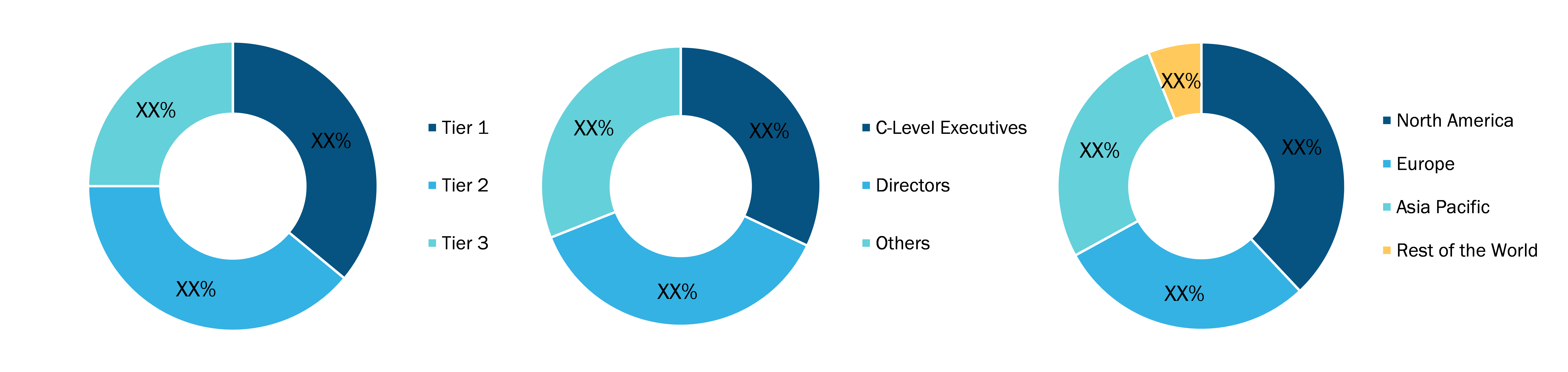
Below is the breakup of our primary respondents by company, designation, and region:
Once we receive the confirmation from primary research sources or primary respondents, we finalize the base year market estimation and forecast the data as per the macroeconomic and microeconomic factors assessed during data collection.
- Data Analysis:
Once data is validated through both secondary as well as primary respondents, we finalize the market estimations by hypothesis formulation and factor analysis at regional and country level.
- 3.1 Macro-Economic Factor Analysis:
We analyse macroeconomic indicators such the gross domestic product (GDP), increase in the demand for goods and services across industries, technological advancement, regional economic growth, governmental policies, the influence of COVID-19, PEST analysis, and other aspects. This analysis aids in setting benchmarks for various nations/regions and approximating market splits. Additionally, the general trend of the aforementioned components aid in determining the market's development possibilities.
- 3.2 Country Level Data:
Various factors that are especially aligned to the country are taken into account to determine the market size for a certain area and country, including the presence of vendors, such as headquarters and offices, the country's GDP, demand patterns, and industry growth. To comprehend the market dynamics for the nation, a number of growth variables, inhibitors, application areas, and current market trends are researched. The aforementioned elements aid in determining the country's overall market's growth potential.
- 3.3 Company Profile:
The “Table of Contents” is formulated by listing and analyzing more than 25 - 30 companies operating in the market ecosystem across geographies. However, we profile only 10 companies as a standard practice in our syndicate reports. These 10 companies comprise leading, emerging, and regional players. Nonetheless, our analysis is not restricted to the 10 listed companies, we also analyze other companies present in the market to develop a holistic view and understand the prevailing trends. The “Company Profiles” section in the report covers key facts, business description, products & services, financial information, SWOT analysis, and key developments. The financial information presented is extracted from the annual reports and official documents of the publicly listed companies. Upon collecting the information for the sections of respective companies, we verify them via various primary sources and then compile the data in respective company profiles. The company level information helps us in deriving the base number as well as in forecasting the market size.
- 3.4 Developing Base Number:
Aggregation of sales statistics (2020-2022) and macro-economic factor, and other secondary and primary research insights are utilized to arrive at base number and related market shares for 2022. The data gaps are identified in this step and relevant market data is analyzed, collected from paid primary interviews or databases. On finalizing the base year market size, forecasts are developed on the basis of macro-economic, industry and market growth factors and company level analysis.
- Data Triangulation and Final Review:
The market findings and base year market size calculations are validated from supply as well as demand side. Demand side validations are based on macro-economic factor analysis and benchmarks for respective regions and countries. In case of supply side validations, revenues of major companies are estimated (in case not available) based on industry benchmark, approximate number of employees, product portfolio, and primary interviews revenues are gathered. Further revenue from target product/service segment is assessed to avoid overshooting of market statistics. In case of heavy deviations between supply and demand side values, all thes steps are repeated to achieve synchronization.
We follow an iterative model, wherein we share our research findings with Subject Matter Experts (SME’s) and Key Opinion Leaders (KOLs) until consensus view of the market is not formulated – this model negates any drastic deviation in the opinions of experts. Only validated and universally acceptable research findings are quoted in our reports.
We have important check points that we use to validate our research findings – which we call – data triangulation, where we validate the information, we generate from secondary sources with primary interviews and then we re-validate with our internal data bases and Subject matter experts. This comprehensive model enables us to deliver high quality, reliable data in shortest possible time.
Trends and growth analysis reports related to Cross Belt Sorters Market

Oct 2025
Industial Rainscreen Cladding Market
Size and Forecast (2021 - 2031), Global and Regional Share, Trend, and Growth Opportunity Analysis Report Coverage: By Cladding Material (Ceramic, Timber, Composite Materials, Metals, and Others), Construction Type (New Construction and Renovation), and Geography
Oct 2025
Commercial Rainscreen Cladding Market
Size and Forecast (2021 - 2031), Global and Regional Share, Trend, and Growth Opportunity Analysis Report Coverage: By Cladding Material (Ceramic, Timber, Composite Materials, Metals, and Others), Construction Type (New Construction and Renovation), and Geography (North America, Europe, Asia Pacific, Middle East and Africa, and South America)
Oct 2025
Residential Rainscreen Cladding Market
Size and Forecast (2021 - 2031), Global and Regional Share, Trend, and Growth Opportunity Analysis Report Coverage: By Cladding Material (Ceramic, Timber, Composite Materials, Metals, and Others), Construction Type (New Construction and Renovation), and Geography (North America, Europe, Asia Pacific, Middle East and Africa, and South America)
Oct 2025
Ring Cross Belt Sorter Market
Size and Forecast (2021 - 2031), Global and Regional Share, Trend, and Growth Opportunity Analysis Report Coverage: By Capacity (Below 5000 units/hr, 5000-15000 units/hr , and above 15000 units/hr), End-Use Industry (Airports, E-Commerce, Retail and Fashion, Food and Beverages, Manufacturing, Automotive, Logistics, and Others), and Geography (North America, Europe, Asia Pacific, Middle East and Africa, and South America)
Oct 2025
Linear Cross Belt Sorter Market
Size and Forecast (2021 - 2031), Global and Regional Share, Trend, and Growth Opportunity Analysis Report Coverage: By Capacity (Below 5000 Units/Hr, 5000-15000 Units/Hr, and Above 15000 Units/Hr), End-Use Industry (Airports, E-Commerce, Retail, and Fashion; Food and Beverages; Manufacturing; Automotive; Logistics; and Others), and Geography (North America, Europe, Asia Pacific, Middle East and Africa, and South and Central America)
Oct 2025
Coordinate Grinding Machinery Market
Size and Forecast (2021 - 2031), Global and Regional Share, Trend, and Growth Opportunity Analysis Report Coverage : By Industry (Medical, Mold and Die Industry, Aerospace and Defense, Automotive, Electronics and Electrics, Industrial Machinery and Others), Machine Technology (CNC or NC Machine and Conventional Machine), and Geography (North America, Europe, Asia Pacific, Middle East and Africa, and South America)
Oct 2025
Cylindrical Grinding Machine Market
Size and Forecast (2021 - 2031), Global and Regional Share, Trend, and Growth Opportunity Analysis Report Coverage:By Type (External, Internal, and Others), Industry (Medical, Mold and Die Industry, Aerospace and Defense, Automotive, Electrics and Electronics, Industrial Machinery, and Others), Machine Technology (CNC or NC Machine and Conventional Machines), and Geography
Oct 2025
Aluminium Formwork Market
Size and Forecast (2021 - 2031), Global and Regional Share, Trend, and Growth Opportunity Analysis Report Coverage: By Offering (Solution, Services), Type (Slab Formwork, Wall Formwork, Corner Formwork, Beam Formwork, Others), Application (Industrial, Commercial, Residential), and Geography (North America, Europe, Asia Pacific, Middle East and Africa, and South and Central America)