
Cetirizine Hydrochloride Market Trends, Demand & Growth by 2034
Coverage: By Dosage Form (Syrup, Tablet, Solution); Age Group (Adult, Pediatric); Application (Allergic Rhinitis, Allergic Conjunctivitis, Eczema, Others); Distribution (Hospital Pharmacies, Retail Pharmacies, Online Pharmacies) , and Geography (North America, Europe, Asia Pacific, and South and Central America)
- Status : Data Released
- Report Code : TIPRE00027678
- Category : Life Sciences
- No. of Pages : 150
- Available Report Formats :


- Last update date : October 23, 2026


2025 Market Size
US$ 885.68 Mn
Base year value
2034 Forecast
US$ 1,010.16 Mn
Projected by 2034
CAGR 2026-2034
1.47 %
Growth rate
Addressable Market
US$ 8,580.57 Mn
(2026-2034)
The Cetirizine Hydrochloride Market was valued at US$ 885.68 Million in 2025 and is projected to reach US$ 1,010.16 Million by 2034. The market is expected to register a CAGR of 1.47% during 2026–2034. The demand will continue to be based on the already recognized use of cetirizine for allergic rhinitis, allergic conjunctivitis, and eczema, facilitated by its wide distribution through both Rx and OTC markets.
North America is seen as a mature yet robust Cetirizine Hydrochloride Market Size with a forecasted CAGR of ~1% over the period up to 2034. It will be positively impacted by high consumer awareness about second-generation antihistamines, numerous private labels available, good coverage by retail pharmacies. Up-to-date labeling, new packaging options, pediatric formulations, and online availability should further drive replacement and seasonal sales.
Cetirizine Hydrochloride Market Assessment and Insights
Regional Outlook
- North America: ~36% of the global market in 2025 | ~1% CAGR through 2034. Market position: North America ranks first, supported by high OTC accessibility, extensive pharmacy coverage, established branded and private-label products, and recurring demand associated with seasonal and perennial allergic conditions.
- US: ~86% of North American market revenue in 2025 | ~1% CAGR through 2034. Market position: The US leads North America through large retail networks, frequent product-label updates, broad generic availability, and substantial utilization across allergic rhinitis, ocular allergy, and dermatological symptom management.
- Europe: ~30% of the global market in 2025 | ~1% CAGR through 2034. Market position: Europe is a mature market with standardized generic prescribing and pharmacy-led distribution. Germany leads the region, while the UK, France, Italy, and Spain maintain significant consumption.
- Asia Pacific: ~25% of the global market in 2025 | ~3% CAGR through 2034. Market position: Asia Pacific is the fastest-growing region as urban allergy exposure, pharmaceutical access, domestic manufacturing, and online pharmacy adoption expand. China leads regional revenue, followed by Japan and India.
Segment Outlook
- Tablet: ~64% Share in 2025 | ~1% CAGR through 2034. Market position: Tablets lead through low unit costs, manufacturing scalability, long shelf life, once-daily administration, extensive generic competition, and suitability for adult consumers purchasing through retail and hospital pharmacies.
- Online Pharmacies: ~18% Share in 2025 | ~4% CAGR through 2034. Market position: Online pharmacies show the strongest growth outlook as digital ordering, home delivery, price comparison, electronic prescriptions, and discreet replenishment improve access to allergy treatments.
Competitive Coverage
Kenvue Inc., Viatris Inc., Nicox S.A., Strides Pharma Science Limited, Apotex Inc., Teva UK Limited, Aurobindo Pharma Limited, Jubilant Pharmova Limited, Tris Pharma, Inc., Cipla Limited, Dr. Reddy’s Laboratories Ltd.
Methodology
The Insight Partners follows Data Collection & Secondary Research, Primary Research, Data Analysis, and Data Triangulation & Final Review to validate market estimates and insights.
Source: The Insight Partners' analysis based on proprietary research, government publications, company annual reports, investor presentations, industry databases, and expert interviews.
From an antihistamine that is predominantly prescribed and branded, cetirizine has emerged as a readily available medication that comes in branded OTC, generic, private label, pediatric, and speciality forms. Its manufacturing has become more reliant on outsourcing to generic manufacturers that have vertically integrated sources for the manufacture of the drug's active ingredients. The tablet form dominates the economics of manufacture, while the oral solution and syrup forms serve those who need dose flexibility. The emphasis in regulation has moved from bioequivalence to improved labeling, pharmacovigilance, package differentiation, flavors, and manufacturing control.
The incremental growth during the period between 2015 to 2034 will become increasingly dependent upon the Asia Pacific region, online pharmacies, pediatric products, and poorly developed secondary cities. The investments made will probably be in formulation line efficiency, compliance export capacity, supply chain redundancy, and product differentiation rather than molecule discovery. The implementation of new labeling and warning regulations will increase compliance costs; nevertheless, it is good for firms that have developed quality systems and regulatory expertise.
Cetirizine Hydrochloride Market Report Scope
| Report Attribute | Details |
|---|---|
| Market size in 2025 | US$ 885.68 Million |
| Market Size by 2034 | US$ 1,010.16 Million |
| Global CAGR (2026 - 2034) | 1.47% |
| Historical Data | 2021-2024 |
| Forecast period | 2026-2034 |
Cetirizine Hydrochloride Market Analysis
The main driver of growth for the Cetirizine Hydrochloride Market is the periodic requirement to treat allergies induced by pollen, dust mites, animal dander, pollutants, and other allergens. The demand for this drug is steady owing to its familiarity, affordability, and availability in various modes of administration. The value chain includes manufacturers of active ingredients, formulators, packagers, distributors, hospitals, pharmacies, and online portals.
The supply side has many generic substitutes and a fair manufacturing capacity in India and other Asian centers for drug manufacturing. The standard production of the tablet form makes economies of scale easy to achieve, but competition limits price flexibility. Differentiation on the part of producers is made possible by pack size, pediatric dosage form, flavorings, private labeling, regulation compliance, and logistics range. The quality control ability is commercially significant as any recalls and labeling problems can cut off any relations with retailers and increase working capital. As per the Cetirizine Hydrochloride Market Report, the market is highly fragmented in terms of its competitive structure, consisting of brand owners for consumer health, multinationals for generics, regional players, and formulation specialists. Kenvue Inc. has an advantage due to the Zyrtec brand, whereas the competitors are Viatris Inc., Apotex Inc., Teva UK Limited, Aurobindo Pharma Limited, Cipla Limited, and Dr. Reddy’s Laboratories Ltd.
Strategic investment is related to the efficiencies of production, shortened application process, export registration, pediatric liquids, unique administration methods, and retail channel relationships. Nicox S.A. offers opportunities in regard to ophthalmic cetirizine, and Tris Pharma, Inc. adds value via its liquid formulations technology. Strides Pharma Science Limited and Jubilant Pharmova Limited provide support for the contract manufacturing and generic drugs space. Competitive advantage is achieved through supply reliability, documentation, channel performance, and product range rather than price alone.
● REPORT CUSTOMIZATION
Tailor This Report To Align With Your Specific Business Requirements
This report can be customized to align precisely with your business objectives, scope, and target markets. Customization options include tailored segmentation, geography, competitive analysis, and strategic insights to support informed decision-making.
Customize This Report →WHAT YOU CAN ADJUST
- ● Segmentations
- ● Geography
- ● Competitive Analysis
- ● Language Preferences
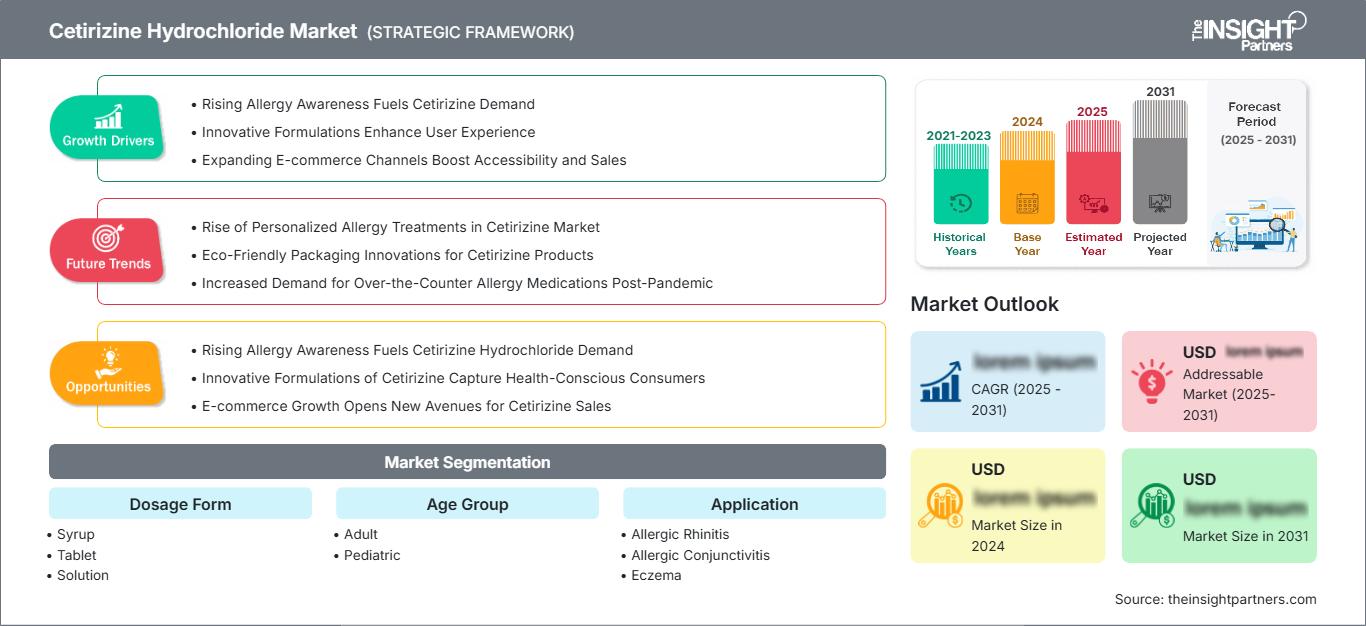
Cetirizine Hydrochloride Market: Strategic Insights
Regional Insights
North America Cetirizine Hydrochloride Market
North America contributed around 36% to the overall market’s revenues in 2025 and is projected to experience a growth rate of around 1% during 2025-2034. The region’s position can be attributed to the wide availability in supermarkets, mass merchandisers, pharmacies within communities, hospital pharmacies, and online retailing. The Cetirizine Hydrochloride Market share of the region will benefit from consumers’ awareness of 24-hour allergy products and significant private label substitution.
Growth will be moderate owing to high levels of product penetration and strong price competition between generics. Future prospects include the development of pediatric formulations, better packaging, omnichannel distribution, and special labeling. Updated guidelines on product warning and packaging need regular investments to comply with, and the existing distribution network will facilitate fast adoption of innovations.
U.S. Cetirizine Hydrochloride Market
Approximately 86% of North American revenues were generated from the US in 2025, and the region is projected to grow at a CAGR of around 1% during 2025-2034. The large size of the market is driven by high OTC penetration, pharmacy chains, warehouse clubs, mass retail, hospital networks, and online channels.
Allergic rhinitis continues to be the key application, along with demand for ocular and skin allergy relief products. Kenvue Inc. sustains branded visibility; on the other hand, generics providers compete in various strengths, pack sizes, and dosage forms. A number of recent regulations concerning tablet, chewable, capsule, and oral liquid labels have shown the significance of lifecycle management.
Europe Cetirizine Hydrochloride Market
Europe accounted for ~30% of total global revenue in 2025 and is estimated to witness a ~1% CAGR between 2025 and 2034. Second generation antihistamines' generic prescribing, well-established community pharmacy system, reimbursement model and popularity drive sustained demand in the region. Market maturity, procurement pressure, and competition from other antihistamines limit revenue growth.
Germany is the largest country within Europe driven by the size of its pharmaceutical market, its pharmacy networks and usage of generics. The United Kingdom leverages community pharmacy and over-the-counter availability whereas France maintains demand due to the involvement of physicians and pharmacists. Italy and Spain are characterized by seasonal consumption due to pollen allergy and favorable climate.
Companies active in Europe need to deal with country specific packaging requirements, language issues, registration and distribution needs. Teva UK Limited, Viatris Inc., Apotex Inc., and many other generics manufacturers compete based on reliable supply and compliance of their product range. Opportunities exist only in efficient tender business, pediatric products, private label and online pharmacy business.
APAC Cetirizine Hydrochloride Market
Asia Pacific accounted for ~25% of global revenue in 2025 and is expected to grow at a ~3% CAGR through 2034, making it the fastest-growing region. China is the leading country in Asia Pacific, driven by population scale, expanding pharmacy coverage, domestic production, and rising treatment access.
The markets in Japan and South Korea are matured and regulated, whereas the market in India is one where there is both a huge number of patients and a good potential for formulating and manufacturing active ingredients. Australia comes into the picture with its existing retail pharmacy demand.
Middle East & Africa Cetirizine Hydrochloride Market
The Middle East & Africa market is projected to expand at a ~2% CAGR through 2034. Saudi Arabia is the leading country in the Middle East & Africa, supported by healthcare investment, organized pharmacy chains, public procurement, and growing pharmaceutical localization. The UAE benefits from modern retail infrastructure and regional distribution capabilities.
As a result, South Africa is the country that sustains the demands of sub-Saharan Africa through the well-developed pharmaceutical distribution systems. In the other parts of the region, growth requires affordable medicines, reliable imports, storage facilities at controlled temperatures where needed, and distribution outside large cities. The development of healthcare infrastructure and localization initiatives will increase availability.
Segmentation Analysis
Dosage Form
Dosage Form is projected to record a ~1% CAGR during 2026–2034. The Cetirizine Hydrochloride Market scope covers syrup, tablet, and solution products designed for different age groups and administration needs. Manufacturing economics favor tablets, while liquid formats support pediatric dosing and patients experiencing swallowing difficulty. Product differentiation increasingly involves flavor, dosing convenience, packaging, and retailer-specific configurations.
- Syrup: Syrup is strategically important in pediatric care because it enables flexible dosing and easier administration. Demand is supported by caregivers, pediatric clinics, and retail pharmacies, although flavor stability, measuring accuracy, and packaging requirements increase production complexity.
- Tablet: Tablet products hold the strongest market position through low manufacturing costs, portability, dose consistency, and long shelf life. Extensive generic competition and broad OTC placement make tablets the primary format for adult allergy management.
- Solution: Solutions address pediatric and swallowing-sensitive users while supporting precise dose adjustment. Their importance is rising in branded pediatric portfolios, but transport weight, bottle integrity, preservation, and shorter post-opening usability require careful supply-chain management.
Age Group
Age Group segment in the Cetirizine Hydrochloride Market is forecast to expand at a ~2% CAGR through 2034. Adult demand provides the largest recurring consumption base, while pediatric requirements support differentiated liquid, chewable, and lower-strength products. Age-appropriate labeling, caregiver education, dosage measurement, and physician guidance influence purchasing. Manufacturers with both adult and pediatric configurations can serve a wider household treatment cycle.
- Adult: Adults form the principal demand group because of occupational exposure, seasonal rhinitis, indoor allergens, and self-directed OTC purchasing. Once-daily tablets dominate this category, with convenience, affordability, and limited perceived sedation shaping product selection.
- Pediatric: Pediatric demand favors syrups and oral solutions that permit age-appropriate dosing. Palatable flavors, child-resistant closures, clear measuring devices, and trusted pharmacy recommendations are strategically important for brands seeking caregiver acceptance and repeat purchases.
Application
Application segment in the Cetirizine Hydrochloride Market is expected to register a ~1% CAGR during 2026–2034. Allergic rhinitis generates the broadest utilization, while allergic conjunctivitis and eczema-related itching create complementary demand. Application growth is influenced by environmental allergen exposure, diagnosis, symptom recurrence, and access to OTC medicines. Oral cetirizine also competes with topical, intranasal, and alternative systemic treatments.
- Allergic Rhinitis: Allergic rhinitis is the core application due to recurring nasal itching, sneezing, rhinorrhea, and associated ocular symptoms. Seasonal purchase peaks encourage retailers to optimize shelf placement, inventory timing, and promotional pack availability.
- Allergic Conjunctivitis: Oral and ophthalmic cetirizine products support patients experiencing itchy or watery eyes linked to allergen exposure. This application offers differentiation potential through targeted eye-care formulations and coordinated oral-plus-ocular treatment portfolios.
- Eczema: Eczema-related use primarily concerns relief of allergy-associated itching rather than treatment of the underlying skin-barrier disorder. Demand is therefore complementary and often guided by clinicians, pharmacists, or broader dermatological treatment plans.
Distribution
Distribution segment in the Cetirizine Hydrochloride Market is projected to achieve a ~2% CAGR through 2034. Retail pharmacies currently provide the broadest consumer access, while hospitals serve acute, supervised, and prescription-linked requirements. Online channels are gaining importance through convenience and price transparency. Omnichannel inventory coordination will become increasingly important for preventing stockouts during seasonal demand peaks.
- Hospital Pharmacies: Hospital pharmacies support supervised treatment, discharge prescriptions, pediatric care, and acute allergy management. Their strategic importance is greater for injectable, specialty, or institutionally administered formulations than for routine OTC tablet purchases.
- Retail Pharmacies: Retail pharmacies remain the principal point of access because pharmacists can guide product selection and dosing while supplying branded and generic alternatives. Their geographic reach sustains both planned purchases and immediate symptom-driven demand.
- Online Pharmacies: Online pharmacies benefit from home delivery, digital comparison, subscription purchasing, and access in areas with limited physical retail choice. Regulatory compliance, authentic sourcing, and reliable last-mile delivery remain essential adoption conditions.
Opportunity Snapshot
| Application | Revenue Contribution | Trend Tag | Adoption Stage |
| Allergic Rhinitis | High | Seasonal Control | Mature |
| Allergic Conjunctivitis | Medium | Ocular Relief | Scaling |
| Eczema | Low | Itch Management | Mature |
Cetirizine Hydrochloride Market Growth Drivers and Impact Analysis
Persistent Exposure to Environmental Allergens
Urban air pollution, changing pollen seasons, indoor dust, mold, and animal dander sustain recurring allergy symptoms across developed and emerging markets. Cetirizine benefits from familiarity, once-daily administration, and availability without a prescription in many countries. The commercial impact is consistent seasonal inventory movement rather than rapid category creation. Manufacturers can improve performance through demand forecasting by geography, pollen-cycle inventory planning, and coordinated retail placement. Suppliers with flexible production schedules are better positioned to respond to spring and autumn peaks without accumulating excessive off-season stock.
Broad Generic and OTC Accessibility
Patent maturity and extensive generic competition have made cetirizine affordable across hospital, retail, and online channels. Low prices expand access and support household stocking, although they compress manufacturer margins. Commercial success therefore depends on scale, procurement efficiency, supplier reliability, and high manufacturing utilization. Private-label programs create volume opportunities for qualified producers, while recognizable brands can defend value through packaging, consumer trust, pediatric options, and product consistency. Wider OTC access also transfers greater importance to clear labeling and pharmacist-led guidance.
Expansion of Pediatric and Flexible-Dose Products
Pediatric allergy management creates demand for syrups and oral solutions that enable measured administration and easier swallowing. These products require formulation expertise involving taste masking, preservatives, bottle design, dosing devices, and stability. The impact extends beyond incremental volume because pediatric formats can strengthen household brand loyalty and pharmacy recommendations. Companies able to demonstrate consistent dosing, child-resistant packaging, and dependable quality can differentiate themselves from undifferentiated tablet suppliers. Flavor extensions and convenient pack sizes may further improve caregiver acceptance.
Cetirizine Hydrochloride Market Future Trends
Lifecycle Innovation in Established Formulations
Cetirizine Hydrochloride Market trends will increasingly focus on lifecycle innovation rather than changes to the active molecule. Manufacturers are expected to use flavor variants, chewable formats, alternative pack sizes, improved dosing devices, and application-specific delivery systems to create differentiation. Regulatory updates will make labeling agility a competitive capability, particularly for companies operating across several dosage forms. Digital instructions and accessible packaging may improve appropriate use, while formulation portfolios spanning tablets, liquids, capsules, and ocular products can broaden channel coverage without requiring novel chemical development.
Data-Led Omnichannel Allergy Management
Retailers and manufacturers are likely to connect pollen information, digital search behavior, pharmacy inventories, and local purchasing patterns to forecast allergy demand more accurately. This shift could reduce stockouts during high-exposure periods and limit obsolete inventory after seasonal peaks. Online pharmacies will complement physical stores by enabling repeat purchasing and rapid delivery. Companies that integrate demand data with regional production planning can improve service levels, although privacy, advertising, and pharmacy-regulation requirements will determine how extensively personalized prompts are used.
Cetirizine Hydrochloride Market Opportunities
Localized Manufacturing for Emerging Markets
Manufacturers can invest in regional packaging, formulation, or contract production capacity to reduce import dependence and improve tender responsiveness. Cetirizine Hydrochloride Market Forecasts indicate that Asia Pacific and selected Middle Eastern markets offer the clearest incremental demand potential through 2034. A successful localization strategy should combine validated active ingredient sourcing, scalable tablet and liquid lines, country-specific registrations, and reliable distribution partnerships. The opportunity is strongest where governments favor domestic pharmaceutical production and where pharmacy access is expanding beyond major metropolitan areas.
Channel-Specific and Private-Label Portfolios
Retail chains, e-commerce platforms, hospitals, and community pharmacies require different pack sizes, price points, and service models. Suppliers can pursue dedicated private-label contracts, seasonal multipacks, pediatric bundles, and professionally oriented hospital configurations. This strategy requires strict batch consistency, responsive packaging operations, and strong retailer forecasting links. Rather than competing only on unit price, manufacturers can create value through high order-fill rates, rapid regulatory updates, traceability, and product portfolios capable of serving both physical and digital channels.
Recent Developments
- July 2026: Unique Pharmaceutical Laboratories, a division of J. B. Chemicals & Pharmaceuticals Ltd. – The company initiated a voluntary US recall of four lots of cetirizine hydrochloride 5 mg tablets distributed by Rising Pharma Holdings Inc. after potential cross-contamination with ranitidine was identified. The action highlights the commercial importance of contamination controls, visual inspection, traceability, and rapid recall execution.
- February 2026: Kenvue Brands LLC – The US FDA approved revised Zyrtec Allergy and Zyrtec Hives labeling addressing rare new-onset itching after discontinuation of cetirizine. The approval covered numerous tablet pack configurations and reflects the continuing need for branded and generic suppliers to maintain current warnings, graphics, and distributor details throughout product lifecycles.
- October 2024: Indoco Remedies Limited – The company received final US FDA approval for its abbreviated new drug application for cetirizine hydrochloride tablets USP, 10 mg OTC, referencing Zyrtec Allergy. Manufacturing was assigned to Indoco’s facility in Verna, Goa, strengthening its participation in the US nonprescription allergy category and widening the pool of approved generic suppliers.
Frequently Asked Questions

- Comprehensive Market Sizing and Forecast Analysis
- Detailed Segmentation Analysis
- In-Depth Market Dynamics Assessment
- Regional and Country-Level Insights
- Competitive Landscape and Company Benchmarking
- Strategic Business Intelligence
Recent Reports
Testimonials

The Insight Partners provided valuable market intelligence that supported our global go-to-market strategy. Their team was professional, responsive, and attentive to our feedback, providing thoughtful analysis and helpful methodological clarifications throughout the project.
Junmo Kim Chief Financial Officer (CFO), Enertech Co., Ltd.
The Insight Partners' SCADA System Market report is comprehensive, with valuable insights on current trends and future forecasts. The team was highly professional, responsive, and supportive throughout. We are very satisfied and highly recommend their services.
RAN KEDEM Partner, Reali Technologies LTDs
I requested a report on a very specific software market and the team produced the report in a few days. The information was very relevant and well presented. I then requested some changes and additions to the report. The team was again very responsive and I got the final report in less than a week.
JEAN-HERVE JENN Chairman, Future Analytica
We worked with The Insight Partners for an important market study and forecast. They gave us clear insights into opportunities and risks, which helped shape our plans. Their research was easy to use and based on solid data. It helped us make smart, confident decisions. We highly recommend them.
PIYUSH NAGPAL Sr. Vice President, High Beam Global
The Insight Partners delivered insightful, well-structured market research with strong domain expertise. Their team was professional and responsive throughout. The user-friendly website made accessing industry reports seamless. We highly recommend them for reliable, high-quality research services
YUKIHIKO ADACHI CEO, Deep Blue, LLC.
This is the first time I have purchased a market report from The Insight Partners.While I was unsure at first, I visited their web site and felt more comfortable to take the risk and purchase a market report.I am completely satisfied with the quality of the report and customer service. I had several questions and comments with the initial report, but after a couple of dialogs over email with their analyst I believe I have a report that I can use as input to our strategic planning process.Thank you so much for taking the extra time and making this a positive experience.I will definitely recommend your service to others and you will be my first call when we need further market data.
JOHN SUZUKI President and Chief Executive Officer, Board Director, BK Technologies
I wish to appreciate your support and the professionalism you displayed in the course of attending to my request for information regarding to infectious disease IVD market in Nigeria. I appreciate your patience, your guidance, and the fact that you were willing to offer a discount, which eventually made it possible for us to close a deal. I look forward to engaging The Insight Partners in the future, all thanks to the impression you have created in me as a result of this first encounter.
DR CHIJIOKE ONYIA MANAGING DIRECTOR, PineCrest Healthcare Ltd.Reason to Buy
- Informed Decision-Making
- Understanding Market Dynamics
- Competitive Analysis
- Identifying Emerging Markets
- Customer Insights
- Market Forecasts
- Risk Mitigation
- Boosting Operational Efficiency
- Strategic Planning
- Investment Justification
- Tracking Industry Innovations
- Aligning with Regulatory Trends





 Get Free Sample for