
Asia-Pacific and MEA Solder Materials Market Demand & Forecast 2034
Coverage: By Product (Wire, Paste, Bar, Spheres, and Others), Process (Printer, Laser, Wave, Reflow, and Others), Type (Lead-Based and Lead-Free), Application (Consumer Electronics, Automotive, Industrial Equipment, Telecommunications, and Others), and Geography (Asia Pacific and the Middle East & Africa)
- Status : Published
- Report Code : TIPRE00044070
- Category : Chemicals and Materials
- No. of Pages : 435
- Available Report Formats :


- Last update date : October 06, 2026


2025 Market Size
US$ 5,080.11 Mn
Base year value
2034 Forecast
US$ 8,344.68 Mn
Projected by 2034
CAGR 2026-2034
5.7 %
Growth rate
Addressable Market
US$ 60,943.85 Mn
(2026-2034)
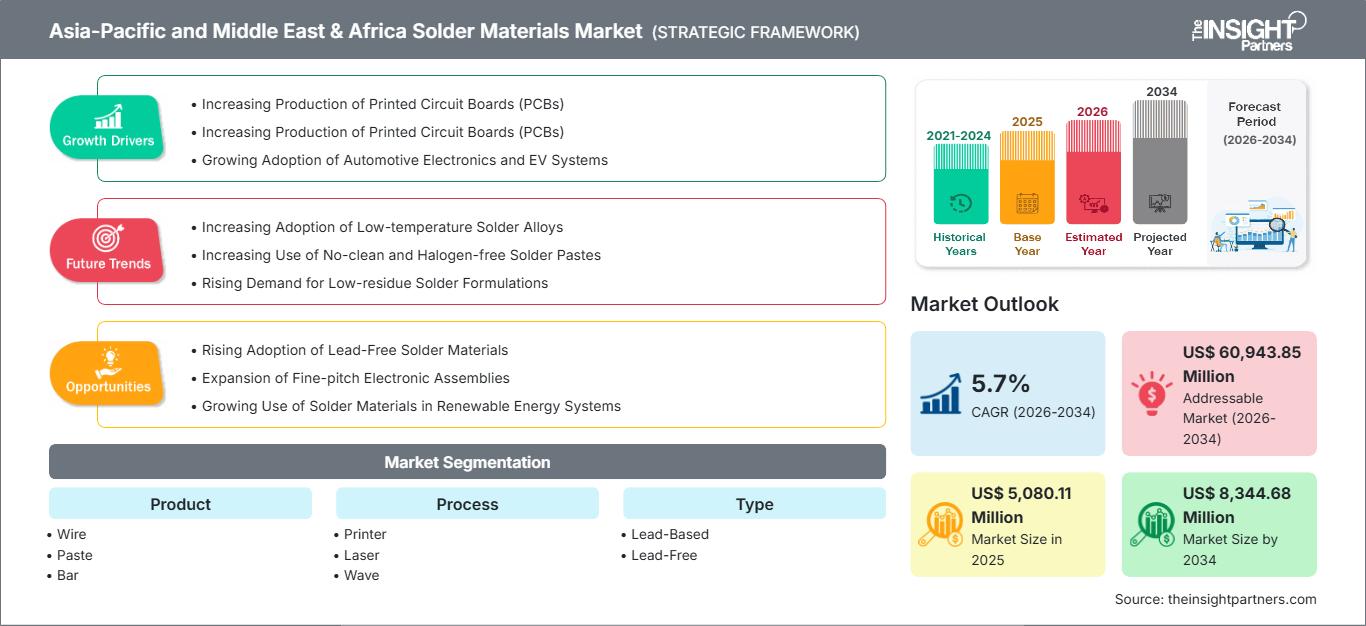
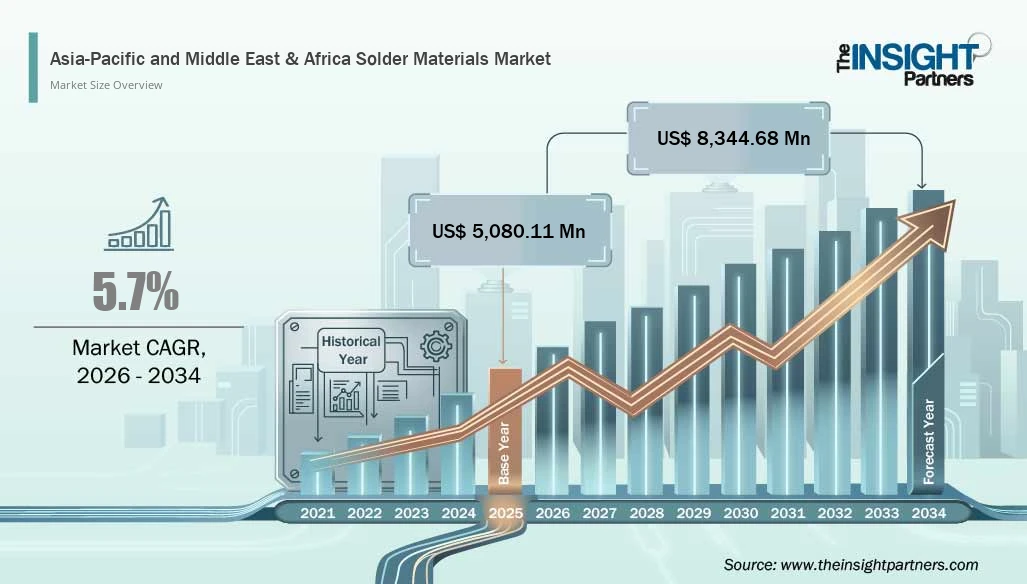
The Asia-Pacific and MEA Solder Materials Market was valued at US$ 5,080.11 million in 2025 and is projected to reach US$ 8,344.68 million by 2034, expanding at a CAGR of 5.7% during 2026–2034. The market involves soldering material used for forming secure electrical and mechanical connections in electronic assemblies and components. This encompasses Wire, Paste, Bar, Spheres, and Others based on Product; Printer, Laser, Wave, Reflow, and Others based on Process; Lead-Based and Lead-Free based on Type; and Consumer Electronics, Automotive, Industrial Equipment, Telecommunications, and Others based on Application.
Within the larger landscape of electronics material markets, North America is outside the defined geographic scope of this research. The research will instead focus on the Asia Pacific and Middle East & Africa regions, which are influenced by electronics manufacturing, automotive electrification, industrial automation, telecommunications infrastructure, and localized assembly capabilities. The geographic scope will enable the Asia-Pacific and MEA Solder Materials Market Size in relation to manufacturing intensity, technology adoption, regulatory environment, and local supply chain evolution.
Asia-Pacific and MEA Solder Materials Market Assessment and Insights
Regional Outlook
- Asia Pacific: ~83% of the defined regional market in 2025 | ~6% CAGR through 2034. Market position: Asia Pacific represents the dominant regional market within the study scope, supported by extensive electronics manufacturing, semiconductor packaging, consumer-device assembly, automotive electronics, and established solder-material production networks across major manufacturing economies.
- Middle East & Africa: ~17% of the defined regional market in 2025 | ~5% CAGR through 2034. Market position: Middle East & Africa has a smaller installed electronics manufacturing base but benefits from industrial diversification, telecommunications deployment, automotive assembly, infrastructure modernization, and increasing localization of electronics-related manufacturing and repair activities.
Segment Outlook
- Paste: ~45% Share in 2025 | ~6% CAGR through 2034. Market position: Paste leads because surface-mount technology depends heavily on controlled deposition of solder powder and flux. Fine-pitch components, miniaturization, automated printing, and high-density boards continue to reinforce paste consumption across electronics and automotive assemblies.
- Automotive: ~27% Share in 2025 | ~7% CAGR through 2034. Market position: Automotive represents the high-growth application because electronic content is increasing in powertrain controls, ADAS, infotainment, sensors, battery systems, and vehicle connectivity, raising demand for thermally stable and mechanically reliable solder joints.
Competitive Coverage
Indium Corporation, KOKI COMPANY LIMITED, Stannol GmbH & Co. KG, National Solder Co (Pty) Ltd, Nihon Superior Co., Ltd., Senju Metal Industry Co., Ltd., Tamura Corporation, Harima Chemicals Group, Inc., Shenmao Technology, Inc., Qualitek International, Inc., AIM Products LLC, Shenzhen Jufeng Solder Co., Ltd., SMT AfriTech, Shenzhen Tongfang Electronic New-Material Co., Ltd., Shenzhen Qingye Electronic New Materials Co., Ltd.
Methodology
The Insight Partners follows Data Collection & Secondary Research, Primary Research, Data Analysis, and Data Triangulation & Final Review to validate market estimates and insights.
Source: The Insight Partners' analysis based on proprietary research, government publications, company annual reports, investor presentations, industry databases, and expert interviews.
The Asia-Pacific and MEA Solder Materials Market has emerged on the back of shift in production from the conventional through-hole to surface-mount technologies. Solder paste is one of the widely used soldering materials, driven by the increasing density of printed electronic assemblies, whereas wire and bars will be useful for selective, wave, hand soldering and rework operations. The need for lead-free solder materials is also increasing due to environment standards and customer demands. Low voids, good wetting properties, heat resistance, halogen-free composition and suitability with automation are some of the ways to differentiate material providers.
In the future, changes to the market include electronic components localization, semiconductors packaging investments, vehicle electrification, and industrial electronics in developing Asian countries. India and Southeast Asia are creating localized ecosystems for electronics manufacturing, while China, Japan, South Korea, and Taiwan have maintained their focus on advanced capabilities for components and assembly of those components. In ME&A region, industrial diversification and investments into digital infrastructure will expand the customer base that the product can reach. Regulations will also play a role in determining the choice of alloys, especially since restrictions of use of lead-based materials are becoming more application-specific, thus creating technically feasible substitutes.
Asia-Pacific and MEA Solder Materials Market Report Scope
| Report Attribute | Details |
|---|---|
| Market size in 2025 | US$ 5,080.11 Million |
| Market Size by 2034 | US$ 8,344.68 Million |
| CAGR (2026 - 2034) | 5.7% |
| Historical Data | 2021-2024 |
| Forecast period | 2026-2034 |
Asia-Pacific and MEA Solder Materials Market Analysis
The demand in the industry is driven by the volumes of electronics assembly, along with the increasing number of solder joints needed in smaller, connected, and high-power devices. Consumer electronics continue to represent a significant part of the consumption, while automotive electronics generate demand for materials that can function in a vibrating environment and temperature variations. Industrial equipment and telecommunications contribute to diversified demand via control boards, power modules, network components, and infrastructure electronics. The value chain includes tin, silver, copper, bismuth, lead, flux chemistry, additives, alloys, powders, pastes, wire bars, packaging, and distribution.
The supply chain relies not only on the metals but also on the knowledge about the formulations. Tin is critical because it makes up the base for most solder alloys without lead, whereas silver and copper affect conductivity, melting point, reliability, and price. Consequently, companies more and more try to develop alloy formulations rather than rely solely on the classical SAC formulations. Regional production is essential because the electronics clients require prompt delivery, process qualifications, consistent properties of the powder, and technical support.
The competitive setting in the Asia-Pacific and MEA Solder Materials Market Report includes large, specialized manufacturers of solder materials, together with local manufacturers meeting the needs of price sensitive and application specific customers. Indium Corporation focuses on high-reliability materials for power electronics and advanced packaging, while KOKI COMPANY LIMITED has increased its presence in Asian manufacturing facilities and continues to develop low void and lead-free solder technologies. Senju Metal Industry Co., Ltd. and Nihon Superior Co., Ltd. have strong positions in terms of advanced alloys and solder materials technology. Tamura Corporation includes solder materials, electronic chemicals and manufacturing technologies.
Other companies compete with the aid of formulation specialization, geographical location and customization of products. Harima Chemicals Group, Inc. produces lead-free and highly resistant to corrosion solder materials for automotive and high-density electronics applications, while Shenmao Technology, Inc., Qualitek International and AIM Products LLC produce for different assembly processes. Investments are increasingly being made into localized production, high reliability materials, fine pitch printing, reduced temperatures and material formulas to minimize defects or energy use.
● REPORT CUSTOMIZATION
Tailor This Report To Align With Your Specific Business Requirements
This report can be customized to align precisely with your business objectives, scope, and target markets. Customization options include tailored segmentation, geography, competitive analysis, and strategic insights to support informed decision-making.
Customize This Report →WHAT YOU CAN ADJUST
- ● Segmentations
- ● Geography
- ● Competitive Analysis
- ● Language Preferences
Asia-Pacific and MEA Solder Materials Market: Strategic Insights
Regional Insights
Asia Pacific Asia-Pacific and MEA Solder Materials Market
The Asia Pacific is expected to make up roughly ~83% of the defined regional market in 2025 and grow at ~6% CAGR through 2034. The regional growth is facilitated by the presence of electronics assembly, semiconductor packaging, PCB manufacturing, consumer device manufacturing, automotive electronics, and industrial equipment manufacturing industries. China continues to be the largest country market for demand in the Asia Pacific owing to its robust electronics production network and large supplier network. High value demand is created in Japan and South Korea by electronics, semiconductors, automotive, and industrial segments.
Demand is rising in India and Southeast Asia due to manufacturers expanding production facilities and establishing more assembly facilities. Solder paste, solder wire, solder bar, and other joining materials demand is growing thanks to electronics manufacturing incentives, infrastructure development, and supply chain localization. Growth in the region's automotive electrification industry is adding another layer of opportunity because battery management systems, power electronics, sensors, and controls all need quality solder joints. As a result, buyers are increasingly considering voiding performance, thermal cycling, process window reliability, alloy cost, and environmental regulations along with traditional criteria like price and availability.
Middle East & Africa Asia-Pacific and MEA Solder Materials Market
Middle East & Africa represents approximately ~17% of the Asia-Pacific and MEA Solder Materials Market Share and is projected to grow at ~5% CAGR through 2034. Demand is supported by telecommunications infrastructure, industrial automation, electronics servicing, automotive assembly, renewable-energy equipment, and expanding technology infrastructure. The United Arab Emirates and Saudi Arabia provide important demand centers in the Middle East through industrial development and technology investment, while South Africa provides a comparatively established industrial and electronics base within Africa.
The pattern of consumption is still more fragmented compared to Asia Pacific, offering possibilities to those distributors and suppliers who can offer technical assistance, secure inventory as well as application-based raw material. Modernization of infrastructure could result in increased need for industrial control systems, communication equipment as well as power electronics. Assembly within the local markets could help to increase the consumption of the solder materials as opposed to importing the end electronic products. This means that logistics and product availability play an important role within the market.
Segmentation Analysis
Product
Product segmentation reflects the physical format and manufacturing use of soldering materials. Paste is the largest product category because automated surface-mount assembly requires controlled deposition, repeatable powder distribution, and consistent reflow behavior. Wire and bar remain important in selective, wave, manual, and repair operations, while spheres serve specialized packaging and interconnection applications. The segment is projected to record a ~6% CAGR from 2026 to 2034, supported by higher board density and increasingly precise assembly requirements.
- Wire: Used extensively for manual soldering, rework, selective operations, and applications requiring controlled material delivery. Demand is linked to repair, maintenance, through-hole assembly, and specialized industrial electronics.
- Paste: Central to surface-mount production, with demand influenced by stencil printing accuracy, powder particle distribution, wetting behavior, void control, and compatibility with high-speed automated assembly.
- Bar: Primarily associated with wave and related bulk soldering processes. Its relevance remains strong where high-volume joining of through-hole components and consistent molten solder delivery are required.
- Spheres: Used mainly in advanced packaging and interconnection applications where controlled geometry and alloy consistency are important. Demand benefits from semiconductor packaging complexity and miniaturized interconnect architectures.
Process
Process segmentation covers the equipment and joining methods through which solder materials are deposited or melted. Reflow remains the principal process for surface-mount assembly, while wave soldering remains relevant for through-hole components. Printer-based deposition is closely connected to paste usage, and laser soldering supports selective and localized joining. The process segment is expected to expand at a ~6% CAGR from 2026 to 2034, reflecting automation and higher assembly precision.
- Printer: Enables controlled solder-paste deposition onto printed circuit boards and supports repeatable high-volume surface-mount production. Process optimization increasingly focuses on print accuracy, transfer efficiency, and defect reduction.
- Laser: Provides localized heat input and supports selective soldering, miniaturized components, and temperature-sensitive assemblies. Its strategic importance increases where conventional thermal exposure must be minimized.
- Wave: Remains important for through-hole assemblies and high-volume board production. Stable solder flow, wetting performance, and material consistency are critical to process yield.
- Reflow: Supports automated surface-mount assembly and remains closely linked to paste consumption. Thermal-profile control, low voiding, joint reliability, and compatibility with lead-free alloys influence material selection.
Type
Type segmentation distinguishes Lead-Based and Lead-Free materials. Lead-Free materials are expected to maintain a stronger long-term position as environmental compliance, customer specifications, and product sustainability requirements influence material selection. Nevertheless, lead-based formulations remain relevant in specialized applications where thermal, electrical, or mechanical properties are difficult to replicate. The type of segment is projected to expand at ~6% CAGR from 2026 to 2034, with formulation development focused on reliability and processing performance.
- Lead-Based: Retains relevance in selected high-temperature, specialized, and legacy applications where established performance characteristics remain important. Regulatory exemptions and application-specific requirements continue to determine where these materials can be used.
- Lead-Free: Benefits from environmental restrictions and increasing customer preference for compliant electronics. Material innovation is focused on lower process temperatures, reduced voiding, improved fatigue resistance, and alternatives to higher-cost alloying elements.
Application
Application segmentation includes Consumer Electronics, Automotive, Industrial Equipment, Telecommunications, and Others. Automotive is expected to record the fastest growth at a ~7% CAGR from 2026 to 2034, supported by increasing electronic content, electrification, sensing, connectivity, and power-management requirements. Consumer electronics remain an important volume base, while industrial and telecommunications applications diversify demand across control, power, and connectivity hardware.
- Consumer Electronics: Includes smartphones, computers, wearables, home electronics, and related devices. High production volumes and rapid product cycles support substantial demand for automated soldering materials.
- Automotive: Covers electronic control units, sensors, ADAS, infotainment, battery systems, power electronics, and vehicle connectivity. Reliability under vibration and thermal cycling is a central material-selection criterion.
- Industrial Equipment: Encompasses automation systems, controllers, drives, instrumentation, power-management equipment, and industrial electronics where long service life and stable joint performance are important.
- Telecommunications: Includes networking equipment, communication hardware, optical and radio systems, and supporting electronics. Deployment of high-density communications infrastructure supports demand for consistent assembly materials.
Opportunity Snapshot
| Application | Revenue Contribution | Trend Tag | Adoption Stage |
|---|---|---|---|
| Consumer Electronics | High | Device Miniaturization | Mature |
| Automotive | High | Vehicle Electrification | Scaling |
| Industrial Equipment | Medium | Factory Automation | Scaling |
| Telecommunications | Medium | Network Expansion | Scaling |
| Others | Low | Specialized Assembly | Emerging |
Asia-Pacific and MEA Solder Materials Market Growth Drivers and Impact Analysis
Expansion of Electronics Manufacturing and Assembly Capacity
The growth of electronics production in Asia Pacific will lead to the growth of the addressable market for soldering materials due to the installation of new assembly lines, components production lines, semiconductor packages production capacity, and localized logistics. China continues to offer significant production capacity, whereas India and Southeast Asia offer growing electronics production capacity as part of the efforts to diversify geographical production footprint of manufacturers. Any new surface mount or through-hole assembly line will create ongoing demand for solder paste, wire, bars, flux, and other solder materials. This trend is not only beneficial to the final product assembly stage but also provides opportunities for manufacturers of materials at the component production stage and repair service stage.
Rising Electronic Content in Vehicles
Electronics in automobiles are raising the technological demands of solder materials. Cars with electric power, ADAS, connectivity, battery management electronics, power converters, sensors, and advanced control units will all need strong joints with good performance under thermal cycling, vibration, and electrical loads. Such demands call for material properties which ensure good fatigue strength, thermal stability, wettability, and void-free joints instead of materials chosen simply due to alloy costs. This effect is important in its broader sense since automotive customers usually have stricter requirements of qualification and tracking compared to many other electronics applications. Companies that can prove their performance in electronics will get longer qualification periods and unique applications opportunities. Asia Pacific is important since this region is characterized by both automotive and electronics production and thus brings together two large solder material markets.
Regulatory Pressure and Material Optimization
There is a trend of encouraging manufacturers to minimize the use of lead-based solder materials wherever technically possible, while ensuring optimal alloying of materials to keep costs and reliability high. There are continuous developments in Europe with respect to the exemption from regulation of high-temperature lead solders, indicating that there is increasing dependence on the applicability level of requirements to select suitable materials and not necessarily by following a one-size-fits-all approach. While Europe is not within the geographic area covered by this study, there is a possibility of influencing the electronics industry supply chain, which spans across Asia Pacific and Middle East & Africa through its regulations. The real market implication would be increased focus on formulation of lead-free materials, low-temperature alloys, halogen-free fluxes, and materials that have reliable performance under tough environments.
Asia-Pacific and MEA Solder Materials Market Future Trends
Greater Adoption of Low-Silver and Alternative Alloy Systems
Future material development in the Asia-Pacific and MEA Solder Materials Market is likely to place greater emphasis on alloy systems that deliver reliable joints while reducing exposure to expensive alloying elements. Nihon Superior has highlighted increasing interest in silver-free lead-free solders, reflecting customer attention to material economics and alloy performance. The broader direction is toward formulations that balance melting behavior, mechanical reliability, wettability, thermal performance, and total process cost. This trend could encourage wider use of optimized tin-copper, bismuth-containing, and other specialized systems where application requirements permit. Suppliers will increasingly differentiate through alloy design rather than relying on conventional compositions. For manufacturers, the commercial benefit comes from controlling material cost while maintaining process yield and joint reliability. Qualification requirements will remain important because alternative alloys must demonstrate compatibility with existing equipment and component finishes.
Process-Specific Materials for High-Density and Power Electronics
The next phase of Asia-Pacific and MEA Solder Materials Market Trends is likely to involve greater customization of solder materials around individual assembly processes and component architectures. High-density boards, advanced packages, power semiconductors, and automotive modules impose different requirements for void control, thermal cycling, wetting, deposition accuracy, and joint geometry. This favors materials designed for combinations of stencil printing, reflow, laser joining, selective soldering, or advanced packaging rather than universal formulations. Suppliers are consequently expected to integrate alloy chemistry with flux design, powder morphology, and process recommendations. The commercial implication is a shift toward application engineering as part of the material proposition. Customers can reduce defects and improve throughput when material suppliers participate in process optimization, creating stronger technical relationships and raising qualification barriers for competing products.
Asia-Pacific and MEA Solder Materials Market Opportunities
Localized Production and Regional Supply-Chain Resilience
Localized production presents an opportunity for solder-material suppliers as electronics manufacturers seek shorter supply chains and greater continuity of critical production inputs. KOKI COMPANY LIMITED's Thailand manufacturing base illustrates this direction, with the facility established to expand Asian business and strengthen business continuity. Regional production can reduce logistics exposure, improve response times, and facilitate customer-specific technical support. Similar opportunities exist in India, Southeast Asia, and selected Middle Eastern manufacturing hubs where electronics assembly ecosystems are developing. Suppliers can capture this opportunity by combining local manufacturing or finishing with centralized alloy and formulation development. Establishing local technical laboratories, qualification support, and inventory hubs can further strengthen customer relationships. The opportunity is particularly relevant for paste and specialized materials because process qualification makes rapid substitution difficult once a formulation is approved.
High-Reliability Materials for Automotive and Power Electronics
Automotive electrification and power-electronics deployment create an opportunity for suppliers to move toward higher-value solder materials rather than competing primarily through commodity volumes in the Asia-Pacific and MEA Solder Materials Market forecast. Products capable of improving thermal performance, reducing voids, supporting low-temperature processing, or maintaining joint integrity under severe cycling can address applications where reliability has a higher economic value than material price alone. Indium Corporation's development activity around high-reliability power-device packaging illustrates the direction of product innovation, including lead-free high-temperature materials and flux-free soldering technologies. Suppliers serving Asia Pacific can combine these technologies with localized technical support for automotive and industrial customers. In MEA, similar opportunities can emerge from renewable-energy equipment, industrial electronics, telecommunications infrastructure, and expanding vehicle assembly.
Recent Developments
- April 2026: Indium Corporation's Sze Pei Lim will present collaborative research on solder alloy reliability for heterogeneous integration at the ICEP-HBS conference in Hiroshima, Japan, from April 14-17. The study compares SnBi and SAC305 solder alloys for first-level interconnects in complex packages.
- April 2026: Indium Corporation has joined India's IDSPS program, a national initiative focused on R&D, workforce development, and supply chain growth in the semiconductor industry. This program aims to foster sustainable manufacturing and growth in India for the AI era through collaboration among the government, state governments, academic institutions, and industries.
- January 2026: Indium Corporation will present its Durafuse solder technology at NEPCON Japan, scheduled for January 22-24 in Tokyo, Japan, highlighting its leadership in the electronics assembly materials industry.
Frequently Asked Questions

- Comprehensive Market Sizing and Forecast Analysis
- Detailed Segmentation Analysis
- In-Depth Market Dynamics Assessment
- Regional and Country-Level Insights
- Competitive Landscape and Company Benchmarking
- Strategic Business Intelligence
Recent Reports
Testimonials

The Insight Partners provided valuable market intelligence that supported our global go-to-market strategy. Their team was professional, responsive, and attentive to our feedback, providing thoughtful analysis and helpful methodological clarifications throughout the project.
Junmo Kim Chief Financial Officer (CFO), Enertech Co., Ltd.
The Insight Partners' SCADA System Market report is comprehensive, with valuable insights on current trends and future forecasts. The team was highly professional, responsive, and supportive throughout. We are very satisfied and highly recommend their services.
RAN KEDEM Partner, Reali Technologies LTDs
I requested a report on a very specific software market and the team produced the report in a few days. The information was very relevant and well presented. I then requested some changes and additions to the report. The team was again very responsive and I got the final report in less than a week.
JEAN-HERVE JENN Chairman, Future Analytica
We worked with The Insight Partners for an important market study and forecast. They gave us clear insights into opportunities and risks, which helped shape our plans. Their research was easy to use and based on solid data. It helped us make smart, confident decisions. We highly recommend them.
PIYUSH NAGPAL Sr. Vice President, High Beam Global
The Insight Partners delivered insightful, well-structured market research with strong domain expertise. Their team was professional and responsive throughout. The user-friendly website made accessing industry reports seamless. We highly recommend them for reliable, high-quality research services
YUKIHIKO ADACHI CEO, Deep Blue, LLC.
This is the first time I have purchased a market report from The Insight Partners.While I was unsure at first, I visited their web site and felt more comfortable to take the risk and purchase a market report.I am completely satisfied with the quality of the report and customer service. I had several questions and comments with the initial report, but after a couple of dialogs over email with their analyst I believe I have a report that I can use as input to our strategic planning process.Thank you so much for taking the extra time and making this a positive experience.I will definitely recommend your service to others and you will be my first call when we need further market data.
JOHN SUZUKI President and Chief Executive Officer, Board Director, BK Technologies
I wish to appreciate your support and the professionalism you displayed in the course of attending to my request for information regarding to infectious disease IVD market in Nigeria. I appreciate your patience, your guidance, and the fact that you were willing to offer a discount, which eventually made it possible for us to close a deal. I look forward to engaging The Insight Partners in the future, all thanks to the impression you have created in me as a result of this first encounter.
DR CHIJIOKE ONYIA MANAGING DIRECTOR, PineCrest Healthcare Ltd.Reason to Buy
- Informed Decision-Making
- Understanding Market Dynamics
- Competitive Analysis
- Identifying Emerging Markets
- Customer Insights
- Market Forecasts
- Risk Mitigation
- Boosting Operational Efficiency
- Strategic Planning
- Investment Justification
- Tracking Industry Innovations
- Aligning with Regulatory Trends





 Get Free Sample for