
Twin Lobe Blowers Market Growth, Share & Trends by 2034
Coverage: By Type (Horizontal, Vertical); Application (Chemical, Petroleum, Oil and Gas, Others) , and Geography (North America, Europe, Asia Pacific, and South and Central America)
- Status : Data Released
- Report Code : TIPRE00019856
- Category : Manufacturing and Construction
- No. of Pages : 150
- Available Report Formats :


- Last update date : October 13, 2026


2025 Market Size
US$ 1.28 Bn
Base year value
2034 Forecast
US$ 1.94 Bn
Projected by 2034
CAGR 2026-2034
4.76 %
Growth rate
Addressable Market
US$ 14.64 Bn
(2026-2034)
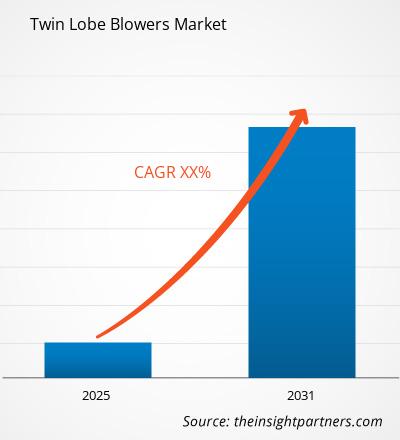
The Twin Lobe Blowers Market is valued at US$ 1.28 Billion in 2025 and is projected to reach US$ 1.94 Billion by 2034, expanding at a 4.76% CAGR during 2026–2034. Twin lobe positive displacement technology remains relevant where plants require steady volumetric airflow, moderate pressure generation, continuous operation, and dependable gas movement. Demand is supported by industrial process-air requirements, wastewater and environmental infrastructure, pneumatic conveying, chemical processing, and petroleum-related applications.
North America represents a mature demand center, with a modeled CAGR of ~4% through 2034, supported by replacement of aging blower equipment, industrial wastewater treatment investment, and efficiency-focused upgrades. The region also benefits from established engineering capabilities and extensive installed bases serving chemical processing, petroleum operations, manufacturing, and environmental applications. The Twin Lobe Blowers Market size is therefore influenced by both new equipment deployment and replacement-oriented purchasing.
Twin Lobe Blowers Market Assessment and Insights
Regional Outlook
- North America: ~30% of the global Twin Lobe Blowers Market share in 2025 | ~4% CAGR through 2034. Market position: North America maintains a substantial mature-market position, supported by established industrial installations, wastewater infrastructure, replacement demand, and continuous requirements for dependable air and gas movement in chemical and petroleum facilities.
- US: ~78% of North American market revenue in 2025 | ~4% CAGR through 2034. Market position: The US represents the principal North American demand center, supported by its extensive industrial base, wastewater infrastructure, chemical processing capacity, and established use of positive displacement blowers in pressure, vacuum, conveying, and aeration applications.
- Europe: ~27% of the global market in 2025 | ~4% CAGR through 2034. Market position: Europe is a mature market characterized by industrial modernization and efficiency requirements. Germany is the leading country in Europe, while the UK, France, Italy, and Spain contribute through process industries, utilities, manufacturing, and environmental infrastructure.
- Asia Pacific: ~32% of the global market in 2025 | ~6% CAGR through 2034. Market position: Asia Pacific is the fastest-growing region, supported by industrial capacity expansion, wastewater infrastructure, chemical and petroleum processing, and manufacturing localization. China is the leading country in Asia Pacific, with India also showing strong equipment adoption.
Segment Outlook
- Horizontal: ~62% Share in 2025 | ~5% CAGR through 2034. Market position: Horizontal configurations lead because their installation architecture suits skid-mounted packages, industrial plants, conveying systems, and established process layouts. Their accessibility for maintenance and broad compatibility with conventional drive arrangements reinforce adoption across diverse industrial facilities.
- Oil and Gas: ~31% Share in 2025 | ~6% CAGR through 2034. Market position: Oil and gas represents the high-growth application segment as operators require dependable gas movement, vapor handling, pneumatic systems, and process support equipment. New processing infrastructure and brownfield modernization create opportunities for specialized blower packages.
Competitive Coverage
Airvac, Acme Air Equipments Co. Pvt. Ltd., Everest Blowers Pvt. Ltd., Ingersoll Rand, Howden, KAESER KOMPRESSOREN SE, KAY International Private Limited, Rootch Service, SV Blowers, TMC Fluid Systems
Methodology
The Insight Partners follows Data Collection & Secondary Research, Primary Research, Data Analysis, and Data Triangulation & Final Review to validate market estimates and insights.
Source: The Insight Partners' analysis based on proprietary research, government publications, company annual reports, investor presentations, industry databases, and expert interviews.
There has been an evolution from the early simple constant speed positive displacement machines into more complex and engineered packages focusing on efficiency, vibration isolation, noise, reliability, and configuration tailored to application requirements. The latest designs of rotary lobe blowers are able to be set up for either pressure or vacuum applications, with various choices regarding cooling systems, drive type, sealing, and material available from the manufacturer. Roots technology is widely used in water treatment facilities, in chemical manufacturing, pneumatic conveying, electricity generation, food production, and in other industrial settings.
In the future, purchases will be influenced not only by the price but also by lifecycle costs. Industrial customers are evaluating parameters such as energy usage, service intervals, noise level, controllability, space requirements, and compatibility with factory automation. New industrial countries are adding wastewater treatment plants and process facilities, whereas developed ones replace the obsolete equipment. In addition, the equipment manufacturers are developing application-oriented engineering skills in gas handling, biogas, chemical processing, and other industrial applications.
Twin Lobe Blowers Market Report Scope
| Report Attribute | Details |
|---|---|
| Market size in 2025 | US$ 1.28 Billion |
| Market Size by 2034 | US$ 1.94 Billion |
| Global CAGR (2026 - 2034) | 4.76% |
| Historical Data | 2021-2024 |
| Forecast period | 2026-2034 |
Twin Lobe Blowers Market Analysis
Demand comes from industry with constant need for low-pressure or vacuum air flow, which is then supplied by engineering companies, systems integration providers, distributors and original equipment manufacturers who configure blower sets to specific process demands. Pneumatic conveying and wastewater aeration demand continuous airflow, while chemical or petroleum applications might call for particular sealing methods, materials or explosion-proof construction. Manufacturers will be competing in volumetric capacity, pressure handling capabilities, reliability, flexibility, maintainability and total cost of operation rather than in production capacities.
Supply chain involves castings and housing, rotors, shafts, bearings, timing gears, seals, motors, drive, control components, silencers and mounting system. Proper rotor balancing and timing gears adjustment directly influence vibration, noise, lifespan and efficiency of operation. Suppliers with their own machining, testing, packaging and field service departments can speed up commissioning and customization of their products. It gives an advantage to larger suppliers but leaves room for smaller regional manufacturers that can provide application engineering and local after-sales services.
Competitors comprise global industrial equipment providers and specialist blower manufacturers. While Ingersoll Rand relies on the Roots range for industrial air and gas transfer needs, Howden may use its strengths in process engineering. KAESER KOMPRESSOREN specializes in low-pressure systems and blowers. Local manufacturers like Acme Air Equipments Co. Pvt. Ltd., Everest Blowers Pvt. Ltd., Airvac, SV Blowers, and KAY International Private Limited compete using the factors of customizability, fast production, and application engineering.
Investment priorities are becoming increasingly geared towards efficiency, digital control, modularity, and specialized gas handling. As the result, the competitive positioning should take into account the necessity to achieve both standardization and customizability. Manufacturers that can provide an entire system including the blower itself, the motor, the controls, the acoustics, the filters, and other elements can embrace the entire value chain of the project. There are obvious benefits of local production in some cases.
● REPORT CUSTOMIZATION
Tailor This Report To Align With Your Specific Business Requirements
This report can be customized to align precisely with your business objectives, scope, and target markets. Customization options include tailored segmentation, geography, competitive analysis, and strategic insights to support informed decision-making.
Customize This Report →WHAT YOU CAN ADJUST
- ● Segmentations
- ● Geography
- ● Competitive Analysis
- ● Language Preferences
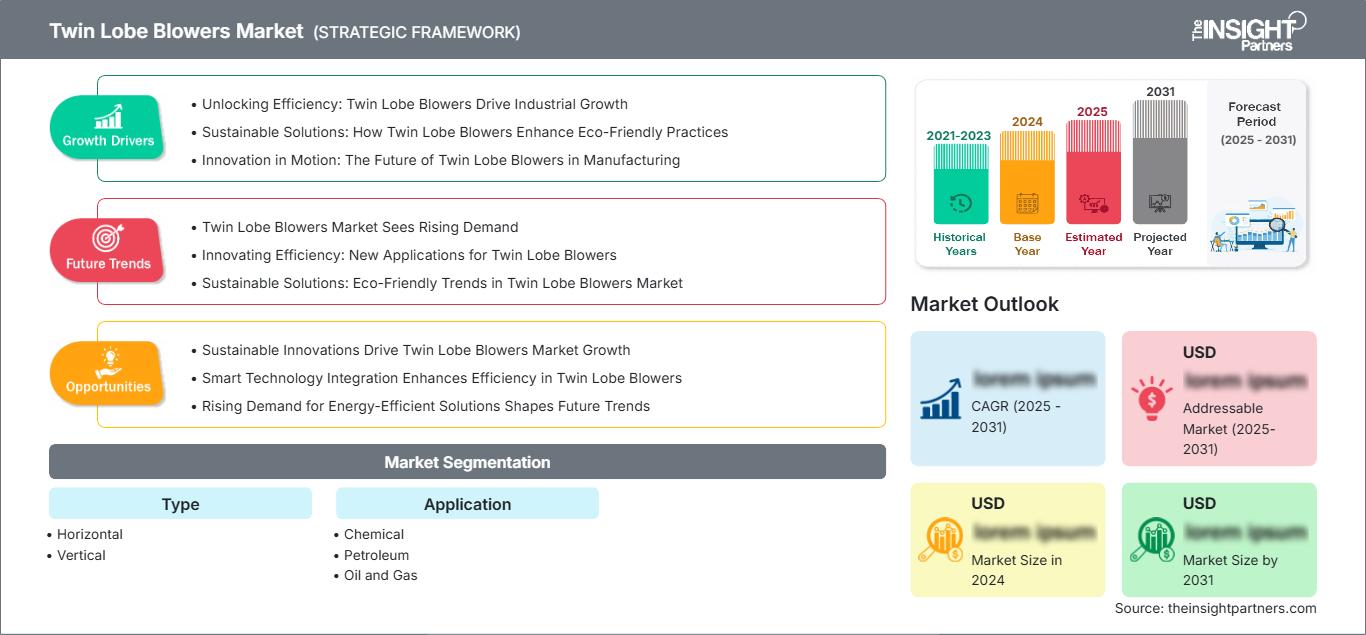
Twin Lobe Blowers Market: Strategic Insights
Regional Insights
North America Twin Lobe Blowers Market
North America accounted for ~30% of the global market in 2025 and is expected to expand at ~4% CAGR through 2034. Positive displacement technology enjoys an established presence in the regional market, with wide-ranging application in municipal and industrial wastewater, chemical processing, food processing, petroleum industry, and pneumatic conveying segments. Replacements become vital in this region, as many customers focus on reliability and continuity over changing the entire plant equipment.
North America is responsible for ~78% of revenue in the region, thanks to a high level of industrial development and a requirement for equipment that works continuously. Energy efficiency considerations are driving replacement of old blowers, equipped with better drives, controls, and system designs. Canada brings additional opportunities through energy production, mining, municipal wastewater treatment, and industrial processing. Meanwhile, Mexico makes incremental contributions through manufacturing and process industry growth.
U.S. Twin Lobe Blowers Market
The US represented ~78% of North American market revenue in 2025 and is projected to grow at ~4% CAGR through 2034. Its demand pattern is diversified for applications ranging from wastewater treatment to chemical plants, petroleum plants, food processing, manufacturing, and material handling. The size of the industrial installed base provides a regular demand for replacements and spare parts.
The competition comes from Ingersoll Rand via Roots, Howden, KAESER KOMPRESSOREN, and application specific suppliers targeting industrial consumers. Trends in terms of applications increasingly call for the supply of packages based on system efficiencies and controllability. Wastewater aeration will still be a key application, with applications in the petroleum and chemical plants resulting in application specific sealing and gas handling requirements.
Europe Twin Lobe Blowers Market
Europe held ~27% of the global market in 2025 and is expected to register ~4% CAGR through 2034. Germany is the leading European nation, due to its industrial manufacturing sector, engineering, chemical industry, and process equipment sector. The UK retains demand for its water infrastructure, industrial processing, and energy facilities. France takes advantage of the chemical industry, food industry, environmental concerns, and manufacturing applications that require reliable low-pressure air and gas transport.
The industrial and engineering base of Germany results in significant demand for lifecycle efficient equipment, while the chemical industry, food industry, machinery, and wastewater applications of France and Italy provide some support. Italy is also home to many companies that specialize in manufacturing industrial equipment and integrating process systems. Spain has contributions coming from water treatment, industrial manufacturing, and energy infrastructure, including applications that require reliable pneumatic or aeration systems.
In Europe, procurement is increasingly driven by energy consumption, equipment size, noise, and serviceability concerns. Therefore, the manufacturers place great importance on variable speed, compact design, monitoring, and system optimization. Replacement of legacy equipment is a necessity, while environmental infrastructure provides repeat business. This balance between existing industrial base and requirements for modernization ensures stability of the market in Europe, with Germany being the strongest individual market in the region.
APAC Twin Lobe Blowers Market
Asia Pacific represented ~32% of the global market in 2025 and is the fastest-growing region at ~6% CAGR through 2034. China is the leading country in Asia Pacific, supported by large industrial production, chemical and petroleum processing, wastewater infrastructure, and extensive manufacturing activity. India is also expanding equipment adoption as industrial plants and environmental infrastructure develop.
Both Japan and South Korea have contributed by virtue of their process industries and advanced manufacturing capabilities, while demand is driven by Australia’s requirements for mining and resources, industrial applications, water treatment etc. Locally-based manufacturing and engineering help in providing equipment and customized solutions. Policy focus on wastewater treatment and industrial environmental management helps as well.
Middle East & Africa Twin Lobe Blowers Market
The Twin Lobe Blowers Market forecast shows that Middle East & Africa is expected to expand at ~5% CAGR through 2034. Saudi Arabia represents the leading country in the Middle East & Africa region where evidence supports a strong industrial and infrastructure demand base, particularly through petroleum processing, petrochemicals, water systems, and industrial development. The UAE adds demand through energy, infrastructure, utilities, and process industries.
South Africa contributes through mining, mineral processing, water treatment, and industrial manufacturing. Rest of MEA includes developing wastewater, energy, and industrial infrastructure where dependable air and gas movement is required. Petroleum and gas applications are particularly relevant in the Gulf, while water scarcity and treatment requirements strengthen demand for aeration equipment. Regional growth is therefore linked to industrial diversification, energy infrastructure, water projects, and modernization of existing facilities.
Segmentation Analysis
Type
The Type segment is expected to expand at ~5% CAGR during 2026–2034. Selection between horizontal and vertical configurations is influenced by plant layout, maintenance accessibility, drive arrangement, available footprint, discharge orientation, and package design. Horizontal systems retain broad industrial applicability, while vertical arrangements can address installations where space utilization or equipment orientation is a determining factor. Configuration flexibility allows suppliers to adapt positive displacement technology to diverse process conditions.
- Horizontal: Horizontal blowers are widely suited to skid-mounted industrial packages and conventional plant layouts. Their accessible configuration supports maintenance and integration with motors, belts, couplings, silencers, and controls, making them relevant to wastewater, conveying, chemical, petroleum, and general industrial applications.
- Vertical: Vertical blowers provide an alternative where footprint, equipment arrangement, piping direction, or plant architecture favors vertical installation. Their strategic importance increases in constrained facilities and customized systems where engineering teams need to optimize equipment placement without changing the underlying blower technology.
Application
The Application segment is projected to grow at ~5% CAGR during 2026–2034. Chemical, petroleum, and oil and gas facilities require dependable airflow or gas displacement under continuous operating conditions. Application requirements vary substantially by gas composition, pressure, temperature, sealing requirements, hazardous-area considerations, and process continuity. Suppliers that provide engineering customization can address these requirements while improving equipment integration and lifecycle reliability.
- Chemical: Chemical plants use positive displacement blowers for process-air duties, gas movement, reactor support, conveying, and related operations. Demand favors oil-free airflow, appropriate materials, robust sealing, and customized configurations capable of maintaining stable operation under demanding chemical environments.
- Petroleum: Petroleum applications require dependable airflow and gas-handling equipment across refining, processing, conveying, and supporting systems. Procurement priorities include reliability, process compatibility, maintenance access, and the ability to configure equipment around site-specific operating conditions and safety requirements.
- Oil and Gas: Oil and gas applications increasingly require specialized blower configurations for gas movement, process support, vapor-related duties, and industrial utilities. The segment benefits from new processing infrastructure, brownfield upgrades, and engineering requirements for reliable equipment in continuous and demanding operating environments.
Opportunity Snapshot
| Application | Revenue Contribution | Trend Tag | Adoption Stage |
| Chemical | High | Process Air | Mature |
| Petroleum | Medium | Refinery Systems | Mature |
| Oil and Gas | High | Gas Handling | Scaling |
Twin Lobe Blowers Market Growth Drivers and Impact Analysis
Expansion of Industrial and Municipal Wastewater Treatment Infrastructure
Wastewater treatment remains a structural demand driver because biological treatment processes require dependable aeration and continuous air delivery. Positive displacement blowers are well suited to applications where stable airflow is required under varying system resistance. As municipalities and industrial facilities expand treatment capacity, blower procurement becomes part of broader plant construction and modernization programs. Existing plants also replace aging equipment to improve reliability and operating efficiency. The impact extends beyond new blower sales because installed equipment creates recurring demand for maintenance, refurbishment, replacement components, and package upgrades. Suppliers with experience in aeration systems can therefore participate across the equipment lifecycle. Increasing attention to energy use in aeration also encourages system-level optimization, supporting demand for improved drives, controls, and correctly sized blower packages.
Growth of Chemical and Process Manufacturing Capacity
Chemical and process industries require controlled air and gas movement across multiple operations, creating a diversified demand base for positive displacement blower systems. New production capacity generates initial equipment requirements, while plant debottlenecking and modernization generate replacement opportunities. Blowers may support pneumatic conveying, reactor-related duties, gas boosting, process-air supply, and other utility functions. Application-specific engineering is particularly important where gases are corrosive, hazardous, hot, or sensitive to contamination. As chemical production expands in industrializing economies, local suppliers can capture opportunities by combining standardized blower platforms with customized materials, sealing, cooling, and drive configurations. This driver also increases the importance of technical support because procurement decisions increasingly consider integration with the complete process rather than isolated blower specifications.
Modernization of Petroleum and Industrial Gas Infrastructure
Petroleum and industrial gas facilities operate equipment continuously and place strong emphasis on reliability, safety, and predictable maintenance. Brownfield modernization creates opportunities when operators replace older blower packages, redesign process systems, or upgrade auxiliary equipment around expanding production capacity. New projects can require engineered blower systems that accommodate specific gas properties, operating pressures, temperature conditions, and hazardous-area requirements. The market impact is strongest for suppliers capable of providing application engineering, testing, documentation, and after-sales service alongside the mechanical package. Regional refining and petrochemical investments can also stimulate local manufacturing and service ecosystems, reducing lead times and improving support availability. This creates opportunities for both global equipment groups and specialized regional manufacturers.
Twin Lobe Blowers Market Future Trends
Shift Toward Smarter and More Energy-Aware Blower Packages
The Twin Lobe Blowers Market trends indicate that future blower procurement is likely to place greater emphasis on system-level energy management, monitoring, and controllability. Instead of evaluating the blower solely on nominal flow and pressure, users can increasingly assess power consumption, operating profile, maintenance condition, and interaction with downstream equipment. Variable-speed drives, pressure controls, sensors, and supervisory systems can help align blower output with changing process requirements. Digital monitoring can also support condition-based maintenance by identifying changes in vibration, temperature, operating hours, or performance. This trend could alter competitive differentiation because mechanical reliability will remain essential, but the value proposition will increasingly include controls, diagnostics, and lifecycle optimization. Suppliers with integrated equipment and service capabilities can respond to these changing procurement criteria.
Greater Customization for Gas Handling and Specialized Processes
Future demand is expected to broaden beyond standardized air-blower configurations toward application-specific systems designed for specialized gases and operating environments. Chemical, petroleum, biogas, and industrial gas users may require customized seals, corrosion-resistant materials, temperature management, pressure configurations, and hazardous-area-compatible equipment. Engineered packages can combine blowers with motors, controls, silencers, filtration, instrumentation, and protective systems, reducing integration work for plant operators. This trend supports higher technical differentiation and creates opportunities for suppliers with engineering-to-order capabilities. It also encourages manufacturers to develop modular platforms that retain standardized components while allowing configuration around customer-specific process parameters, balancing manufacturing efficiency with application flexibility.
Twin Lobe Blowers Market Opportunities
Expansion of Application-Specific Blower Packages in Emerging Industrial Economies
Industrialization in emerging economies creates an opportunity for suppliers to offer complete blower packages rather than standalone machines. Chemical processing, wastewater treatment, petroleum infrastructure, food processing, and material handling projects often require equipment configured around local plant conditions. Regional manufacturing can reduce logistics costs and lead times while enabling closer technical support. Vendors can strengthen their position by developing modular systems with standardized blower elements, locally sourced auxiliary components, and application-specific engineering. Partnerships with EPC contractors, distributors, and system integrators can further improve project access. The opportunity is particularly relevant where industrial infrastructure is expanding faster than specialized maintenance ecosystems, allowing suppliers to capture initial equipment sales and establish recurring service, spare-parts, and refurbishment relationships.
Growth of Specialized Gas, Biogas, and Energy Infrastructure Applications
Specialized gas applications provide an opportunity to extend positive displacement blower technology into projects requiring controlled gas movement rather than conventional air service. Biogas facilities, gas boosting systems, industrial gas handling, and energy-related infrastructure can require reliable equipment with customized sealing, materials, and operating configurations. Suppliers can address this opportunity by developing application-specific engineering capabilities and certification support while integrating monitoring and protective systems. The opportunity also supports aftermarket growth because specialized installations require maintenance expertise and application-specific replacement components. Companies with established blower platforms can use modular engineering to enter adjacent gas applications without developing an entirely new mechanical architecture, potentially improving product utilization and expanding addressable customer segments.
Recent Developments
- September 2026: Gardner Denver - Gardner Denver updated its D825 and D925 bi-lobe drum blower models for dry-bulk truck applications. The updated range introduces features intended to increase bearing life, while the D925 adds a higher continuous pressure capability and bidirectional rotation. The development demonstrates continued engineering investment in established bi-lobe technology for demanding pneumatic conveying applications. -
- September 2026: KAESER KOMPRESSOREN - KAESER announced its participation at WEFTEC 2026 with an energy-efficient skid-mounted blower system incorporating variable-frequency drive technology and an adaptive master controller. The company is also displaying rotary lobe and turbo blower technologies. The development highlights the industry's movement toward integrated blower systems, automation, and energy management for water and wastewater facilities. -
- September 2026: Blowers published an updated product-focused release on September 1, 2026, covering its Twin Lobe Air Blower for STP, ETP, WTP, aquaculture, pneumatic conveying, and industrial applications. The company highlights oil-free air delivery, continuous operation, low vibration, durability, and easier maintenance.
Frequently Asked Questions

- Comprehensive Market Sizing and Forecast Analysis
- Detailed Segmentation Analysis
- In-Depth Market Dynamics Assessment
- Regional and Country-Level Insights
- Competitive Landscape and Company Benchmarking
- Strategic Business Intelligence
Recent Reports
Testimonials

The Insight Partners provided valuable market intelligence that supported our global go-to-market strategy. Their team was professional, responsive, and attentive to our feedback, providing thoughtful analysis and helpful methodological clarifications throughout the project.
Junmo Kim Chief Financial Officer (CFO), Enertech Co., Ltd.
The Insight Partners' SCADA System Market report is comprehensive, with valuable insights on current trends and future forecasts. The team was highly professional, responsive, and supportive throughout. We are very satisfied and highly recommend their services.
RAN KEDEM Partner, Reali Technologies LTDs
I requested a report on a very specific software market and the team produced the report in a few days. The information was very relevant and well presented. I then requested some changes and additions to the report. The team was again very responsive and I got the final report in less than a week.
JEAN-HERVE JENN Chairman, Future Analytica
We worked with The Insight Partners for an important market study and forecast. They gave us clear insights into opportunities and risks, which helped shape our plans. Their research was easy to use and based on solid data. It helped us make smart, confident decisions. We highly recommend them.
PIYUSH NAGPAL Sr. Vice President, High Beam Global
The Insight Partners delivered insightful, well-structured market research with strong domain expertise. Their team was professional and responsive throughout. The user-friendly website made accessing industry reports seamless. We highly recommend them for reliable, high-quality research services
YUKIHIKO ADACHI CEO, Deep Blue, LLC.
This is the first time I have purchased a market report from The Insight Partners.While I was unsure at first, I visited their web site and felt more comfortable to take the risk and purchase a market report.I am completely satisfied with the quality of the report and customer service. I had several questions and comments with the initial report, but after a couple of dialogs over email with their analyst I believe I have a report that I can use as input to our strategic planning process.Thank you so much for taking the extra time and making this a positive experience.I will definitely recommend your service to others and you will be my first call when we need further market data.
JOHN SUZUKI President and Chief Executive Officer, Board Director, BK Technologies
I wish to appreciate your support and the professionalism you displayed in the course of attending to my request for information regarding to infectious disease IVD market in Nigeria. I appreciate your patience, your guidance, and the fact that you were willing to offer a discount, which eventually made it possible for us to close a deal. I look forward to engaging The Insight Partners in the future, all thanks to the impression you have created in me as a result of this first encounter.
DR CHIJIOKE ONYIA MANAGING DIRECTOR, PineCrest Healthcare Ltd.Reason to Buy
- Informed Decision-Making
- Understanding Market Dynamics
- Competitive Analysis
- Identifying Emerging Markets
- Customer Insights
- Market Forecasts
- Risk Mitigation
- Boosting Operational Efficiency
- Strategic Planning
- Investment Justification
- Tracking Industry Innovations
- Aligning with Regulatory Trends





 Get Free Sample for