
Steam Condenser Market Trends, Size & Growth by 2034
Coverage: By Material (Jet Condenser, Surface Condenser); End-use Industry (Power Plants, Chemical, Refinery, Others) , and Geography (North America, Europe, Asia Pacific, and South and Central America)
- Status : Data Released
- Report Code : TIPRE00022488
- Category : Manufacturing and Construction
- No. of Pages : 150
- Available Report Formats :


- Last update date : October 23, 2026


2025 Market Size
US$ 20.71 Bn
Base year value
2034 Forecast
US$ 28.07 Bn
Projected by 2034
CAGR 2026-2034
3.44 %
Growth rate
Addressable Market
US$ 221.57 Bn
(2026-2034)
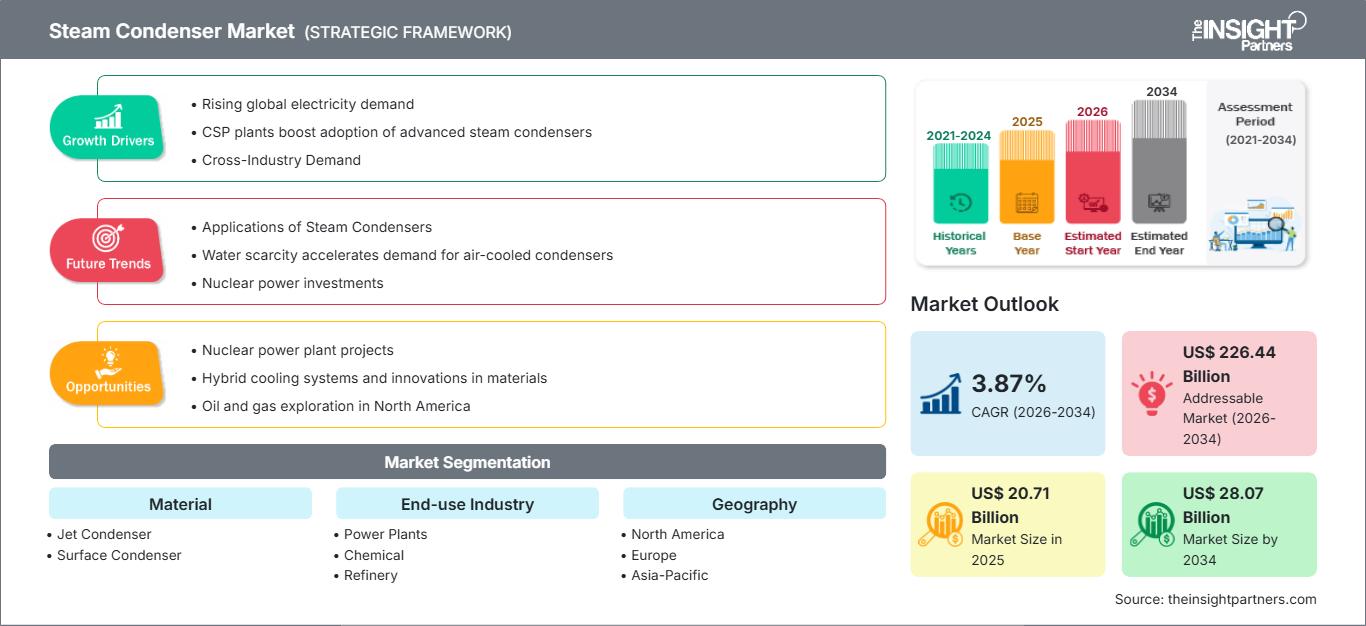
The Steam Condenser Market was valued at US$ 20.71 Billion in 2025 and is projected to reach US$ 28.07 Billion by 2034, registering a CAGR of 3.44% from 2026 to 2034. The market covers equipment used to condense exhaust steam and recover condensate across power generation and industrial processes. Demand is shaped by thermal efficiency requirements, replacement of aging equipment, new generation capacity, process-industry investment, and increasing emphasis on water and energy management.
North America remains an established market supported by a large installed base of thermal generation and industrial processing facilities. The regional Steam Condenser Market Size is modeled to expand at approximately 3% CAGR through 2034, with replacement projects, combined-cycle capacity, refinery modernization, and efficiency upgrades supporting equipment demand. The increasing focus on reducing auxiliary power consumption and improving turbine backpressure performance is also encouraging investment in higher-efficiency condenser configurations.
Steam Condenser Market Assessment and Insights
Regional Outlook
- North America: ~24% of the global Steam Condenser Market in 2025 | ~3% CAGR through 2034. Market position: North America represents a mature installed-base market supported by utility refurbishment, industrial steam systems, refinery projects, and replacement demand. Engineering requirements increasingly emphasize reliability, maintainability, corrosion resistance, and improved turbine cold-end performance.
- US: ~82% of North American market revenue in 2025 | ~3% CAGR through 2034. Market position: The US accounts for the largest portion of North American demand, supported by its extensive power-generation infrastructure and industrial base. Condensers are used across utility generation, refining, chemical processing, and combined-cycle facilities.
- Europe: ~22% of the global market in 2025 | ~3% CAGR through 2034. Market position: Europe is a mature market where replacement, energy efficiency, industrial decarbonization, and process optimization influence demand. Germany represents the leading country in Europe, followed by established industrial markets including the UK, France, Italy, and Spain.
- Asia Pacific: ~39% of the global Steam Condenser Market in 2025 | ~4% CAGR through 2034. Market position: Asia Pacific is the largest regional market and the fastest-growing major region, supported by industrial capacity expansion, power infrastructure investment, refinery development, and manufacturing activity. China represents the leading country in Asia Pacific, with Japan, South Korea, India, and Australia contributing established demand.
Segment Outlook
- End-use Industry: ~64% Share in 2025 | ~3% CAGR through 2034. Market position: End-use Industry represents the largest main segment because condenser demand is closely tied to power-generation assets and steam-intensive industrial facilities. Large installed bases, plant refurbishment, and new capacity additions sustain equipment requirements across multiple industries.
- Material: ~36% Share in 2025 | ~4% CAGR through 2034. Market position: Material represents the higher-growth main segment as buyers increasingly specify condenser configurations according to operating pressure, cooling-water conditions, corrosion exposure, efficiency requirements, and plant configuration. Surface condenser demand supports a substantial portion of equipment procurement.
Competitive Coverage
Ambassador Heat Transfer, ENERGYEN, GEA Group Aktiengesellschaft, General Electric, Graham Corporation, Holtec International, J.D. Cousins, Kelvion Holding GmbH, Larsen and Toubro Limited, Shuangliang EcoEnergy
Methodology
The Insight Partners follows Data Collection & Secondary Research, Primary Research, Data Analysis, and Data Triangulation & Final Review to validate market estimates and insights.
Source: The Insight Partners' analysis based on proprietary research, government publications, company annual reports, investor presentations, industry databases, and expert interviews.
The development of technology for the production of steam condensers has gone hand in hand with developments in the design of turbines, power station sizes, cooling facilities, and industrial processes. Surface condensers continue to be important in situations where steam condensate must be recovered and separation between steam and cooling fluids is necessary, whereas jet condensers are used in situations where the mixing of the steam and the cooling water is permissible. The design of condenser equipment has seen improvements in the form of lower backpressure, efficient heat transfer, less chance of leaks, better tube arrangements, and ease of maintenance.
From now up to 2034, demand will go beyond the replacement of existing equipment to include new applications in industry and improved efficiency retrofits. The Asia Pacific region will see continued interest due to the growth of power, refineries, chemicals, and manufacturing plants. Mature markets will see interest in the refurbishment of existing equipment in order to maintain thermal performance without replacing whole power island installations. Environmental issues regarding water usage and thermal emissions could lead to increased interest in air cooled and more efficient water cooled condensing equipment.
Steam Condenser Market Report Scope
| Report Attribute | Details |
|---|---|
| Market size in 2025 | US$ 20.71 Billion |
| Market Size by 2034 | US$ 28.07 Billion |
| Global CAGR (2026 - 2034) | 3.44% |
| Historical Data | 2021-2024 |
| Forecast period | 2026-2034 |
Steam Condenser Market Analysis
Demand arises mainly from power stations and steam-heavy industrial operations, where condensation efficiency is critical to turbine back pressure, condensate recovery, and thermal efficiency of the operation. The need for replacement arises from the age of the equipment, corrosion, erosion, tube wear, fouling, leakage, and change in operational characteristics. In industries such as the chemical and refining industries, there is a possibility that condensers will require special material handling due to harsh processing environments.
The supply chain starts with engineering and specification, followed by procurement of tubes, tube sheets, shells, and structural materials, testing, manufacturing, transportation, installation, commissioning, and after sales services. Engineering firms have an advantage in terms of thermal efficiency, vacuum capability, material, modular design and ease of retrofit. Conditions affecting supply include stainless steel, titanium, nickel alloys, carbon steel, aluminum, manufacturing and welding abilities and logistics. Utility condenser production involves significant manufacturing and logistic requirements.
Competitors mentioned in the Steam Condenser Market Report consist of diversified heat transfer equipment firms, power equipment suppliers, specialized condenser suppliers, and engineering companies. General Electric, which runs the power business via GE Vernova, competes through power generation system solutions and condenser engineering. Graham Corporation concentrates on condensers and vacuum systems that are custom-engineered for energy and process industries. Holtec International is a supplier of water cooled condensers used in both commercial and nuclear power applications. GEA Group Aktiengesellschaft and Kelvion Holding GmbH supply thermal management solutions, whereas Larsen and Toubro Limited supplies engineering and heavy industrial project execution capabilities.
Investor focus is shifting from capacity and capability considerations towards flexibility in manufacturing, retrofit engineering, materials optimization, digitalization of design, and regional service network. Suppliers are also marketing their condenser equipment as part of the plant efficiency solutions rather than separate heat transfer products. This presents opportunities for companies with combined expertise in thermal performance and installation simplicity. Regional manufacturing facilities can accelerate projects and minimize logistical risks, whereas regional engineering organizations can tailor equipment to local cooling water quality, ambient conditions, regulatory requirements, and maintenance practices of customers.
● REPORT CUSTOMIZATION
Tailor This Report To Align With Your Specific Business Requirements
This report can be customized to align precisely with your business objectives, scope, and target markets. Customization options include tailored segmentation, geography, competitive analysis, and strategic insights to support informed decision-making.
Customize This Report →WHAT YOU CAN ADJUST
- ● Segmentations
- ● Geography
- ● Competitive Analysis
- ● Language Preferences
Steam Condenser Market: Strategic Insights
Regional Insights
North America Steam Condenser Market
North America represented ~24% of global revenue in 2025 and is modeled to grow at ~3% CAGR through 2034. The region benefits from a large installed base of thermal and combined-cycle power facilities as well as extensive refining, petrochemical, chemical, and industrial steam infrastructure. Replacement and modernization are important because condenser performance can deteriorate through tube fouling, corrosion, leakage, and degradation of vacuum conditions. Operators can therefore create demand without constructing entirely new power plants.
The United States represents around 82% of North America’s revenue due to its huge volume of electricity production as well as industrial processing facilities. The application area ranges from utility condensers to industrial steam applications and refining processes. This creates a competitive edge for suppliers who already have engineering and servicing expertise since most of the time the condenser installation project is required to be compatible with the turbine exhaust system, cooling, foundation, and plant controls.
U.S. Steam Condenser Market
The United States was estimated to have contributed about 82% of North America Steam Condenser Market revenues in 2025 and would grow at about 3% CAGR between 2026 and 2034. The country's large power generation fleet results in recurring opportunities for replacement and upgrades, and the country's combined cycle plants have to use condensers that can accept turbine exhaust and heat recovery steam generation designs.
The competitive landscape consists of diverse power equipment suppliers and heat transfer equipment makers. Graham Corporation conducts manufacturing and engineering operations on surface condensers as well as vacuum equipment used in energy and process industries. GE Vernova provides water-cooled surface condensers in both the industrial as well as utility-scale steam turbine applications. Factors such as availability of water, environmental performance, plant size, and maintenance considerations also determine choice of water-cooled or air-cooled designs in various projects.
Europe Steam Condenser Market
Europe had ~22% Steam Condenser Market share of global revenue in 2025 and is forecasted to have ~3% CAGR growth until 2034. Germany is the leading country in Europe due to its significant presence of industrial manufacturing industry, process industries, engineering, and power infrastructure. UK is relevant through its thermal-generation plants, industrial units, and infrastructure upgrade. France offers its contribution to the market via power generation and industrial demand, while Italy and Spain add their demand for equipment from utilities, chemical processing, refining, manufacturing, and other steam intensive industries.
The European market is characterized with the presence of matured equipment parks and higher attention to efficiency, life-cycle management, environment performance, and plant optimization. The demand is not based solely on the increase in capacity but can be addressed through replacement of condensers, tube-bundle replacement, use of corrosion resistant materials, vacuum improvement, and engineering. The industrial consumers tend to analyze the equipment based on total cost of operation, which makes the demand favorable to the companies able to engineer their products based on the specifics of cooling water, steam demand, and maintenance schedules.
The European market also boasts a well-defined network of suppliers for heat transfer and thermal management technologies. Companies like GEA Group Aktiengesellschaft and Kelvion Holding GmbH are active in wider heat exchange markets and offer their engineering experience in industrial cooling and heat transfer needs. The existing supplier network enables local engineering and after-sales support, while the environment pushes buyers to look at water usage, heat rejection, energy consumption, and machine life.
APAC Steam Condenser Market
In 2025, the Asia-Pacific region accounted for ~39% of the global market revenue share and is expected to be the fastest growing major regional market at ~4% CAGR till 2034. China dominates the Asia-Pacific region on account of extensive industrial capacity, power infrastructure, manufacturing base, and process industry needs. Japan and South Korea bring in their mature technology and replacement market, whereas India and Australia are additional markets in terms of power sector, refining, chemicals, and industries.
The regional market drivers include capacity additions as well as upgrade of existing facilities. China has a well-developed equipment manufacturing base, while India has the combination of new infrastructural build and development in domestic engineering capability. High-performance equipment and life cycle optimization are priorities for Japan and South Korea, while Australia is an opportunity market based on resource processing and energy infrastructure needs. Water availability and environmental considerations can affect condenser choice increasingly, favoring water-cooling and air-cooling.
Middle East & Africa Steam Condenser Market
Middle East and Africa demand is modeled to grow at ~4% CAGR through 2034. Saudi Arabia represents the leading country in the Middle East & Africa region where evidence supports a stronger combination of power, refining, petrochemical, desalination, and industrial investment. The UAE also contributes significant demand through energy infrastructure and large industrial developments. South Africa remains an important market because of its established power-generation infrastructure.
The regional opportunity is closely linked to energy and water constraints. Large power and industrial projects require reliable heat rejection, while limited freshwater availability can influence the selection of air-cooled and water-efficient condenser configurations. Refinery and petrochemical investments create additional requirements for process condensers and vacuum equipment. Suppliers with regional engineering, fabrication, and service capabilities can reduce logistics complexity and provide faster maintenance support for large installations.
Segmentation Analysis
Material
The Material segment in the Steam Condenser Market is modeled to grow at ~4% CAGR from 2026 to 2034. Material selection is central to condenser performance because tubes and structural components must withstand thermal cycling, corrosion, vibration, pressure differences, and cooling-water chemistry. Procurement decisions increasingly consider lifecycle reliability alongside heat-transfer performance. Material engineering therefore remains important in both new installations and replacement projects, particularly where seawater, contaminated cooling water, or aggressive industrial fluids increase corrosion exposure.
- Jet Condenser: Jet condensers provide direct-contact condensation in applications where steam and cooling water can mix. Their simpler construction can support specific industrial processes where condensate purity requirements are less restrictive. Strategic use depends on cooling-water availability, process configuration, operating pressure, and requirements for condensate recovery.
- Surface Condenser: Surface condensers maintain physical separation between steam and cooling media through heat-transfer surfaces. They are particularly important in power-generation applications where condensate quality, turbine performance, vacuum conditions, and water recovery are priorities. Their design can be customized around turbine exhaust geometry and plant cooling conditions.
End-use Industry
The End-use Industry main segment in the Steam Condenser Market is modeled to grow at ~3% CAGR through 2034 and represents the largest revenue category. Power generation remains a major application because condenser performance directly affects steam-turbine exhaust pressure and cycle efficiency. Industrial demand is diversified across chemical facilities, refineries, and other steam-intensive operations. Replacement, refurbishment, and plant modernization provide recurring demand alongside new installations.
- Power Plants: Power plants require reliable condensation to maintain turbine operating conditions and recover condensate. Procurement decisions focus on heat-transfer performance, vacuum stability, cooling-water conditions, tube reliability, and integration with turbine and cooling systems. Utility-scale projects can require highly customized equipment.
- Chemical: Chemical facilities use condensers within process heating, evaporation, distillation, and utility systems. Equipment selection depends strongly on process chemistry, operating temperature, pressure, contamination risk, and corrosion resistance. Customized metallurgy and compact integration can be strategically important where process uptime and product quality are critical.
- Refinery: Refineries employ condensers across steam systems, process units, vacuum systems, and heat-recovery applications. Demand is supported by refinery upgrades, capacity expansion, maintenance programs, and equipment replacement. Suppliers able to provide corrosion-resistant materials, reliable vacuum performance, and retrofit compatibility can address complex operating environments.
Opportunity Snapshot
| End-use Industry | Revenue Contribution | Trend Tag | Adoption Stage |
| Power Plants | High | Thermal Efficiency | Mature |
| Chemical | Medium | Process Integration | Scaling |
| Refinery | Medium | Capacity Upgrades | Mature |
| Others | Low | Industrial Retrofit | Scaling |
Steam Condenser Market Growth Drivers and Impact Analysis
Expansion and modernization of thermal and industrial steam infrastructure
The expansion and modernization of steam-based infrastructure remains a fundamental demand mechanism. New combined-cycle plants require condensers as part of the steam turbine island, while industrial facilities use them within utility and process systems. At the same time, mature installations require replacement because tube corrosion, fouling, vibration, leakage, and declining vacuum performance can reduce operational efficiency. Modernization projects can therefore generate equipment demand even where overall power generation capacity changes only gradually. The impact extends across engineering, fabrication, installation, testing, and aftermarket services. Suppliers that can provide replacement equipment compatible with existing turbine exhausts and foundations can reduce project disruption. This creates a market in which lifecycle service capability is increasingly important alongside original equipment manufacturing.
Growing emphasis on thermal efficiency and lifecycle operating cost
Condenser performance has a direct relationship with turbine exhaust pressure and the effectiveness of the steam cycle. As plant operators seek to reduce fuel consumption and improve asset utilization, attention increasingly moves toward the cold end of the power cycle. Improved tube layouts, optimized heat-transfer surfaces, better air-removal systems, and appropriate material selection can improve operating stability. For industrial users, condenser performance can also influence process heat recovery and steam utilization. Consequently, purchasing decisions are increasingly based on lifecycle economics rather than equipment acquisition cost alone. The resulting market impact favors engineered systems that combine reliable heat transfer with manageable maintenance requirements. Retrofit solutions can be particularly valuable where operators want efficiency improvements without replacing major upstream equipment.
Water availability and environmental constraints shaping condenser selection
Water availability is becoming a more important engineering consideration in condenser procurement. Conventional water-cooled systems can provide strong heat-transfer performance but depend on suitable cooling-water infrastructure and effective water management. Plants located in water-stressed regions may therefore consider air-cooled or hybrid configurations, particularly where large industrial or power facilities are planned. Environmental requirements related to thermal discharge can further influence system design. These considerations broaden the addressable equipment landscape by making condenser selection a site-specific engineering decision. Suppliers that can compare water-cooled and air-cooled approaches, optimize equipment around local climate conditions, and integrate condensers with broader heat-rejection systems can address a wider range of project requirements.
Steam Condenser Market Future Trends
Greater integration of condenser design with digital plant engineering
Future condenser procurement in the Steam Condenser Market Trends is likely to become more closely integrated with digital plant engineering and lifecycle monitoring. Three-dimensional design models can improve coordination between condenser geometry, turbine exhausts, foundations, piping, instrumentation, and cooling systems before equipment reaches the construction site. Digital models can also support retrofit assessment by identifying dimensional and interface constraints in existing plants. Over time, operating data can help engineers identify fouling, vacuum deterioration, tube degradation, and changes in cooling performance. This can support condition-based maintenance rather than relying exclusively on fixed inspection schedules. The commercial implication is a shift from equipment-only procurement toward integrated engineering and lifecycle service packages. Suppliers that combine thermal design with digital documentation, commissioning support, monitoring, and aftermarket engineering may gain greater relevance in complex projects.
Advanced materials and low-water cooling configurations
Future equipment designs are expected to place greater emphasis on materials and cooling configurations suited to challenging environmental conditions. Advanced tube materials can improve resistance to corrosion and erosion in applications involving aggressive cooling water, while optimized surfaces can maintain heat-transfer performance over longer operating periods. In water-constrained locations, air-cooled and hybrid condenser arrangements can reduce dependence on freshwater resources. These developments are particularly relevant to new power and industrial projects in arid regions and locations where environmental permitting constrains water discharge. The Steam Condenser Market trend also supports greater modularization, enabling equipment to be fabricated, transported, assembled, and commissioned with fewer site activities. As engineering requirements become more site-specific, material selection and cooling architecture will increasingly be treated as integrated design decisions.
Steam Condenser Market Opportunities
Retrofit and replacement programs for aging condenser fleets
A substantial commercial opportunity exists in replacement and retrofit programs involving installed condenser fleets. Aging equipment can experience tube failures, corrosion, fouling, vacuum deterioration, and performance loss, creating requirements for tube-bundle replacement, complete condenser replacement, or equipment modification. Retrofit projects can be attractive because customers can target specific performance limitations without rebuilding an entire power or process system. Suppliers can develop standardized engineering modules that are adaptable to existing turbine exhaust arrangements, foundations, piping, and cooling systems. The opportunity also extends to material upgrades where customers move toward corrosion-resistant tube materials or improved configurations. Companies with detailed historical equipment records, engineering documentation, field-service teams, and manufacturing flexibility are positioned to address these projects efficiently. Regional service networks can further reduce outage duration and improve customer responsiveness.
Integrated condenser solutions for water-constrained industrial projects
Water-constrained industrial projects provide another opportunity for suppliers capable of combining condenser engineering with broader heat-rejection systems. Industrial plants in arid regions may require solutions that balance thermal performance, water consumption, equipment footprint, ambient temperature, and maintenance requirements. Air-cooled condensers can address sites where cooling-water access is restricted, while hybrid configurations can balance water use and thermal performance under changing conditions. Opportunities in the Steam Condenser Market Forecast extend across power generation, refining, petrochemicals, and large process facilities. Suppliers can strengthen their position by offering feasibility engineering, thermal modeling, equipment manufacturing, installation support, commissioning, and lifecycle maintenance as a coordinated package. Such capabilities can reduce procurement complexity for customers and allow condenser design to be optimized around the complete plant cooling architecture.
Recent Developments
- October 2025: Godrej Enterprises Group — The Process Equipment business manufactured and delivered its heaviest Ecolaire surface condenser, weighing close to 450 metric tonnes, for a US power-generation project. The equipment was manufactured at Godrej’s GreenCo-certified Dahej facility in Gujarat and was designed for a natural-gas project with hydrogen-capable characteristics. The development illustrates the growing role of Indian manufacturing in large engineered condenser exports.
- June 2025: Graham Corporation reported fiscal 2025 results and highlighted continued activity across its Energy & Process portfolio, which includes surface condensers and related heat-transfer and vacuum systems. The company reported a record backlog of US$412.3 million and identified a surface-condenser order for a North American net-zero-carbon ethylene cracker among its significant fiscal 2025 orders.
- January 2025: Holtec Asia announced an expansion of its Dahej, Gujarat manufacturing facility to meet rising demand for air-cooled condensers used to condense low-pressure steam from power-generation and industrial plants without relying on cooling-water sources. The expansion was planned to increase fabrication capacity and strengthen manufacturing capability for water-constrained applications.
Frequently Asked Questions

- Comprehensive Market Sizing and Forecast Analysis
- Detailed Segmentation Analysis
- In-Depth Market Dynamics Assessment
- Regional and Country-Level Insights
- Competitive Landscape and Company Benchmarking
- Strategic Business Intelligence
Recent Reports
Testimonials

The Insight Partners provided valuable market intelligence that supported our global go-to-market strategy. Their team was professional, responsive, and attentive to our feedback, providing thoughtful analysis and helpful methodological clarifications throughout the project.
Junmo Kim Chief Financial Officer (CFO), Enertech Co., Ltd.
The Insight Partners' SCADA System Market report is comprehensive, with valuable insights on current trends and future forecasts. The team was highly professional, responsive, and supportive throughout. We are very satisfied and highly recommend their services.
RAN KEDEM Partner, Reali Technologies LTDs
I requested a report on a very specific software market and the team produced the report in a few days. The information was very relevant and well presented. I then requested some changes and additions to the report. The team was again very responsive and I got the final report in less than a week.
JEAN-HERVE JENN Chairman, Future Analytica
We worked with The Insight Partners for an important market study and forecast. They gave us clear insights into opportunities and risks, which helped shape our plans. Their research was easy to use and based on solid data. It helped us make smart, confident decisions. We highly recommend them.
PIYUSH NAGPAL Sr. Vice President, High Beam Global
The Insight Partners delivered insightful, well-structured market research with strong domain expertise. Their team was professional and responsive throughout. The user-friendly website made accessing industry reports seamless. We highly recommend them for reliable, high-quality research services
YUKIHIKO ADACHI CEO, Deep Blue, LLC.
This is the first time I have purchased a market report from The Insight Partners.While I was unsure at first, I visited their web site and felt more comfortable to take the risk and purchase a market report.I am completely satisfied with the quality of the report and customer service. I had several questions and comments with the initial report, but after a couple of dialogs over email with their analyst I believe I have a report that I can use as input to our strategic planning process.Thank you so much for taking the extra time and making this a positive experience.I will definitely recommend your service to others and you will be my first call when we need further market data.
JOHN SUZUKI President and Chief Executive Officer, Board Director, BK Technologies
I wish to appreciate your support and the professionalism you displayed in the course of attending to my request for information regarding to infectious disease IVD market in Nigeria. I appreciate your patience, your guidance, and the fact that you were willing to offer a discount, which eventually made it possible for us to close a deal. I look forward to engaging The Insight Partners in the future, all thanks to the impression you have created in me as a result of this first encounter.
DR CHIJIOKE ONYIA MANAGING DIRECTOR, PineCrest Healthcare Ltd.Reason to Buy
- Informed Decision-Making
- Understanding Market Dynamics
- Competitive Analysis
- Identifying Emerging Markets
- Customer Insights
- Market Forecasts
- Risk Mitigation
- Boosting Operational Efficiency
- Strategic Planning
- Investment Justification
- Tracking Industry Innovations
- Aligning with Regulatory Trends





 Get Free Sample for