
Spoil Detection Based Smart Label Market Growth, Demand & Size by 2034
Spoil Detection Based Smart Label Market Size and Forecasts (2021–2034), Global and Regional Share, Trends, and Growth Opportunity Analysis Report Coverage : By Technology (RFID, Sensing Labels, and NFC), End-user Industry (Pharmaceutical, Food, and Cosmetics, and Others)
- Status : Data Released
- Report Code : TIPRE00039641
- Category : Electronics and Semiconductor
- No. of Pages : 150
- Available Report Formats :


- Last update date : October 23, 2026


2025 Market Size
US$ 2.54 Bn
Base year value
2034 Forecast
US$ 6.39 Bn
Projected by 2034
CAGR 2026-2034
12.22 %
Growth rate
Addressable Market
US$ 42.51 Bn
(2026-2034)
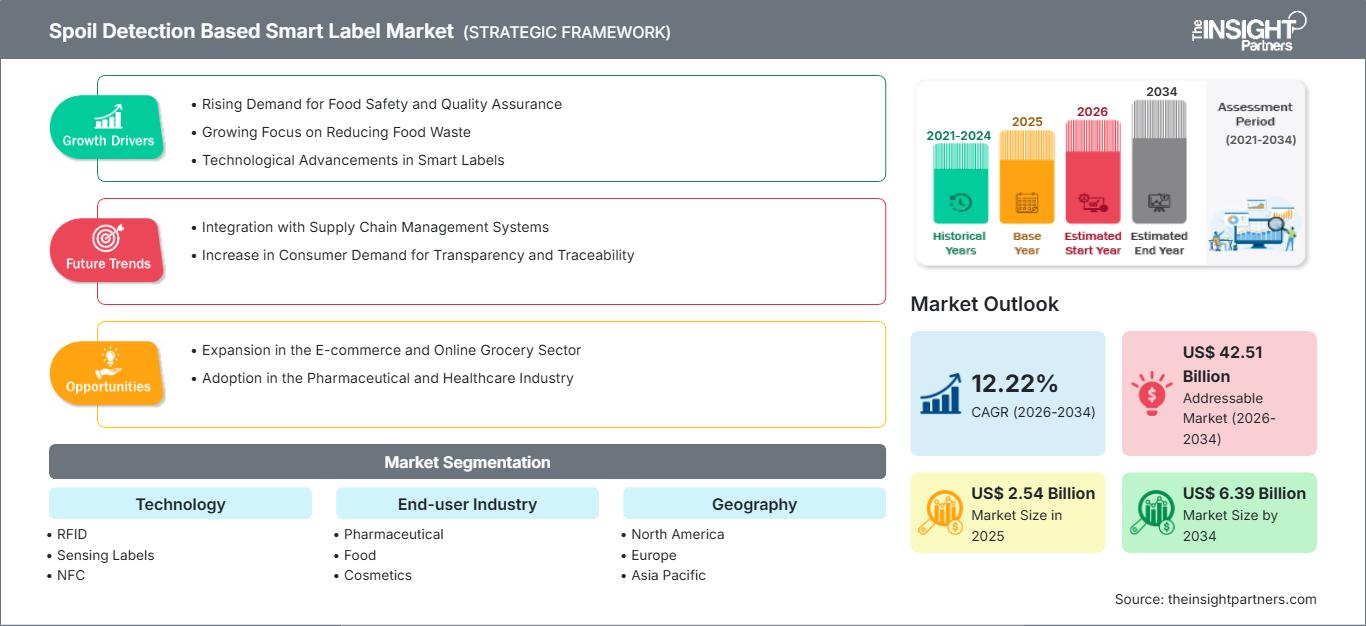
The Spoil Detection Based Smart Label Market was valued at US$ 2.54 Billion in 2025 and is projected to reach US$ 6.39 Billion by 2034, registering a CAGR of 12.22% during 2026–2034. The market covers smart labeling technologies designed to identify, monitor, or indicate spoilage-related conditions across packaged products. Technology categories include RFID, sensing labels, and NFC, while end-user industries comprise pharmaceutical, food, and cosmetics applications.
North America remains an important commercialization center, with the Spoil Detection Based Smart Label Market size supported by advanced food distribution networks, pharmaceutical traceability requirements, and established RFID infrastructure. The region is expected to record a CAGR of ~11% through 2034. Increasing deployment of intelligent packaging, demand for real-time product-condition visibility, and investments in automated inventory and cold-chain monitoring are strengthening adoption across food and healthcare supply chains.
Spoil Detection Based Smart Label Market Assessment and Insights
Regional Outlook
- North America: ~31% of the global market in 2025 | ~11% CAGR through 2034. Market position: The region represents a mature commercialization environment supported by established RFID ecosystems, sophisticated food logistics, pharmaceutical traceability requirements, and strong adoption of connected packaging technologies.
- US: ~78% of North American market revenue in 2025 | ~11% CAGR through 2034. Market position: The US accounts for most regional demand, supported by large food and pharmaceutical supply chains, technology-intensive retailers, established labeling infrastructure, and investment in real-time inventory and product-condition monitoring.
- Europe: ~27% of the global market in 2025 | ~11% CAGR through 2034. Market position: Europe combines mature packaging and labeling capabilities with stringent product safety, traceability, sustainability, and pharmaceutical requirements. Germany represents the leading country in Europe, supported by advanced manufacturing and logistics infrastructure.
- Asia Pacific: ~34% of the global market in 2025 | ~14% CAGR through 2034. Market position: Asia Pacific is the fastest-growing region, supported by expanding packaged food production, pharmaceutical manufacturing, digital retail infrastructure, and investments in supply-chain automation. China represents the leading country in Asia Pacific.
Segment Outlook
- Technology: ~62% Share in 2025 | ~12% CAGR through 2034. Market position: Technology represents the largest main segment because RFID and sensing capabilities provide automated identification, condition monitoring, traceability, and data capture. Increasing integration with digital supply-chain platforms strengthens the commercial relevance of intelligent labels.
- End-user Industry: ~38% Share in 2025 | ~13% CAGR through 2034. Market position: End-user Industry has the higher growth outlook as food, pharmaceutical, and cosmetics companies increasingly seek condition-aware packaging. Adoption is supported by product safety requirements, waste reduction objectives, traceability initiatives, and differentiated consumer experiences.
Competitive Coverage
Smartrac Technology Group, Thin Film Electronics ASA, Avery Dennison, Zebra Technologies, Applied Ink Solutions, Invengo Technology Pte. Ltd., NNB Tag & Label, UPM Raflatac, Checkpoint Systems, CCL Industries
Methodology
The Insight Partners follows Data Collection & Secondary Research, Primary Research, Data Analysis, and Data Triangulation & Final Review to validate market estimates and insights.
Source: The Insight Partners' analysis based on proprietary research, government publications, company annual reports, investor presentations, industry databases, and expert interviews.
Spoil Detection Based Smart Label Market has moved from standard ID labels to those that are connected, able to hold digital identities as well as information regarding the conditions of the products being tracked. RFID technology has increased visibility and automation at item level, while sensing labels are adding capabilities such as monitoring of temperature, freshness and environmental exposure. NFC adds interactivity as well as authentication of products via smartphones. The production process is increasingly influenced by material compatibility, antenna and sensors design, semiconductors availability, printing and converting abilities as well as integration of the label production systems within the existing packaging machines.
In the future, market growth will be driven by expansion to emerging Asian markets, upgrades to food distribution networks, pharmaceutical traceability programs and initiatives for digital product identification. Investments will likely be made in cost-effective electronics, sensing components, high performance RFID inlays as well as software connectivity. The regulatory focus on traceability and food safety will contribute to the use of intelligent labels if they help in providing auditable information about the product. However, recyclability, materials optimization, electronic components disposal and compatibility with packaging will be among other product development considerations.
Spoil Detection Based Smart Label Market Report Scope
| Report Attribute | Details |
|---|---|
| Market size in 2025 | US$ 2.54 Billion |
| Market Size by 2034 | US$ 6.39 Billion |
| Global CAGR (2026 - 2034) | 12.22% |
| Historical Data | 2021-2024 |
| Forecast period | 2026-2034 |
Spoil Detection Based Smart Label Market Analysis
The Spoliation Detection Based Smart Label Market growth is very much tied into efforts to reduce product loss, increase traceability and acquire information without the requirement of manual inspection of the products at each step in the supply chain process. For food manufacturers and retailers, connected labels may be used to associate the product identity with its freshness or environmental information whereas the pharmaceutical companies may use smart labeling in order to strengthen chain of custody. The industry includes players such as substrate and adhesive suppliers, antenna, chip, sensors, converting, printing, software and system integration suppliers. Thus the dynamics of the supply process depend upon the size of the label production and the presence of compatible electronic components.
Demand for smart labels is also driven by the economics of spoliation. In case the product under question is highly valuable and has short shelf life, the label that can help to know early about the bad condition of the product would allow inventory prioritization and intervention. Manufacturers look at label solutions in terms of read reliability, sensing capabilities, integration with enterprise systems, printing capabilities and total cost of deployment.
The Spoil Detection Based Smart Label Market report points out a competitive environment that comprises material specialists, RFID technology firms, smart label makers, and identification firms that incorporate the use of RFID technology. Avery Dennison merges material labels and digital identification technologies, while Zebra Technologies brings in RFID hardware, printers, and sensing technology. Checkpoint Systems concentrates on RFID-based labeling and tracing services, while CCL Industries provides specialty label technology through subsidiaries like Checkpoint.
Other participants provide niche components in the environment. Smartrac Technology Group provides RFID-based identification technology, Thin Film Electronics ASA specializes in printed electronics and sensing technology, UPM Raflatac offers material label products and inlay solutions, and Invengo Technology Pte. Ltd. offers RFID identification and systems. Applied Ink Solutions and NNB Tag & Label offer specialized label and printing technologies. Competitiveness is increasingly based on interoperability, sensing precision, scalability, sustainability, and intelligent label integration with existing supply chain processes.
● REPORT CUSTOMIZATION
Tailor This Report To Align With Your Specific Business Requirements
This report can be customized to align precisely with your business objectives, scope, and target markets. Customization options include tailored segmentation, geography, competitive analysis, and strategic insights to support informed decision-making.
Customize This Report →WHAT YOU CAN ADJUST
- ● Segmentations
- ● Geography
- ● Competitive Analysis
- ● Language Preferences
Spoil Detection Based Smart Label Market: Strategic Insights
Regional Insights
North America Spoil Detection Based Smart Label Market
The North American market held ~31% of the total market share in 2025 and is projected to witness a ~11% CAGR during the forecast period through 2034. The region has advantages of well-established RFID technology usage, efficient food distribution chain, regulations for tracking drugs, and automated inventory system. It makes it easier for implementation of intelligent labels because manufacturers and users are able to integrate new features of labels within existing infrastructure for product identification.
The United States holds ~78% of the North American market share. Food retail, packaged foods, pharmaceuticals, health care distribution and logistics are the major industries driving the growth of the market. The companies have started to connect RFID label, environmental indicators and sensors with their enterprise software solutions to gain better visibility.
U.S. Spoil Detection Based Smart Label Market
The US accounted for ~78% of North American revenue in 2025 and is expected to record a CAGR of ~11% through 2034. The market benefits from a large installed base of RFID readers and printers, extensive food and pharmaceutical distribution networks, and strong participation by labeling and identification technology providers. Avery Dennison, Zebra Technologies, Checkpoint Systems, and CCL Industries are among the companies contributing to the broader intelligent-label ecosystem.
Freshness visibility, inventory turn, and the ability to recall have become important in food applications. Traceability and identification of medicines have become important for pharmaceuticals. The convergence of large-scale retail networks and logistics systems presents an attractive situation for growing smart label solutions from pilots into operations. Cloud integration is making the data from the labels as valuable as the physical label itself.
Europe Spoil Detection Based Smart Label Market
The Europe region accounted for ~27% of the Spoil Detection Based Smart Label Market share in 2025 and is expected to grow at a CAGR of ~11% until 2034. Among European countries, Germany is the largest, owing to strong manufacturing capabilities along with logistics and packaging solutions, coupled with advanced automation systems. The contribution from the UK comes in the form of digital retail and pharmaceutical distribution channels, whereas, the contribution from France, Italy, and Spain stems from applications such as food, beverages, cosmetics, and consumer goods.
In Germany, intelligent labels can be implemented through manufacturing and logistics process automation, whereas in the UK market, the influence comes from digitally integrated retail and pharmaceutical logistics operations. In France, there are chances of using intelligent labels in food and cosmetics packaging, while in Italy and Spain, food processing and consumer products play an important role. In Europe, it becomes important for suppliers to maintain a fine balance between electronic functionalities and sustainability aspects of packaging.
Therefore, the European opportunity is much wider than the RFID identification process. NFC consumer engagement, sensing labels for condition monitoring, and smart packaging could help to achieve authentication, product data, and supply chain transparency. Procurement choices will be made based on operational and environmental considerations, which would lead manufacturers to produce thin and recyclable intelligent label structures.
Asia Pacific Spoil Detection Based Smart Label Market
Asia Pacific accounted for ~34% of the total global market in 2025 and is projected to have a CAGR of ~14% up until 2034, thus becoming the fastest growing regional market segment. China emerges as the leader of Asia Pacific with a large-scale manufacturing industry, huge consumer base, increasing food distribution and capability in electronics. While Japan and South Korea come up with advancements in electronics and automation, India has growing packaged foods, pharmaceuticals, and organized retail applications.
Australia offers potential for food traceability and supply chain monitoring applications. Modernization of distribution facilities coupled with increasing digitization drives adoption of the technology. Low level of penetration in various applications presents an opportunity for growth with decreasing costs of labeling systems and ease of integration. Also, manufacturing of RFID components, printed electronics, labels, and packaging materials can be done locally.
Middle East & Africa Spoil Detection Based Smart Label Market
The Middle East & Africa market is expected to expand at a CAGR of ~10% through 2034. Saudi Arabia represents an important country in the Middle East & Africa market, supported by food-security initiatives, modern retail infrastructure, logistics investment, and pharmaceutical supply-chain development. The UAE provides a highly digitized logistics and distribution environment, while South Africa contributes through established retail, food-processing, and healthcare networks.
In the Middle East, temperature-sensitive food and pharmaceutical distribution creates an operational case for condition-monitoring labels. Infrastructure investment and increasing emphasis on supply-chain visibility can support RFID and sensing deployments. In Africa, adoption remains more selective and is influenced by infrastructure availability, deployment economics, and the maturity of organized retail and pharmaceutical distribution. The resulting opportunity is strongest where intelligent labeling directly addresses traceability, quality, or loss-prevention requirements.

Segmentation Analysis
Technology
Technology represents the largest main segment, with a CAGR of ~12% during 2026–2034. The Spoil Detection Based Smart Label Market scope under this segment includes RFID, sensing labels, and NFC solutions used to connect physical products with identification, condition, or interaction data. RFID supports automated tracking at scale, sensing labels provide condition-related information, and NFC enables close-range digital interaction. Adoption depends on application economics, required sensing precision, infrastructure compatibility, and the value of captured information.
- RFID: RFID labels support automated identification, item-level visibility, inventory management, traceability, and supply-chain monitoring. Their strategic importance increases where high-volume product handling makes manual scanning inefficient and where businesses already have compatible readers, printers, and software infrastructure.
- Sensing Labels: Sensing labels add condition-related functionality to packaging by indicating or monitoring environmental factors associated with product quality. They are particularly relevant where temperature, freshness, exposure, or other spoilage indicators materially affect product value and safety.
- NFC: NFC labels enable short-range digital communication through compatible devices, supporting product authentication, consumer engagement, traceability, and access to digital product information. Their role is expanding where brands want physical packaging to provide a direct connection to digital services.
End-user Industry
End-user Industry is expected to record a CAGR of ~13% during 2026–2034. Pharmaceutical, food, and cosmetics companies are evaluating smart labels according to product sensitivity, regulatory requirements, distribution complexity, and consumer expectations. Food represents an important application environment because spoilage and freshness directly affect waste and product quality, while pharmaceutical users emphasize traceability and controlled handling. Cosmetics applications can use intelligent labels for authentication, product information, and connected consumer engagement.
- Pharmaceutical: Pharmaceutical users prioritize traceability, identification, authentication, inventory visibility, and environmental monitoring. Smart labels can strengthen control across manufacturing, distribution, storage, and dispensing while supporting digital records associated with individual products or packages.
- Food: Food applications emphasize freshness, spoilage visibility, traceability, inventory rotation, and waste reduction. Intelligent labels are increasingly relevant for products moving through complex refrigerated and high-volume supply chains where timely information can influence handling and merchandising decisions.
- Cosmetics: Cosmetics companies use connected labeling to support authenticity, digital product information, consumer engagement, and supply-chain visibility. NFC and RFID are particularly relevant where premium products require stronger brand protection and richer digital interactions without substantially changing packaging workflows.
Opportunity Snapshot
| Segment Name | Revenue Contribution | Trend Tag | Adoption Stage |
|---|---|---|---|
| Agriculture Machinery | Low | Freshness Monitoring | Emerging |
| Pharmaceutical | High | Traceability Systems | Scaling |
| Cosmetics | Medium | Product Authentication | Scaling |
Spoil Detection Based Smart Label Market Growth Drivers and Impact Analysis
Food Waste Reduction and Freshness Visibility
Food waste reduction is a major structural driver because producers, distributors, and retailers need better visibility into product condition and remaining usability. Conventional labels communicate identity and printed information but provide limited ability to capture dynamic conditions during distribution. Smart labels can connect product identity with sensing or digital information, allowing businesses to identify exposure events, prioritize inventory, and improve handling decisions. The commercial impact is strongest for perishable products where spoilage has a direct financial consequence. RFID also supports faster inventory identification and rotation, while sensing technologies can provide additional condition information. As food companies increasingly measure waste and operational efficiency, the value proposition moves from labeling cost alone toward the economic value of improved product visibility, lower losses, and more responsive inventory management.
Pharmaceutical Traceability and Product Integrity
Pharmaceutical supply chains require reliable product identification, traceability, and controlled handling because products move through multiple manufacturing, distribution, storage, and dispensing stages. Smart labels can support item-level identification while connecting physical products to digital records. Sensing functionality can add information about environmental exposure when product integrity depends on defined storage conditions. The impact extends beyond operational efficiency because better visibility can support recalls, authentication, inventory reconciliation, and compliance workflows. Pharmaceutical manufacturers and distributors therefore evaluate intelligent labels based on reliability, data integrity, integration with existing systems, and deployment economics. As supply chains become more digitally connected, smart labeling can serve as a physical data-capture layer between products and enterprise or cloud systems.
Connected Packaging and Consumer Interaction
Connected packaging is expanding the role of labels from passive information carriers into digital access points. NFC and RFID can allow products to carry unique identities that connect packaging with authentication, product information, provenance, and consumer engagement services. This capability is particularly relevant for premium cosmetics and other branded goods where counterfeit risk and customer interaction influence packaging strategy. For manufacturers, the opportunity lies in using one physical label to support multiple functions across production, distribution, retail, and post-purchase engagement. The impact can include more consistent product identification and richer data collection without requiring a major redesign of packaging architecture. Adoption will depend on the measurable value of digital interactions and the ability to integrate connected labels into existing packaging operations.
Spoil Detection Based Smart Label Market Future Trends
Integration of Sensing with Digital Product Identity
One of the most important Spoil Detection Based Smart Label Market trends is the convergence of identification and sensing. Instead of treating RFID, NFC, and environmental indicators as separate technologies, manufacturers are increasingly developing label architectures that combine product identity with condition-related information. This integration can allow businesses to associate a specific product with relevant exposure or handling information and then transfer that information into supply-chain systems. The trend is particularly important for fresh food and pharmaceutical applications, where product condition and product identity have to be interpreted together. Future solutions are likely to emphasize compact construction, reliable performance on challenging packaging materials, lower deployment complexity, and interoperability with printers, readers, cloud platforms, and analytics tools.
Smarter and More Sustainable Intelligent Labels
Future product development is likely to focus simultaneously on intelligence and material efficiency. Intelligent labels contain additional components compared with conventional labels, creating challenges related to material separation, recyclability, component reduction, and end-of-life management. Suppliers are therefore exploring label structures that maintain required electronic performance while minimizing material use and integrating more efficiently with existing packaging. Another direction is the use of printed or thin electronic elements that can potentially support scalable manufacturing. As brands increase sustainability reporting and packaging targets, procurement decisions may increasingly evaluate both digital functionality and environmental compatibility. This could encourage suppliers to develop intelligent-label formats that are easier to process, apply, recover, or integrate into established recycling systems.
Spoil Detection Based Smart Label Market Opportunities
Expansion of Smart Fresh-Food Labeling
The food industry provides a substantial commercial opportunity because freshness management requires information that conventional static labels cannot provide. The Spoil Detection Based Smart Label Market Forecasts indicate an opportunity for suppliers that can develop labels capable of reliable operation in cold, wet, densely packed, or otherwise challenging environments. Solutions that fit existing label dimensions and application processes can reduce implementation friction for food producers and retailers. Commercial strategies can prioritize high-value perishable categories where waste reduction and inventory visibility offer measurable returns. Suppliers can also build opportunities by connecting intelligent labels with warehouse, retail, and supply-chain software so that condition data becomes actionable rather than remaining isolated at the package level.
Integrated Pharmaceutical and Cosmetics Solutions
Pharmaceutical and cosmetics applications provide an opportunity for suppliers to combine identification, authentication, sensing, and consumer-facing digital functionality. Pharmaceutical deployments can focus on traceability and environmental monitoring, while cosmetics can emphasize authentication and connected product experiences. Companies developing modular label platforms may be able to adapt the same underlying technology across multiple packaging formats, reducing customization requirements. Partnerships among label converters, sensor developers, RFID specialists, software providers, and packaging manufacturers can accelerate commercialization. The opportunity is strongest where intelligent labeling addresses a clearly defined business problem, such as product integrity, counterfeit prevention, inventory visibility, or regulatory traceability, rather than functioning only as an additional packaging feature.
Recent Developments
- February 2026: Avery Dennison launched the AD IdentiFresh inlay series for fresh-food categories including bakery, meat, deli, and produce. The company positioned the solution as an RFID innovation designed to improve freshness visibility, operational efficiency, and waste reduction in challenging food environments. The launch expands intelligent labeling into applications where moisture, temperature, and dense packaging have historically complicated RFID deployment.
- January 2026: Avery Dennison highlighted intelligent labeling, RFID, and Bluetooth Low Energy sensor technologies at NRF 2026, focusing on applications that provide retail teams with greater product visibility and faster operational decision-making. The company’s presentation emphasized the growing role of intelligent items and sensor-enabled identification in retail processes, including applications associated with food waste and supply-chain efficiency.
- August 2025: Checkpoint Systems announced ARC certification for its Voltis M830 RFID label, supporting compact form-factor applications and item-level visibility. The certification strengthened the label’s suitability for retail programs requiring consistent RFID performance and simplified supplier onboarding. The development reflects continued investment in RFID label performance, interoperability, and deployment at scale across connected supply-chain environments.
Frequently Asked Questions

- Comprehensive Market Sizing and Forecast Analysis
- Detailed Segmentation Analysis
- In-Depth Market Dynamics Assessment
- Regional and Country-Level Insights
- Competitive Landscape and Company Benchmarking
- Strategic Business Intelligence
Recent Reports
Testimonials

The Insight Partners provided valuable market intelligence that supported our global go-to-market strategy. Their team was professional, responsive, and attentive to our feedback, providing thoughtful analysis and helpful methodological clarifications throughout the project.
Junmo Kim Chief Financial Officer (CFO), Enertech Co., Ltd.
The Insight Partners' SCADA System Market report is comprehensive, with valuable insights on current trends and future forecasts. The team was highly professional, responsive, and supportive throughout. We are very satisfied and highly recommend their services.
RAN KEDEM Partner, Reali Technologies LTDs
I requested a report on a very specific software market and the team produced the report in a few days. The information was very relevant and well presented. I then requested some changes and additions to the report. The team was again very responsive and I got the final report in less than a week.
JEAN-HERVE JENN Chairman, Future Analytica
We worked with The Insight Partners for an important market study and forecast. They gave us clear insights into opportunities and risks, which helped shape our plans. Their research was easy to use and based on solid data. It helped us make smart, confident decisions. We highly recommend them.
PIYUSH NAGPAL Sr. Vice President, High Beam Global
The Insight Partners delivered insightful, well-structured market research with strong domain expertise. Their team was professional and responsive throughout. The user-friendly website made accessing industry reports seamless. We highly recommend them for reliable, high-quality research services
YUKIHIKO ADACHI CEO, Deep Blue, LLC.
This is the first time I have purchased a market report from The Insight Partners.While I was unsure at first, I visited their web site and felt more comfortable to take the risk and purchase a market report.I am completely satisfied with the quality of the report and customer service. I had several questions and comments with the initial report, but after a couple of dialogs over email with their analyst I believe I have a report that I can use as input to our strategic planning process.Thank you so much for taking the extra time and making this a positive experience.I will definitely recommend your service to others and you will be my first call when we need further market data.
JOHN SUZUKI President and Chief Executive Officer, Board Director, BK Technologies
I wish to appreciate your support and the professionalism you displayed in the course of attending to my request for information regarding to infectious disease IVD market in Nigeria. I appreciate your patience, your guidance, and the fact that you were willing to offer a discount, which eventually made it possible for us to close a deal. I look forward to engaging The Insight Partners in the future, all thanks to the impression you have created in me as a result of this first encounter.
DR CHIJIOKE ONYIA MANAGING DIRECTOR, PineCrest Healthcare Ltd.Reason to Buy
- Informed Decision-Making
- Understanding Market Dynamics
- Competitive Analysis
- Identifying Emerging Markets
- Customer Insights
- Market Forecasts
- Risk Mitigation
- Boosting Operational Efficiency
- Strategic Planning
- Investment Justification
- Tracking Industry Innovations
- Aligning with Regulatory Trends




 Get Free Sample for