
Retinal Imaging Devices Market Size, Demand & Growth by 2034
Coverage: By Device Type (Fluorescein Angiography, Fundus Camera, and Optical Coherence Tomography), and End-User (Hospitals & Clinics, Ambulatory Surgical Centers, Specialized Eye Care Centers, and Other End Users), and Geography (North America, Europe, Asia Pacific, and South and Central America)
- Status : Data Released
- Report Code : TIPRE00008683
- Category : Life Sciences
- No. of Pages : 150
- Available Report Formats :


- Last update date : October 23, 2026


2025 Market Size
US$ 4.29 Bn
Base year value
2034 Forecast
US$ 8.81 Bn
Projected by 2034
CAGR 2026-2034
8.33 %
Growth rate
Addressable Market
US$ 58.84 Bn
(2026-2034)
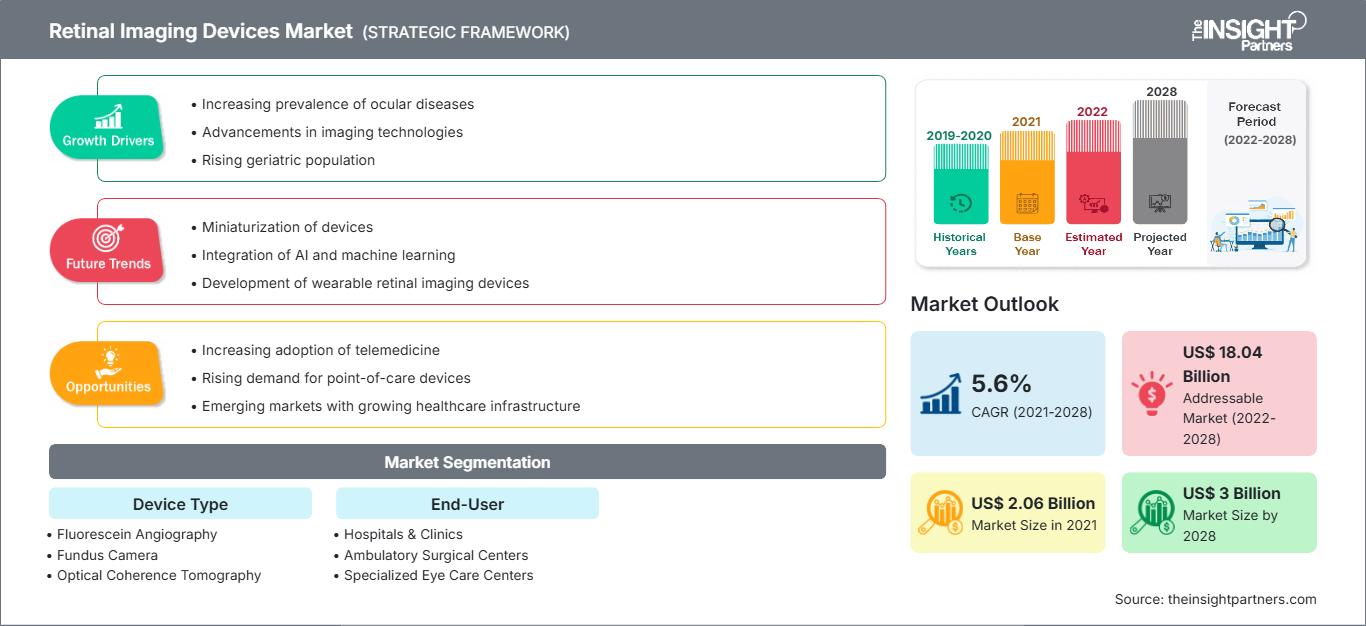
The Retinal Imaging Devices (RID) Market size was valued at US$ 4.29 Billion in 2025 and is projected to reach US$ 8.81 Billion by 2034, expanding at a CAGR of 8.3% during 2026–2034. The market encompasses diagnostic technologies used to visualize retinal structures, vascular features, and disease-related changes, with demand shaped by the increasing use of multimodal imaging across ophthalmology, retina care, screening, and longitudinal disease monitoring.
North America remains a major revenue center, supported by established ophthalmic infrastructure, high utilization of advanced diagnostic equipment, and integration of imaging with digital clinical workflows. The region is modeled to expand at a CAGR of ~7% through 2034, with replacement demand and increasing use of automated image analysis supporting equipment utilization across hospitals, clinics, and specialized eye-care settings.
Retinal Imaging Devices Market Assessment and Insights
Regional Outlook
- North America: ~39% of the global Retinal Imaging Devices (RID) Market share in 2025 | ~7% CAGR through 2034. Market position: The region maintains the largest regional revenue base, supported by advanced ophthalmic infrastructure, established reimbursement pathways, high specialist density, installed imaging equipment, and continued adoption of connected diagnostic workflows.
- US: ~88% of North American market revenue in 2025 | ~7% CAGR through 2034. Market position: The US accounts for most North American revenue, reflecting extensive retina-care infrastructure, high diagnostic utilization, specialist practices, clinical research activity, and demand for OCT, fundus imaging, and multimodal diagnostic platforms.
- Europe: ~28% of the global market in 2025 | ~7% CAGR through 2034. Market position: Europe represents a mature imaging market, with Germany the leading country in Europe and established demand also supported by the UK, France, Italy, and Spain across hospital and specialist ophthalmology networks.
- Asia Pacific: ~24% of the global market in 2025 | ~10% CAGR through 2034. Market position: Asia Pacific is the fastest-growing region, supported by expanding ophthalmic capacity, aging populations, diabetes-related retinal screening, local manufacturing, and increasing adoption of advanced imaging across China, Japan, South Korea, India, and Australia.
Segment Outlook
- Optical Coherence Tomography: ~58% Share in 2025 | ~8% CAGR through 2034. Market position: OCT leads because it provides cross-sectional retinal visualization and supports diagnosis and monitoring across macular, vascular, and optic-nerve conditions, making it central to routine specialist workflows and longitudinal disease assessment.
- Specialized Eye Care Centers: ~22% Share in 2025 | ~9% CAGR through 2034. Market position: Specialized eye care centers represent the high-growth main segment as retina-focused practices expand multimodal imaging capacity, improve diagnostic throughput, and increasingly connect imaging systems with treatment planning and longitudinal patient records.
Competitive Coverage
Carl Zeiss Meditec AG, Topcon Corporation, NIDEK Co., Ltd., Nikon Corporation, Optos, Heidelberg Engineering GmbH, Canon Medical Systems Corporation, Kowa Company, Ltd., Huvitz Co., Ltd., Optopol Technology Sp. z o.o., Optomed Plc
Methodology
The Insight Partners follows Data Collection & Secondary Research, Primary Research, Data Analysis, and Data Triangulation & Final Review to validate market estimates and insights.
Source: The Insight Partners' analysis based on proprietary research, government publications, company annual reports, investor presentations, industry databases, and expert interviews.
The development of retinal imaging in the Retinal Imaging Devices (RID) Market has gone from standalone imaging systems based on photography to multi-modal systems incorporating structural imaging, blood flow visualization, image fusion, and automated imaging capture. OCT has become more prevalent in routine retinal care workflows, while fundus imagers have extended beyond traditional posterior pole photographs through increased field size, non-mydriatic capability, and software integration. Optical performance is thus becoming a secondary factor for manufacturers to compete on, as speed of workflow, repeatability, interoperability, and the integration of multiple imaging modes in one examination process become more important factors.
In the future, growth in the Retinal Imaging Devices (RID) Market will be expected in developing Asian markets, as well as specialist outpatient facilities, as ophthalmological capacity expands. Growth in the market will include smaller imaging systems, portable fundus imaging, AI-assisted interpretation, and image transfer via the cloud. The regulatory environment surrounding AI-driven medical devices is also setting up an expanding environment for software-driven retinal imaging evaluation, while healthcare facilities are looking for imaging technology that integrates into PACS and electronic medical record systems.
Retinal Imaging Devices Market Report Scope
| Report Attribute | Details |
|---|---|
| Market size in 2025 | US$ 4.29 Billion |
| Market Size by 2034 | US$ 8.81 Billion |
| Global CAGR (2026 - 2034) | 8.33% |
| Historical Data | 2021-2024 |
| Forecast period | 2026-2034 |
Retinal Imaging Devices Market Analysis
The demand is correlated with the growing need for objective retinal evaluation in chronic eye diseases and routine eye examinations. The industry comprises optical component suppliers and imaging component suppliers, device manufacturers, software providers, distributors, hospitals, specialized clinics, and diagnostic networks. The replacement demand is significant due to the periodic need for upgrading existing systems along with the improvement of resolution, image acquisition speed, automation, and connectivity of systems. The supply chain tends to favor integrated hardware-software systems.
The competitive differentiation is moving from devices for a single use to multimodal platforms. Among others, the companies like Carl Zeiss Meditec AG, Topcon Corporation, and NIDEK Co., Ltd. have wide ophthalmic imaging product lines, and Nikon Corporation by Optos provides ultra-widefield imaging. Heidelberg Engineering concentrates on multimodal imaging and imaging data solutions. Canon Medical Systems Corporation, Kowa Company, Ltd., Huvitz Co., Ltd., Optopol Technology Sp. z o.o., and Optomed Plc create competition through various combinations of OCT technology, fundus imaging, portability, automation, or screening-oriented products. The investment emphasis is now placed on imaging software, artificial intelligence-based analysis, portability, and interoperability.
● REPORT CUSTOMIZATION
Tailor This Report To Align With Your Specific Business Requirements
This report can be customized to align precisely with your business objectives, scope, and target markets. Customization options include tailored segmentation, geography, competitive analysis, and strategic insights to support informed decision-making.
Customize This Report →WHAT YOU CAN ADJUST
- ● Segmentations
- ● Geography
- ● Competitive Analysis
- ● Language Preferences
Retinal Imaging Devices Market: Strategic Insights
Regional Insights
North America Retinal Imaging Devices (RID) Market
North America accounted for ~39% of global revenue in 2025 and is modeled to expand at a CAGR of ~7% through 2034. The regional environment takes advantage of the existing ophthalmic infrastructure, presence of specialist groups, high imaging use rate, and large existing equipment installation base. The US forms the demand center, while Canada participates in providing equipment via ophthalmic departments of hospitals and specialist practices.
The regional opportunity is increasingly moving away from equipment replacements to more sophisticated solutions such as automated acquisition and image management, remote interpreting, and multimodal platforms that can help reduce examination friction. The ongoing diabetic retinal screening and chronic disease management help in providing for continuous utilization, while specialist practices continue to need high resolution OCT and fundus imaging systems. Competition among the vendors is therefore based on the image quality, workflow, and integration capabilities.
U.S. Retinal Imaging Devices (RID) Market
The US represented ~88% of North American market revenue in 2025 and is projected to grow at a CAGR of ~7% through 2034. It is due to the availability of a broad range of ophthalmology service providers, retina specialists, strong clinical facilities, and consistent use of OCT and fundus imaging for diagnosis and monitoring. The use of imaging techniques is increasingly becoming part of the diagnostic pathway as compared to using it just as a standalone technique.
There are other areas where application of this technology is growing, especially screening and decentralized care approach. Non-mydriatic fundus imaging can be used outside the retina clinic setting while OCT remains important for structural evaluation. Examples of companies that serve various requirements of specialist, hospitals, general practitioners, and mobile imaging include Carl Zeiss Meditec AG, Topcon Corporation, Heidelberg Engineering GmbH, and Optomed Plc.
Europe Retinal Imaging Devices (RID) Market
Europe represented ~28% of global revenue in 2025 and is modeled to grow at a CAGR of ~7% through 2034. Germany is the leading country in Europe, supported by a developed ophthalmology ecosystem, specialist centers, established medical-device manufacturing capabilities, and demand for advanced imaging. The UK has a strong screening infrastructure and formal camera-approval processes, while France and Italy maintain substantial hospital and specialist ophthalmology networks.
Technology development can also be supported through firms like Carl Zeiss Meditec AG and Heidelberg Engineering GmbH in Germany. The market in the UK is focused on the use of retinal screening and diagnostic workflows, thus the need for fundus imaging systems that have been approved. The markets in France and Italy still focus on specialist imaging through hospitals and outpatient ophthalmology. Spain is contributing to the growth of the regional markets through eye care providers in the private and public sectors, with more focus on interconnected diagnostic and imaging solutions.
APAC Retinal Imaging Devices (RID) Market
The Retinal Imaging Devices (RID) Market forecast show that APAC accounted for ~24% of global revenue in 2025 and is projected to expand at a CAGR of ~10%, making it the fastest-growing region. China represents the most dominant country in the Asia Pacific region, owing to the presence of a large patient pool, growing ophthalmic infrastructure, local device manufacturing, and increased adoption of sophisticated diagnostic equipment. The technological platform of Japan complements South Korea’s presence via ophthalmic device manufacturing.
India and Australia bring their own growth drivers into the market. In India, there exists considerable scope for expansion in terms of screening and diagnosis as the expertise base expands, whereas Australia boasts a mature clinical platform coupled with geographical necessities for portable imaging. The move towards OCT, OCTA, and multimodal imaging from the traditional fundus photography is opening up new avenues for both multinationals and regional players in APAC.
Middle East & Africa Retinal Imaging Devices (RID) Market
Middle East and Africa is modeled to expand at a CAGR of ~8% through 2034. Saudi Arabia represents the leading country in the Middle East & Africa where available market evidence supports a concentrated investment base, particularly through healthcare modernization, specialist hospital development, and expansion of advanced diagnostic services. The UAE also supports premium ophthalmic infrastructure through specialized hospitals and private healthcare providers.
South Africa remains an important diagnostic hub in Africa, while the Rest of MEA market is shaped by differences in healthcare access, specialist availability, procurement capacity, and infrastructure. Energy reliability, digital connectivity, and equipment service networks influence adoption alongside clinical demand. Portable and automated imaging can address workflow constraints where specialist resources are limited, while centralized hospitals and private specialty centers provide the most suitable environments for higher-end multimodal systems.
Segmentation Analysis
Device Type
Device Type is projected to expand at a CAGR of ~8% during 2026–2034. Demand is increasingly concentrated around systems capable of generating repeatable, high-resolution images while minimizing acquisition complexity. Multimodal platforms can improve equipment utilization by combining several diagnostic functions, while software integration supports image comparison and longitudinal monitoring. Procurement decisions therefore increasingly consider the full diagnostic workflow, including acquisition, analysis, storage, and clinical review.
- Fluorescein Angiography: Fluorescein angiography remains important for evaluating retinal vascular leakage, perfusion abnormalities, and selected complex retinal conditions. Its strategic role is increasingly complemented by non-invasive vascular imaging, but it continues to support cases requiring dynamic vascular assessment and specialist interpretation.
- Fundus Camera: Fundus cameras remain essential for photographic documentation and screening, particularly where rapid, non-mydriatic acquisition is required. Wider-field systems, portable designs, automated capture, and AI-supported workflows are expanding their relevance across specialist and non-specialist care environments.
- Optical Coherence Tomography: OCT represents the core high-value imaging modality because it provides detailed cross-sectional visualization and supports repeat monitoring. Integration with OCT angiography, fundus imaging, automated segmentation, and artificial intelligence is broadening its diagnostic and workflow utility.
End-User
End-User is projected to expand at a CAGR of ~9% during 2026–2034. Demand varies according to patient volume, specialist availability, procurement budgets, and the complexity of retinal conditions treated. Specialized providers increasingly seek integrated systems that support rapid acquisition and longitudinal comparison, while broader clinical settings favor easier operation, compact configurations, and interoperability with existing digital infrastructure.
- Hospitals & Clinics: Hospitals and multispecialty clinics require retinal imaging for ophthalmology, emergency assessment, chronic disease management, and referral pathways. Procurement often emphasizes broad modality coverage, interoperability, service support, and integration with established imaging and electronic-record infrastructure.
- Ambulatory Surgical Centers: Ambulatory surgical centers use retinal imaging to support preoperative assessment, postoperative monitoring, and selected diagnostic workflows. Compact systems with rapid acquisition can be attractive where space, staffing, and procedure scheduling place greater emphasis on operational efficiency.
- Specialized Eye Care Centers: Specialized eye care centers have strong requirements for high-resolution OCT, fundus imaging, angiography, and multimodal assessment. These facilities also provide a natural environment for advanced analytics, image comparison, specialist interpretation, and technology upgrades.
Opportunity Snapshot
| End Users | Revenue Contribution | Trend Tag | Adoption Stage |
| Hospitals & Clinics | High | Multimodal Diagnostics | Mature |
| Ambulatory Surgical Centers | Medium | Workflow Imaging | Scaling |
| Specialized Eye Care Centers | High | Retina Specialization | Scaling |
| Other End Users | Low | Distributed Screening | Emerging |
Retinal Imaging Devices Market Growth Drivers and Impact Analysis
Expansion of chronic retinal disease monitoring
Growing requirements for repeated retinal assessment are increasing the utilization frequency of imaging systems rather than limiting equipment demand to initial diagnosis. Conditions requiring longitudinal monitoring create recurring requirements for structural and photographic comparison, particularly where treatment decisions depend on measurable changes in retinal morphology. This favors OCT and multimodal platforms that can reproduce images consistently over time. For manufacturers, the commercial implication extends beyond hardware placement because installed systems can generate demand for software updates, workflow modules, service agreements, and replacement equipment. Providers also gain operational value when a single platform can support multiple retinal applications. Consequently, chronic monitoring strengthens the business case for higher-function imaging systems and encourages providers to replace older equipment when newer platforms improve acquisition speed, repeatability, or analytical capability.
Automation and interoperability in ophthalmic workflows
Automation is changing the economics of retinal imaging by reducing dependence on highly specialized operating techniques and improving consistency between examinations. Auto-alignment, automated focus, eye tracking, standardized acquisition protocols, and integrated reporting can reduce operator variability while supporting higher patient throughput. Interoperability adds another layer of value because images can move between acquisition devices, PACS environments, electronic records, and remote interpretation services. This expands the addressable use case from specialist retina centers toward multispecialty clinics and distributed screening programs. Manufacturers that combine imaging hardware with workflow software can therefore address procurement criteria beyond optical specifications. The resulting market impact is a shift toward integrated platforms where acquisition, image management, analysis, and clinical review are considered as one workflow rather than separate technology purchases.
Increasing access to retinal screening
The expansion of screening programs creates demand for imaging systems that can operate outside highly specialized ophthalmology environments. Diabetes management, aging populations, and limited access to retina specialists increase the value of non-mydriatic and portable fundus imaging. Handheld systems can be deployed in primary care, community settings, emergency departments, and mobile screening programs, while cloud connectivity enables images to be reviewed remotely. This model can increase utilization without requiring every site to maintain a full specialist diagnostic department. For manufacturers, the opportunity lies in developing products that balance image quality, portability, automation, cybersecurity, and ease of use. The market effect is a broader equipment footprint, with some future demand shifting from large specialist facilities toward distributed points of capture connected to centralized interpretation.
Retinal Imaging Devices Market Future Trends
Multimodal imaging will become more integrated
The Retinal Imaging Devices (RID) Market trends indicate that future retinal imaging platforms are likely to combine OCT, fundus photography, angiographic functions, autofluorescence, and other complementary modalities within increasingly unified workflows. The commercial rationale is to reduce repeated patient positioning, simplify image registration, and provide clinicians with multiple perspectives from a single examination. Fully automated acquisition can further reduce training requirements and improve consistency across operators. Integrated platforms may also become more valuable as image-analysis software requires standardized, high-quality datasets. Rather than competing solely through incremental improvements in individual sensors, suppliers are likely to differentiate through coordinated imaging, workflow orchestration, data management, and analytical capabilities. This trend could alter procurement patterns by encouraging providers to evaluate the total diagnostic pathway and the number of clinical functions supported by one platform.
AI-supported interpretation will move closer to routine workflows
AI is likely to become increasingly embedded within retinal imaging systems as image volumes and diagnostic complexity increase. Rather than replacing clinical interpretation, the primary opportunity is to prioritize images, identify potentially abnormal findings, quantify structural features, and support longitudinal comparisons. Retinal imaging generates structured visual information that is suitable for algorithmic analysis, creating opportunities for automated quality checks and decision-support functions. Future systems may therefore combine acquisition guidance with AI-assisted review in the same interface. Regulatory clearance, validation across diverse populations, cybersecurity, and explainability will remain important commercialization considerations. Suppliers that can demonstrate reliable workflow benefits while preserving clinician oversight may be better positioned to integrate AI into routine imaging environments.
Retinal Imaging Devices Market Opportunities
Portable imaging for distributed screening
Portable retinal imaging creates an opportunity to extend diagnostic capture beyond conventional ophthalmology facilities. Handheld and compact non-mydriatic systems can support primary care, community screening, emergency departments, rural programs, and mobile clinics where fixed high-end equipment may be impractical. The commercial opportunity is strongest when hardware is combined with simple acquisition workflows, secure connectivity, and remote interpretation. Manufacturers can also develop channel partnerships with screening organizations, primary-care networks, and healthcare systems seeking to identify patients who require specialist referral. Product design should prioritize battery operation, rapid image capture, operator guidance, cybersecurity, and integration with clinical records. As distributed care models expand, portable imaging can complement rather than replace advanced systems in specialist centers.
Connected imaging and diagnostic software ecosystems
Connected imaging platforms provide an opportunity to create recurring value around installed equipment through data management, analytics, workflow applications, and remote services. Providers increasingly need to compare images over time, move studies between locations, and manage growing diagnostic datasets. Vendors can respond through cloud-enabled repositories, structured reporting, AI-assisted analysis, device fleet management, and interoperability tools. The opportunity is particularly relevant for multi-site ophthalmology groups and hospital networks where standardized imaging protocols can improve consistency across locations. Strategic investment can therefore extend beyond optical hardware into software architecture, cybersecurity, data governance, and clinical workflow integration. Companies with established installed bases can use connectivity to deepen customer relationships while supporting upgrades and additional applications.
Recent Developments
- September 2026: Carl Zeiss Meditec AG announced the ZEISS ALTA DUO 300, a fully automated multimodal system combining OCT and fundus imaging in a single device. The platform also incorporates OCT angiography capabilities and is positioned to broaden access to multimodal retinal assessment across eye-care practices with different clinical and workflow requirements.
- August 2026: Heidelberg Engineering GmbH announced commercial availability of a new SPECTRALIS software release with CE and FDA clearance. The update introduces 250 kHz OCT angiography acquisition, enhanced eye tracking, and additional multimodal imaging capabilities, reinforcing the role of software improvements in increasing acquisition speed, image quality, and diagnostic workflow flexibility.
- June 2026: Optos announced that its global installed base had reached 30,000 devices. The milestone reflects continued deployment of ultra-widefield retinal imaging technology across eye-care settings and highlights the expanding installed base supporting retinal imaging, screening, and disease-management workflows.
Frequently Asked Questions

- Comprehensive Market Sizing and Forecast Analysis
- Detailed Segmentation Analysis
- In-Depth Market Dynamics Assessment
- Regional and Country-Level Insights
- Competitive Landscape and Company Benchmarking
- Strategic Business Intelligence
Recent Reports
Testimonials

The Insight Partners provided valuable market intelligence that supported our global go-to-market strategy. Their team was professional, responsive, and attentive to our feedback, providing thoughtful analysis and helpful methodological clarifications throughout the project.
Junmo Kim Chief Financial Officer (CFO), Enertech Co., Ltd.
The Insight Partners' SCADA System Market report is comprehensive, with valuable insights on current trends and future forecasts. The team was highly professional, responsive, and supportive throughout. We are very satisfied and highly recommend their services.
RAN KEDEM Partner, Reali Technologies LTDs
I requested a report on a very specific software market and the team produced the report in a few days. The information was very relevant and well presented. I then requested some changes and additions to the report. The team was again very responsive and I got the final report in less than a week.
JEAN-HERVE JENN Chairman, Future Analytica
We worked with The Insight Partners for an important market study and forecast. They gave us clear insights into opportunities and risks, which helped shape our plans. Their research was easy to use and based on solid data. It helped us make smart, confident decisions. We highly recommend them.
PIYUSH NAGPAL Sr. Vice President, High Beam Global
The Insight Partners delivered insightful, well-structured market research with strong domain expertise. Their team was professional and responsive throughout. The user-friendly website made accessing industry reports seamless. We highly recommend them for reliable, high-quality research services
YUKIHIKO ADACHI CEO, Deep Blue, LLC.
This is the first time I have purchased a market report from The Insight Partners.While I was unsure at first, I visited their web site and felt more comfortable to take the risk and purchase a market report.I am completely satisfied with the quality of the report and customer service. I had several questions and comments with the initial report, but after a couple of dialogs over email with their analyst I believe I have a report that I can use as input to our strategic planning process.Thank you so much for taking the extra time and making this a positive experience.I will definitely recommend your service to others and you will be my first call when we need further market data.
JOHN SUZUKI President and Chief Executive Officer, Board Director, BK Technologies
I wish to appreciate your support and the professionalism you displayed in the course of attending to my request for information regarding to infectious disease IVD market in Nigeria. I appreciate your patience, your guidance, and the fact that you were willing to offer a discount, which eventually made it possible for us to close a deal. I look forward to engaging The Insight Partners in the future, all thanks to the impression you have created in me as a result of this first encounter.
DR CHIJIOKE ONYIA MANAGING DIRECTOR, PineCrest Healthcare Ltd.Reason to Buy
- Informed Decision-Making
- Understanding Market Dynamics
- Competitive Analysis
- Identifying Emerging Markets
- Customer Insights
- Market Forecasts
- Risk Mitigation
- Boosting Operational Efficiency
- Strategic Planning
- Investment Justification
- Tracking Industry Innovations
- Aligning with Regulatory Trends






 Get Free Sample for