
Professional Service Robots Market Share, Demand & Growth by 2034
Coverage: by Type (UAV, Unmanned Ground Based Vehicles, Demining Robots, Defense Robot, Construction Robots, Others); Application (Logistics, Healthcare, Customer Service, Aerospace and Defense, Others) , and Geography (North America, Europe, Asia Pacific, and South and Central America)
- Status : Data Released
- Report Code : TIPRE00011544
- Category : Electronics and Semiconductor
- No. of Pages : 150
- Available Report Formats :


- Last update date : October 13, 2026


2025 Market Size
US$ 42.23 Bn
Base year value
2034 Forecast
US$ 94.22 Bn
Projected by 2034
CAGR 2026-2034
10.55 %
Growth rate
Addressable Market
US$ 648.82 Bn
(2026-2034)
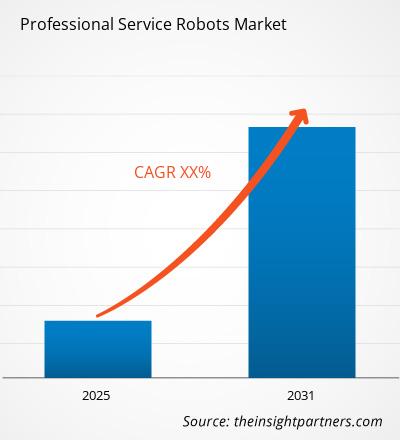
The professional service robots market reached US$ 42.23 Billion in 2025 and is projected to attain US$ 94.22 Billion by 2034, registering a CAGR of 10.55% during 2026–2034. Expansion is being supported by autonomous mobility, artificial intelligence, machine vision, fleet orchestration, and demand for safer task execution across logistics, healthcare, aerospace and defense, and customer-facing environments.
North America presents a strong deployment environment as labor availability, warehouse automation, defense modernization, and healthcare efficiency encourage adoption. The professional service robots market size is supported by an estimated regional CAGR of 10.0–11.0% through 2034, with investment increasingly shifting toward autonomous navigation, collaborative operation, robotics software, and integrated platforms.
Professional Service Robots Market Assessment and Insights
- North America: The region represented a 27–31% professional service robots market share in 2025 and is projected to grow at a CAGR of 10.0–11.0% between 2026–2034, supported by logistics automation, defense modernization, and advanced healthcare robotics adoption.
- US: The US accounted for 70–74% of North America's 2025 value and is expected to expand at a CAGR of 10.2–11.2% during 2026–2034, led by logistics and defense deployments.
- Europe: Europe held a 24–28% share in 2025 and is projected to register a CAGR of 9.5–10.5% through 2034, with Germany, the UK, France, Italy, and Spain strengthening automation across logistics, construction, and industrial services.
- Asia Pacific: Asia Pacific represented 31–35% in 2025 and is forecast to grow at 11.5–12.5% CAGR between 2026–2034, led by China, Japan, South Korea, India, and Australia through industrial automation and technology investment.
- Largest Segment: UAV represented a 35–39% market share in 2025 and is estimated to grow at a 10.5–11.5% CAGR between 2026–2034, benefiting from surveillance and inspection requirements.
- High Growth Segment: Construction Robots held a 12–16% market share in 2025 and is projected to expand at a 13.0–15.0% CAGR during 2026–2034, driven by jobsite automation.
- Key companies analyzed in detail: ABB Ltd.; Boston Dynamics, Inc.; Comau S.p.A.; Daifuku Co., Ltd.; Kawasaki Heavy Industries, Ltd.; KUKA SE & Co. KGaA; Mitsubishi Electric Corporation; Ontario Drive & Gear Ltd.; Universal Robots A/S; Yaskawa Electric Corporation.
Source: The Insight Partners' analysis based on proprietary research, government publications, company annual reports, investor presentations, industry databases, and expert interviews.
Deployment has evolved from standalone automation projects to robotic fleets that have capabilities for sensing, navigation, coordination, and collecting operational data. Sales of professional service robots according to IFROBOTSA reached about 200,000 units by 2024, growing by 9%, while robot as a service fleets rose by 31%. Logistics remained the main professional application, indicating the move towards scalable mobile automation.
The professional service robots Market report shows that in the future, investments will be made into physical AI, simulation, edge computing, and multibot orchestration technologies. The emerging demand in India, Southeast Asia, the Middle East, and Latin America will contribute to deployment beyond automation hubs. Safety of machines, cybersecurity, human-robot interaction, and autonomous operation will play an increasingly important role in the procurement process and system architecture.
Professional Service Robots Market Report Scope
| Report Attribute | Details |
|---|---|
| Market size in 2025 | US$ 42.23 Billion |
| Market Size by 2034 | US$ 94.22 Billion |
| Global CAGR (2026 - 2034) | 10.55% |
| Historical Data | 2021-2024 |
| Forecast period | 2026-2034 |
Professional Service Robots Market Analysis
Labor shortage, fulfillment complexity, safety, and constant operation are among the main factors shaping professional service robots market growth. Manufacturers of hardware components start incorporating such components as sensors, actuators, navigational devices, controllers, and AI-driven software, and integrators incorporate robots into systems for managing warehouses, hospitals, factories, and security facilities to create recurring income in the form of maintenance, software, fleet management, and analytics services.
The changes in supply also include the development of modular robots able to be configured to various weight-bearing and environmental conditions. Autonomous mobile platforms, UAVs, and advanced systems designed for military use need more complex perception and communication abilities. In addition, robot-as-a-service allows logistics companies, hospitals, and other service providers to grow their robotic fleets incrementally without huge initial investments.
Market analysis for professional service robots shows that competitive factors now revolve around software proficiency, integration, mobility, reliability, and application-oriented engineering instead of merely focusing on hardware capabilities. ABB Ltd. integrates industrial robotics with autonomous mobile platforms whereas Boston Dynamics, Inc. concentrates on mobility and robotic intelligence. Daifuku Co., Ltd. shows high inclination towards automated material handling while KUKA SE & Co. KGaA is developing software-based automation.
Strategic investments are being made in AI-based perception, simulation, digital twin, and flexible deployments. Universal Robots A/S is concentrating on collaborative automation whereas Mitsubishi Electric Corporation and Yaskawa Electric Corporation are utilizing automation ecosystem advantages. Kawasaki Heavy Industries, Ltd. and Comau S.p.A. are showcasing their advanced engineering capabilities while Ontario Drive & Gear Ltd. is adding its unique strengths in unmanned mobility.
● REPORT CUSTOMIZATION
Tailor This Report To Align With Your Specific Business Requirements
This report can be customized to align precisely with your business objectives, scope, and target markets. Customization options include tailored segmentation, geography, competitive analysis, and strategic insights to support informed decision-making.
Customize This Report →WHAT YOU CAN ADJUST
- ● Segmentations
- ● Geography
- ● Competitive Analysis
- ● Language Preferences
Professional Service Robots Market: Strategic Insights

Regional Insights
North America professional service robots market
North America accounted for a 27–31% share in 2025 and is expected to expand at a 10.0–11.0% CAGR through 2034. The United States is still the leading contributor in the region, thanks to warehouse automation, defense procurements, labor demands in the healthcare industry, and investments in artificial intelligence. The Canadian contribution comes from mining, logistics, agriculture, and automation in a remote environment.
The focus on deployment has shifted towards robotic systems that can safely function around people and infrastructure. While logistics companies are using mobile robots for motion and sorting, defense organizations are focusing more on surveillance and unmanned operations. Healthcare providers are exploring robots for transportation, disinfection, rehabilitation, and other supportive roles.
U.S. professional service robots Market
The US represented 70–74% of North America's 2025 value and is expected to grow at a 10.2–11.2% CAGR through 2034. Strong company presence includes ABB Ltd., Boston Dynamics, Inc., Universal Robots A/S, and other automation suppliers serving logistics, defense, healthcare, and commercial operations.
The applications need is moving from the warehouse movement to construction inspection, autonomous security, logistics in hospitals, and higher-level military operations. Total lifecycle costs, cyber-security, interoperability, and training requirements become major procurement criteria. Artificial intelligence infrastructure development by the government and private enterprises will benefit robotic systems development, and logistics infrastructures will offer good conditions for large-scale autonomous vehicles trials.
Europe professional service robots Market
Europe held a 24–28% share in 2025 and is projected to record a 9.5–10.5% CAGR through 2034. Germany is still one of the leading nations that are helped by industrial automation, logistics upgrading, and robotic engineering. Additional demands come from the UK, France, Italy, and Spain, where healthcare, construction, logistics, and public services require robotics.
Germany offers good manufacturing and automation, which results in demand for mobile robots, collaborative robots, inspection robots, and automatic transportation of materials. In the UK, there is an emphasis on logistics, healthcare innovations, security, and research-led robotics. France, Italy, and Spain expand the use of robotics due to industrial upgrading, infrastructure, and service automation.
APAC professional service robots Market
APAC represented a 31–35% share in 2025 and is projected to grow at an 11.5–12.5% CAGR. China comes first, then Japan, South Korea, India, and Australia. The use of automation in industrial production, the making of electronic equipment, logistics automation, and government initiatives aimed at the use of technology are increasing the adoption rate.
China combines industrial production and automation of its logistics sector, whereas Japan and South Korea focus on robotics and workforces that consist of elderly people. India presents possibilities for warehousing, construction, healthcare, and infrastructure, whereas Australia has a demand for mining and distant places.
Middle East & Africa professional service robots Market
Middle East and Africa adoption is developing from a smaller base, with estimated growth of 10.5–11.5% through 2034. Saudi Arabia leads regional momentum, supported by infrastructure investment and economic diversification. The UAE is advancing smart logistics, security, and service automation, while South Africa contributes through mining, industrial services, and logistics.
Energy infrastructure, construction megaprojects, and remote operating environments create opportunities for unmanned systems. Saudi Arabia's large development programs can support autonomous construction and inspection applications, while the UAE provides technology-friendly environments for logistics and public-service automation. South Africa and the rest of MEA present specialized opportunities where robotics can reduce exposure to hazardous environments and address workforce constraints.
Segmentation Analysis
Type
The type segment is characterized by diverse robotic architectures serving aerial, terrestrial, defense, construction, and specialized missions. UAVs currently hold the largest position, while construction robots are gaining momentum as autonomy, perception, and machine control improve. The segment is projected to expand at a 10.5–11.5% CAGR during 2026–2034.
- UAV: UAVs serve surveillance, inspection, mapping, monitoring, and defense missions where aerial mobility provides operational advantages and reduces human exposure to difficult or hazardous environments.
- Unmanned Ground Based Vehicles: Ground vehicles support material movement, inspection, security, and remote operations, particularly where persistent navigation and payload transport are required across structured or semi-structured environments.
- Demining Robots: Demining systems address hazardous explosive environments by enabling remote detection and neutralization, with strategic importance for defense, humanitarian operations, and infrastructure recovery.
- Defense Robot: Defense robots support surveillance, reconnaissance, logistics, perimeter security, and tactical missions, allowing organizations to improve situational awareness while reducing personnel exposure.
- Construction Robots: Construction robots automate repetitive, hazardous, and precision-intensive activities, improving jobsite consistency and creating opportunities for autonomous operations where labor shortages constrain project execution.
Application
Application demand is becoming more diversified as robotics moves beyond traditional material handling into healthcare, customer-facing services, and aerospace and defense. The application segment is projected to grow at a 10.0–11.0% CAGR during 2026–2034, with logistics retaining strong commercial importance.
- Logistics: Logistics represents a mature deployment environment because robots can repeatedly transport, sort, inspect, and retrieve goods while integrating with warehouse software and automated storage systems.
- Healthcare: Healthcare adoption is expanding around internal transportation, assistance, rehabilitation, disinfection, and support functions where automation can address workforce pressures and improve workflow consistency.
- Customer Service: Customer service robots support navigation, information delivery, reception, guidance, and repetitive interactions, particularly in airports, hotels, retail environments, and public facilities.
- Aerospace and Defense: Aerospace and defense applications prioritize autonomous surveillance, inspection, reconnaissance, remote handling, and mission support where reliability and reduced human exposure are critical.
Opportunity Snapshot
| Application | Revenue Contribution (High/Medium/Low) | Trend Tag | Adoption Stage |
|---|---|---|---|
| Logistics | High | Fleet Automation | Mature |
| Healthcare | Medium | Care Support | Scaling |
| Customer Service | Medium | Smart Reception | Scaling |
| Aerospace and Defense | High | Autonomous Mission | Scaling |
Professional Service Robots Market Growth Drivers and Impact Analysis
Labor shortages accelerating autonomous task execution
Persistent shortages of qualified workers are increasing the economic value of robots that can perform repetitive, physically demanding, or hazardous activities. International Federation of Robotics reporting identifies staff shortages as a key reason organizations deploy professional service robots, while logistics remains the largest application by units sold. The effect extends beyond labor replacement because robotic systems can provide consistent operating schedules, reduce workplace exposure, and standardize repetitive processes. Companies increasingly evaluate robotics against recruitment difficulty, employee turnover, and overtime expenses rather than hardware cost alone. This changes purchasing decisions toward measurable productivity and lifecycle economics. As integration tools become easier to use, smaller operators can adopt specialized robots without maintaining large internal robotics engineering teams, widening the addressable customer base.
Artificial intelligence improving autonomy and operational flexibility
Artificial intelligence is increasing the ability of robots to perceive changing environments, classify objects, plan routes, and respond to exceptions. Advances in machine vision, neural networks, edge computing, and simulation are reducing dependence on rigid programming. The commercial impact is especially important in environments where workflows change frequently, such as warehouses, construction sites, hospitals, and public facilities. Robots that can adapt to new layouts or task variations require fewer physical modifications and can therefore deliver greater utilization over their operating lives. Suppliers are also integrating software platforms that collect operational data, enabling predictive maintenance and performance optimization. As physical AI becomes more reliable, procurement teams are likely to shift from evaluating individual machines toward assessing complete autonomous workflows, including orchestration, cybersecurity, integration, and continuous software improvement.
Rising demand for safer remote operations
Robotic deployment is increasingly justified by the need to keep personnel away from hazardous, inaccessible, or operationally demanding environments. Demining, defense reconnaissance, industrial inspection, construction monitoring, and remote infrastructure assessment can benefit from unmanned systems that extend human capabilities without requiring direct exposure. This driver is particularly relevant where the cost of an incident exceeds the cost of automation. Advanced sensors, communications, autonomous navigation, and remote control are improving operational reliability while reducing the need for constant human presence. In commercial settings, similar principles apply to confined spaces, elevated structures, contaminated areas, and repetitive transport routes. Consequently, safety requirements are becoming an investment criterion alongside productivity, helping specialized robotic platforms gain adoption even when deployment volumes remain lower than logistics-focused systems.
Professional Service Robots Market Future Trends
Physical AI moving from demonstrations toward deployable fleets
The professional service robots market trends are shifting toward physical AI systems that combine perception, reasoning, motion, and task execution. Future deployments are likely to use foundation models, synthetic training data, simulation environments, and edge inference to reduce programming requirements. Rather than operating as isolated machines, robots will increasingly function as coordinated fleets connected through software layers that allocate tasks according to workload and location. This transition should favor suppliers capable of integrating hardware, AI models, simulation, and fleet management. Commercial buyers will increasingly assess whether platforms can learn from operational data and adapt without extensive re-engineering. As reliability improves, physical AI could expand robotics into environments previously considered too variable for automation, including construction sites, mixed-use facilities, and dynamic service environments.
Robotics becoming increasingly software-defined
Robotic platforms are moving toward modular software architectures that separate task intelligence from underlying hardware. This trend should allow organizations to update navigation, perception, scheduling, and analytics without replacing complete robotic systems. Cloud connectivity will coexist with edge processing, enabling sensitive or latency-critical workloads to remain local while broader fleet analytics operate centrally. Digital twins will become more important for testing routes, evaluating throughput, and validating safety before deployment. Interoperability will also gain importance as users combine robots from multiple suppliers within one facility. These developments can reduce technology lock-in and improve asset utilization. Suppliers with open interfaces, simulation capabilities, cybersecurity controls, and strong integration ecosystems are therefore positioned to capture a greater portion of long-term software and service revenue.
Professional Service Robots Market Opportunities
Expanding robotics-as-a-service for smaller operators
The professional service robots market Forecasts indicate a growing opportunity for subscription, leasing, and usage-based models that lower the initial financial barrier to automation. International Federation of Robotics data already shows a 31% increase in robot-as-a-service fleets, indicating greater acceptance of alternative ownership structures. Providers can package hardware, software, maintenance, fleet monitoring, and upgrades into recurring contracts, making automation more predictable for customers. This model is particularly attractive to smaller warehouses, hospitals, construction contractors, and commercial facilities that lack large capital budgets. Investors and suppliers can target applications with measurable recurring workloads, such as transport, cleaning, inspection, and inventory movement. Strong service coverage and rapid redeployment capabilities will be essential for protecting margins while demonstrating measurable customer value.
Localized robotics ecosystems in emerging economies
Emerging economies provide an opportunity to build localized robotics ecosystems around application-specific needs rather than replicating mature-market automation models. India, Southeast Asia, the Middle East, and selected Latin American economies have expanding logistics, infrastructure, healthcare, and manufacturing requirements that can support targeted robotic deployments. Local assembly, system integration, training, maintenance, and software development can reduce implementation barriers while creating regional expertise. Companies entering these markets should prioritize modular platforms capable of operating in variable infrastructure conditions and support multilingual interfaces and locally relevant safety requirements. Partnerships with universities, technology firms, integrators, and public institutions can accelerate workforce development. Investment in regional service networks may become as important as hardware availability because customers require dependable commissioning, maintenance, and technical support throughout the robot lifecycle.
Frequently Asked Questions

- Comprehensive Market Sizing and Forecast Analysis
- Detailed Segmentation Analysis
- In-Depth Market Dynamics Assessment
- Regional and Country-Level Insights
- Competitive Landscape and Company Benchmarking
- Strategic Business Intelligence
Recent Reports
Testimonials

The Insight Partners provided valuable market intelligence that supported our global go-to-market strategy. Their team was professional, responsive, and attentive to our feedback, providing thoughtful analysis and helpful methodological clarifications throughout the project.
Junmo Kim Chief Financial Officer (CFO), Enertech Co., Ltd.
The Insight Partners' SCADA System Market report is comprehensive, with valuable insights on current trends and future forecasts. The team was highly professional, responsive, and supportive throughout. We are very satisfied and highly recommend their services.
RAN KEDEM Partner, Reali Technologies LTDs
I requested a report on a very specific software market and the team produced the report in a few days. The information was very relevant and well presented. I then requested some changes and additions to the report. The team was again very responsive and I got the final report in less than a week.
JEAN-HERVE JENN Chairman, Future Analytica
We worked with The Insight Partners for an important market study and forecast. They gave us clear insights into opportunities and risks, which helped shape our plans. Their research was easy to use and based on solid data. It helped us make smart, confident decisions. We highly recommend them.
PIYUSH NAGPAL Sr. Vice President, High Beam Global
The Insight Partners delivered insightful, well-structured market research with strong domain expertise. Their team was professional and responsive throughout. The user-friendly website made accessing industry reports seamless. We highly recommend them for reliable, high-quality research services
YUKIHIKO ADACHI CEO, Deep Blue, LLC.
This is the first time I have purchased a market report from The Insight Partners.While I was unsure at first, I visited their web site and felt more comfortable to take the risk and purchase a market report.I am completely satisfied with the quality of the report and customer service. I had several questions and comments with the initial report, but after a couple of dialogs over email with their analyst I believe I have a report that I can use as input to our strategic planning process.Thank you so much for taking the extra time and making this a positive experience.I will definitely recommend your service to others and you will be my first call when we need further market data.
JOHN SUZUKI President and Chief Executive Officer, Board Director, BK Technologies
I wish to appreciate your support and the professionalism you displayed in the course of attending to my request for information regarding to infectious disease IVD market in Nigeria. I appreciate your patience, your guidance, and the fact that you were willing to offer a discount, which eventually made it possible for us to close a deal. I look forward to engaging The Insight Partners in the future, all thanks to the impression you have created in me as a result of this first encounter.
DR CHIJIOKE ONYIA MANAGING DIRECTOR, PineCrest Healthcare Ltd.Reason to Buy
- Informed Decision-Making
- Understanding Market Dynamics
- Competitive Analysis
- Identifying Emerging Markets
- Customer Insights
- Market Forecasts
- Risk Mitigation
- Boosting Operational Efficiency
- Strategic Planning
- Investment Justification
- Tracking Industry Innovations
- Aligning with Regulatory Trends





 Get Free Sample for