
OEM Insulation Market Share, Demand & Growth by 2034
OEM Insulation Market Size and Forecasts (2021 - 2034), Global and Regional Share, Trends, and Growth Opportunity Analysis Report Coverage : by Product (Polyurethane Foam, Glass Wool, Elastomeric Foam); Application (Building & Construction, Automotive, Aerospace & Defense, Electronics); and Geography (North America, Europe, Asia Pacific, and South and Central America)
- Status : Data Released
- Report Code : TIPRE00040292
- Category : Chemicals and Materials
- No. of Pages : 150
- Available Report Formats :


- Last update date : September 28, 2026


2025 Market Size
US$ 41.12 Bn
Base year value
2034 Forecast
US$ 61.67 Bn
Projected by 2034
CAGR 2026-2034
4.61 %
Growth rate
Addressable Market
US$ 466.76 Bn
(2026-2034)
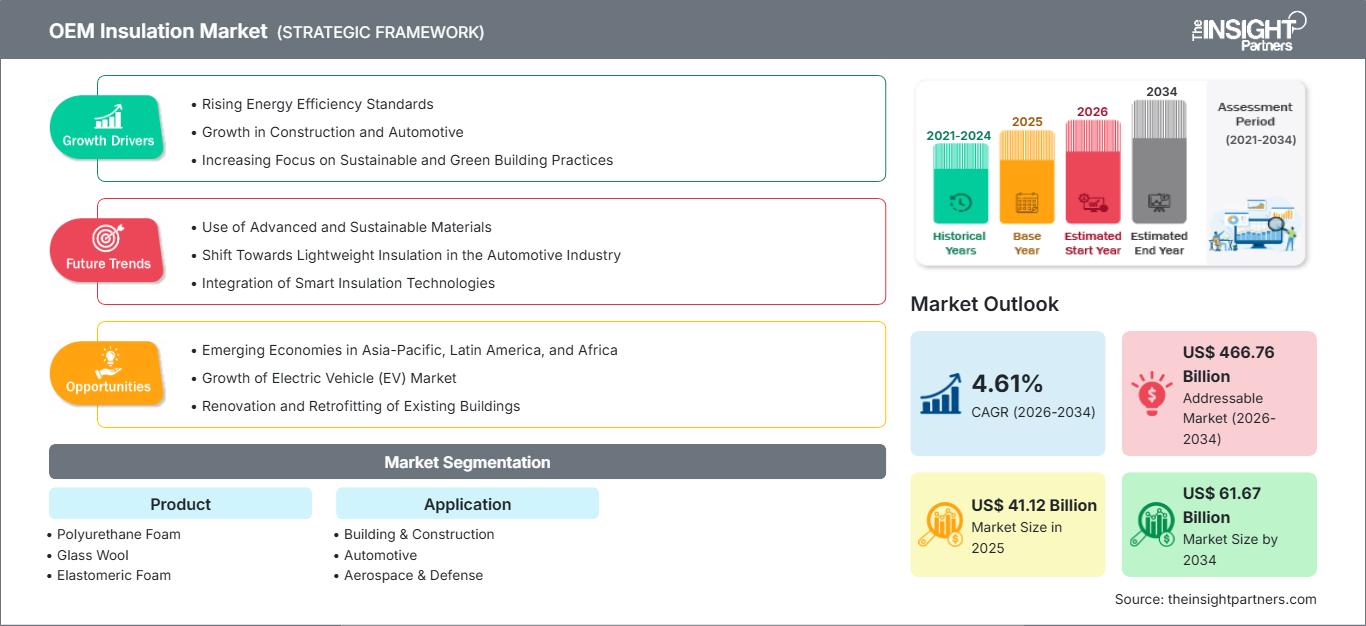
The oem insulation market size is valued at US$ 41.12 Billion in 2025 and is projected to reach US$ 61.67 Billion by 2034, expanding at a CAGR of 4.61% during 2026–2034. Demand is supported by energy-efficiency requirements, vehicle lightweighting, thermal management, and increasing insulation requirements across buildings, transportation systems, electronics, and specialized industrial equipment.
North America presents a structurally resilient outlook for the oem insulation market, supported by renovation activity, stricter building-energy performance requirements, automotive localization, and investment in advanced manufacturing. The regional market is expected to expand at a CAGR of 4.4–4.9% during 2026–2034, with polyurethane-based solutions benefiting from thermal-performance and installation-efficiency requirements.
OEM Insulation Market Assessment and Insights
- North America: North America represents a substantial portion, with a 2025 oem insulation market share of 24–27% and a CAGR of 4.4–4.9% between 2026–2034. Building renovation, automotive production, and industrial thermal management support sustained demand.
- US: The US accounts for 82–86% of North America in 2025, supported by building-code compliance, vehicle manufacturing, cold-chain infrastructure, and demand for higher-performance insulation systems. It is projected to grow at a 4.3–4.8% CAGR during 2026–2034.
- Europe: Europe holds a 2025 share of 27–30%, expanding at a 4.7–5.2% CAGR between 2026–2034. Germany, France, Italy, Spain, and the UK remain important markets as energy-efficiency legislation and building renovation programs strengthen insulation demand.
- Asia Pacific: Asia Pacific accounts for a 2025 share of 35–39% and is expected to record a 5.0–5.6% CAGR between 2026–2034. China, Japan, South Korea, and India benefit from manufacturing expansion, urban construction, automotive production, and electronics investment.
- Largest Segment: Polyurethane Foam commands a 44–48% market share in 2025 and is projected to grow at a 5.0–5.5% CAGR during 2026–2034, reflecting strong thermal efficiency and broad application compatibility.
- High Growth Segment: Elastomeric Foam represents a 14–18% market share in 2025 and is expected to expand at a 6.0–6.5% CAGR during 2026–2034, supported by HVAC, automotive, and moisture-control applications.
- Key companies analyzed in detail: Aeroflex Company Limited, Compagnie de Saint-Gobain S.A., Paul Bauder GmbH & Co. KG, MDH-Makel Group, Wacker Chemie AG, BASF SE, Armacell, Avon Group Manufacturing Ltd, Covestro AG, and Johns Manville.
Source: The Insight Partners' analysis based on proprietary research, government publications, company annual reports, investor presentations, industry databases, and expert interviews.
The OEM insulation market has changed from simple thermal barrier solutions into complex material blends of thermal resistance, sound performance, fire properties, moisture management, weight reduction, and manufacturability. Polyurethane systems have become more prevalent for uses in which thin profiles and higher insulation effectiveness are needed, while glass wool continues to be critical for use in buildings. Elastomeric foams can meet the needs of complex geometry, condensation, and vibration-sensitive equipment. Manufacturing approaches will thus need to adapt to specialized formulation, automation, low emission chemistries, and regional manufacturing operations.
During the forecast period, the OEM insulation market will be boosted by investment in Asia Pacific, energy efficiency improvements in Europe, and localized production of automobiles and electronics in North America. The regulatory drive is also shifting from minimum thermal performance to a carbon footprint over its lifetime. Manufacturers of low-emitting systems, using recycled or renewable feedstocks, light-weight construction, and certification can thus target premium applications while staying within OEM qualification protocols.
OEM Insulation Market Report Scope
| Report Attribute | Details |
|---|---|
| Market size in 2025 | US$ 41.12 Billion |
| Market Size by 2034 | US$ 61.67 Billion |
| Global CAGR (2026 - 2034) | 4.61% |
| Historical Data | 2021-2024 |
| Forecast period | 2026-2034 |
OEM Insulation Market Analysis
Based on the oem insulation market research report, demand is dependent on energy performance of buildings, thermal management in vehicles, temperature control in industries, and electronic component protection. Raw material input in the production process includes polymers, intermediates, glass fibers, blowing agents, binders, and specialty chemicals. Other inputs include insulation material production, conversion, lamination, molding, cutting, and integration into systems. OEMs are increasingly specifying insulation based on thermal properties, acoustic properties, fire resistance, weight, durability, and installation requirements instead of just material type.
OEM insulation market supply dynamics are highly sensitive to availability of raw materials and production economics in different regions. Producers of polyurethane are subject to the cost of isocyanates and polyols whereas glass wool producers are subject to costs of minerals and furnace energy. Flexible foam producers have need for cell structure and dimensional stability. Therefore, production in different regions is becoming strategically significant especially for customers who want short lead times, regional certification, custom formats, and resilient supply chains.
The oem insulation industry is comprised of diversified construction materials, specialized foam products, polymers, and engineered component players. Compagnie de Saint-Gobain S.A. and Johns Manville offer comprehensive insulation solutions, whereas BASF SE and Covestro AG operate in the industry at a more upstream level using polyurethane solutions and raw material inputs. Armacell concentrates on flexible and technical insulations, and Paul Bauder GmbH & Co. KG places emphasis on roofing and building envelope systems.
The positioning of strategic value increasingly relies on product differentiation rather than just on commoditized volumes. Wacker Chemie AG supplies silicone and specialty materials, Aeroflex Company Limited concentrates on flexible insulation solutions, and Avon Group Manufacturing Ltd provides engineered insulations and acoustic components for OEMs. The investments are increasingly being made towards low carbon manufacturing, localization of production, advanced product certification, and materials that can cater to different performance criteria within a single component.
● REPORT CUSTOMIZATION
Tailor This Report To Align With Your Specific Business Requirements
This report can be customized to align precisely with your business objectives, scope, and target markets. Customization options include tailored segmentation, geography, competitive analysis, and strategic insights to support informed decision-making.
Customize This Report →WHAT YOU CAN ADJUST
- ● Segmentations
- ● Geography
- ● Competitive Analysis
- ● Language Preferences
OEM Insulation Market: Strategic Insights
Regional Insights
North America oem insulation market
North America represents a 24–27% share in 2025, with growth expected at a 4.4–4.9% CAGR during 2026–2034. There are advantages of renovation, construction, auto-industry, HVAC upgrading, and the development of temperature-control systems in the region. The demand in the region is highly correlated with insulation thickness, efficiency in energy usage, moisture resistance, and productivity in installations.
The US is the leading regional market, and Canada participates through its residential construction, industrial plants, and energy saving programs. Auto industry is essential because there is more and more insulation used in thermal acoustic systems, protection of batteries and engines, and interior elements. Mexico adds to the manufacturing environment through auto and industrial supply chains.
U.S. oem insulation Market
The US represents 82–86% of North America's 2025 market, expanding at a 4.3–4.8% CAGR during 2026–2034. Demand is driven by renovation projects, residential energy efficiency improvements, HVAC replacement, cold chain logistics, and manufacturing activity. Building code requirements drive improvements in the performance of insulation products, especially when energy efficiency and comfort become key purchasing considerations.
BASF SE, Johns Manville, Compagnie de Saint-Gobain S.A., Armacell, and other players have well-developed distribution networks and applications know-how. Automotive insulation is growing around electric vehicle battery insulation, acoustics management, and thermal insulation of lightweight vehicles. Data center and high technology buildings also drive insulation demand for equipment and temperature control needs, although specifications are quite different from traditional building insulation.
Europe oem insulation Market
Europe accounts for a 27–30% share in 2025 and is expected to grow at a 4.7–5.2% CAGR through 2034. Germany continues to be the largest market due to its industry presence, auto manufacturing, and its existing insulation supply chain. The UK, France, Italy, and Spain offer demand due to the renovation and efficiency of buildings.
The UK is driven by its need for retrofits and greater attention to building energy performance. Germany is able to combine automotive, industrial, and construction demand, thus diversifying its insulation industry. France is driven by renovation activities and decarbonization, while Italy and Spain by renovations, climate control demands, and construction modernization. European demand is becoming more sensitive to embodied carbon assessment and product environmental declarations.
APAC oem insulation Market
Asia Pacific holds a 35–39% share in 2025 and is forecast to grow at a 5.0–5.6% CAGR during 2026–2034, making it the leading regional market. China remains the largest country, supported by manufacturing scale, construction, automotive production, and electronics.
Oem Insulation Market Forecast reveals that Japan and South Korea have high demand for precision insulation for automotive and electronic purposes whereas India is growing on account of constructions, automobiles, infrastructure, and industrial manufacturing. The contribution of Australia comes from building-energy needs and climate control applications.
Middle East & Africa oem insulation Market
The oem insulation Market report shows that demand in Middle East and Africa is supported by extreme temperatures, energy-intensive cooling, industrial infrastructure, and construction projects. Saudi Arabia and the UAE remain leading Gulf markets, while South Africa anchors demand in southern Africa. Growth is expected at a 4.1–4.6% CAGR during 2026–2034.
Saudi Arabia benefits from large-scale infrastructure development, while the UAE emphasizes high-performance building envelopes and HVAC efficiency. South Africa provides demand from commercial buildings, industrial facilities, and automotive manufacturing. The rest of the region remains smaller but offers opportunities where energy costs, climate exposure, and infrastructure modernization increase the economic value of thermal insulation.
Segmentation Analysis
Product
The Product segment in the oem insulation Market is expected to expand at a 4.3–4.8% CAGR during 2026–2034. Material selection depends on thermal conductivity, flexibility, fire behavior, moisture resistance, density, thickness, processing requirements, and application geometry. Polyurethane Foam remains the largest category because high insulation efficiency can be achieved with relatively thin structures, while Glass Wool remains important for building applications and Elastomeric Foam serves flexible technical applications.
- Polyurethane Foam: Polyurethane Foam maintains the strongest market position because of its high thermal efficiency, dimensional stability, low weight, and suitability for panels, appliances, vehicles, refrigeration systems, and building envelopes. Its broad processing flexibility supports OEM customization.
- Glass Wool: Glass Wool remains strategically important where non-combustibility, acoustic absorption, durability, and building-envelope performance are prioritized. Its established manufacturing infrastructure and familiarity among contractors support continued adoption across residential, commercial, and industrial construction.
- Elastomeric Foam: Elastomeric Foam is increasingly selected for flexible components, HVAC systems, piping, automotive thermal management, and condensation control. Its closed-cell structure and flexibility support installations involving vibration, movement, irregular geometries, and fluctuating operating temperatures.
Application
The Application segment is projected to grow at a 4.6–5.1% CAGR during 2026–2034. Building and construction remains the principal demand center, while automotive, aerospace and defense, and electronics applications require increasingly specialized thermal, acoustic, fire, and lightweight performance. OEM qualification requirements also encourage suppliers to develop application-specific grades and converted components.
- Building & Construction: Building & Construction represents the broadest application base, supported by energy-efficiency requirements, renovation, roofing, wall systems, floors, HVAC, and cold-storage facilities. Material selection increasingly considers lifecycle performance alongside initial installation cost.
- Automotive: Automotive demand is shifting toward lightweight thermal-acoustic components, battery protection, engine-compartment insulation, and heat shielding. Electrification creates additional requirements around battery thermal management, cabin comfort, noise control, and protection of sensitive components.
- Aerospace & Defense: Aerospace & Defense applications prioritize weight reduction, fire resistance, temperature stability, acoustic performance, and stringent certification. Although volumes are lower than construction, high qualification barriers and specialized material requirements create attractive value-added opportunities.
- Electronics: Electronics applications require compact thermal management, electrical safety, dimensional stability, and protection against heat generated by densely packaged components. Data centers, power electronics, communications equipment, and advanced devices support demand for engineered insulation systems.
Opportunity Snapshot
| Application | Revenue Contribution | Trend Tag | Adoption Stage |
| Building & Construction | High | Energy Retrofit | Mature |
| Automotive | High | EV Thermal | Scaling |
| Aerospace & Defense | Medium | Lightweight Shielding | Scaling |
| Electronics | Medium | Thermal Management | Scaling |
OEM Insulation Market Growth Drivers and Impact Analysis
Stricter building energy-performance requirements
Energy-efficiency regulation is driving an increase in both quantity and quality of insulation used in new constructions and renovations. European Commission's Roadmap to Implementation of the Energy Performance of Building Directive aims to improve building energy consumption and de-carbonization, thus supporting high-performance material solutions in terms of their business case. In fact, these goals of energy savings are pursued not only in Europe but also in North America and the Asia Pacific region. In addition to the quantity of material, issues such as its thermal conductivity, thickness, installability, and long-term performance are being considered together, thus favoring those companies which can provide a system solution rather than material only solution.
Electrification is expanding thermal-management requirements
Electrical vehicle components have increased the need for insulation in applications other than engines and exhaust systems. The materials in areas like batteries, power electronics, charging stations, circuits, and interiors should be able to withstand high temperatures while meeting some weight, noise, fire safety, and strength needs. The global automotive production increased from 92.7 million vehicles in 2024 to 96.4 million vehicles in 2025 according to OICA figures. The significance of the impact comes from the fact that electrical vehicle architectures create qualification opportunities for insulation manufacturers. Insulating materials that will be able to provide heat protection, light weight, and sound characteristics may get specified for use in batteries, cabins, and electronics, whereas companies with engineering experience in the automotive industry may approach Tier 1.
Growth of temperature-controlled industrial infrastructure
The growth of cold storage, logistics facilities, data centers, processing industries, and advanced HVAC systems is boosting the need for insulation that keeps the system at constant operating temperatures. Insulation helps minimize heat loss and enhance efficiency of machines, especially when the machine operates non-stop. Infrastructure that needs to be temperature controlled also needs to use materials that will prevent moisture penetration, condensation, mechanical damage, and thermal cycles. Closed-cell foam insulations and engineered insulation systems are used in most technological applications. The biggest opportunities exist where energy costs play an important role in the operations of the business and where machinery downtime will cost the company.
OEM Insulation Market Future Trends
Integration of lower-carbon material pathways
The future development of new products will entail the integration of thermal performance with a quantifiable reduction of embodied carbon. Companies will use recycled content, biogenic content, mass balance approach, and lower emission feedstocks, while retaining the same processing performance as before. Such changes will be very significant in the development of polyurethane systems, given that the chemistry involved can have an impact on the footprint of such products. The environmental product declarations and lifecycle assessments are increasingly likely to drive purchasing decisions in Europe. New products with lower carbon emissions are unlikely to replace traditional products immediately, but rather coexist until customers start setting carbon limits within their specifications.
Application-specific multifunctional insulation systems
The oem insulation market trends indicate that the next generation of products would involve the development of insulation systems that could carry out multiple functions at once. Materials with properties such as heat insulation and sound absorption, flame resistance, and compatibility with the structure itself will be used in the automotive industry. The construction industry, on the other hand, will have products that combine heat insulation, moisture regulation, airtightness, and ease of installation. There will be similar specifications in the electronics industry, wherein the product should be small enough to enable thermal management without increasing the dimensions of the electronic gadgets. Such innovations may result in reduced costs owing to lesser components and processes in assembly, moving the competition away from price per kilogram of material to performance per unit.
OEM Insulation Market Opportunities
Localized production in high-growth manufacturing hubs
Avenues of growth include building or increasing manufacturing capacity near the automotive, electronic, construction, and industrial customer bases in India, Southeast Asia, China, and select Middle Eastern countries. Proximity manufacturing cuts down on shipping time and distance as well as enables customization of product for the local codes and applications. This strategy is especially appropriate for converted insulation parts, which could be cut, laminated, molded, and assembled near the OEM facilities. Regional manufacturing capacity would not only ensure continuity of supply in case of logistical disruptions but also enable companies to manufacture in areas that have consistent access to energy, chemical feedstocks, skilled labor, and industrial concentration. Collaboration with regional converters and Tier 1 suppliers would speed up the process of qualification and entry into the market without making huge upfront manufacturing investments.
Premium insulation for electric and electronic platforms
There is an opportunity for a value-added product line in engineered insulation for electric vehicles, batteries, battery charging, power electronics, aerospace equipment, and data centers. This market has multiple demands which will allow the supplier to add value with engineered solutions instead of just raw materials. Investment should be made in thin-wall, flame-retardant, sound-proofing, heat shields, and temperature-cycleable components. Once the materials are incorporated into platform products, there will be a long-term relationship between the OEM customer and the supplier because the material will become qualified. The supplier can increase margins by being involved early in engineering projects and testing, simulations, prototypes, and component conversions.
Recent Developments
- July 2026: Paul Bauder GmbH & Co. KG opened a new insulation and waterproofing facility in Drusenheim, France, strengthening its European production footprint. The investment expands regional manufacturing capability for roofing and insulation systems and supports closer supply to customers in major European construction markets. The facility reflects the company's focus on production scale, logistics efficiency, and continued development of high-performance building-envelope solutions.
- July 7, 2026: Compagnie de Saint-Gobain S.A. announced the acquisition of a glass-fiber plant in North America to reinforce its insulation supply chain. The transaction strengthens access to an important input for glass-wool products and supports regional supply resilience. The move also demonstrates continued vertical integration around insulation manufacturing, particularly as demand for energy-efficient construction materials increases across North American markets.
Frequently Asked Questions

- Comprehensive Market Sizing and Forecast Analysis
- Detailed Segmentation Analysis
- In-Depth Market Dynamics Assessment
- Regional and Country-Level Insights
- Competitive Landscape and Company Benchmarking
- Strategic Business Intelligence
Recent Reports
Testimonials

The Insight Partners provided valuable market intelligence that supported our global go-to-market strategy. Their team was professional, responsive, and attentive to our feedback, providing thoughtful analysis and helpful methodological clarifications throughout the project.
Junmo Kim Chief Financial Officer (CFO), Enertech Co., Ltd.
The Insight Partners' SCADA System Market report is comprehensive, with valuable insights on current trends and future forecasts. The team was highly professional, responsive, and supportive throughout. We are very satisfied and highly recommend their services.
RAN KEDEM Partner, Reali Technologies LTDs
I requested a report on a very specific software market and the team produced the report in a few days. The information was very relevant and well presented. I then requested some changes and additions to the report. The team was again very responsive and I got the final report in less than a week.
JEAN-HERVE JENN Chairman, Future Analytica
We worked with The Insight Partners for an important market study and forecast. They gave us clear insights into opportunities and risks, which helped shape our plans. Their research was easy to use and based on solid data. It helped us make smart, confident decisions. We highly recommend them.
PIYUSH NAGPAL Sr. Vice President, High Beam Global
The Insight Partners delivered insightful, well-structured market research with strong domain expertise. Their team was professional and responsive throughout. The user-friendly website made accessing industry reports seamless. We highly recommend them for reliable, high-quality research services
YUKIHIKO ADACHI CEO, Deep Blue, LLC.
This is the first time I have purchased a market report from The Insight Partners.While I was unsure at first, I visited their web site and felt more comfortable to take the risk and purchase a market report.I am completely satisfied with the quality of the report and customer service. I had several questions and comments with the initial report, but after a couple of dialogs over email with their analyst I believe I have a report that I can use as input to our strategic planning process.Thank you so much for taking the extra time and making this a positive experience.I will definitely recommend your service to others and you will be my first call when we need further market data.
JOHN SUZUKI President and Chief Executive Officer, Board Director, BK Technologies
I wish to appreciate your support and the professionalism you displayed in the course of attending to my request for information regarding to infectious disease IVD market in Nigeria. I appreciate your patience, your guidance, and the fact that you were willing to offer a discount, which eventually made it possible for us to close a deal. I look forward to engaging The Insight Partners in the future, all thanks to the impression you have created in me as a result of this first encounter.
DR CHIJIOKE ONYIA MANAGING DIRECTOR, PineCrest Healthcare Ltd.Reason to Buy
- Informed Decision-Making
- Understanding Market Dynamics
- Competitive Analysis
- Identifying Emerging Markets
- Customer Insights
- Market Forecasts
- Risk Mitigation
- Boosting Operational Efficiency
- Strategic Planning
- Investment Justification
- Tracking Industry Innovations
- Aligning with Regulatory Trends





 Get Free Sample for