
Mobile Robots Market Trends, Demand & Growth by 2034
Coverage: by Component (Hardware, Software); Type (Personal and Domestic Robots, Professional Robots); Operating Environment (Ground, Marine, Aerial) , and Geography (North America, Europe, Asia Pacific, and South and Central America)
- Status : Data Released
- Report Code : TIPRE00007085
- Category : Electronics and Semiconductor
- No. of Pages : 150
- Available Report Formats :


- Last update date : October 15, 2026


2025 Market Size
US$ 18.22 Bn
Base year value
2034 Forecast
US$ 60.09 Bn
Projected by 2034
CAGR 2026-2034
14.18 %
Growth rate
Addressable Market
US$ 337.21 Bn
(2026-2034)
The mobile robots market was valued at US$ 18.22 Billion in 2025 and is projected to reach US$ 60.09 Billion by 2034, registering a CAGR of 14.18% during 2026–2034. Rising automation across manufacturing, logistics, healthcare, defense, agriculture, and consumer applications continues to reshape demand for intelligent robotic platforms. Improvements in autonomous navigation, artificial intelligence, machine vision, edge computing, and battery technologies are enabling wider commercial deployment while supporting higher operational efficiency across multiple industrial environments.
Across North America, technology innovation, advanced manufacturing capabilities, and strong investment in warehouse automation continue to strengthen industry expansion. The mobile robots market size is supported by growing adoption of autonomous material handling systems, increasing labor shortages, and expanding deployment of service robots across healthcare and commercial facilities. Regional demand is expected to advance at a CAGR ranging between 13.5% and 14.5% through 2034, supported by continuous research investments and favorable digital transformation initiatives.
Mobile Robots Market Assessment and Insights
- North America: North America remains the leading regional market, supported by extensive industrial automation, defense modernization, and logistics digitization. The region accounted for an estimated 34–36% Share in 2025 and is anticipated to expand at a CAGR between 13.5–14.5% during 2026–2034.
- US: The United States represents the largest contributor within North America owing to strong robotics investments, warehouse automation, and defense applications. The country represented 78–82% Share in 2025 of the regional market and is projected to grow at a CAGR between 13.8–14.8% during 2026–2034.
- Europe: Europe continues to witness strong adoption across manufacturing, automotive, healthcare, and industrial automation, led by Germany, France, Italy, and the United Kingdom. The region accounted for 26–29% Share in 2025 and is forecast to register a CAGR between 13.0–14.0% during 2026–2034.
- Asia Pacific: Asia Pacific is emerging as the fastest expanding regional market due to rapid industrialization, government automation initiatives, expanding e-commerce infrastructure, and electronics manufacturing across China, Japan, South Korea, and India. The region held 28–31% Share in 2025 and is expected to record a CAGR between 15.5–16.5% during 2026–2034.
- Largest Segment: Professional Robots remained the leading segment, accounting for approximately 68–72% market share in 2025, driven by widespread industrial, logistics, healthcare, and defense deployments. The segment is projected to expand at a CAGR between 14.5–15.5% during 2026–2034.
- High Growth Segment: Software is expected to register the strongest growth as intelligent navigation, AI-based perception, fleet management, and cloud robotics become critical differentiators. The segment represented approximately 32–35% market share in 2025 and is anticipated to grow at a CAGR between 16.5–17.5% during 2026–2034.
- Key companies analyzed in detail: Boston Dynamics, DJI, Honda Motor Co., Ltd., iRobot Corporation, Kongsberg Maritime AS, KUKA AG, Lockheed Martin Corporation, Northrop Grumman Corporation, Samsung Electronics Co., Ltd., SoftBank Corp.
Source: The Insight Partners' analysis based on proprietary research, government publications, company annual reports, investor presentations, industry databases, and expert interviews.
Technological innovations in sensing technology, artificial intelligence, SLAM, computer vision, and autonomous navigation have completely revolutionized the landscape of commercial robotics in the past decade. Companies have become more inclined towards designing autonomous robots that can be used for operations in manufacturing facilities, warehouses, hospitals, farms, and the outside world. Reduction in costs associated with sensors, better performance of lithium-ion batteries, and the development of scalable software solutions have contributed to this trend. At the same time, rapid growth in e-commerce fulfillment centers, industrial automation initiatives, and labor shortages across developed economies continues to accelerate commercial adoption. These developments collectively support long-term mobile robots market growth, while expanding use cases across logistics, inspection, security, cleaning, healthcare, and last-mile delivery operations worldwide.
Future-wise, investments are likely to become more diverse and spread from the already developed industrial nations to include Southeast Asia, the Middle East, Latin America, and some Eastern European regions due to the governments' focus on smart manufacturing and digital infrastructure. Government-backed policies for encouraging the development of Industry 4.0, manufacturing of semiconductors and advanced manufacturing are likely to promote the use of smart robotics in the region and the development of safety standards for collaborative and autonomous robots will increase business confidence. Partnerships among robotics firms, software companies, cloud computing providers and components manufacturers will promote innovation and application of robotics in the future.
Mobile Robots Market Report Scope
| Report Attribute | Details |
|---|---|
| Market size in 2025 | US$ 18.22 Billion |
| Market Size by 2034 | US$ 60.09 Billion |
| Global CAGR (2026 - 2034) | 14.18% |
| Historical Data | 2021-2024 |
| Forecast period | 2026-2034 |
Mobile Robots Market Analysis
The market continues to benefit from expanding automation requirements across manufacturing, logistics, healthcare, retail, agriculture, and defense sectors. Increasing demand for autonomous material transportation, inventory optimization, and intelligent inspection systems is reshaping enterprise investment priorities. The mobile robots market analysis indicates that organizations increasingly prefer scalable robotic fleets capable of integrating with warehouse management systems, enterprise software, and cloud-based analytics platforms. On the other hand, advancements in the areas of computer vision, AI hardware, and wireless capabilities are facilitating safer movement and enhanced flexibility in operation within dynamic work environments.
The ecosystem in the supply chains has been increasingly becoming sophisticated with the efforts being made by the component manufacturers in collaboration with software firms, system integration companies, semiconductor manufacturers, and cloud computing vendors. The presence of standardized sensors, enhanced battery technology, and embedded processors has reduced the time-to-market of the product design while facilitating customization for various industrial purposes.
The competitive landscape is likely to continue growing as the traditional industrial robotics players build autonomous mobile robots, while the tech firms further develop their artificial intelligence. The firms like Boston Dynamics, KUKA AG, Honda Motor Co., Ltd., iRobot Corporation, DJI, Samsung Electronics Co., Ltd., and SoftBank Corp. keep investing in intelligent mobility systems, while the other firms like Lockheed Martin Corporation, Northrop Grumman Corporation, and Kongsberg Maritime AS invest in autonomous products tailored for specific military and maritime applications. Product differentiation will be based on navigation precision, software intelligence, fleet management, cybersecurity, and lifecycle services.
The investment trends are increasingly tilting towards the companies that can create software ecosystems, fleet management systems using cloud computing, digital twin, and AI-based perception systems. Collaborations are increasing among robotics companies, semiconductor firms, logistics firms, and industrial automation firms to facilitate the adoption of the technology in various industries. Venture capitalists and corporate investors have been particularly focusing on warehouse automation, robotics in health care, inspection, and service robotics.
● REPORT CUSTOMIZATION
Tailor This Report To Align With Your Specific Business Requirements
This report can be customized to align precisely with your business objectives, scope, and target markets. Customization options include tailored segmentation, geography, competitive analysis, and strategic insights to support informed decision-making.
Customize This Report →WHAT YOU CAN ADJUST
- ● Segmentations
- ● Geography
- ● Competitive Analysis
- ● Language Preferences
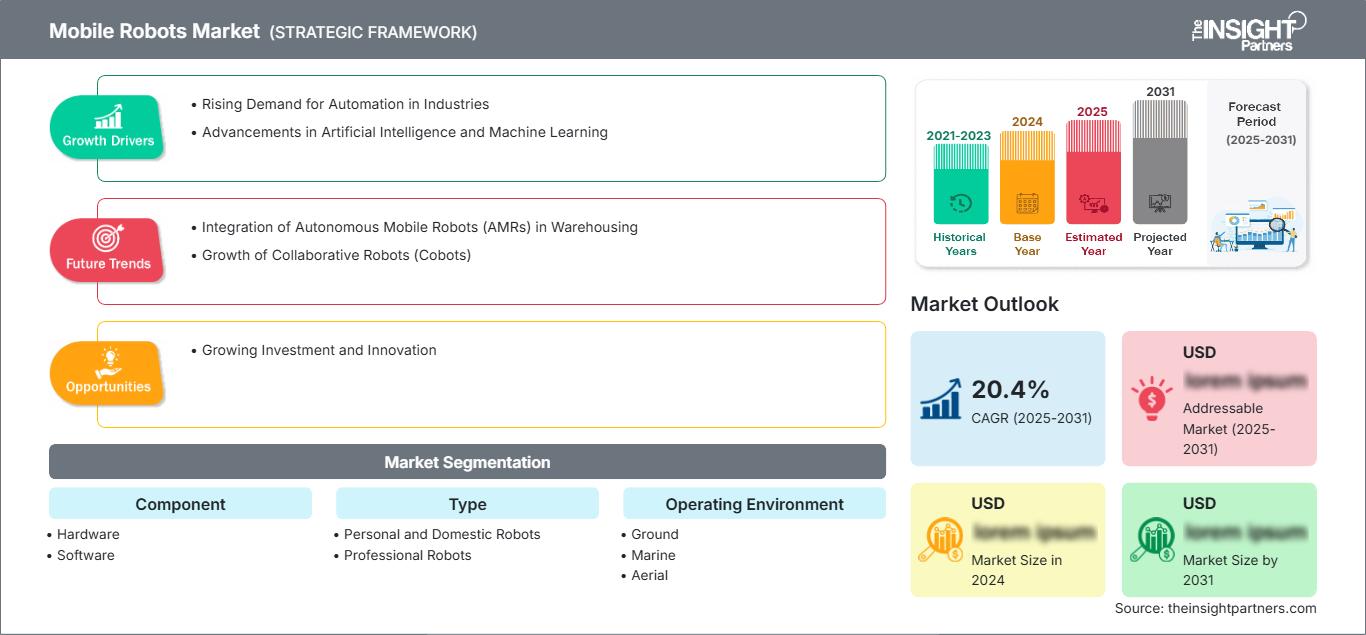
Mobile Robots Market: Strategic Insights
Regional Insights
North America Mobile Robots Market
North America accounted for an estimated 34–36% of the global mobile robots market share in 2025 and is projected to expand at a CAGR between 13.5–14.5% during 2026–2034. The area enjoys sophisticated automation, digital transformation, and warehouse renovation. The shortage of labor force in the manufacturing and logistics sectors keeps driving demand for AMRs used for material handling, inventory management, and industrial inspections. Another source of demand is the application of healthcare robots at facilities in charge of transportation, cleaning, and assistance to patients.
Support from the government in favor of advanced manufacturing, semiconductor manufacturing, and modernization of the defense sector helps increase the competitiveness of the area. Thanks to the presence of companies that produce robotic systems, AI software, and semiconductors, the commercialization process of smart robotic systems can be completed faster. The popularity of the robotics-as-a-service business model stimulates the use of robots in SMEs, whereas innovations in machine vision, edge computing, and autonomous navigation contribute to sustainable market growth.
U.S. Mobile Robots Market
The United States represented approximately 78–82% of the North American Mobile Robots Market in 2025 and is anticipated to register a CAGR between 13.8–14.8% during 2026–2034. Large-scale investments in e-commerce order fulfillment facilities, manufacturing, healthcare, and military equipment are helping maintain the status of an innovation center for the region. Competent research and successful venture capital funding helped accelerate the introduction of autonomous mobile robots in logistics, inspection, agricultural operations, and various commercial services.
Key players keep building their R&D, manufacturing, and software development capabilities to develop robust ecosystems of autonomous robotics. The use of fleet management software and other technologies for warehouses helps achieve better efficiency. Defense departments, healthcare providers, manufacturers, and logistics firms widely implement intelligent robotics for achieving better efficiency and safety.
Europe Mobile Robots Market
Europe accounted for an estimated 26–29% share of the global Mobile Robots Market in 2025 and is projected to grow at a CAGR between 13.0–14.0% during 2026–2034. Germany remains the leading regional market due to its highly automated automotive, machinery, and manufacturing sectors, while continued investments in smart factories and Industry 4.0 initiatives support sustained deployment of autonomous robotic systems.
The United Kingdom continues expanding robotics adoption across healthcare, logistics, research, and public infrastructure, supported by increasing investment in artificial intelligence and innovation programs. France, Italy, and Spain are witnessing the growing deployment of autonomous systems in manufacturing, agriculture, warehouse automation, and commercial service applications. Regional emphasis on workplace safety, energy efficiency, and industrial productivity continues to encourage enterprises to integrate intelligent mobile robotic platforms across diverse operational environments.
APAC Mobile Robots Market
Asia Pacific held approximately 28–31% of the global Mobile Robots Market in 2025 and is forecast to record the highest regional CAGR between 15.5–16.5% during 2026–2034. China leads regional production capacity, while Japan and South Korea continue advancing robotics innovation through strong industrial automation and electronics manufacturing ecosystems.
India and Australia are experiencing increasing deployment across logistics, mining, agriculture, and healthcare as digital transformation accelerates. Government initiatives supporting smart manufacturing, semiconductor production, and automation investments continue strengthening regional competitiveness while encouraging broader commercial adoption across multiple industries.
Middle East & Africa Mobile Robots Market
The Middle East and Africa Mobile Robots Market is expected to register a CAGR between 12.0–13.0% during 2026–2034. Saudi Arabia and the United Arab Emirates continue investing in smart cities, logistics infrastructure, industrial diversification, and digital transformation programs that create favorable conditions for autonomous robotic deployments.
South Africa remains a key market for industrial automation, mining applications, and warehouse modernization, while the rest of the region gradually expands adoption through infrastructure development and manufacturing investments. Rising energy, logistics, and construction activities continue creating new opportunities for intelligent robotic solutions across commercial and industrial sectors.
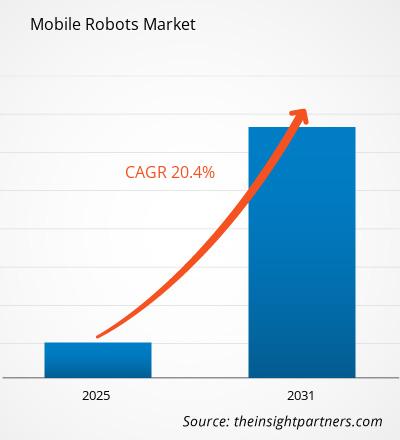
Segmentation Analysis
Component
The Component segment represents the technological foundation of the market, encompassing the physical robotic platform and the intelligence that enables autonomous operation. Continuous innovation in sensors, embedded processors, AI algorithms, and cloud connectivity is improving navigation accuracy and operational efficiency across industries. The segment is projected to grow at a CAGR between 14.2–15.2% during 2026–2034, supported by increasing enterprise investments in intelligent automation. The mobile robots market scope continues to expand as organizations prioritize scalable robotic ecosystems capable of integrating with existing industrial software and digital infrastructure.
- Hardware: Hardware forms the largest revenue contributor, comprising sensors, cameras, actuators, batteries, controllers, and communication modules. Continuous advancements in lightweight materials and energy-efficient components enhance robot performance while reducing maintenance requirements across industrial and commercial deployments.
- Software: Software enables autonomous navigation, fleet management, machine vision, AI-based decision-making, and predictive maintenance. Growing demand for cloud-enabled robotic platforms and real-time analytics is strengthening software's strategic importance across logistics, manufacturing, healthcare, and service applications.
Type
The Type segment reflects the broad application landscape of autonomous robotic systems across consumer and enterprise environments. Growing demand for industrial productivity, warehouse automation, healthcare assistance, and autonomous inspection continues to accelerate commercial deployment. The segment is forecast to register a CAGR between 14.5–15.5% during 2026–2034, supported by continuous advances in artificial intelligence, perception technologies, and autonomous mobility.
- Personal and Domestic Robots: Consumer-oriented robots continue gaining traction for household cleaning, security monitoring, lawn maintenance, and personal assistance. Rising smart home adoption and AI-enabled functionality support increasing consumer acceptance across developed and emerging economies.
- Professional Robots: Professional robots remain the dominant revenue contributor due to widespread deployment in manufacturing, logistics, healthcare, agriculture, defense, inspection, and commercial services. Their ability to improve productivity, reduce labor dependency, and operate continuously strengthens long-term enterprise adoption.
Operating Environment
The Operating Environment segment highlights the diverse deployment conditions addressed by autonomous robotic technologies. Expanding applications across land, marine, and aerial operations continue to encourage manufacturers to develop highly specialized robotic platforms for complex environments. The segment is expected to expand at a CAGR between 14.8–15.8% during 2026–2034, driven by increasing investments in industrial automation, infrastructure inspection, environmental monitoring, and defense modernization.
- Ground: Ground-based robots account for the largest deployment volume across warehouses, factories, hospitals, agricultural operations, defense facilities, and commercial buildings. Their operational versatility, cost efficiency, and advanced navigation capabilities continue to support sustained market leadership.
- Marine: Marine robots are increasingly utilized for offshore energy inspection, underwater exploration, environmental monitoring, naval surveillance, and scientific research. Improvements in autonomous navigation, underwater imaging, and communication technologies continue expanding commercial and government applications.
- Aerial: Aerial robots are witnessing rapid adoption for infrastructure inspection, precision agriculture, mapping, surveillance, emergency response, and logistics. Advances in autonomous flight control, obstacle avoidance, and high-resolution imaging are improving operational efficiency across numerous industrial sectors.
Opportunity Snapshot
| Type | Revenue Contribution | Trend Tag | Adoption Stage |
| Personal and Domestic Robots | Medium | Smart Homes | Scaling |
| Professional Robots | High | Warehouse Automation | Mature |
Mobile Robots Market Growth Drivers and Impact Analysis
Expansion of Warehouse Automation and Intelligent Logistics
With the growing use of e-commerce, omnichannel commerce and same-day delivery, warehouses are undergoing major changes. Increasingly, automated mobile robots are being utilized by distribution centers to streamline the processes of inventory management, order picking, pallet transport and real-time inventory monitoring. By integrating their systems with warehouse management systems and artificial intelligence, they constantly monitor routes and minimize the cost of operations while increasing efficiency. Logistics companies are also adopting robotic fleet management to overcome challenges of labor shortage and increased cost of operation. With the increasing complexity of the supply chain, automation is becoming the top priority of businesses that need a flexible solution working around the clock with minimal human interaction.
Advancements in Artificial Intelligence and Autonomous Navigation
Ongoing innovations in artificial intelligence, machine learning, computer vision, simultaneous localization and mapping, edge computing, and sensor fusion have led to increased efficiency of autonomous robotics. Contemporary mobile robots are able to detect obstacles, operate in changing conditions, interact securely with people, and make independent decisions during their operations. Innovations such as LiDAR, 3D cameras, embedded processing, and wireless connections also increase the level of precision and dependability of the navigation process. The use of AI-based robotics platforms by companies is increasing since it allows for higher efficiency and lower risks.
Growing Adoption Across Healthcare and Industrial Operations
Healthcare providers, manufacturing firms, energy companies, and public infrastructure firms will continue to increase the number of robot deployments due to increased efficiency, improved workplace safety, and quality services. Hospitals are using autonomous robots for drug delivery, lab transportation, cleaning, and patient care so that healthcare professionals can concentrate on clinical work. Manufacturers are using autonomous robots for inspection, predictive maintenance, dangerous materials handling, and logistics, thus minimizing worker injuries and boosting productivity. With more resources being dedicated to the creation of smart factories and digital manufacturing ecosystems, the chances for robot deployments will increase. Organizations want to have resilient operations that will enable them to address worker shortages and increased labor costs.
Mobile Robots Market Future Trends
Rise of AI-Powered Multi-Robot Fleet Intelligence
Artificial intelligence is increasingly shifting from enabling individual robot autonomy to orchestrating coordinated robotic fleets operating within shared environments. The mobile robots market trends indicate growing adoption of cloud-connected fleet management platforms capable of optimizing task allocation, traffic flow, battery utilization, predictive maintenance, and operational scheduling. Future deployments will increasingly integrate digital twins, edge AI, and real-time analytics, enabling enterprises to improve resource utilization across warehouses, manufacturing facilities, airports, hospitals, and commercial campuses. Enhanced interoperability between robotic platforms from different manufacturers is expected to become an important competitive differentiator while supporting large-scale autonomous operations across complex industrial ecosystems.
Expansion of Robotics-as-a-Service Business Models
Subscription-based Robotics-as-a-Service (RaaS) models are expected to reshape enterprise purchasing decisions by reducing upfront capital investments and providing scalable deployment options. Vendors are increasingly offering integrated solutions that combine robotic hardware, software updates, fleet management, predictive maintenance, cybersecurity, and technical support under long-term service agreements. This approach enables organizations to rapidly expand or modify robotic fleets according to operational requirements without significant infrastructure investments. Small and medium-sized enterprises are anticipated to become major beneficiaries of RaaS offerings, supporting broader commercialization across manufacturing, logistics, healthcare, retail, hospitality, agriculture, and public infrastructure applications.
Mobile Robots Market Opportunities
Automation Expansion Across Emerging Industrial Economies
Rapid industrialization across Southeast Asia, the Middle East, Latin America, and parts of Eastern Europe presents substantial investment opportunities for robotics manufacturers and technology providers. Mobile robots market Forecasts indicate that expanding manufacturing capacity, logistics modernization, and government-supported digital transformation programs will continue increasing demand for autonomous robotic solutions. Investments in semiconductor manufacturing, automotive production, pharmaceuticals, electronics assembly, and smart warehouses are expected to create new commercial opportunities for integrated robotic platforms. Companies capable of delivering localized solutions, regional service networks, scalable software platforms, and industry-specific automation capabilities are likely to strengthen their competitive position while capturing long-term revenue growth across emerging markets.
Specialized Robots for Critical Infrastructure and Public Services
Demand for autonomous robotic systems designed for infrastructure inspection, disaster response, utilities, environmental monitoring, defense, and public safety continues to increase worldwide. Governments and infrastructure operators are investing in robotic technologies capable of operating within hazardous, remote, or inaccessible environments while minimizing risks to personnel. Advanced sensing technologies, autonomous navigation, and artificial intelligence are enabling robots to perform inspection, surveillance, maintenance, and emergency response tasks with greater accuracy and efficiency. Vendors that develop highly specialized platforms for energy, transportation, utilities, telecommunications, and public infrastructure sectors are expected to benefit from sustained procurement programs and long-term strategic partnerships.
Frequently Asked Questions

- Comprehensive Market Sizing and Forecast Analysis
- Detailed Segmentation Analysis
- In-Depth Market Dynamics Assessment
- Regional and Country-Level Insights
- Competitive Landscape and Company Benchmarking
- Strategic Business Intelligence
Recent Reports
Testimonials

The Insight Partners provided valuable market intelligence that supported our global go-to-market strategy. Their team was professional, responsive, and attentive to our feedback, providing thoughtful analysis and helpful methodological clarifications throughout the project.
Junmo Kim Chief Financial Officer (CFO), Enertech Co., Ltd.
The Insight Partners' SCADA System Market report is comprehensive, with valuable insights on current trends and future forecasts. The team was highly professional, responsive, and supportive throughout. We are very satisfied and highly recommend their services.
RAN KEDEM Partner, Reali Technologies LTDs
I requested a report on a very specific software market and the team produced the report in a few days. The information was very relevant and well presented. I then requested some changes and additions to the report. The team was again very responsive and I got the final report in less than a week.
JEAN-HERVE JENN Chairman, Future Analytica
We worked with The Insight Partners for an important market study and forecast. They gave us clear insights into opportunities and risks, which helped shape our plans. Their research was easy to use and based on solid data. It helped us make smart, confident decisions. We highly recommend them.
PIYUSH NAGPAL Sr. Vice President, High Beam Global
The Insight Partners delivered insightful, well-structured market research with strong domain expertise. Their team was professional and responsive throughout. The user-friendly website made accessing industry reports seamless. We highly recommend them for reliable, high-quality research services
YUKIHIKO ADACHI CEO, Deep Blue, LLC.
This is the first time I have purchased a market report from The Insight Partners.While I was unsure at first, I visited their web site and felt more comfortable to take the risk and purchase a market report.I am completely satisfied with the quality of the report and customer service. I had several questions and comments with the initial report, but after a couple of dialogs over email with their analyst I believe I have a report that I can use as input to our strategic planning process.Thank you so much for taking the extra time and making this a positive experience.I will definitely recommend your service to others and you will be my first call when we need further market data.
JOHN SUZUKI President and Chief Executive Officer, Board Director, BK Technologies
I wish to appreciate your support and the professionalism you displayed in the course of attending to my request for information regarding to infectious disease IVD market in Nigeria. I appreciate your patience, your guidance, and the fact that you were willing to offer a discount, which eventually made it possible for us to close a deal. I look forward to engaging The Insight Partners in the future, all thanks to the impression you have created in me as a result of this first encounter.
DR CHIJIOKE ONYIA MANAGING DIRECTOR, PineCrest Healthcare Ltd.Reason to Buy
- Informed Decision-Making
- Understanding Market Dynamics
- Competitive Analysis
- Identifying Emerging Markets
- Customer Insights
- Market Forecasts
- Risk Mitigation
- Boosting Operational Efficiency
- Strategic Planning
- Investment Justification
- Tracking Industry Innovations
- Aligning with Regulatory Trends





 Get Free Sample for