
KVM over IP Market Demand, Size & Forecast by 2034
Coverage: By Type (Low-end KVM over IP, Mid-range KVM over IP, High-end KVM over IP); Application (Internet Industry, Government Agencies, Telecommunication Industry, Education Sector, Financial Sector, Manufacturing Industry, Others), and Geography (North America, Europe, Asia Pacific, and South and Central America)
- Status : Data Released
- Report Code : TIPRE00014111
- Category : Electronics and Semiconductor
- No. of Pages : 150
- Available Report Formats :


- Last update date : October 22, 2026


2025 Market Size
US$ 254.80 Mn
Base year value
2034 Forecast
US$ 448.80 Mn
Projected by 2034
CAGR 2026-2034
6.49 %
Growth rate
Addressable Market
US$ 3,181.96 Mn
(2026-2034)
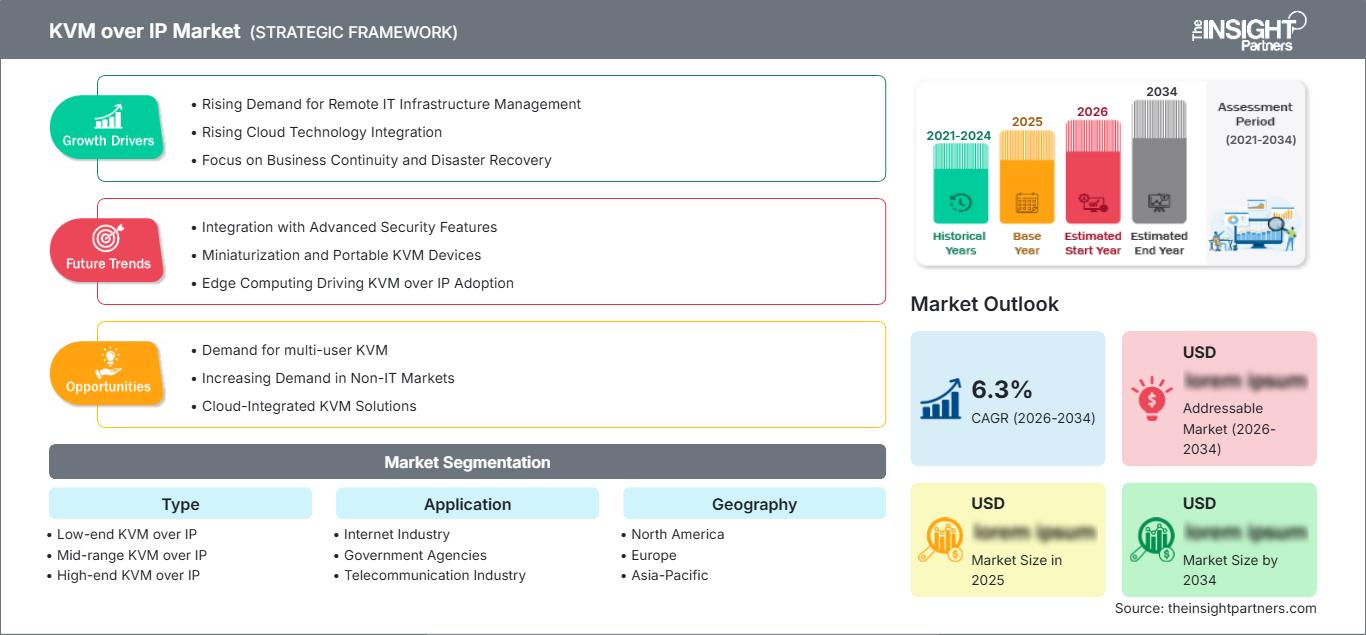
The KVM Over IP Market was valued at US$ 254.80 Million in 2025 and is projected to reach US$ 448.80 Million by 2034, registering a CAGR of 6.49% during 2026–2034. Demand is driven by the requirement for guaranteed access to servers on a BIOS level within an increasingly distributed digital network architecture in which administrators need to be able to control the machines even when the operating system and remote access tools have failed.
The North American region will grow at 5.8%-6.4% until 2034 due to growth in hyperscale computing capabilities, edge computing facilities, and regulated infrastructure. The KVM Over IP Market size in the North American region will benefit from developed colocation markets and strong cybersecurity measures which focus on hardware-based recovery procedures, and refreshing demand will focus on encryption, directory integration, multifactor authentication, and high-definition video.
KVM over IP Market Assessment and Insights
- North America: Share in 2025 is estimated at 31–34%, with CAGR between 2026–2034 of 5.8–6.4%, supported by hyperscale clusters, colocation density, and stringent resilience controls.
- US: The country represents 82–86% of North American revenue in 2025 and is growing at 5.9–6.5%, led by cloud, government, and financial infrastructure.
- Europe: Share in 2025 is estimated at 24–27%, with CAGR between 2026–2034 of 5.4–6.0%; the UK and Germany lead, followed by France, Italy, and Spain.
- Asia Pacific: Share in 2025 is estimated at 34–37%, with CAGR between 2026–2034 of 7.1–7.8%; China leads, while India, Japan, South Korea, and Australia broaden deployment.
- Largest Segment: High-end KVM over IP holds 44–48% market share in 2025 and grows at 6.4–7.0%, reflecting multiuser, high-port-density requirements.
- High Growth Segment: Internet Industry holds 29–33% market share in 2025 and expands at 7.2–7.9%, driven by cloud and colocation operations.
- Key companies analyzed in detail: Adder Technology Limited, Schneider Electric SE, ATEN International Co., Ltd., Belkin International, Inc., Black Box Corporation, Vertiv Group Corp., Legrand SA, Guntermann & Drunck GmbH, WEYTEC AG, and Lantronix, Inc.
Source: The Insight Partners' analysis based on proprietary research, government publications, company annual reports, investor presentations, industry databases, and expert interviews.
Technology architecture has progressed from simple web-based switching to secure, high resolution, multi-user systems with centralized device management capability. More vendors are offering encrypted remote console access, virtual media, power coordination, and audit logging solutions. Production is still differentiated due to the importance of video compression, low latency firmware, interoperability, and long-lived components as opposed to volumes. KVM Over IP Market thus favors vendors who develop appliances that fit the refresh cycles in data centers, needs of industrial control and channel sales models.
From 2024 to 2034, demand will expand beyond well-defined markets in data centers to Southeast Asia, the Gulf, India, and secondary European regions. Investment in artificial intelligence ready infrastructures increases the base of devices requiring secure administrator access. On the other hand, cyber recovery policies create the need for alternative management paths. Digital public sector transformation, sovereign cloud initiatives, and edge computing enable wider distribution of systems although buyers are expected to evaluate products based on encryption, authentication, firmware support, energy efficiency, and regional cybersecurity standards.
KVM over IP Market Report Scope
| Report Attribute | Details |
|---|---|
| Market size in 2025 | US$ 254.80 Million |
| Market Size by 2034 | US$ 448.80 Million |
| Global CAGR (2026 - 2034) | 6.49% |
| Historical Data | 2021-2024 |
| Forecast period | 2026-2034 |
KVM over IP Market Analysis
KVM Over IP Market growth rests on the increasing number of remote server rooms, edge nodes, and mission critical computing environments. Hardware level access allows for reaching the BIOS, restarting crashed machines, mounting virtual media and restoring the service in case in band solutions are not available. Buyers consider latency, quality of video transmission, number of concurrent sessions, port density, encryption and support for heterogeneous server estates. Appliances are integrated with rack power distribution, identity and network operations processes.
The eco-system includes semiconductor and codec vendors, appliances manufacturers, software vendors, distributors, system integrators and managed service providers. Supply issues include secure firmware, availability of components, certification, and extended support periods. High end appliances gain value through redundancy of power supplies, fail over options, central management, roles based permissioning and logging. Procurements stay projects driven, driven by data center rollouts, control room upgrades, government cycles and industrial automation.
According to KVM Over IP market report, there is concentrated competition characterized by differentiation among branded specialists based on high performance, cybersecurity, compatibility with the installed base, and global support. Adder Technology Limited and ATEN International Co., Ltd. focus on high-performance IP systems; Vertiv Group Corp. and Legrand SA offer remote access solutions combined with management solutions for infrastructure; Schneider Electric SE benefits from its relationship with data centers; Belkin International, Inc. and Black Box Corporation target enterprise and secure connectivity applications.
Funding is going into platform software, APIs, support for virtual machines, zero-U designs, 4K and multi-monitor capabilities, IT/OT separation via hardware. Guntermann & Drunck GmbH and WEYTEC AG are active in challenging control rooms environments, whereas Lantronix, Inc. offers solutions within out-of-band management. Strategic positioning will increasingly be defined by lifecycle services, channel training, testing for interoperability and ability to offer architectures ranging from single-port remote access to matrix solutions.
● REPORT CUSTOMIZATION
Tailor This Report To Align With Your Specific Business Requirements
This report can be customized to align precisely with your business objectives, scope, and target markets. Customization options include tailored segmentation, geography, competitive analysis, and strategic insights to support informed decision-making.
Customize This Report →WHAT YOU CAN ADJUST
- ● Segmentations
- ● Geography
- ● Competitive Analysis
- ● Language Preferences
KVM over IP Market: Strategic Insights
Regional Insights
North America KVM Over IP Market
The KVM Over IP Market share held by North America in the in 2025 stood at 31-34% and will grow at a CAGR of 5.8-6.4% during 2034. The extensive presence of hyperscale and colocation centers, distributed IT infrastructure, and requirement for uptime are driving investments in upgrades and new purchases. Recovery at the hardware level will increasingly be accompanied by privileged access management, session recording, encrypted virtual media, and centralized authentication.
Other areas of application include non-cloud deployments within government infrastructure, finance services, telecommunication industry, manufacturing industry, and academia computing infrastructure. Buying decisions will be driven by proximity of vendor presence, certification of firmware, and integrations with rack power and monitoring solutions. Edge sites will allow space for smaller single-port and low-port count solutions, while campuses will be adopting matrix solutions that will enable multiple administrators to connect to remote resources without visiting the sites.
U.S. KVM Over IP Market
The United States represented 82–86% of North American revenue in 2025 and is forecasted to register CAGRs of 5.9–6.5% till 2034. The dense presence of cloud facilities, colocation sites, defense infrastructures, scientific computing capabilities, and financial data centers drives a wide demand. Vertiv Group Corp., Belkin International, Inc., Black Box Corporation, and foreign vendors offer a solid channel or customer network.
Driving factors for the application include secure remote remediation activities, lights-out management, and central control of edge data centers. ISPs have the requirement of high density multi-user switches while organizations require capabilities such as access control, encryption, and managed audits; industries use IP KVM solution to safeguard operators against dangerous or unauthorized portions of the factory. Investment in AI infrastructure is fueling the growth in the server pool despite the purchases depending on cybersecurity certifications and compatibility.
Europe KVM Over IP Market
Europe has an estimate of 24-27% in 2025, with the projection of growth up to 5.4-6.0% up to 2034. United Kingdom is leading because of colocation, financial services, media, and governmental markets, where users prefer remote control and continuous operations. Germany ranks second because of industrial automation, automotive engineering, and distributed manufacturing which create the need for secured IT/OT connections and matrix systems.
France finds advantages in sovereign cloud and public digital infrastructure projects, while Italy and Spain generate demand from telco modernization, data centers and traffic management systems. Regional cybersecurity laws in Europe encourage auditable access, software provided by manufacturers, and the least possible exposure of management networks. European suppliers, such as Adder Technology Limited, Legrand SA, Guntermann & Drunck GmbH, and WEYTEC AG offer engineering and distribution capabilities, while international competitors operate large portfolios of products.
APAC KVM Over IP Market
The Asia Pacific region represented a market share of 34–37% in 2025 and is projected to record a CAGR of 7.1–7.8% in the coming ten years. The leading country in the Asia Pacific region is China because of its internet-based platforms, manufacturing, telecom systems, and local data center constructions.
India will gain from cloud regions and digital public infrastructures, while Australia will gain from colocation and governmental needs. The industrial digitalization, growth of 5G networks, and data localization policies in addition to new capacities in the region will help in the scalability of remote administrations.
Middle East & Africa KVM Over IP Market
The area will grow at 6.3-7.0% until 2034. Saudi Arabia comes in first due to hyperscale, smart city, energy and government initiatives that lead to needs for secure infrastructure. UAE ranks second due to cloud regions, carrier-neutral, financial services, and aviation control environments.
South Africa is the main driving force behind sub-Saharan needs thanks to telecommunications, financial institutions, and enterprises' data centers, while other areas in MEA choose to develop selectively through connectivity nodes. Energy applications need remote access to devices scattered geographically. New infrastructure projects provide for matrix and single port systems.
Segmentation Analysis
Type
The Type segment is expected to grow at 6.2–6.8% during 2026–2034. KVM Over IP Market scope spans economical remote access for small sites, scalable platforms for enterprise server rooms, and high-density systems for data centers and control rooms. Adoption depends on concurrent-user requirements, port count, redundancy, display resolution, security controls, and centralized management. Refresh activity increasingly favors modular products that preserve cabling investments while improving encryption and video performance.
- Low-end KVM over IP: Demand concentrates in branch offices, small server rooms, laboratories, and unattended edge sites where single-user access, straightforward deployment, and economical remote troubleshooting are primary purchasing considerations.
- Mid-range KVM over IP: Enterprise buyers favor balanced port density, directory integration, virtual media, and multiuser access, making this tier strategically important for regional data centers and expanding private-cloud environments.
- High-end KVM over IP: Large data centers and control rooms prioritize redundant architecture, high concurrency, 4K video, granular permissions, session logging, and centralized matrix management for resilient, large-scale operations.
Application
The Application segment is forecast to advance at 6.5–7.1% during 2026–2034. Demand varies with uptime sensitivity, geographic distribution, compliance obligations, and the cost of dispatching specialists. Internet and telecom operators emphasize port density and automation; government and finance prioritize secure authentication and auditability; education balances shared access with budgets; manufacturing values hardware isolation and reliable control across industrial networks.
- Internet Industry: Cloud, hosting, and colocation operators require dense, concurrent remote administration across large server estates, positioning this application as the largest and fastest-expanding demand pool.
- Government Agencies: Agencies emphasize encryption, role-based access, audit trails, procurement assurance, and resilient recovery for defense, public safety, administration, and sovereign digital infrastructure.
- Telecommunication Industry: Operators use remote consoles across core networks, exchanges, edge facilities, and 5G sites, reducing technician travel and improving response to equipment outages.
- Education Sector: Universities and research institutions deploy systems for laboratories, campus data centers, high-performance computing, and classroom technology, with demand shaped by shared administration and constrained budgets.
- Financial Sector: Banks, exchanges, and insurers prioritize low-latency access, segregation of duties, session accountability, and rapid recovery across highly regulated, always-available computing environments.
- Manufacturing Industry: Manufacturers need dependable access to production servers and industrial computers while limiting floor exposure, supporting centralized maintenance, IT/OT separation, and continuity across distributed plants.
Opportunity Snapshot
| Application | Revenue Contribution | Trend Tag | Adoption Stage |
| Internet Industry | High | Cloud Scale | Mature |
| Government Agencies | Medium | Sovereign Access | Scaling |
| Telecommunication Industry | High | Edge Control | Scaling |
| Education Sector | Low | Lab Access | Scaling |
| Financial Sector | Medium | Audit Security | Mature |
| Manufacturing Industry | Medium | OT Isolation | Emerging |
KVM over IP Market Growth Drivers and Impact Analysis
Expansion of Distributed Data-Center and Edge Infrastructure
There is an increasing number of locations which need remote control due to the growing number of cloud regions, colocation campuses, telecommunications edge locations, and corporate micro-data centers. In the report published by the International Energy Agency, the consumption of electricity in data centers rose by 17% in 2025 due to the extensive use of the infrastructure and investments made into it. Each new site contributes to the growth of the need for secure access which would be independent from the operating system and production network. The use of IP KVM reduces travel time, minimizes downtime, and allows for the central management of disparate resources. It is the most efficient solution in case of sparse staffing or remote sites.
Cyber-Resilience and Out-of-Band Recovery Requirements
Ransomware attacks, misconfigurations, and network disruption highlight the shortcomings of management systems that are based entirely on software. Access at the hardware level allows users to enter BIOS, safe mode, and pre-boot environments in situations where remote desktop software becomes inadequate. It is increasingly gaining relevance in the spheres of finance, government, telecommunication, and critical infrastructure, where recovery time and log records matter significantly. Hence, the requirement for multi-factor authentication, encryption, role-based permission schemes, firmware signing, network segmentation, and session logging is growing. Software vendors who can provide evidence of secure development lifecycle and timely patching will gain an edge during procurement. The result is increased adoption of management systems and services, lengthened qualification process, and the need for replacement of legacy devices.
Operational Efficiency Across Specialized Technical Workflows
As control rooms, broadcast centers, laboratories, production lines, and network operations centers consolidate specialists, they become less reliant on centralized computing equipment. The advantages of KVM over IP include switching capabilities for both physical and virtual sources, keeping latency low, and avoiding the heat, noise, or critical nature of computing hardware near the desk. Multi-monitor capability and high-resolution video make it useful outside of server management in its traditional sense. Hardware-separation is also valuable in manufacturing for reducing IT/OT exposure in corporations. Educational and research institutions also benefit from remote console sharing in terms of maximizing the use of costly computer systems. All of this results in reduced workstation duplication, quicker specialist assistance, and more flexible staffing requirements. The key differentiators for KVM over IP are, therefore, user experience, video quality, peripheral compatibility, and matrix scalability.
KVM over IP Market Future Trends
API-Driven Automation and Unified Infrastructure Control
KVM Over IP Market trends increasingly point toward programmable platforms rather than isolated appliances. APIs will allow orchestration tools to discover endpoints, launch sessions, coordinate power cycling, apply access policies, and collect audit data. Integration with data-center infrastructure management, privileged-access management, and incident-response platforms can shorten recovery sequences while reducing manual errors. Vendors will differentiate through documented interfaces, secure tokens, event streaming, and broad interoperability. Automation will be particularly valuable in large estates where administrators manage thousands of devices. Buyers will nonetheless require safeguards, including approval workflows, least-privilege permissions, and tamper-resistant logs, before allowing automated actions on critical systems.
Higher-Fidelity Video with Bandwidth-Aware Delivery
Remote workstations are shifting towards 4K, multi-screens, better colors, and reactive peripheral device support; however, the capability of networks is not uniform among locations. Future solutions will involve efficient codec technology, adjustable frame rates, and policy-based quality parameters, maintaining usability while preventing congestion of management networks. The new development opens up additional opportunities for addressable application in media production, medicine training, engineering visualization, transportation, and manufacturing inspection processes. Hardware offload and enhanced endpoint will improve latency and energy usage. Companies able to combine high image quality with deterministic behavior will be favored, particularly where users have to analyze the information on their screens.
KVM over IP Market Opportunities
Secure Edge Management Bundles for Distributed Enterprises
For companies that run retail locations, manufacturing facilities, clinics, campus environments, and telecommunications sites, there is a need for cost-effective ways of accessing unattended computing resources. Suppliers can offer off-the-shelf solutions by bundling up one port or small switches, management via a secure cloud or in-house environment, identity management, and an optional remote power controller. The business case here is about the ease of deployment, subscription-based services, and channel-driven implementation rather than custom engineering. Solutions around device templating, zero-touch provisioning, health management, and automatic firmware management can help reduce costs. Partners must focus on verticals where travel costs and downtime can be measured, and deliver return on investment by avoiding travel and minimizing downtime.
Certified Platforms for Regulated and Sovereign Environments
Governments, military, financial, energy, and cloud computing initiatives generate the need for remote access facilities that have undergone thorough verification processes. The vendor can provide certification, secure supply chain information, regional support, and long-term maintenance for their firmware branches. Hardware-level isolation of management, manufacturing, and operations networks enables vendors to offer a differentiation play where software-based solutions are not allowed. The value of this market arises from the fact that qualification processes will restrict price-based competition and foster multi-year partnerships. To succeed, the company will have to manage vulnerabilities, components traceability, and be compatible with approved identity infrastructures.
Recent Developments
- July 2026: Legrand SA introduced the Raritan Dominion KX III G2, a next-generation KVM-over-IP matrix built on the Xerus architecture. The platform adds automation-ready management through an API, supports deployments from 10 to 10,000 devices, strengthens secure daily administration, and is designed to accelerate recovery when outages, software failures, or cyber incidents interrupt normal access.
- May 2026: Adder Technology Limited – upgraded ARDx remote-access technology with multi-head connectivity, user-defined automatic frame-rate control, an updated interface, auto-discovery, grouping, and a software development kit. The release enables integrators to embed ARDx into third-party platforms and AI-driven workflows while improving bandwidth management and control of multiple video sources from one workspace – https://www.adder.com/en/news-media/press-releases/adder-advances-remote-access-kvm-over-ip-new-ardxtm-upgrade
- February 2026: ATEN International Co., Ltd. enhanced the KX9980 5K DisplayPort dual-display KVM over IP extender with USB 3.2 connectivity and virtual-machine support through hardware-based IT/OT network separation. The design supports high-speed peripherals and access to physical and virtual systems while maintaining isolation for mission-critical control-room, energy, transportation, and industrial workflows.
Frequently Asked Questions

- Comprehensive Market Sizing and Forecast Analysis
- Detailed Segmentation Analysis
- In-Depth Market Dynamics Assessment
- Regional and Country-Level Insights
- Competitive Landscape and Company Benchmarking
- Strategic Business Intelligence
Recent Reports
Testimonials

The Insight Partners provided valuable market intelligence that supported our global go-to-market strategy. Their team was professional, responsive, and attentive to our feedback, providing thoughtful analysis and helpful methodological clarifications throughout the project.
Junmo Kim Chief Financial Officer (CFO), Enertech Co., Ltd.
The Insight Partners' SCADA System Market report is comprehensive, with valuable insights on current trends and future forecasts. The team was highly professional, responsive, and supportive throughout. We are very satisfied and highly recommend their services.
RAN KEDEM Partner, Reali Technologies LTDs
I requested a report on a very specific software market and the team produced the report in a few days. The information was very relevant and well presented. I then requested some changes and additions to the report. The team was again very responsive and I got the final report in less than a week.
JEAN-HERVE JENN Chairman, Future Analytica
We worked with The Insight Partners for an important market study and forecast. They gave us clear insights into opportunities and risks, which helped shape our plans. Their research was easy to use and based on solid data. It helped us make smart, confident decisions. We highly recommend them.
PIYUSH NAGPAL Sr. Vice President, High Beam Global
The Insight Partners delivered insightful, well-structured market research with strong domain expertise. Their team was professional and responsive throughout. The user-friendly website made accessing industry reports seamless. We highly recommend them for reliable, high-quality research services
YUKIHIKO ADACHI CEO, Deep Blue, LLC.
This is the first time I have purchased a market report from The Insight Partners.While I was unsure at first, I visited their web site and felt more comfortable to take the risk and purchase a market report.I am completely satisfied with the quality of the report and customer service. I had several questions and comments with the initial report, but after a couple of dialogs over email with their analyst I believe I have a report that I can use as input to our strategic planning process.Thank you so much for taking the extra time and making this a positive experience.I will definitely recommend your service to others and you will be my first call when we need further market data.
JOHN SUZUKI President and Chief Executive Officer, Board Director, BK Technologies
I wish to appreciate your support and the professionalism you displayed in the course of attending to my request for information regarding to infectious disease IVD market in Nigeria. I appreciate your patience, your guidance, and the fact that you were willing to offer a discount, which eventually made it possible for us to close a deal. I look forward to engaging The Insight Partners in the future, all thanks to the impression you have created in me as a result of this first encounter.
DR CHIJIOKE ONYIA MANAGING DIRECTOR, PineCrest Healthcare Ltd.Reason to Buy
- Informed Decision-Making
- Understanding Market Dynamics
- Competitive Analysis
- Identifying Emerging Markets
- Customer Insights
- Market Forecasts
- Risk Mitigation
- Boosting Operational Efficiency
- Strategic Planning
- Investment Justification
- Tracking Industry Innovations
- Aligning with Regulatory Trends





 Get Free Sample for