
IO-Link Market Growth, Share & Trends by 2034
Coverage: by Type (IO-Link Wired, IO-Link Wireless); Component (IO-Link Masters, IO-Link Devices); Industry (Process Industries, Hybrid Industries); Application (Machine Tools, Intralogistics Solutions); and Geography (North America, Europe, Asia Pacific, and South and Central America)
- Status : Data Released
- Report Code : TIPRE00002827
- Category : Electronics and Semiconductor
- No. of Pages : 150
- Available Report Formats :


- Last update date : October 22, 2026


2025 Market Size
US$ 20.09 Bn
Base year value
2034 Forecast
US$ 139.94 Bn
Projected by 2034
CAGR 2026-2034
24.07 %
Growth rate
Addressable Market
US$ 617.84 Bn
(2026-2034)
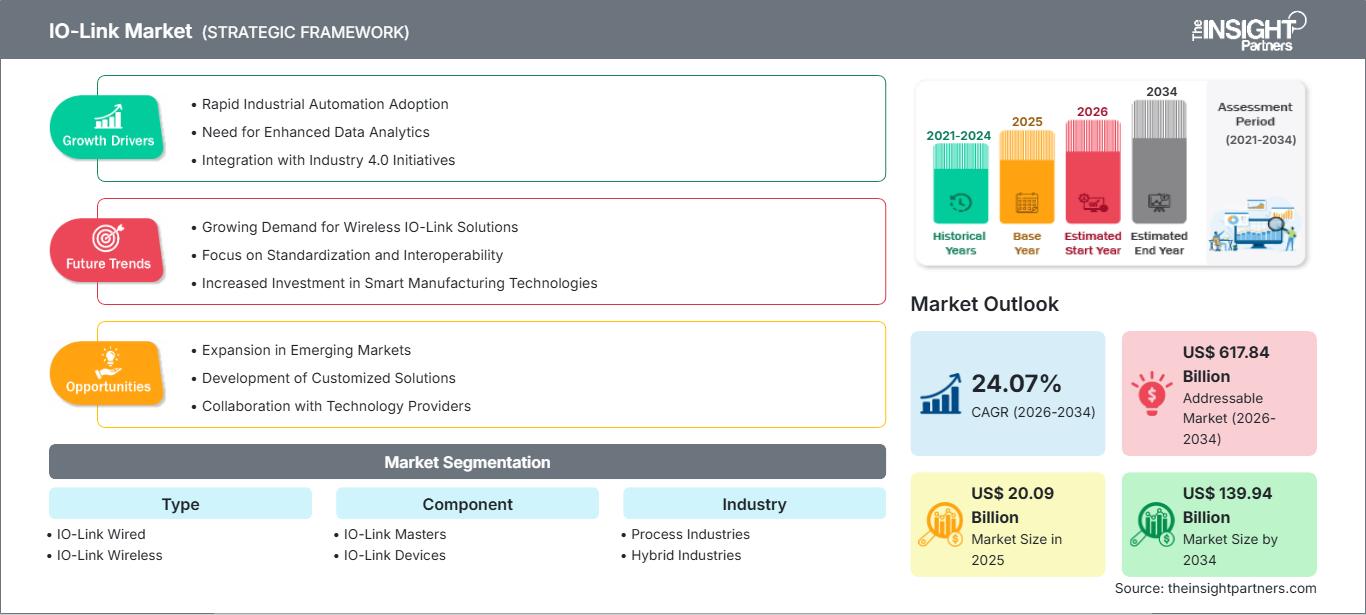
The IO-Link Market was valued at US$ 20.09 Billion in 2025 and is projected to reach US$ 139.94 Billion by 2034, expanding at a CAGR of 24.07% during 2026–2034. Adoption is advancing as manufacturers connect intelligent sensors and actuators through standardized point-to-point communication, enabling remote parameterization, richer diagnostics, faster device replacement, and reliable production data exchange across automated equipment and industrial control architectures.
Within North America, the IO-Link Market size is expected to rise at a modelled 22.5–24.5% CAGR through 2034. An extensive installed base of programmable automation accelerated reshoring of electronics and battery manufacturing, and expanding warehouse automation underpin demand. Brownfield compatibility is particularly important because standard unshielded three-wire cabling allows users to obtain device-level data without redesigning complete fieldbus or controller environments.
IO-Link Market Assessment and Insights
- North America represented 27–31% Share in 2025 and is modelled to grow at a CAGR between 22.5–24.5% during 2026–2034, supported by reshoring, machine modernization, and logistics automation.
- US accounted for 78–82% of North American demand in 2025 and is expected to expand at a CAGR between 23.0–25.0% during 2026–2034.
- Europe held 29–33% Share in 2025 and is forecast at a CAGR between 21.5–23.5% during 2026–2034, led by Germany, Italy, France, and the UK.
- Asia Pacific captured 31–35% Share in 2025 and is projected to grow at a CAGR between 25.0–27.0% during 2026–2034, led by China, Japan, South Korea, and India.
- Largest Segment IO-Link Wired secured 82–86% market share in 2025 and is modelled at a 22.5–24.5% CAGR during 2026–2034, reflecting installed-device compatibility.
- High Growth Segment IO-Link Wireless held 14–18% market share in 2025 and is projected at a 31.0–34.0% CAGR during 2026–2034, driven by moving assets and retrofits.
- Key companies analyzed in detail: Siemens AG; Rockwell Automation, Inc.; OMRON Corporation; Hans Turck GmbH & Co. KG; Balluff GmbH; ifm electronic gmbh; Pepperl+Fuchs SE; SICK AG; Festo SE & Co. KG; SMC Corporation.
Source: The Insight Partners' analysis based on proprietary research, government publications, company annual reports, investor presentations, industry databases, and expert interviews.
Technological developments have taken IO-Link beyond sensor parameterization to develop an information layer that connects operational technology with analytics systems. Masters are incorporating multiprotocol fieldbus capability, OPC UA, MQTT, REST interface, IODD parsing capabilities, and port level power management. Device manufacturing is moving away from proximity and pressure sensors to include valve terminals, RFID heads, motorized roller, grippers, and safety devices. Standardized device descriptions and interoperability test procedures minimize engineering complexity, and decentralized IP67 modules enable machine-based intelligence from control panels.
IO-Link will gain traction in Southeast Asian factory floors, India's industrial belts, North American battery production facilities, and upgraded digital process facilities in Europe through 2034. Investments will favor reuseable machine designs, condition monitoring, energy visibility, and faster commissioning. The process of IEC standardization, development of IO-Link Safety, and wireless standards are creating favorable headwinds. Vendors integrating comprehensive device product portfolio, controller independent masters, engineering solutions, cybersecurity solutions, and global services will generate more value than individual products vendors.
IO-Link Market Report Scope
| Report Attribute | Details |
|---|---|
| Market size in 2025 | US$ 20.09 Billion |
| Market Size by 2034 | US$ 139.94 Billion |
| Global CAGR (2026 - 2034) | 24.07% |
| Historical Data | 2021-2024 |
| Forecast period | 2026-2034 |
IO-Link Market Analysis
Drivers for IO-Link Market Growth include the need to transmit process values, diagnostic information, and parameterizations to the sensor level without having to redesign automation systems. Machine builders get the advantage of reuse within PROFINET, EtherNet/IP, EtherCAT, and other network types, while end users get the benefits of reduced manual settings and unpredicted downtime. The market consists of suppliers of semiconductors, connectors and cables, sensors and actuators, masters, controllers, IODD libraries, distributors, systems integrators, and industrial software platforms.
The supply side is being driven by modular offerings and communications stacks. Over 71 million IO-Link nodes and master ports have been installed across the globe by the end of 2025, with 9.7 million additional units being sold on top of that last year. Availability is good; however, certification, electromagnetic compatibility, rugged enclosures, and protocol integration continue to be issues.
IO-Link Market Report reveals competition in the integrated automation systems group as well as sensor-specific firms. Siemens AG, Rockwell Automation, Inc., and OMRON Corporation provide IO-Link connection to their controller ecosystems. Hans Turck GmbH & Co. KG, Balluff GmbH, and ifm electronic gmbh concentrate on decentralized masters and devices, whereas Pepperl+Fuchs SE and SICK AG specialize in sensing and identification.
The investments are done for direct OT to IT data connection, multiprotocol master, device applications configuration, wireless bridge, and functional safety. The use of IO-Link technology by the pneumatic and electric automation is supported by Festo SE & Co. KG and SMC Corporation, where the parameterized valves and actuators will benefit the maintenance process. The strategic position needs support for existing controller,IODD management, secured edge connection, and lifecycle availability for replicated machines globally.
● REPORT CUSTOMIZATION
Tailor This Report To Align With Your Specific Business Requirements
This report can be customized to align precisely with your business objectives, scope, and target markets. Customization options include tailored segmentation, geography, competitive analysis, and strategic insights to support informed decision-making.
Customize This Report →WHAT YOU CAN ADJUST
- ● Segmentations
- ● Geography
- ● Competitive Analysis
- ● Language Preferences
IO-Link Market: Strategic Insights
Regional Insights
North America IO-Link Market
The North American region captured 27-31% of the simulated IO-Link Market share in 2025 and will witness a 22.5-24.5% CAGR up to 2034. Automation investments are facilitated by high labor costs, reshoring operations, and increased production of semiconductors, batteries, medical devices, and foods. The use of IO-Link is attractive to operators since the remote parameterization and diagnostics are capable of enhancing changeovers and maintenance without analog wiring within brownfield facilities.
The growing installation of automated warehouses, conveyors, mobile robots, and machine vision cells also drives demand. Multiprotocol masters are helpful in heterogeneous control systems, while IP67 modules make it possible to install equipment without a cabinet. The Canadian contribution is made in the automotive industry, food processing, mining, and packaging sectors, while Mexico has nearshored manufacturing operations. Potential barriers to adoption include fragmented plant specifications, cybersecurity assessments, and poor engineering skills.
U.S. IO-Link Market
USA constituted 78–82% of North American sales during 2025 and is forecasted to record a CAGR growth of 23.0–25.0%. Applications including semiconductor fabrication facilities, EV and batteries factories, parcels distribution centers, and high throughput food plants need sensor technology and predictive maintenance. Rockwell Automation, Inc., Siemens AG, Balluff GmbH, ifm electronic gmbh, and SICK AG have robust commercial and integration capabilities for the said applications.
Machine manufacturers are moving towards standardized IO-Link masters within their product portfolios to eliminate controller-specific variants and speed up installation. Intralogistics operators use photoelectric sensors, RFID, motorized rollers, and indicator devices, whereas hybrid applications include pressure, flow, temperature, and valve feedback. Governmental incentives in manufacturing boost capital formation; however, strong purchase arguments are still operational and include reduced cabling, automatic parameter restoration following a changeover, energy data collection, and faster trouble shooting over geographically scattered locations.
Europe IO-Link Market
Europe was projected to have a modelled 29-33% market share by 2025 and a growth of CAGR of 21.5-23.5%. Germany stands out with its large range of clusters such as machines tool, automobile, packaging, chemicals, and intralogistics that increase device demand. United Kingdom concentrates its application in food, pharmaceuticals, logistics, and water industries where compatibility with retrofits is required. Germany is preferred by its efficient supply chain, interoperability features, and machine makers who provide standard sensors on their internationally available machines.
In France, there are aerospace, food, pharmaceutical, and transportation automation clusters while in Italy there are good clusters in packaging and machines. In Spain, there are clusters in automobile, food, and renewable equipment manufacturing industry. Europeans like features such as energy monitoring, product traceability, machine safety, and life cycle management. For future deployment, IO-Link Safety and secure communication would be used but the conservative validation process in highly regulated facilities might cause a delay in adoption.
APAC IO-Link Market
Asia-Pacific had a strong position with an estimated market share of 31-35% in 2025 and a predicted CAGR of 25.0-27.0%. China leads the pack through manufacturing of electronics, batteries, automobiles and machinery. Japan and South Korea leverage automation with precise control whereas India is capitalizing on larger manufacturing floor space while Australia is leveraging connected sensing technology in food processing, mining and material handling.
Government support to manufacture digital systems, manufacturing of sensors locally and high wage rates makes this process easy. The exporters of machine tools prefer device agnostic field connectivity but due to financial limitations, discrete I/O is still the leading technology in basic machines. Companies having localized solutions, protocol awareness and multiprotocol masters have the greatest growth opportunity.
Middle East & Africa IO-Link Market
MEA Market is estimated to grow at a CAGR of 20.0%-22.0%. Saudi Arabia dominates the market with its efforts in industrial diversification, logistics, agriculture, and energy. UAE relies on its ports, airports, and smart warehouses, whereas South Africa focuses on mining, automotive, and process industries with the use of intelligent sensing.
Rest of MEA region continues to be driven by projects due to the integrators' capability and automation equipment imports. Harsh conditions in the Rest of MEA region will drive the need for rugged IP67 products, remote maintenance, and less cabinet wiring. Greenfield sites provide a more defined approach than brownfield sites.
Segmentation Analysis
Type
The type segment is forecast to expand at a modelled 23.5–25.5% CAGR during 2026–2034. The IO-Link Market scope encompasses wired connections built on established three-wire cabling and wireless links engineered for deterministic, reliable device communication. Wired systems retain scale through cost, maturity, and installed compatibility, while wireless adoption accelerates where cables restrict motion, hygiene, accessibility, or rapid reconfiguration.
- IO-Link Wired dominates installed demand because standard cables, deterministic communication, broad device availability, and familiar commissioning reduce implementation risk across mainstream factory and process-hybrid automation.
- IO-Link Wireless is strategically important for rotating tools, mobile carriers, robots, retrofit sensors, and sanitary equipment where cable wear, routing constraints, or frequent reconfiguration undermine conventional connections.
Component
The component segment is modelled at a 24.0–26.0% CAGR during 2026–2034. Masters concentrate protocol conversion, parameter storage, diagnostics, and increasingly edge connectivity, making them central to architecture decisions. Devices generate most network volume and recurring replacement demand. Portfolio depth, interoperable IODDs, ruggedness, current capacity, fieldbus support, and configuration software determine vendor differentiation across both categories.
- IO-Link Masters connect field devices with controllers and IT environments, with demand favoring decentralized IP67 designs, multiprotocol operation, integrated web tools, power monitoring, and OPC UA or MQTT interfaces.
- IO-Link Devices form the larger unit base across sensors, RFID heads, valves, indicators, grippers, and drives, making device variety and diagnostic usefulness decisive for ecosystem expansion.
Industry
The industry segment is projected to post a modelled 23.0–25.0% CAGR during 2026–2034. Process industries use IO-Link for measurement, valve feedback, condition monitoring, and parameter management at the edge of established control systems. Hybrid industries combine continuous processes with packaging, assembly, and logistics, creating especially broad demand for sensors, actuators, identification, and decentralized I/O.
- Process Industries prioritize robust pressure, temperature, flow, level, and vibration devices that provide diagnostics and remote configuration while fitting brownfield control architectures and demanding operating environments.
- Hybrid Industries create strategically diverse demand across food, pharmaceuticals, chemicals, consumer goods, and materials, where continuous production intersects with discrete packaging, inspection, traceability, and warehouse automation.
Application
The application segment is forecast at a modelled 24.5–26.5% CAGR during 2026–2034. Machine tools require precise position, pressure, tool identification, and condition data, while intralogistics systems depend on distributed photoelectric sensing, RFID, rollers, diverters, and indicators. High device counts, repetitive architectures, and measurable downtime costs make both applications attractive for standardized masters and automated parameter restoration.
- Machine Tools adopt intelligent sensors for clamping, lubrication, coolant, positioning, tool management, and vibration monitoring, supporting faster setup and predictive service in digitally connected machining cells.
- Intralogistics Solutions use IO-Link across conveyors, sortation, automated storage, and mobile handling to simplify wiring, accelerate commissioning, improve diagnostics, and support rapid layout changes.
Opportunity Snapshot
| Application | Revenue Contribution | Trend Tag | Adoption Stage |
| Machine Tools | High | Smart Tooling | Mature |
| Intralogistics Solutions | High | Flexible Conveyance | Scaling |
IO-Link Market Growth Drivers and Impact Analysis
Demand for Device-Level Data and Predictive Maintenance
There is a growing requirement for continuous insight into sensor quality, process data, temperature, vibration, contamination, and switching margins in factories. Traditional discrete connections provide information only about the final status, while IO-Link provides diagnostics and parameter details along with process data. Maintenance staff can detect drift before failure, differentiate between faulty devices and faulty wiring, and plan servicing during downtime. Parameter backup automatically enables the new device to inherit validated parameter data, and hence decreases reliance on expert technicians. This effect is most pronounced in large fleets of repetitive devices such as conveyors, packaging lines, machining units, and valve assembly units. As there is a growing consumption of analytics and artificial intelligence of the data from the field, IO-Link is a cost-effective way of acquiring data from field devices.
Machine Modularity and Faster Commissioning
Equipment designs include modular construction such that the pieces may be reproduced in other products, plants, and even other nations. IO-Link addresses this by providing standard point-to-point wiring, downloadable IODDs, protocol-independent device description, and automatic parameterization. Original equipment manufacturers are able to utilize shared sensing architecture and control system architecture while adapting the uplink protocol to meet the needs of the customer. Commissioning involves configuring many devices at once instead of individual switch and display configurations, thus cutting down mistakes and walking time. There is more to the business benefit than saving on labor: reusable software blocks allow shortened lead times, simplified spares management, and remote diagnostics of installed machines. As a result, suppliers who provide multiprotocol masters and extensive device selection will reach machine platforms as opposed to single machines.
Expansion of Smart Factories and Automated Logistics
Automotive, electronics, food, pharmaceutical, and consumer goods manufacturers are adding to automation density to enhance throughput, traceability, quality, and labor efficiency. Warehouses are at the same time installing conveyors, sorters, automated storage, mobile robotics, and identification technology. There will be thousands of sensors and actuators, which make installation effort and diagnostics an operational issue. IO-Link merges digital and analog inputs and outputs, ensures standardized device data and decentralized I/O near devices. Intralogistics is especially suitable for quick sensor replacements, diagnostics at the port level, and configurable indicators or motorized rollers. What follows is a bigger number of devices in one automation project and more repeat business as additional modules are installed. Rugged masters, photoelectric sensors, RFID, connectivity, and engineering services will enable vendors to earn more out of each automation BOM.
IO-Link Market Future Trends
Convergence of Safety, Wireless, and Edge Connectivity
IO-Link Market trends will increasingly unite standard devices, functional safety, wireless links, and secure edge interfaces within one engineering environment. IO-Link Safety creates a path for failsafe sensors, actuators, and masters to use familiar connection principles, while wireless communication reaches moving, rotating, or inaccessible assets. Masters will concurrently translate device semantics into OPC UA, MQTT, REST, and cloud-ready formats. This convergence should reduce the number of isolated networks inside machines and make sensor information more accessible to analytics. Adoption will depend on certification, coexistence testing, latency assurance, cybersecurity, and lifecycle support, creating advantage for suppliers that can validate complete architectures rather than individual products.
Semantic Device Data for Artificial Intelligence Applications
Future implementations will move beyond collecting raw values toward contextualized, machine-readable information. IODDs, device profiles, asset identifiers, and standardized data models will allow software to understand units, limits, health indicators, and maintenance events consistently across vendors. Edge applications can then filter streams, detect anomalies, and forward actionable information rather than every signal. Artificial intelligence models will benefit from higher-quality field context, especially across replicated machines where comparable device behavior creates useful training sets. Suppliers will invest in digital twins, automated device onboarding, and secure update mechanisms. Commercial differentiation will increasingly depend on data usability and software integration, not solely sensing accuracy or enclosure performance.
IO-Link Market Opportunities
Brownfield Modernization with Multiprotocol Masters
IO-Link Market Forecasts support targeted investment in brownfield upgrades where operators need better diagnostics without replacing controllers, cabling, or entire machines. Suppliers can identify production lines with high sensor replacement rates, analog wiring complexity, recurring setup errors, or inaccessible devices. A packaged offer should combine multiprotocol masters, hubs, selected intelligent devices, engineering templates, and technician training. Benefits can be measured through reduced commissioning hours, fewer unplanned interventions, lower spare inventories, and faster changeovers. System integrators should begin with one repetitive machine family, establish reusable designs, and expand across plants. Financing and service contracts can align expenditure with verified operational savings, while controller neutrality reduces customer concern about long-term platform dependence.
Wireless Retrofit Kits for Mobile and Reconfigurable Assets
IO-Link Wireless opens an investment opportunity around assets where physical cabling creates wear, contamination, movement restrictions, or installation downtime. Priority applications include robot end effectors, indexing tables, rotating fixtures, automated guided vehicles, replaceable tooling, and temporary condition-monitoring points. Vendors can offer bridge devices, wireless masters, compact batteries or energy solutions, coexistence surveys, and network-management software as validated retrofit kits. Early projects should quantify avoided cable failures, faster tool changes, reduced slip-ring maintenance, and improved access to previously unmonitored equipment. Partnerships with robot, gripper, machine-tool, and conveyor manufacturers can embed wireless capability in standard options. Demonstrated reliability in metal-dense environments will be essential for scaling procurement.
Recent Developments
- August 2026: AMETEK has expanded its GEMCO 953 series of linear position sensors with the new 953I, adding IO-Link communication for applications that require reliable position monitoring inside hydraulic cylinders. Designed for demanding industrial and mobile environments, the 953I is a non-contact magnetostrictive linear position sensor. It uses a magnetic sensing mechanism to continuously determine the position of a hydraulic cylinder while operating in harsh conditions.
- September 2025: Encoder Products Company (EPC) has introduced a new range of IO-Link-enabled encoders, designed to support smarter, more connected industrial automation systems. The new encoders combine motion feedback with IO-Link communication, allowing automation equipment to exchange detailed device and process information through a standardized interface. According to EPC, the technology can help manufacturers improve system visibility, simplify installation, and reduce equipment downtime.
- November 2024: Renesas Electronics has expanded its portfolio of IO-Link solutions with two new semiconductor devices aimed at improving connectivity, sensor integration, and system efficiency in industrial automation. The new products are the CCE4511 four-channel IO-Link master IC and the ZSSC3286 dual-channel, IO-Link-ready sensor signal conditioner IC. Both devices are designed to support the growing adoption of IO-Link and connected technologies associated with Industry 4.0.
Frequently Asked Questions

- Comprehensive Market Sizing and Forecast Analysis
- Detailed Segmentation Analysis
- In-Depth Market Dynamics Assessment
- Regional and Country-Level Insights
- Competitive Landscape and Company Benchmarking
- Strategic Business Intelligence
Recent Reports
Testimonials

The Insight Partners provided valuable market intelligence that supported our global go-to-market strategy. Their team was professional, responsive, and attentive to our feedback, providing thoughtful analysis and helpful methodological clarifications throughout the project.
Junmo Kim Chief Financial Officer (CFO), Enertech Co., Ltd.
The Insight Partners' SCADA System Market report is comprehensive, with valuable insights on current trends and future forecasts. The team was highly professional, responsive, and supportive throughout. We are very satisfied and highly recommend their services.
RAN KEDEM Partner, Reali Technologies LTDs
I requested a report on a very specific software market and the team produced the report in a few days. The information was very relevant and well presented. I then requested some changes and additions to the report. The team was again very responsive and I got the final report in less than a week.
JEAN-HERVE JENN Chairman, Future Analytica
We worked with The Insight Partners for an important market study and forecast. They gave us clear insights into opportunities and risks, which helped shape our plans. Their research was easy to use and based on solid data. It helped us make smart, confident decisions. We highly recommend them.
PIYUSH NAGPAL Sr. Vice President, High Beam Global
The Insight Partners delivered insightful, well-structured market research with strong domain expertise. Their team was professional and responsive throughout. The user-friendly website made accessing industry reports seamless. We highly recommend them for reliable, high-quality research services
YUKIHIKO ADACHI CEO, Deep Blue, LLC.
This is the first time I have purchased a market report from The Insight Partners.While I was unsure at first, I visited their web site and felt more comfortable to take the risk and purchase a market report.I am completely satisfied with the quality of the report and customer service. I had several questions and comments with the initial report, but after a couple of dialogs over email with their analyst I believe I have a report that I can use as input to our strategic planning process.Thank you so much for taking the extra time and making this a positive experience.I will definitely recommend your service to others and you will be my first call when we need further market data.
JOHN SUZUKI President and Chief Executive Officer, Board Director, BK Technologies
I wish to appreciate your support and the professionalism you displayed in the course of attending to my request for information regarding to infectious disease IVD market in Nigeria. I appreciate your patience, your guidance, and the fact that you were willing to offer a discount, which eventually made it possible for us to close a deal. I look forward to engaging The Insight Partners in the future, all thanks to the impression you have created in me as a result of this first encounter.
DR CHIJIOKE ONYIA MANAGING DIRECTOR, PineCrest Healthcare Ltd.Reason to Buy
- Informed Decision-Making
- Understanding Market Dynamics
- Competitive Analysis
- Identifying Emerging Markets
- Customer Insights
- Market Forecasts
- Risk Mitigation
- Boosting Operational Efficiency
- Strategic Planning
- Investment Justification
- Tracking Industry Innovations
- Aligning with Regulatory Trends





 Get Free Sample for