
Intelligent Flow Meter Market Share, Growth & Demand by 2034
Coverage: by Offering (Hardware, Software, Services); Type (Coriolis, Magnetic, Ultrasonic, Multiphase, Vortex, Variable area, Differential pressure, Thermal, Turbine); Communication Protocol (PROFIBUS, Modbus, HART, Others); Application (Chemical, Power generation, Food & Beverages, Oil & Gas, Metals & Mining, Pulp & Paper, Pharmaceuticals, Water & wastewater, Others); and Geography (North America, Europe, Asia Pacific, and South and Central America)
- Status : Data Released
- Report Code : TIPTE100000441
- Category : Electronics and Semiconductor
- No. of Pages : 150
- Available Report Formats :


- Last update date : October 16, 2026


2025 Market Size
US$ 4.37 Bn
Base year value
2034 Forecast
US$ 7.96 Bn
Projected by 2034
CAGR 2026-2034
6.89 %
Growth rate
Addressable Market
US$ 55.70 Bn
(2026-2034)
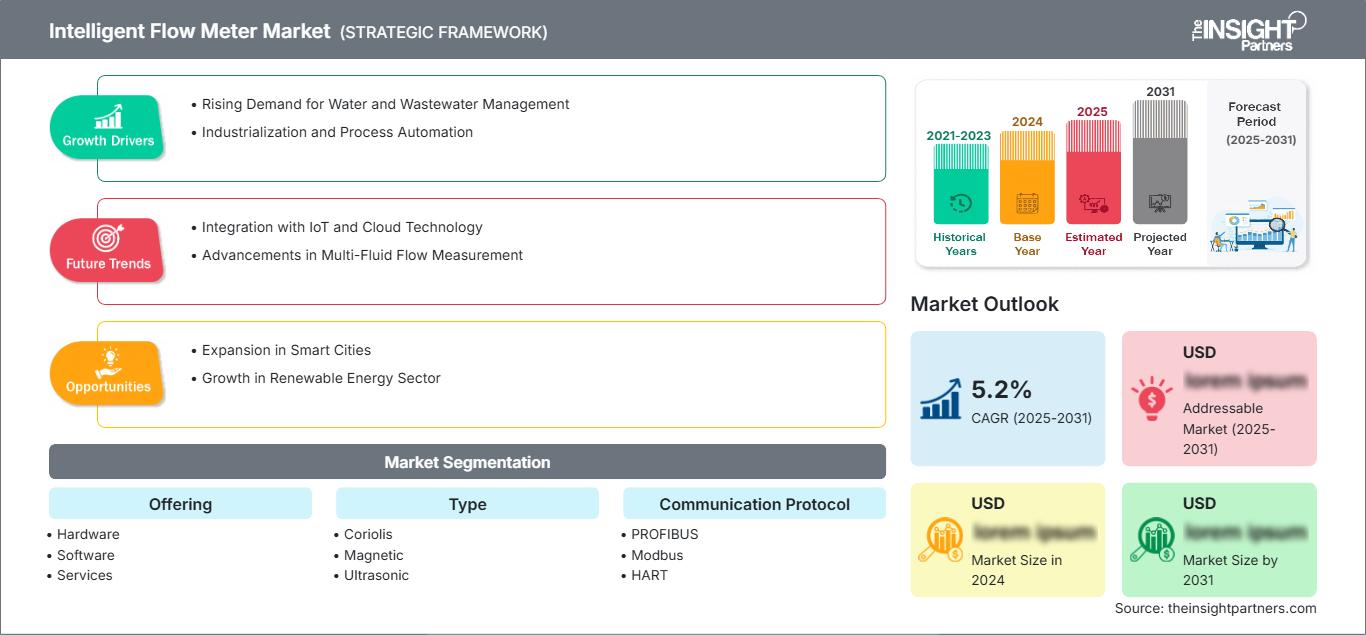
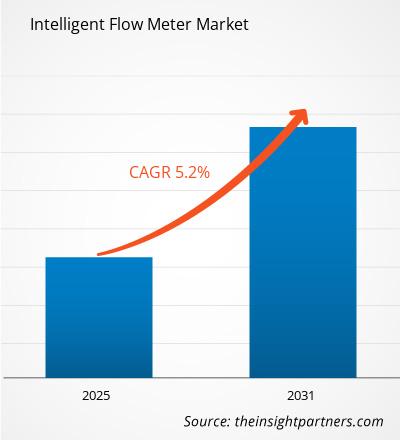
The Intelligent Flow Meter Market was valued at US$ 4.37 Billion in 2025 and is projected to reach US$ 7.96 Billion by 2034, registering a CAGR of 6.89% during 2026–2034. This market segment includes hardware, software, and services that apply Coriolis, magnetic, ultrasonic, multiphase, vortex, variable area, differential pressure, thermal, and turbine technology, targeting chemical, power generation, food and beverages, oil and gas, metals and mining, pulp and paper, pharmaceuticals, and water and wastewater industries.
North America continues to be a technologically mature market for intelligent flow metering, with Intelligent Flow Meter Market size driven by increasing automation of industries, upgrades to old measurement facilities, and growing need for connectivity of process instruments. The forecast period growth rate is expected to reach 5.5%-6.5% CAGR in 2026-2034.
Intelligent Flow Meter Market Assessment and Insights
- North America: North America is estimated to hold a 28–31% share in 2025 and expand at a 5.5–6.5% CAGR between 2026–2034, supported by industrial automation, infrastructure replacement, digitalization, and connected process-control investments.
- US: The US represents approximately 78–82% of North American demand in 2025 and is expected to grow at a 5.5–6.5% CAGR during 2026–2034, driven by process industries and utility modernization.
- Europe: Europe is estimated at a 20–23% share in 2025 and is projected to grow at a 5.8–6.8% CAGR during 2026–2034, with Germany, the UK, France, Italy, and Spain supporting demand across chemicals, pharmaceuticals, energy, food processing, and water.
- Asia Pacific: Asia Pacific is estimated to account for 36–39% share in 2025 and is expected to register a 7.5–8.5% CAGR through 2034, with China, Japan, South Korea, India, and Australia supported by industrial expansion and infrastructure investment.
- Largest Segment: Coriolis is estimated to hold a 25–29% market share in 2025 and grow at a 7.0–8.0% CAGR during 2026–2034, supported by precision mass-flow and multiparameter measurement.
- High Growth Segment: Services represent an estimated 15–19% market share in 2025 and are projected to grow at an 8.0–9.0% CAGR through 2034, supported by calibration, diagnostics, and lifecycle support.
- Key companies analyzed in detail: ABB Ltd., Sierra Instruments, Inc., Nidec Corporation, Honeywell International Inc., Endress+Hauser AG, General Electric Company, Azbil Corporation, Brooks Instrument, Siemens AG, American Industrial Partners, Emerson Electric Co.
Source: The Insight Partners' analysis based on proprietary research, government publications, company annual reports, investor presentations, industry databases, and expert interviews.
The Intelligent Flow Meter Market has moved from traditional stand-alone measuring instruments to instruments that are intelligent, diagnostic, multiparameter, configurable and communicate via digital means. Coriolis flow meters are combining the ability to measure flow, density, and temperature data. Ultrasonic meters offer a non-intrusive way of measuring. Magnetic meters still play an important role when conducting fluid measurements and waste water measurement. Smart flow meter product lines are increasingly featuring diagnostics and communication abilities.
Future growth is expected to move into new industrial nations as manufacturing capacity, water facilities, pharmaceutical production capacity, and energy developments increase. Asia-Pacific is projected to still be the largest regional market, while investment in infrastructure and water in the Middle East offers additional applications. Growth from mature markets is also expected as upgrades of existing installations are necessary.
Intelligent Flow Meter Market Report Scope
| Report Attribute | Details |
|---|---|
| Market size in 2025 | US$ 4.37 Billion |
| Market Size by 2034 | US$ 7.96 Billion |
| Global CAGR (2026 - 2034) | 6.89% |
| Historical Data | 2021-2024 |
| Forecast period | 2026-2034 |
Intelligent Flow Meter Market Analysis
The factors affecting demand include process accuracy, efficiency, custody transfer, regulation, automation, and visibility. The growth of the Intelligent Flow Meter Market will be driven by a supply chain that includes sensor vendors, electronic component providers, automation vendors, engineering contractors, systems integrators, and industrial end users. The connected flow meters are capable of providing measurement data and diagnostic information for the PLC, DCS, SCADA, and asset management systems.
The supply drivers continue to depend on specific technologies. Coriolis meter providers compete on high accuracy and density measurement and multi-parameter capabilities, while ultrasonic providers compete on non-intrusive installation capability and large pipe size ranges. Magnetic flow meters continue to play important role in conductive liquid application. The product line of Endress+Hauser includes electromagnetic, Coriolis, ultrasonic, vortex, thermal, and differential pressure flow meter technologies.
Intelligent Flow Meter Market Report competitive analysis reveals the rivalry of diversified automation players and specialist measurement companies. ABB, Siemens, Honeywell, Endress+Hauser, and Emerson take advantage of diversified instrument ranges, automation, and global service offerings. Sierra Instruments and Brooks Instrument have their focus on specialist flow technologies, whereas Azbil has a strong specialization in measurements and control systems. Competitors like Nidec, General Electric Company, etc., compete in selected geographic and industrial markets.
The investments in competing are now more oriented to connectivity, diagnostics, non-invasive measurements, and special engineering applications. Competitive product differentiation is moving from being exclusively about accuracy to integration, security, lifecycle services, and total cost of ownership. This trend can be illustrated by the example of Endress+Hauser that developed the Prosonic Flow P 500, featuring both clamp-on ultrasonic measurement and diagnostics and configuration capabilities.
● REPORT CUSTOMIZATION
Tailor This Report To Align With Your Specific Business Requirements
This report can be customized to align precisely with your business objectives, scope, and target markets. Customization options include tailored segmentation, geography, competitive analysis, and strategic insights to support informed decision-making.
Customize This Report →WHAT YOU CAN ADJUST
- ● Segmentations
- ● Geography
- ● Competitive Analysis
- ● Language Preferences
Intelligent Flow Meter Market: Strategic Insights
Regional Insights
North America Intelligent Flow Meter Market
North America is estimated to represent 28–31% of the Intelligent Flow Meter Market Share in 2025 and is projected to expand at a 5.5–6.5% CAGR through 2034. The region benefits from established process industries, replacement of aging equipment, and continued investment in oil and gas, chemicals, power generation, manufacturing, and municipal water infrastructure. Demand is increasingly connected to plant modernization rather than only new capacity additions.
The US represents an estimated 78-82% share of the regional market demand, and the largest opportunity in terms of nations. Connected instrumentation is becoming increasingly relevant due to the requirement for remote diagnostic, enhanced asset visibility, and compatibility with contemporary control systems. Applications include water infrastructure, liquefied natural gas, refineries, pharmaceuticals, and advanced manufacturing facilities. The presence of the installed base regionally leads to ongoing needs for recalibration, maintenance, upgrades, and replacement of equipment.
U.S. Intelligent Flow Meter Market
The US constitutes about 78-82% of North American demand in 2025 and is forecast to grow at a 5.5-6.5% CAGR during 2025-2034. Significant coverage of industries including chemicals, oil and gas, pharmaceuticals, food processing, power generation and water utilities results in diversified demand. Major international instrument manufacturers are present throughout the country both commercially and in terms of service.
Trends in applications increasingly require instruments that have remote diagnostics, multiple parameter measurement capability, non-intrusive installation capability, and compatibility with existing control systems. This will lead to replacement being a significant source of demand as users replace old instruments without having to redesign the entire production line. Industrial cybersecurity and lifecycle management are also becoming increasingly relevant criteria for selection.
Europe Intelligent Flow Meter Market
Europe is estimated to hold a 20–23% Intelligent Flow Meter Market share in 2025 and is expected to expand at a 5.8–6.8% CAGR through 2034. Germany is the leading national market, supported by advanced manufacturing, chemicals, machinery, energy, and industrial automation. The UK maintains significant demand from energy, pharmaceuticals, water, and process industries, while France benefits from chemicals, power, food, and water applications.
The German industrial sector provides a foundation for instrumentation demand, where there is need for accuracy and digital capabilities. There is support for the UK in the modernization of energy and water systems, as well as production in the pharmaceutical industry. France offers prospects in the areas of nuclear energy, chemical manufacture, and utilities. Italy and Spain provide input in terms of manufacturing, food processing, water, and energy systems. Suppliers in Europe keep on developing unique flow technologies, including clamp-on ultrasonic systems for high temperatures. The Endress+Hauser Prosonic Flow P 500 demonstrates such development.
APAC Intelligent Flow Meter Market
Asia Pacific is estimated to account for 36–39% of the Intelligent Flow Meter Market in 2025 and is projected to grow at a 7.5–8.5% CAGR through 2034. China is the leading market, followed by Japan, South Korea, India, and Australia. Industrial capacity expansion, semiconductor production, chemicals, pharmaceuticals, mining, power generation, and water infrastructure underpin regional demand.
China is the world leader when it comes to manufacturing on a large scale, which means that China is the leader in having the largest installation base. Japan and South Korea focus on precision manufacturing and automation technology. Increasing investments by India in the industrial and infrastructure sectors means a lot of demand in the area, as well as mining and LNG applications for Australia.
Middle East & Africa Intelligent Flow Meter Market
Middle East and Africa is expected to expand at a 6.8–7.8% CAGR through 2034. Saudi Arabia is the leading market, supported by oil and gas, industrial diversification, water infrastructure, and large-scale development. The UAE follows through energy, desalination, utilities, and infrastructure projects, while South Africa provides demand from mining, water, chemicals, and power.
Energy projects continue to be one of the key areas of demand, but water infrastructure is becoming more and more relevant. The desalination, wastewater treatment, water supply systems, and industrial water management need accurate metering throughout several stages of process. In Rest of MEA, there are still growth opportunities in the area of energy and infrastructure projects.
Segmentation Analysis
Offering
The Offering segment includes hardware, software, and services and is projected to grow at a 6.5–7.5% CAGR during 2026–2034. The Intelligent Flow Meter Market scope increasingly extends beyond physical instruments as software, diagnostics, calibration, asset monitoring, and lifecycle services become integral to connected measurement architectures.
- Hardware: Hardware remains the principal purchase component because sensor accuracy, material compatibility, pressure ratings, temperature capability, and installation design directly determine measurement reliability across industrial processes.
- Software: Software is gaining strategic importance through configuration, diagnostics, asset monitoring, data visualization, and integration with plant systems, increasing the recurring digital value of connected instrumentation.
- Services: Services support calibration, commissioning, maintenance, troubleshooting, and lifecycle optimization, creating recurring opportunities as industrial operators seek consistent measurement performance.
Type
The Type segment includes Coriolis, Magnetic, Ultrasonic, Multiphase, Vortex, Variable area, Differential pressure, Thermal, and Turbine technologies and is expected to grow at a 6.5–7.5% CAGR through 2034. Technology selection depends on fluid properties, accuracy requirements, installation conditions, pressure, temperature, maintenance, and process objectives.
- Coriolis: Coriolis meters are preferred where direct mass-flow measurement, density information, and high precision are important, particularly across chemicals, pharmaceuticals, food processing, and custody-transfer applications.
- Magnetic: Magnetic meters serve conductive liquids, slurries, and wastewater applications, benefiting from low pressure loss and limited mechanical wear during continuous operation.
- Ultrasonic: Ultrasonic meters provide nonintrusive or clamp-on measurement options, reducing process disruption where pipe modification or shutdown is difficult.
- Multiphase: Multiphase meters address complex oil and gas streams containing multiple fluid phases, supporting continuous monitoring while reducing dependence on extensive separation equipment.
- Vortex: Vortex meters are suited to steam, gases, and liquids where stable measurement and broad industrial applicability are required.
- Variable area: Variable-area meters provide simple local indication and remain relevant for utility services, laboratory environments, and rugged industrial applications.
- Differential pressure: Differential-pressure meters maintain a broad installed base because of established engineering practices, extensive user familiarity, and compatibility with diverse process conditions.
- Thermal: Thermal meters are particularly relevant to gas measurement and compressed-air systems where direct mass-flow information is valuable.
- Turbine: Turbine meters remain important for clean liquids and gases requiring repeatable measurement, particularly within established energy and industrial installations.
Communication Protocol
The Communication Protocol segment includes PROFIBUS, Modbus, HART, and Others and is expected to grow at a 6.0–7.0% CAGR during 2026–2034. Protocol selection remains influenced by installed control infrastructure, interoperability, data requirements, cybersecurity, and migration costs.
- PROFIBUS: PROFIBUS remains relevant in established process automation environments where dependable field communication and integration with installed control systems are priorities.
- Modbus: Modbus maintains broad adoption because of straightforward integration, extensive equipment compatibility, and suitability for distributed industrial monitoring architectures.
- HART: HART supports large installed bases by adding digital configuration and diagnostics to conventional analog instrumentation without requiring complete architecture replacement.
- Others: Newer Ethernet-based approaches are gaining relevance where higher bandwidth, richer data access, and integration with digital plant networks are priorities.
Application
The Application segment covers Chemical, Power generation, Food & Beverages, Oil & Gas, Metals & Mining, Pulp & Paper, Pharmaceuticals, Water & wastewater, and Others and is projected to grow at a 6.5–7.5% CAGR through 2034. Application requirements differ according to fluid properties, hygiene, accuracy, safety, and operating conditions.
- Chemical: Chemical plants require accurate measurement across corrosive, hazardous, and variable-density fluids, supporting robust Coriolis, magnetic, and ultrasonic technologies.
- Power generation: Power facilities use flow measurement for water, steam, fuel, and cooling systems, creating demand for reliable instruments capable of continuous operation.
- Food & Beverages: Hygienic processing and precise batching support demand for sanitary flow technologies with strong cleaning compatibility and repeatable measurement.
- Oil & Gas: Oil and gas operators require measurement for production, transportation, custody transfer, allocation, and process optimization, creating demand for high-accuracy instrumentation.
- Metals & Mining: Mining and metals applications require durable measurement for slurries, water, chemicals, and process fluids under demanding operating conditions.
- Pulp & Paper: Pulp and paper facilities use flow measurement across water, chemicals, pulp, and steam systems, requiring instruments suited to difficult process media.
- Pharmaceuticals: Pharmaceutical production prioritizes precision, hygiene, traceability, and noncontamination, supporting advanced Coriolis and noninvasive measurement technologies.
- Water & wastewater: Utilities require accurate measurement for distribution, treatment, pumping, leakage management, and process optimization, supporting magnetic and ultrasonic technologies.
Opportunity Snapshot
| Application | Revenue Contribution (High/Medium/Low) | Trend Tag | Adoption Stage |
| Chemical | High | Process Safety | Mature |
| Power generation | High | Steam Optimization | Mature |
| Food & Beverages | Medium | Hygienic Flow | Scaling |
| Oil & Gas | High | Digital Custody | Mature |
| Metals & Mining | Medium | Slurry Monitoring | Scaling |
| Pulp & Paper | Medium | Water Efficiency | Mature |
| Pharmaceuticals | Medium | Sterile Processing | Scaling |
| Water & wastewater | High | Leak Detection | Scaling |
Intelligent Flow Meter Market Growth Drivers and Impact Analysis
Industrial digitalization increases demand for connected measurement
Industrial digitalization is transforming flow meters into connected process assets capable of diagnostics, remote configuration, verification, and data transmission. This encourages replacement of conventional instruments even when the underlying measurement point remains unchanged. Connected devices can provide measurement-health information to maintenance teams and control platforms, helping identify abnormal conditions earlier. Endress+Hauser identifies diagnostics, verification, monitoring, and communication as central characteristics of smart flow measurement. The market impact is strongest in process facilities implementing predictive maintenance and centralized asset management. As digital architectures become more common in new plants and retrofit programs, connectivity is increasingly treated as a procurement requirement. Suppliers that combine measurement accuracy with interoperability, diagnostics, and application software are therefore positioned to capture greater value across the instrument lifecycle.
Water infrastructure modernization expands advanced measurement demand
Water scarcity, infrastructure aging, leakage reduction, and treatment efficiency are increasing demand for accurate flow measurement. Utilities require reliable measurement across abstraction, treatment, pumping, distribution, and wastewater processes. Industrial facilities similarly use flow data to manage water, chemicals, steam, and compressed gases. ABB's June 2026 upgrade of the ProcessMaster FER620 specifically targeted water abstraction, treatment, distribution, irrigation, low-flow conditions, and buriable applications. Such developments demonstrate how product design is adapting to infrastructure requirements rather than only conventional process applications. The impact extends beyond new installations because established networks require replacement and modernization over long operating cycles. This creates recurring opportunities for suppliers offering rugged instruments, diagnostics, calibration services, and installation solutions suited to difficult field environments.
Precision requirements support adoption in regulated industries
Pharmaceutical, food, chemical, and energy applications increasingly prioritize accuracy, repeatability, hygiene, traceability, and operational safety. Coriolis instruments can combine mass-flow measurement with density and temperature information, while noninvasive ultrasonic technologies can reduce contamination and process-interruption risks. Brooks Instrument's BCU Series demonstrates this direction by providing clamp-on ultrasonic measurement for single-use and hybrid bioprocessing without contacting process fluid. The resulting market impact extends the addressable application base for intelligent instruments. Measurement suppliers can capture demand where conventional devices create installation complexity, contamination concerns, or maintenance burdens. Regulated industries also tend to emphasize documentation, verification, and lifecycle support, increasing the value of suppliers capable of combining instrumentation with application engineering and service capabilities.
Intelligent Flow Meter Market Future Trends
Ethernet-native instrumentation will reshape industrial connectivity
The Intelligent Flow Meter Market trends are increasingly centered on Ethernet-based field connectivity, particularly architectures designed to move richer measurement and diagnostic information directly from process instruments into plant networks. Ethernet-APL is positioned to support higher-speed communication in process environments while maintaining field-level requirements. ABB has expanded flowmeter connectivity around Ethernet-APL, reflecting broader supplier movement toward digital field architectures. Over the forecast period, buyers are likely to evaluate instruments based on data accessibility, interoperability, cybersecurity, diagnostics, and lifecycle analytics in addition to measurement accuracy. This shift can reduce dependence on isolated device configuration and make measurement information more accessible to asset-management, maintenance, and optimization platforms. Suppliers that provide open integration and secure device-management capabilities may gain an advantage as plants move toward increasingly connected operational technology architectures.
Noninvasive measurement will expand in sensitive applications
Noninvasive measurement is expected to gain adoption where shutdowns, contamination, or piping modifications create significant operational costs. Clamp-on ultrasonic technologies allow measurement without penetrating the process line and can therefore address applications where maintaining sterility or avoiding process interruption is critical. Brooks Instrument's BCU Series was introduced for single-use and hybrid bioprocessing and provides real-time liquid-flow measurement without contacting process fluid. Future products are likely to combine this installation flexibility with embedded diagnostics, digital connectivity, and automated verification. The opportunity extends beyond biopharmaceutical production to water systems, temporary measurement, retrofit projects, and difficult-to-access process lines. As operators increasingly quantify the cost of downtime, noninvasive technologies can become strategically attractive even when their initial unit price is higher than conventional alternatives.
Intelligent Flow Meter Market Opportunities
Lifecycle service models can strengthen recurring revenue
Lifecycle services represent an important opportunity as connected instruments generate greater volumes of device and measurement information. Suppliers can combine calibration, remote diagnostics, verification, maintenance planning, troubleshooting, and replacement management into integrated service programs. Such offerings can shift customer relationships from periodic equipment purchases toward longer-term performance management. The opportunity is particularly relevant to chemical, pharmaceutical, energy, and utility operators managing large geographically distributed installed bases. Suppliers with established field-service networks can use device information to prioritize interventions and identify potential measurement degradation before it affects production. This approach can also support customers seeking lower maintenance costs and greater asset availability. Service providers that connect physical instrumentation with digital monitoring can therefore increase recurring revenue while strengthening customer retention.
Retrofit strategies can unlock mature installed-base demand
The Intelligent Flow Meter Market Forecasts indicate that mature industrial regions will continue generating replacement opportunities alongside new installations. Retrofit-focused products can preserve existing piping and control architectures while introducing improved diagnostics, accuracy, connectivity, and verification capabilities. This reduces project disruption and can make modernization economically attractive where complete plant redesign is unnecessary. ABB's current FER620 offering illustrates how modern instruments can combine measurement improvements with established HART and Modbus communication options, supporting integration into existing environments. Vendors can develop migration kits, compatibility assessments, engineering support, and staged upgrade programs around legacy installed bases. This strategy is especially relevant in North America and Europe, where industrial facilities often contain large populations of established instrumentation requiring modernization because of obsolescence, maintenance constraints, cybersecurity requirements, or changing operational standards.
Recent Developments
- June 2026: ABB advances flow measurement performance with a major upgrade to the ProcessMaster FER620 flowmeter family, delivering greater accuracy, reliability and efficiency for harsh conditions and low-flow applications. The ProcessMaster FER620 features a rugged, fully welded and hermetically sealed sensor that ensures long‑term stability and performance in the most challenging environments across pumping stations, water abstraction, water treatment, water distribution and irrigation.
- January 2026: Brooks Instrument, a world leader in advanced fluid measurement and control technologies, has introduced a new, non-invasive clamp-on ultrasonic flow meter with EtherNet/IP that’s easy to integrate for bioprocessing applications. Engineered specifically for the demands of modern single-use or hybrid bioprocessing, Brooks Instrument’s BCU Series flow meter allows users to accurately measure liquid flow through flexible tubing — without penetrating the line or contacting the process fluid — thus preserving sterility and reducing contamination risk.
- November 2025: ABB has launched AquaMaster4 electromagnetic flowmeter with Message Queuing Telemetry Transport (MQTT) technology to support water conservation efforts across the water industry. The solution will minimize pipeline water leaks, reduce energy use, and support broader sustainability goals in the water industry.
Frequently Asked Questions

- Comprehensive Market Sizing and Forecast Analysis
- Detailed Segmentation Analysis
- In-Depth Market Dynamics Assessment
- Regional and Country-Level Insights
- Competitive Landscape and Company Benchmarking
- Strategic Business Intelligence
Recent Reports
Testimonials

The Insight Partners provided valuable market intelligence that supported our global go-to-market strategy. Their team was professional, responsive, and attentive to our feedback, providing thoughtful analysis and helpful methodological clarifications throughout the project.
Junmo Kim Chief Financial Officer (CFO), Enertech Co., Ltd.
The Insight Partners' SCADA System Market report is comprehensive, with valuable insights on current trends and future forecasts. The team was highly professional, responsive, and supportive throughout. We are very satisfied and highly recommend their services.
RAN KEDEM Partner, Reali Technologies LTDs
I requested a report on a very specific software market and the team produced the report in a few days. The information was very relevant and well presented. I then requested some changes and additions to the report. The team was again very responsive and I got the final report in less than a week.
JEAN-HERVE JENN Chairman, Future Analytica
We worked with The Insight Partners for an important market study and forecast. They gave us clear insights into opportunities and risks, which helped shape our plans. Their research was easy to use and based on solid data. It helped us make smart, confident decisions. We highly recommend them.
PIYUSH NAGPAL Sr. Vice President, High Beam Global
The Insight Partners delivered insightful, well-structured market research with strong domain expertise. Their team was professional and responsive throughout. The user-friendly website made accessing industry reports seamless. We highly recommend them for reliable, high-quality research services
YUKIHIKO ADACHI CEO, Deep Blue, LLC.
This is the first time I have purchased a market report from The Insight Partners.While I was unsure at first, I visited their web site and felt more comfortable to take the risk and purchase a market report.I am completely satisfied with the quality of the report and customer service. I had several questions and comments with the initial report, but after a couple of dialogs over email with their analyst I believe I have a report that I can use as input to our strategic planning process.Thank you so much for taking the extra time and making this a positive experience.I will definitely recommend your service to others and you will be my first call when we need further market data.
JOHN SUZUKI President and Chief Executive Officer, Board Director, BK Technologies
I wish to appreciate your support and the professionalism you displayed in the course of attending to my request for information regarding to infectious disease IVD market in Nigeria. I appreciate your patience, your guidance, and the fact that you were willing to offer a discount, which eventually made it possible for us to close a deal. I look forward to engaging The Insight Partners in the future, all thanks to the impression you have created in me as a result of this first encounter.
DR CHIJIOKE ONYIA MANAGING DIRECTOR, PineCrest Healthcare Ltd.Reason to Buy
- Informed Decision-Making
- Understanding Market Dynamics
- Competitive Analysis
- Identifying Emerging Markets
- Customer Insights
- Market Forecasts
- Risk Mitigation
- Boosting Operational Efficiency
- Strategic Planning
- Investment Justification
- Tracking Industry Innovations
- Aligning with Regulatory Trends





 Get Free Sample for