
Instrument Transformers Market Size, Demand & Growth by 2034
Coverage: by Type (Current Transformers, Potential Transformers, Combined Instrument Transformers); Enclosure Type (Indoor, Outdoor); Dielectric Medium (Solid, Liquid, SF6 Gas); End-User (Power Utilities, Transportation, Oil and Gas, Chemicals, Automobile, Others) , and Geography (North America, Europe, Asia Pacific, and South and Central America)
- Status : Data Released
- Report Code : TIPRE00007395
- Category : Electronics and Semiconductor
- No. of Pages : 150
- Available Report Formats :


- Last update date : October 16, 2026


2025 Market Size
US$ 7.22 Bn
Base year value
2034 Forecast
US$ 11.47 Bn
Projected by 2034
CAGR 2026-2034
5.28 %
Growth rate
Addressable Market
US$ 84.79 Bn
(2026-2034)
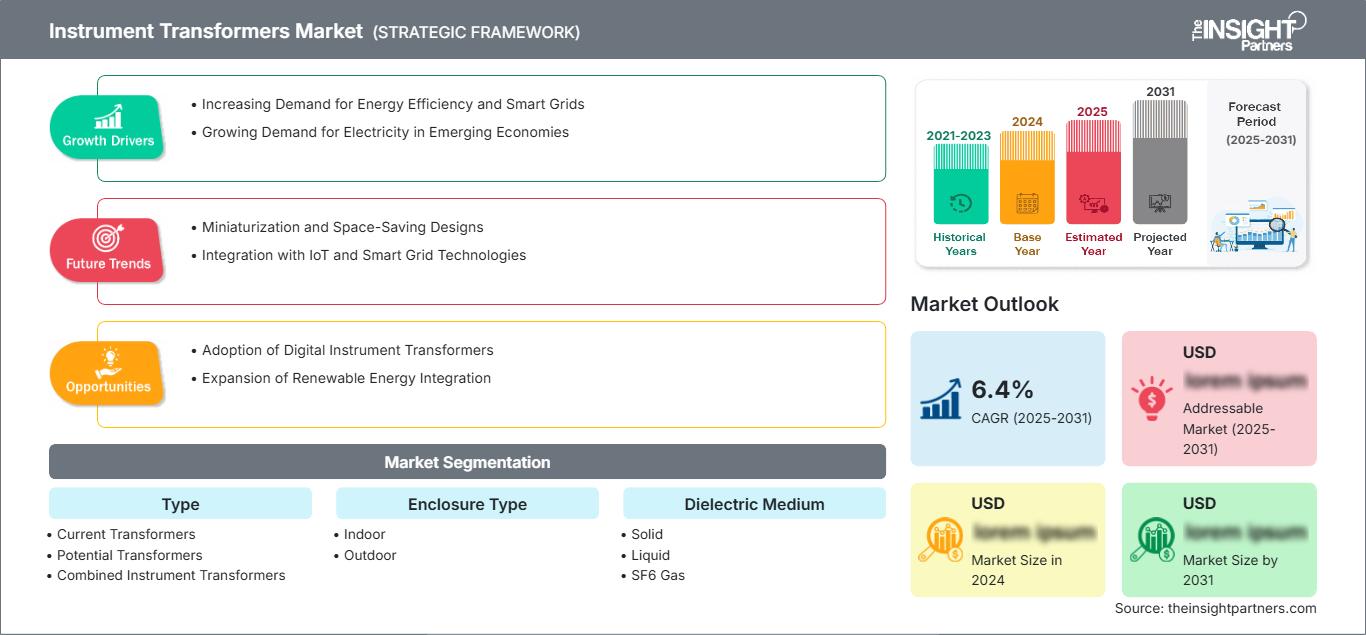
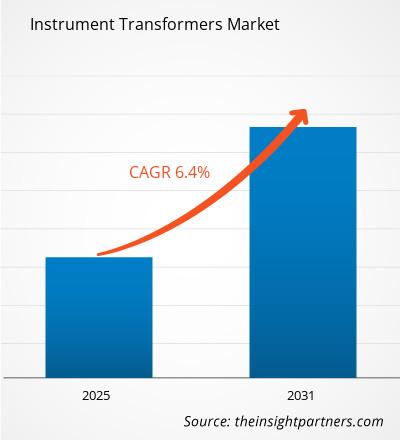
The Instrument Transformers Market is positioned at the intersection of electrical measurement, protection, metering, and grid automation. The market was valued at US$ 7.22 Billion in 2025 and is projected to reach US$ 11.47 Billion by 2034, expanding at a CAGR of 5.28% from 2026 to 2034. Demand is supported by transmission upgrades, renewable integration, industrial electrification, and increasing requirements for accurate current and voltage measurement across modern power networks.
North America is expected to maintain a strong position as utilities modernize aging substations and accommodate distributed generation, data centers, and electric transportation. The Instrument Transformers Market size in the region is supported by replacement cycles, grid-hardening programs, and digital protection requirements, with regional growth estimated at 4.9–5.4% CAGR between 2026 and 2034.
Instrument Transformers Market Assessment and Insights
- North America: North America is expected to account for a 30–34% Instrument Transformers Market share in 2025, supported by transmission modernization, substation replacement, and renewable integration, while the regional market is projected to expand at a 4.9–5.4% CAGR between 2026–2034.
- US: The US is expected to represent 72–76% of North America's 2025 share, with demand supported by aging grid assets, data-center load growth, and utility investment, expanding at a 4.8–5.3% CAGR between 2026–2034.
- Europe: Europe is estimated to hold a 25–29% share in 2025, led by Germany, the UK, France, Italy, and Spain. Grid reinforcement, renewable interconnection, and industrial electrification are expected to support a 4.7–5.2% CAGR between 2026–2034.
- Asia Pacific: Asia Pacific is projected to hold a 27–31% share in 2025, led by China, Japan, India, and South Korea, with transmission expansion, renewable capacity additions, and industrial electrification supporting a 6.0–6.6% CAGR between 2026–2034.
- Largest Segment: Current Transformers are estimated to command a 48–52% market share in 2025, reflecting extensive protection and metering deployment, with a 5.1–5.6% CAGR between 2026–2034.
- High Growth Segment: SF6 Gas is estimated at a 13–17% market share in 2025, supported by compact high-voltage installations, with a 6.0–6.6% CAGR between 2026–2034.
- Key companies analyzed in detail: ABB Ltd, ARTECHE, Bharat Heavy Electricals Limited, CG Power and Industrial Solutions Limited, General Electric Company, Konar Instrument Transformers Inc., Mitsubishi Electric Corporation, NISSIN ELECTRIC Co., Ltd., PFIFFNER Instrument Transformers Ltd, and Schneider Electric SE.
Source: The Insight Partners' analysis based on proprietary research, government publications, company annual reports, investor presentations, industry databases, and expert interviews.
The development of technology is leading the market for instrument transformers away from simply measuring instruments and towards application-specific devices that are used for protection, automation, and digital substations. Traditional electromechanical technologies continue to be widely employed at high voltages, whereas dry-type design, better insulation systems, optical sensors, and digital monitoring systems receive increased interest. The manufacturing process is still being affected by the prices of copper, electrical steel, insulation materials, testing, and high-voltage equipment production facilities.
The future demand for the product will be more and more related to the expansion of grids in developing countries, where the transmission system has to account for renewable energy generation and increasing consumption of electricity. Priority areas of investments will be represented by high voltage grids, flexible substations, distributed energy resources, and protection coordination.
Instrument Transformers Market Report Scope
| Report Attribute | Details |
|---|---|
| Market size in 2025 | US$ 7.22 Billion |
| Market Size by 2034 | US$ 11.47 Billion |
| Global CAGR (2026 - 2034) | 5.28% |
| Historical Data | 2021-2024 |
| Forecast period | 2026-2034 |
Instrument Transformers Market Analysis
The development of the Instrument Transformers Market is directly associated with the development of generation, transmission, and distribution infrastructure due to the need for the current and voltage transformers in order to scale electrical signals for the purpose of metering, relaying, protection, and monitoring. Value Chain starts from the electrical steel, copper, insulation, resin, oil, and enclosure manufacturers followed by special windings, assembling, insulating, testing, and certification facilities. The needs of the utilities greatly affect the configuration of the products.
The market dynamics depend on the production capacity, high-voltage testing facilities, engineering skills, and delivery schedules. According to the IEA, since 2021, there has been an increase in the purchasing time and cost of grid components worldwide. This situation is beneficial for suppliers with diversification in sources, qualifications, local production, and after-market capabilities.
The Instrument Transformers Market report suggests a fragmented industry featuring diversified electrical equipment companies as well as companies specializing in transformers. ABB Ltd, Schneider Electric SE, Mitsubishi Electric Corporation, and General Electric Company benefit from diverse portfolios featuring switchgear, automation, protection, and grid equipment. ARTECHE, PFIFFNER Instrument Transformers Ltd, and Konar Instrument Transformers Inc. offer more focused portfolios featuring measurement and protection equipment.
Key investment trends in the Instrument Transformers Market include higher voltage applications, digital substations, advanced insulation systems, and localized manufacturing. Bharat Heavy Electricals Limited and CG Power and Industrial Solutions Limited enjoy an advantage resulting from expanding Indian power infrastructure. NISSIN ELECTRIC Co., Ltd. offers expertise in electrical equipment. The suppliers differentiate by qualification, customization, testing facilities, reliability, and integration with modern protection systems.
● REPORT CUSTOMIZATION
Tailor This Report To Align With Your Specific Business Requirements
This report can be customized to align precisely with your business objectives, scope, and target markets. Customization options include tailored segmentation, geography, competitive analysis, and strategic insights to support informed decision-making.
Customize This Report →WHAT YOU CAN ADJUST
- ● Segmentations
- ● Geography
- ● Competitive Analysis
- ● Language Preferences
Instrument Transformers Market: Strategic Insights
Regional Insights
North America Instrument Transformers Market
North America is estimated to represent a 30–34% share in 2025, supported by replacement of aging transmission equipment, substation refurbishment, renewable interconnection, and rising electricity requirements from digital infrastructure. The regional CAGR is projected at 4.9–5.4% through 2034. Utilities increasingly prioritize reliable measurement and protection equipment when upgrading substations and strengthening network resilience.
In the region, the US constitutes the leading element of demand whereas Canada will be providing through transmission reinforcement, renewables incorporation and industrial electrification. The procurement of the equipment focuses on short circuit capabilities, reliability of insulation, space saving features, and compatibility with digital protection systems. Qualification by utility is an important competitive advantage because the equipment should meet tough technical standards.
U.S. Instrument Transformers Market
The US is estimated to account for 72–76% of North America's 2025 market, with growth projected at 4.8–5.3% through 2034. The factors driving the demand are the upgrading of transmission network, aging substation infrastructure, renewable energy sources, and rising demand for electricity from data centers. Instrument transformers are significant elements in modernizing the protection, metering, and automation systems.
ABB Ltd, General Electric Company, and Schneider Electric SE have a well-established presence in the market owing to their portfolio of electrical infrastructure, whereas application-specific design of current and voltage transformers is used by specialized companies. The buyers are becoming conscious of compact design, accuracy, thermal rating, and installation issues. The applications are projected to be in data centers, manufacturing plants, renewable energy projects, and substations in the forecast period.
Europe Instrument Transformers Market
Europe is estimated to hold a 25–29% share in 2025, with the regional market projected to expand at 4.7–5.2% through 2034. Germany is one of the dominant nations, with industry electrification, renewable energy incorporation, and power network reinforcements in place. Others include the United Kingdom, France, Italy, and Spain, who have contributed by way of power network modernization and power network investments.
The United Kingdom is investing in its network reinforcement capabilities to accommodate wind generation from the sea, distributed generation, and electrification. Germany, on the other hand, uses industrial power requirements together with renewable energy integration and network reinforcements. France has nuclear generation infrastructure and transmission modernization, while Italy has network reinforcement because of renewable energy integration and inter-regional networks.
APAC Instrument Transformers Market
APAC is estimated to represent a 27–31% share in 2025, with growth of 6.0–6.6% through 2034. China is the largest market, Japan and South Korea come second, then comes India, and then Australia. Manufacturing, incorporation of renewables, and transmission infrastructure drive demand.
China profits from heavy investments into power grid, while in India, expansion of transmission infrastructure goes hand-in-hand with electrification. Japan and South Korea are focused on the reliability of their manufacturing and utility infrastructure, while Australia needs equipment for incorporating renewables along the long transmission corridors. IEA forecasts addition of more than 570 TWh of consumption per year in India for five years.
Middle East & Africa Instrument Transformers Market
Middle East and Africa demand is supported by power-generation expansion, industrial development, oil and gas infrastructure, and grid reinforcement. Saudi Arabia is the leading regional market, followed by the UAE and South Africa. The region is projected to record a 5.3–5.9% CAGR through 2034, with infrastructure modernization supporting replacement demand.
Saudi Arabia and the UAE are investing in power infrastructure linked to economic diversification, while South Africa requires network reinforcement and reliability improvements. Rest of MEA demand is concentrated around utilities, industrial projects, mining, and energy infrastructure. High-temperature environments, installation conditions, and maintenance accessibility influence product specifications and supplier selection across regional projects.
Segmentation Analysis
Type
The Type segment in the Instrument Transformers Market is projected to expand at a 5.4–5.8% CAGR from 2026–2034. Current transformers remain central to protection and metering, while potential transformers support voltage measurement. Combined configurations are attractive where footprint, installation simplicity, and integrated measurement requirements influence substation design. The segment remains closely tied to utility capital expenditure and replacement programs.
- Current Transformers: Current transformers maintain the broadest deployment base because protection relays, meters, and monitoring systems require dependable current measurement. Their importance spans transmission, distribution, industrial switchgear, renewable plants, and large commercial electrical installations.
- Potential Transformers: Potential transformers provide controlled voltage signals for metering and protection systems. Demand remains concentrated in substations, switchgear, transmission networks, and industrial installations where accurate voltage measurement and electrical isolation are essential.
- Combined Instrument Transformers: Combined instrument transformers integrate current and voltage measurement functions, supporting compact substation configurations. Their strategic value increases where equipment footprint, installation complexity, and integrated protection requirements influence procurement decisions.
Enclosure Type
The Enclosure Type segment in the Instrument Transformers Market is forecast to grow at a 5.0–5.5% CAGR from 2026–2034. Indoor designs remain important for compact switchgear and controlled environments, while outdoor equipment serves substations and transmission infrastructure. Environmental exposure, insulation requirements, available space, and maintenance practices determine configuration selection across utility and industrial projects.
- Indoor: Indoor instrument transformers are widely deployed within switchgear assemblies, control rooms, and protected industrial environments. Their compact design and controlled operating conditions support applications where space optimization and easier maintenance are important.
- Outdoor: Outdoor configurations address substations, transmission yards, and exposed electrical installations. Their strategic importance stems from weather resistance, insulation performance, mechanical durability, and reliable operation across demanding environmental conditions.
Dielectric Medium
The Dielectric Medium segment is expected to register a 5.5–6.0% CAGR from 2026–2034. Solid, liquid, and SF6 gas insulation serve different voltage classes and installation environments. Procurement decisions increasingly balance electrical performance, footprint, environmental considerations, maintenance requirements, and lifecycle economics as utilities modernize equipment.
- Solid: Solid insulation supports compact and low-maintenance designs, particularly where dry construction and reduced leakage risk are valued. Resin-based solutions are relevant for indoor switchgear and industrial environments requiring reliable insulation performance.
- Liquid: Liquid dielectric systems remain important in high-voltage applications where thermal management and insulation coordination are critical. Utility procurement continues to consider established performance, service experience, maintenance requirements, and fire-safety considerations.
- SF6 Gas: SF6 gas supports compact high-voltage equipment where space efficiency and dielectric strength are priorities. Demand remains relevant in constrained substations, although environmental considerations are increasing interest in alternative insulation technologies.
End-User
The End-User segment is projected to expand at a 5.2–5.7% CAGR from 2026–2034. Power utilities remain the principal demand center, while transportation, oil and gas, chemicals, and automobile manufacturing contribute through electrification and automation. Purchasing decisions increasingly emphasize reliability, testing, interoperability, and lifecycle support.
- Power Utilities: Power utilities represent the largest demand base because current and voltage measurement is fundamental to grid protection, metering, and substation automation. Replacement programs and transmission expansion sustain recurring equipment requirements.
- Transportation: Railways, metros, electrified transport systems, and associated substations require accurate measurement and protection. Electrification programs create demand for compact equipment capable of reliable operation within specialized power-distribution environments.
- Oil and Gas: Oil and gas facilities require measurement and protection equipment across generation, processing, pumping, and distribution systems. Reliability, hazardous-area considerations, environmental conditions, and continuous operation shape product selection.
- Chemicals: Chemical plants use instrument transformers within motor control, substations, distribution equipment, and process facilities. Buyers emphasize electrical safety, reliability, environmental resistance, and compatibility with automated monitoring and protection systems.
- Automobile: Automotive manufacturing plants require dependable electrical distribution and protection for highly automated production lines. Electrification of manufacturing processes and battery-related facilities supports additional demand for monitoring and protection equipment.
- Others: Other end users include commercial infrastructure, mining, data centers, and renewable projects. These applications increasingly require compact, accurate, and reliable measurement equipment to support distributed electrical systems and critical-load protection.
Opportunity Snapshot
| End-User | Revenue Contribution (High/Medium/Low) | Trend Tag | Adoption Stage |
|---|---|---|---|
| Power Utilities | High | Grid Modernization | Mature |
| Transportation | Medium | Rail Electrification | Scaling |
| Oil and Gas | Medium | Asset Electrification | Mature |
| Chemicals | Medium | Plant Automation | Mature |
| Automobile | Medium | Factory Electrification | Scaling |
| Others | Low | Distributed Power | Scaling |
Instrument Transformers Market Growth Drivers and Impact Analysis
Grid Modernization and Renewable Interconnection
Growing network and substation assets lead to an increase in the need for measuring and protecting devices. The consumption of electricity grew by 3% in 2025 worldwide; however, the forecast of the International Energy Agency states that the average annual growth rate will amount to 3.6% within 2026 to 2030. The development of renewable generation leads to the increase of the number of connection points for measuring current and voltage. Thus, utilities purchase measuring transformers when building substations and upgrading lines, making retrofits, and connecting renewable sources. The commercial effect is more extensive than the effect of demand because the more complex is the network – the higher demands arise.
Electrification of Industry and Critical Infrastructure
Electrical industrialization is expanding the usage beyond traditional utility substations. Data centers, industries, electric vehicles, chemical plants, and highly electricity-consuming processes need reliable monitoring and protection of electricity. The IEA considers industry, electric vehicles, cooling systems, and data centers to be key components in future electricity consumption increase. In case of growing dynamic electricity load, the users need precise measurements for protection coordination, energy management, and monitoring. It is creating market potential for the instrument transformers producers in new construction and retrofitting projects. The demand is resilient because the lack of reliability can create disruptions in production, which requires accuracy, reliability, thermal performance, and technical service during purchase decision.
Replacement of Aging Grid Assets and Reliability Requirements
The aging electrical infrastructure presents a repeating opportunity for replacement since instrument transformers work as an inherent part of the protection and measurement system. Utilities now often integrate replacement with automation of the substations, increase in fault-level requirements, and the introduction of digitized monitoring. Procurement pressures further prompt early procurement because according to the IEA, costs and procurement time for essential grid elements have been growing noticeably since 2021. This will result in favoring suppliers with an existing qualification, local production, and reliable delivery. Moreover, equipment replacement projects may also need customization of ratios, insulation classes, mechanical design, and test procedures.
Instrument Transformers Market Future Trends
Digital Monitoring and Sensor-Integrated Substations
Future Instrument Transformers Market trends are expected to increasingly connect measurement equipment with digital substations, intelligent protection systems, and condition-monitoring platforms. Rather than considering transformers as mere passive instruments of measurement, the utilities can utilize better signals for automation of protection, diagnostics, and operational analysis. The digital infrastructure would enable interoperability with the new relay systems, communication networks, and supervisory solutions. The vendors would be able to compete in the areas of signal quality, diagnostic compatibility, security-aware interface design, and ease of installation. Such an evolution process must be gradual because the existing electromechanical instrumentation is extensively used in the installed infrastructure of the utilities. However, the construction of new substations or large-scale renovation projects can facilitate the use of sensor-based products.
Alternative Insulation and Environmentally Responsible Designs
It is anticipated that environmental factors will play an important role when utilities consider alternatives to the traditional SF6 insulated products. The future product development will be focused on low environmental impact in combination with maintaining dielectric properties, reliability, small size, and longevity. Such approach can be achieved through solid insulation, vacuum insulation technologies for the neighboring switchgear equipment, alternative gas solutions, and material innovations. The transformation process will differ depending on voltage level as the existing high-voltage technologies must be qualified and validated thoroughly. Therefore, it will make sense for the purchasing department to take into account not only the price but also the lifecycle emissions, maintenance needs, safety, and other performance parameters.
Instrument Transformers Market Opportunities
Localized Manufacturing for Emerging Grid Investments
Emerging economies offer investment opportunities through localized production, engineering centers, testing laboratories, and service networks. India, Southeast Asia, the Middle East, and selected African markets are expanding power infrastructure while seeking shorter procurement cycles and stronger domestic supply chains. The opportunity extends beyond manufacturing because utilities often require application engineering, commissioning, testing, replacement parts, and technical support. Companies entering these markets can prioritize partnerships with local switchgear manufacturers, EPC contractors, and utilities rather than relying solely on direct sales. Localization can also reduce exposure to international logistics disruptions and improve responsiveness to utility-specific standards. Instrument Transformers Market Forecasts should therefore consider not only unit demand but also the geographic shift toward regional manufacturing ecosystems, especially where transmission expansion and industrial electrification create sustained equipment requirements.
High-Voltage and Renewable Integration Applications
High-voltage transmission, renewable generation, battery storage, and grid interconnection projects present attractive opportunities for suppliers with specialized engineering capabilities. Large renewable plants require reliable measurement at generation and grid-connection points, while transmission upgrades require equipment capable of operating across demanding electrical and environmental conditions. Vendors can prioritize products with high insulation performance, compact construction, improved diagnostics, and adaptable installation configurations. Strategic partnerships with renewable developers, transmission contractors, and substation integrators can improve specification visibility before procurement decisions are finalized. Opportunity creation will increasingly depend on demonstrating lifecycle reliability and compliance rather than offering equipment at the lowest upfront price. Suppliers can also build recurring revenue through testing, refurbishment, replacement, and technical services around installed equipment.
Recent Developments
- July 2026: ABB Ltd completed its acquisition of Specialtrasfo S.p.A., an Italian manufacturer of specialized medium-voltage transformers. The transaction adds converter and rectifier transformer capabilities, three Italian production sites, and more than 130 employees to ABB’s portfolio, strengthening its broader positioning in specialized transformer applications supporting industrial electrification and energy infrastructure.
- February 2025: Schneider Electric SE showcased electrical and automation technologies at ELECRAMA 2025 in India, emphasizing solutions for energy management, industrial automation, infrastructure, data centers, buildings, and homes. The event reinforced the company’s focus on India’s expanding electrification and digitalization requirements and highlighted its broad electrical equipment portfolio.
- July 2025: Bharat Heavy Electricals Limited issued a tender for testing higher-rated transformers, reactors, instrument transformers, bushings, and capacitors at its Bhopal facility. The procurement covered test-connection work associated with high-voltage products, demonstrating continued activity around specialized testing infrastructure for transformer and related electrical equipment.
Frequently Asked Questions

- Comprehensive Market Sizing and Forecast Analysis
- Detailed Segmentation Analysis
- In-Depth Market Dynamics Assessment
- Regional and Country-Level Insights
- Competitive Landscape and Company Benchmarking
- Strategic Business Intelligence
Recent Reports
Testimonials

The Insight Partners provided valuable market intelligence that supported our global go-to-market strategy. Their team was professional, responsive, and attentive to our feedback, providing thoughtful analysis and helpful methodological clarifications throughout the project.
Junmo Kim Chief Financial Officer (CFO), Enertech Co., Ltd.
The Insight Partners' SCADA System Market report is comprehensive, with valuable insights on current trends and future forecasts. The team was highly professional, responsive, and supportive throughout. We are very satisfied and highly recommend their services.
RAN KEDEM Partner, Reali Technologies LTDs
I requested a report on a very specific software market and the team produced the report in a few days. The information was very relevant and well presented. I then requested some changes and additions to the report. The team was again very responsive and I got the final report in less than a week.
JEAN-HERVE JENN Chairman, Future Analytica
We worked with The Insight Partners for an important market study and forecast. They gave us clear insights into opportunities and risks, which helped shape our plans. Their research was easy to use and based on solid data. It helped us make smart, confident decisions. We highly recommend them.
PIYUSH NAGPAL Sr. Vice President, High Beam Global
The Insight Partners delivered insightful, well-structured market research with strong domain expertise. Their team was professional and responsive throughout. The user-friendly website made accessing industry reports seamless. We highly recommend them for reliable, high-quality research services
YUKIHIKO ADACHI CEO, Deep Blue, LLC.
This is the first time I have purchased a market report from The Insight Partners.While I was unsure at first, I visited their web site and felt more comfortable to take the risk and purchase a market report.I am completely satisfied with the quality of the report and customer service. I had several questions and comments with the initial report, but after a couple of dialogs over email with their analyst I believe I have a report that I can use as input to our strategic planning process.Thank you so much for taking the extra time and making this a positive experience.I will definitely recommend your service to others and you will be my first call when we need further market data.
JOHN SUZUKI President and Chief Executive Officer, Board Director, BK Technologies
I wish to appreciate your support and the professionalism you displayed in the course of attending to my request for information regarding to infectious disease IVD market in Nigeria. I appreciate your patience, your guidance, and the fact that you were willing to offer a discount, which eventually made it possible for us to close a deal. I look forward to engaging The Insight Partners in the future, all thanks to the impression you have created in me as a result of this first encounter.
DR CHIJIOKE ONYIA MANAGING DIRECTOR, PineCrest Healthcare Ltd.Reason to Buy
- Informed Decision-Making
- Understanding Market Dynamics
- Competitive Analysis
- Identifying Emerging Markets
- Customer Insights
- Market Forecasts
- Risk Mitigation
- Boosting Operational Efficiency
- Strategic Planning
- Investment Justification
- Tracking Industry Innovations
- Aligning with Regulatory Trends





 Get Free Sample for