
Industrial Fabrics Market Size, Share & Growth by 2034
Coverage: by Fiber Type (Polyamide, Nylon, Aramid, Composite); Type (Woven and Non-woven); Application (Conveyor Belt, Protective Apparel, Automotive, Building Material, Leather Goods) , and Geography (North America, Europe, Asia Pacific, and South and Central America)
- Status : Data Released
- Report Code : TIPRE00004858
- Category : Chemicals and Materials
- No. of Pages : 150
- Available Report Formats :


- Last update date : September 01, 2026


2025 Market Size
US$ 160.87 Bn
Base year value
2034 Forecast
US$ 202.74 Bn
Projected by 2034
CAGR 2026-2034
2.60 %
Growth rate
Addressable Market
US$ 1,649.71 Bn
(2026-2034)
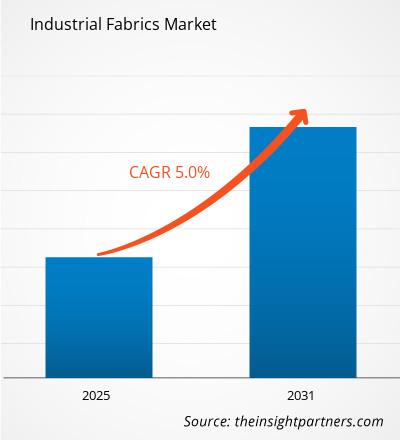
The industrial fabrics market is valued at US$ 160.87 Billion in 2025 and is projected to reach US$ 202.74 Billion by 2034, expanding at a CAGR of 2.60% during 2026–2034. This market consists of textile structures that have been engineered and which require either strength, abrasion resistance, dimensional stability, thermal properties, or reinforcement. Needs arise from applications such as industrial handling, occupational protection, automotive parts, construction materials, leather products, and where the engineering of fibers plays a part in selection and performance.
The North American region is still important for industrial fabrics market size with a combination of conveyor systems, protective workwear needs, automotive industry, and renovation efforts. This market is anticipated to post a CAGR of 2.2–2.6% through 2034. Replacements, safety at workplaces, and automation of material handling create a fairly stable base for suppliers.
Industrial Fabrics Market Assessment and Insights
- North America: North America is expected to account for a 24–28% share in 2025 and grow at a CAGR of 2.2–2.6% between 2026–2034, supported by industrial automation, protective apparel demand, automotive production, and infrastructure maintenance.
- US: The US is estimated to represent 68–72% of North America's 2025 market and expand at a CAGR of 2.1–2.5% during 2026–2034, supported by manufacturing modernization and safety standards.
- Europe: Europe is projected to hold a 27–31% share in 2025 and grow at a CAGR of 2.3–2.7% during 2026–2034. Germany, Italy, France, the UK, and Spain provide strong automotive, construction, industrial machinery, and technical-textile demand.
- Asia Pacific: Asia Pacific is expected to command a 38–42% share in 2025 and record a CAGR of 3.0–3.4% during 2026–2034. China, Japan, India, South Korea, and Australia benefit from manufacturing capacity, infrastructure investment, automotive output, and expanding technical-textile adoption.
- Largest Segment: Woven products are estimated to hold a 58–62% market share in 2025 and grow at a CAGR of 2.4–2.8% during 2026–2034, reflecting broad industrial reinforcement applications.
- High Growth Segment: Protective apparel is estimated at a 12–16% market share in 2025 and is expected to grow at a CAGR of 3.4–3.8% during 2026–2034 as safety specifications become more demanding.
- Key companies analyzed in detail: Forbo International SA, Ahlstrom Oyj, Habasit AG, Toray Industries, Inc., ContiTech Deutschland GmbH, CEREX Advanced Fabrics, Inc., W. Barnet GmbH & Co. KG, DuPont de Nemours, Inc., Fitesa S.A., G.R. Henderson Co. Textiles Ltd.
Source: The Insight Partners' analysis based on proprietary research, government publications, company annual reports, investor presentations, industry databases, and expert interviews.
Technological advancements in production processes are moving away from traditional textile production methods toward advanced designs, which are based on controllable weave structures, high tenacity yarns, coatings, lamination, and composite reinforcements. Advanced weaving, non-woven formation, coating, and digital quality controls help increase the consistency of the production process. More and more companies optimize fabric properties according to tensile strength, fatigue resistance, thermal stability, and weight instead of minimizing costs of raw material.
During the forecast period, most investments will be targeted at lightweight products, recycled raw materials, localized production capabilities in the region, and higher-performing protective materials. The Asia-Pacific region will receive additional capacity through localization, whereas North America and Europe will focus on efficiency and certification of products. Increasing regulation related to safety for workers, exposure to chemicals, recyclability, and resource efficiency will favor suppliers demonstrating traceability and controlled formulations.
Industrial Fabrics Market Report Scope
| Report Attribute | Details |
|---|---|
| Market size in 2025 | US$ 160.87 Billion |
| Market Size by 2034 | US$ 202.74 Billion |
| Global CAGR (2026 - 2034) | 2.60% |
| Historical Data | 2021-2024 |
| Forecast period | 2026-2034 |
Industrial Fabrics Market Analysis
The industrial fabrics market is brought about by the fact that conventional products are being substituted with engineered fabrics that offer reduced weight, flexibility control, abrasion resistance, and reinforcement. The need can come from different sources such as fiber, yarn, fabric producers, coating manufacturers, laminators, converters, equipment manufacturers, and industrial users. The conveyor belts and protective clothing need repeated demands due to exposure to wear, contamination, heat, and safety that makes them require replacement. Applications from automobiles and construction industries add the demands arising out of longevity and dimensional stability.
The supply is still influenced by polymer, fiber, energy, and specialty chemicals prices. Materials like high tenacity polyamide, nylon, aramids, and composites need specialized techniques of manufacturing whereas woven and nonwoven techniques have different costs and performances. The companies are therefore adopting techniques of procurement of raw materials from different regions, vertical integration, qualification and application engineering. The users are usually concerned about life span, maintenance periods, certifications, and performance.
The competitive environment highlighted in the industrial fabrics market report includes diversified material suppliers, technical textiles companies, conveyor systems suppliers, and nonwovens suppliers. Forbo International SA and Habasit AG take advantage of their competitive strength regarding solutions concerning movement and conveyor systems, whereas Ahlstrom Oyj is an expert in engineered fiber materials. Toray Industries Inc. is famous for its deep knowledge in materials, and ContiTech Deutschland GmbH combines the fields of textile reinforcements and industrial systems. Some of the other players in the market that have unique competencies are CEREX Advanced Fabrics, Inc., W. Barnet GmbH & Co. KG, Fitesa S.A., and G.R. Henderson Co. Textiles Ltd.
Strategic positioning increasingly relies on application engineering, availability geographically, sustainability, and customer qualification. The traditional supplier of high performance aramid-based solutions is DuPont de Nemours, Inc., which will divest of the Aramids business by 2026 and therefore alter the competitive environment regarding Kevlar and Nomex. Areas for investment include fiber blend differentiating technology, advanced coating, recycling feedstock, and production automation.
● REPORT CUSTOMIZATION
Tailor This Report To Align With Your Specific Business Requirements
This report can be customized to align precisely with your business objectives, scope, and target markets. Customization options include tailored segmentation, geography, competitive analysis, and strategic insights to support informed decision-making.
Customize This Report →WHAT YOU CAN ADJUST
- ● Segmentations
- ● Geography
- ● Competitive Analysis
- ● Language Preferences
Industrial Fabrics Market: Strategic Insights

Regional Insights
North America industrial fabrics market
The region is estimated to account for 24–28% of the industrial fabrics market share in 2025 and to grow at a CAGR of 2.2–2.6% through 2034. The US is still the main market, due to manufacturing, logistics, mining, construction, automotive assembly, and workplace protection needs. Conveyor fabrics profit from automation in distribution centers and from replacement, while protective materials do so from strict occupational safety measures. Canada participates with its mining, energy, transport, and infrastructure uses, whereas Mexico contributes with automotive manufacturing and offshoring. Increasingly, customers are more interested in durability, certifications, reliable sourcing, and less maintenance, rather than the lowest price.
The supply chain comprises global fiber suppliers, fabric makers, and converters. It is strategic that there are local manufacturing and warehousing facilities since industrial buyers frequently need short delivery times and specific product specifications. Sustainability issues are also affecting procurement, in cases where buyers request recyclable fibers, low-energy production processes, and durable goods. Ahlstrom Oyj's investment in the US to manufacture high-performance synthetic filtration materials represents an example of the larger trend towards localized production of specialty materials. Growth prospects will be moderate since industrial infrastructure is mature and only selected markets will grow fast.
U.S. industrial fabrics Market
The US is expected to comprise 68-72% of North America’s market share in 2025 and is anticipated to grow at a CAGR of 2.1-2.5% from 2024 to 2034. Drivers include logistics infrastructure, automotive manufacturing, construction, machinery, mining, and protective clothing. Replenishing conveyor systems and safety equipment results in cyclic demand for technical textiles. There is competition among domestic and international suppliers through certified raw materials, engineering designs, customization, and service. Large organizations have the ability to supply in all sectors of reinforcement materials, specialty fibers, non-wovens, and movement systems.
Current application trends call for lightweight but highly durable materials that extend equipment lifespan or enhance mobility of workers. Weight-controlled reinforcement and interior materials as well as abrasion-resistant and dimensionally stable materials are required by automotive manufacturers. On the other hand, industrial organizations are in need of technical textiles that are able to withstand heat, chemical, and mechanical stresses. Reshoring and investments in advanced manufacturing are able to provide growth for localized technical-textile supply. Buyers are now considering environmental records, recycled content, and lifecycle costs in addition to their normal requirements.
Europe industrial fabrics Market
Europe is estimated to occupy the market share of 27-31% in 2025 and to have CAGR of 2.3-2.7% until 2034. Germany is the market leader due to automotive engineering, machinery production, industrial equipment, and textile technology. In the United Kingdom, demand comes from infrastructure construction, protective apparel, transportation, and industrial maintenance. France is represented by aerospace, automotive, construction, and specialty textile demand. Italy profits from machinery, leather goods, footwear, and manufacturing applications. Spain has automotive, construction, and industrial conversion demand. Regulations on sustainability and circular materials are increasingly driving purchases in the region.
The higher cost of energy, labor, compliance, and conversion in Europe makes producers use automation and develop premium applications. Therefore, manufacturers focus on long lifespan, low material intensity, recycling, and improved environmental performance. Woven reinforcement becomes necessary in case of tough conditions, and non-woven reinforcement is used when filtration, insulation, coverage, or light construction is needed. Germany is going to stay as the market leader due to the developed industrial manufacturing and equipment producers' presence. Growth in Europe is stable rather than fast with value being added by performance.
APAC industrial fabrics Market
APAC is expected to hold 38-42% of the global value in 2025, growing with a CAGR of 3.0-3.4% up until 2034. China is still the leader, while Japan, South Korea, India, and Australia come second, third, fourth, and fifth respectively. The industry is driven by automotive production, construction, logistics, mining, and industrial equipment, while there is new manufacturing capacity in India and Southeast Asia.
This region offers both high-volume production and specialization. Advanced materials are offered by China and Japan, industrial and automotive applications are provided by South Korea, while India expands its technical textile production. Australia has demand in mining and infrastructure projects. All these together with supportive policies, infrastructure investments, export-oriented manufacturing, and growing labor safety standards will keep APAC being the fastest-growing regional market.
Middle East & Africa industrial fabrics Market
Middle East & Africa is expected to grow at a CAGR of 2.7–3.1% through 2034, supported by infrastructure development, industrial diversification, energy projects, mining, logistics, and construction. Saudi Arabia and the UAE lead regional investment, while South Africa provides established mining, automotive, industrial, and infrastructure demand. The rest of MEA remains fragmented but offers project-based opportunities.
Diversification of energy sources is also generating new demands for applications other than the traditional use of oil and gas in areas such as transport, construction, utilities, and industrial processing. Saudi Arabia is in the best position to supply since there will be significant infrastructure and industrial development programs taking place there. UAE will have logistical and construction-related demands while South Africa’s needs will arise out of mining and manufacturing.
Segmentation Analysis
Fiber Type
Fiber Type segment in the industrial fabrics market remains a central determinant of performance, price, and application suitability. The segment is expected to grow at a CAGR of 2.5–2.9% during 2026–2034 as buyers balance tensile strength, flexibility, abrasion resistance, heat performance, and material cost. High-performance fibers are gaining relevance where failure carries significant operational or safety consequences.
- Polyamide: Polyamide fabrics provide strength, flexibility, abrasion resistance, and balanced economics, supporting demand in conveyor reinforcement, automotive components, protective materials, and industrial structures requiring repeated mechanical loading.
- Nylon: Nylon remains important where high tensile strength, flexibility, and fatigue resistance are required. Its established processing infrastructure supports broad industrial adoption and enables manufacturers to optimize fabric construction for specific mechanical conditions.
- Aramid: Aramid fabrics serve demanding applications requiring high strength-to-weight performance, thermal resistance, and flame protection. Their strategic importance is highest in protective apparel and specialized reinforcement where performance requirements outweigh material cost.
- Composite: Composite structures combine multiple materials to achieve tailored mechanical or thermal properties. Demand is concentrated in applications requiring lightweight reinforcement, dimensional stability, and specialized performance beyond conventional single-fiber constructions.
Type
Type segment in the industrial fabrics market is expected to expand at a CAGR of 2.4–2.8% during 2026–2034. Woven structures retain broad industrial relevance because controlled yarn orientation provides predictable strength and dimensional stability, while non-woven products address applications emphasizing surface coverage, filtration, insulation, lightweight construction, and process flexibility.
- Woven: Woven fabrics maintain a leading market position because controlled construction supports high tensile performance, dimensional stability, fatigue resistance, and consistent reinforcement across conveyor, automotive, construction, and protective applications.
- Non-woven: Non-woven fabrics are strategically important where lightweight structures, rapid production, filtration, insulation, surface treatment, or adaptable fiber orientation provides advantages over conventional woven constructions.
Application
Application segment in the industrial fabrics market is expected to grow at a CAGR of 2.8–3.2% during 2026–2034, with demand diversified across industrial handling, worker protection, transportation, construction, and consumer-linked manufacturing. Application-specific certification and lifecycle performance increasingly influence material selection.
- Conveyor Belt: Conveyor applications require reinforcement capable of handling continuous tension, abrasion, impact, and flexing. Demand is tied to mining, logistics, manufacturing, ports, and bulk-material handling infrastructure.
- Protective Apparel: Protective apparel increasingly uses engineered fabrics offering heat, flame, chemical, abrasion, and mechanical protection. Adoption is strengthened by occupational safety requirements and demand for lighter garments without sacrificing protection.
- Automotive: Automotive applications require lightweight, durable fabrics for reinforcement, interiors, carpets, trim, and structural components. Vehicle production, electrification, comfort requirements, and weight reduction continue to influence material development.
- Building Material: Building applications use industrial fabrics for reinforcement, roofing, insulation, membranes, and structural support. Demand is connected to construction activity, renovation, durability requirements, and material-efficiency objectives.
- Leather Goods: Leather-goods applications use engineered fabrics for backing, reinforcement, lining, and structural support. Demand is influenced by product durability, weight reduction, design flexibility, and consistency across large-scale manufacturing.
Opportunity Snapshot
| Application | Revenue Contribution | Trend Tag | Adoption Stage |
| Conveyor Belt | High | Wear Resistance | Mature |
| Protective Apparel | Medium | Thermal Protection | Scaling |
| Automotive | High | Lightweighting | Scaling |
| Building Material | Medium | Structural Reinforcement | Scaling |
| Leather Goods | Low | Material Backing | Mature |
Industrial Fabrics Market Growth Drivers and Impact Analysis
Expansion of automated material handling infrastructure
The expansion of automated warehouses, distribution centers, mining systems, ports, and continuous manufacturing increases the requirement for reliable conveyor reinforcement and movement-system fabrics. Automated equipment operates for longer cycles and places greater emphasis on dimensional stability, fatigue resistance, low maintenance, and predictable replacement intervals. This changes procurement from simple fabric purchasing toward lifecycle performance evaluation. Suppliers able to combine reinforcement engineering with application support can capture higher-value contracts, particularly where downtime has a direct impact on throughput. The effect extends beyond conveyor belts because automation also increases requirements for protective barriers, industrial coverings, filtration structures, and flexible machine components. As logistics networks become more automated, fabric suppliers with standardized quality systems, regional inventory, and rapid technical response should gain an advantage in recurring industrial accounts.
Stronger occupational protection requirements
Workplace safety requirements are increasing demand for fabrics that provide multiple protective properties without creating excessive garment weight or restricting worker mobility. Industrial employees in energy, chemicals, utilities, metal processing, construction, and emergency response environments may face simultaneous exposure to heat, flame, abrasion, chemicals, or mechanical hazards. This creates opportunities for engineered fiber combinations rather than single-property fabrics. Aramid and other high-performance materials are particularly relevant where thermal stability and strength are critical. Buyers increasingly evaluate certification, durability after repeated cleaning, seam compatibility, moisture management, and garment ergonomics. Consequently, suppliers can strengthen market positions by developing fabrics that integrate several protective functions while maintaining comfort. The commercial impact is a gradual shift toward higher-value technical products, with specification-led purchasing becoming more influential than commodity pricing in safety-critical applications.
Demand for lightweight and durable automotive materials
Automotive manufacturers continue to balance vehicle weight, durability, comfort, safety, and manufacturing efficiency. Engineered fabrics can support these objectives through reinforcement, interior structures, carpeting, trim, acoustic components, and selected composite applications. Electrified vehicles further increase attention to mass efficiency because reducing nonessential weight can support vehicle range and overall energy performance. At the same time, interior materials must meet durability, abrasion, appearance, and dimensional requirements over long service periods. This combination encourages suppliers to develop thinner constructions, optimized fiber blends, recycled inputs, and higher-performance coatings. Automotive qualification cycles remain demanding, so suppliers with established relationships and consistent quality can benefit from platform-level adoption. The impact is likely to favor companies capable of integrating materials science, textile processing, coating expertise, and application engineering rather than those competing solely on fabric volume.
Industrial Fabrics Market Future Trends
Greater use of circular and recycled fiber systems
Sustainability requirements are expected to move beyond corporate reporting toward material-level purchasing decisions. Industrial customers will increasingly request recycled content, traceable feedstocks, lower-impact processing, and documentation of product lifecycle performance. The transition will be selective because demanding applications cannot compromise tensile strength, heat resistance, dimensional stability, or safety certification. Producers are therefore likely to invest in controlled recycling streams, chemically recycled polyamide and nylon, recycled polyester, and hybrid constructions that retain performance while lowering virgin-material intensity. Digital product documentation can support traceability from fiber to finished fabric and help converters demonstrate compliance to customers. Over time, circularity will become a differentiator in tender specifications, particularly in Europe and among multinational industrial buyers. Companies that validate recycled materials under application-specific conditions should be better positioned than suppliers relying only on generic sustainability claims.
Integration of smart textile functionality
The industrial fabrics market trends are likely to evolve from passive reinforcement structures toward functional textile systems capable of sensing, monitoring, or responding to operating conditions. Embedded conductive elements, printed sensors, temperature indicators, and condition-monitoring technologies can enable earlier detection of fatigue, overheating, excessive strain, or environmental exposure. Conveyor systems could benefit from fabrics that provide information about structural degradation, while protective apparel could incorporate indicators for hazardous exposure or thermal events. Adoption will initially concentrate on high-value applications where downtime or safety incidents have significant financial consequences. The technical challenge is maintaining washability, flexibility, durability, and reliable signal performance without creating excessive manufacturing complexity. As sensor costs decline and industrial connectivity expands, intelligent fabric components can become an important route toward predictive maintenance and higher-value product differentiation.
Industrial Fabrics Market Opportunities
Localized production for resilient industrial supply chains
Supply-chain disruptions have increased customer interest in geographically diversified manufacturing and inventory. This creates an opportunity for industrial fabric producers to establish regional converting, warehousing, or finishing capabilities close to major automotive, logistics, construction, and industrial clusters. Local production can shorten qualification-to-delivery cycles, reduce transportation exposure, and enable application-specific customization. North America and Europe are attractive for high-value specialty products, while Asia Pacific offers opportunities for scalable production and integration with expanding manufacturing ecosystems. Investors should prioritize facilities capable of handling multiple fiber types and fabric constructions rather than single-purpose capacity. Partnerships with regional converters can also reduce entry costs. The strongest opportunities are likely to emerge where customers require consistent global specifications combined with local availability, creating a hybrid supply model that combines centralized material technology with regional production and service.
Advanced protective fabrics for high-hazard industries
High-hazard industries in the industrial fabrics market forecast provide an opportunity for suppliers to develop premium fabrics combining thermal protection, flame resistance, chemical resistance, abrasion performance, and ergonomic properties. Oil and gas, utilities, metal processing, firefighting, construction, and electrical maintenance require products that can withstand demanding environments while remaining practical for extended use. Product development can focus on multi-layer constructions, lighter high-performance fibers, improved moisture management, and longer garment service life. Companies entering this opportunity should prioritize certification, field testing, and relationships with specialized garment manufacturers because technical validation strongly influences purchasing decisions. The opportunity is especially relevant in regions strengthening industrial safety practices and upgrading energy infrastructure. Suppliers that demonstrate measurable protection and lifecycle benefits can establish higher-value positions, while standard fabrics remain exposed to pricing pressure and substitution.
Recent Developments
- April 2026: DuPont de Nemours, Inc. completed the divestiture of its Aramids business, including Kevlar and Nomex, to Arclin in a transaction valued at approximately US$1.8 billion. The transaction changes ownership of major high-performance aramid assets and strengthens Arclin's position in specialized materials serving transportation infrastructure, weather and fire protection, and other demanding applications.
- November 2025: Recover, a materials science company and one of the world’s largest producers of recycled cotton fiber, announced the launch of Recover Fabrics, a new product line designed to make premium, low-impact fabrics readily accessible to brands of all sizes, from global retailers to emerging labels.
- November 2025: Getzner Textil launched new getzspace three-dimensional weaving at Functional Fabric Fair. Intended to increase performance and reduce waste, getzspace reduces the need for seams in three-dimensional structures.
Frequently Asked Questions

- Comprehensive Market Sizing and Forecast Analysis
- Detailed Segmentation Analysis
- In-Depth Market Dynamics Assessment
- Regional and Country-Level Insights
- Competitive Landscape and Company Benchmarking
- Strategic Business Intelligence
Recent Reports
Testimonials

The Insight Partners provided valuable market intelligence that supported our global go-to-market strategy. Their team was professional, responsive, and attentive to our feedback, providing thoughtful analysis and helpful methodological clarifications throughout the project.
Junmo Kim Chief Financial Officer (CFO), Enertech Co., Ltd.
The Insight Partners' SCADA System Market report is comprehensive, with valuable insights on current trends and future forecasts. The team was highly professional, responsive, and supportive throughout. We are very satisfied and highly recommend their services.
RAN KEDEM Partner, Reali Technologies LTDs
I requested a report on a very specific software market and the team produced the report in a few days. The information was very relevant and well presented. I then requested some changes and additions to the report. The team was again very responsive and I got the final report in less than a week.
JEAN-HERVE JENN Chairman, Future Analytica
We worked with The Insight Partners for an important market study and forecast. They gave us clear insights into opportunities and risks, which helped shape our plans. Their research was easy to use and based on solid data. It helped us make smart, confident decisions. We highly recommend them.
PIYUSH NAGPAL Sr. Vice President, High Beam Global
The Insight Partners delivered insightful, well-structured market research with strong domain expertise. Their team was professional and responsive throughout. The user-friendly website made accessing industry reports seamless. We highly recommend them for reliable, high-quality research services
YUKIHIKO ADACHI CEO, Deep Blue, LLC.
This is the first time I have purchased a market report from The Insight Partners.While I was unsure at first, I visited their web site and felt more comfortable to take the risk and purchase a market report.I am completely satisfied with the quality of the report and customer service. I had several questions and comments with the initial report, but after a couple of dialogs over email with their analyst I believe I have a report that I can use as input to our strategic planning process.Thank you so much for taking the extra time and making this a positive experience.I will definitely recommend your service to others and you will be my first call when we need further market data.
JOHN SUZUKI President and Chief Executive Officer, Board Director, BK Technologies
I wish to appreciate your support and the professionalism you displayed in the course of attending to my request for information regarding to infectious disease IVD market in Nigeria. I appreciate your patience, your guidance, and the fact that you were willing to offer a discount, which eventually made it possible for us to close a deal. I look forward to engaging The Insight Partners in the future, all thanks to the impression you have created in me as a result of this first encounter.
DR CHIJIOKE ONYIA MANAGING DIRECTOR, PineCrest Healthcare Ltd.Reason to Buy
- Informed Decision-Making
- Understanding Market Dynamics
- Competitive Analysis
- Identifying Emerging Markets
- Customer Insights
- Market Forecasts
- Risk Mitigation
- Boosting Operational Efficiency
- Strategic Planning
- Investment Justification
- Tracking Industry Innovations
- Aligning with Regulatory Trends





 Get Free Sample for