
Fertigation and Chemigation Market Size, Trends & Demand by 2034
Coverage: by Crop Type (Field crops, Plantation crops, Orchard crops, Forage and turf grasses); Agricultural Input (Fertilizers, Insecticides, Fungicides, Herbicides, Others); Application (Agriculture irrigation, Landscape irrigation, Greenhouse irrigation, Others); Irrigation System (Drip, Sprinkler) , and Geography (North America, Europe, Asia Pacific, and South and Central America)
- Status : Data Released
- Report Code : TIPRE00010426
- Category : Chemicals and Materials
- No. of Pages : 150
- Available Report Formats :


- Last update date : September 28, 2026


2025 Market Size
US$ 13.37 Bn
Base year value
2034 Forecast
US$ 27.64 Bn
Projected by 2034
CAGR 2026-2034
8.40 %
Growth rate
Addressable Market
US$ 184.03 Bn
(2026-2034)
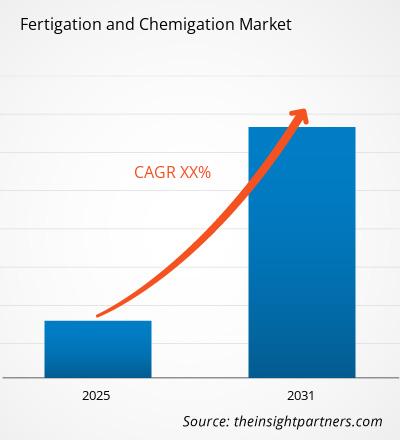
The Fertigation and Chemigation Market was valued at US$ 13.37 Billion in 2025 and is projected to reach US$ 27.64 Billion by 2034, expanding at a validated CAGR of 8.40% from 2026 to 2034. The market covers systems, equipment, controls, and integrated irrigation solutions used to deliver fertilizers and crop-protection inputs through irrigation infrastructure. Its scope spans field crops, plantation crops, orchard crops, and forage and turf grasses across fertilizer, insecticide, fungicide, and herbicide applications, serving agriculture, landscape, and greenhouse irrigation.
North America remains a high-value market because established pressurized irrigation infrastructure allows growers to add injection, dosing, monitoring, and automation capabilities without replacing the complete irrigation system. The Fertigation and Chemigation Market size is supported by replacement of conventional application practices with controlled nutrient and crop-protection delivery, particularly where water efficiency, labor availability, and application uniformity influence farm economics. North America is estimated to account for ~26.5% of global 2025 demand and is projected to grow at ~7.1% CAGR through 2034. In the US, regulatory requirements for pesticide application through irrigation systems reinforce demand for correctly engineered injection, backflow prevention, interlocks, and calibrated delivery equipment.
Fertigation and Chemigation Market Assessment and Insights
- North America: The region represented ~26.5% of the global market in 2025 and is projected to expand at ~7.1% CAGR. Mature irrigation infrastructure, established center-pivot and drip systems, and stringent chemigation operating requirements support recurring equipment and automation demand. The implication is that North American growth is increasingly tied to system modernization, controls, dosing accuracy, and aftermarket upgrades rather than basic irrigation installation alone.
- U.S.: The US accounted for ~78% of North American demand in 2025 and is projected to grow at ~7.0% CAGR. Large-scale field agriculture, center-pivot irrigation, specialty crop production, and established pesticide-label requirements create a comparatively sophisticated buyer base. EPA requirements covering chemigation labels, metering systems, check valves, pressure controls, and interlocks make compliance-oriented equipment an important part of system selection.
- Europe: Europe represented ~20.5% of global 2025 demand and is projected to grow at ~7.8% CAGR. Spain, Italy, France, Germany, and the Netherlands are important markets, with water scarcity, protected cultivation, high-value horticulture, and precision agriculture supporting adoption. The principal differentiator is the emphasis on water productivity and resource-efficient input application rather than expansion of irrigated acreage alone.
- Asia Pacific: APAC represented ~39.5% of global 2025 demand and is projected to expand at ~9.7% CAGR. China, India, Japan, and Australia form important demand centers, supported by agricultural modernization, irrigation expansion, high-value horticulture, and water-management requirements. The region's industrial and agricultural scale makes localized manufacturing, dealer networks, financing, and simplified dosing systems particularly important to adoption.
- Largest Segment: Agriculture irrigation is the largest application segment and is projected to grow at ~8.6% CAGR. Its lead reflects the breadth of field-crop and permanent-crop irrigation infrastructure, where fertigation and chemigation can be integrated directly into established water-delivery systems.
- High Growth Segment: Greenhouse irrigation is projected to record the fastest growth at ~10.2% CAGR. Controlled-environment agriculture requires precise water and nutrient management, making automated dosing, filtration, sensor feedback, and closed-loop control particularly valuable.
- Key companies analyzed in detail: Mahindra EPC Irrigation Limited, Jain Irrigation Systems Limited, Lindsay Corporation, Nelson Irrigation Corporation, Orbia Netafim, Rain Bird Corporation, Rivulis Irrigation, The Toro Company, T-L Irrigation Co., and Valmont Industries, Inc.
Source: The Insight Partners' analysis based on proprietary research, government publications, company annual reports, investor presentations, industry databases, and expert interviews.
In general, the market has evolved from rather simple fertilization tanks and injection systems to fully integrated systems that provide precise dosing, filtration, pressure control, automation, and even irrigation management. This development is especially noticeable in cases of drip and greenhouse irrigation systems where uniform application of nutrients in the root zone requires high precision of injection and, therefore, affects the results of cultivation. New irrigation systems integrate scheduling and dosing of fertilizer and water together as an operational process. One can find an example of this trend in Netafim's latest innovation, the AI-powered dosing system.
As for chemigation, the path that it follows differs a little bit since it requires additional considerations regarding labeling, backflow protection, interlock requirements, calibration and operator accountability. The recommendations on chemigation provided by the EPA in the US take into consideration all those aspects, including sprinkler and drip chemigation. Therefore, this market takes into account both the hydraulic performance of equipment and its safety and applicability.
Going forward until 2034, deployment will evolve beyond traditional high-value horticulture applications to more extensive field deployments through the convergence of irrigation modernization and digital farm management initiatives. APAC, along with certain developing agricultural markets, represents white space opportunity as the irrigation network expands alongside efforts by farmers to increase efficiency in input use. Meanwhile, mature markets will produce opportunities through demand for pump replacements, injection equipment, valves, filtration, sensors, controllers, and digital platforms.
Capital expenditure is moving toward local manufacturing and technologies. Rivulis' efforts to build automated drip and sprinkler manufacturing and Lindsay's efforts to develop agricultural data represent two examples of how vendors are preparing to serve both physical irrigation infrastructure and digital decision support needs.
Fertigation and Chemigation Market Report Scope
| Report Attribute | Details |
|---|---|
| Market size in 2025 | US$ 13.37 Billion |
| Market Size by 2034 | US$ 27.64 Billion |
| Global CAGR (2026 - 2034) | 8.40% |
| Historical Data | 2021-2024 |
| Forecast period | 2026-2034 |
Fertigation and Chemigation Market Analysis
Fertigation and chemigation market shares are the outcome of the dynamics created by the relationship between water shortage, input cost management, manpower limitations, and the need for consistency in crop treatment. The grower aiming at saving on water usage gradually shifts to pressurized irrigation; when the irrigation system is ready, then fertilizer or chemical application to the crops becomes possible through the same hydraulic system. This way, a value chain consisting of pumps and sources, filtration, pressure, injectors, valves, emitters/sprinklers, sensors, controllers, agronomy software, and servicing is formed.
The value offering is specific for each type of crop. Field crops require scalability and automation of the process of injection of fertilizers and chemicals, whereas orchards and plantations may need local application of fertilizers or chemicals around the root system of plants. Greenhouses pay more attention to dosing, fertilization recipes, electrolyte and pH control, filtration, and fast response to crop changes. In such a manner, companies providing the hydraulic equipment along with controls and agronomic support will cover the larger part of the farm's workflow.
The supply side is becoming more technology oriented. Lindsay integrates its irrigation equipment with FieldNET for remote management, and Valmont's portfolio of agricultural solutions consists of irrigation equipment, aftermarket services, and precision agriculture technologies. These examples suggest that competition has shifted from equipment supply to system performance, data, servicing, and aftermarket relationship.
Competitive positioning is different based on geographic market coverage. Multinational companies have advantages from existing dealer networks and wide range of products, while regional players can compete with their expertise in the local agronomic conditions, implementation capabilities, financial relationships, and customizations. Jain Irrigation and Mahindra EPC Irrigation are especially pertinent examples of competitive positioning in the context of India's complex agricultural landscape, where price, distribution, technical expertise, and support for government-sponsored irrigation projects play role.
● REPORT CUSTOMIZATION
Tailor This Report To Align With Your Specific Business Requirements
This report can be customized to align precisely with your business objectives, scope, and target markets. Customization options include tailored segmentation, geography, competitive analysis, and strategic insights to support informed decision-making.
Customize This Report →WHAT YOU CAN ADJUST
- ● Segmentations
- ● Geography
- ● Competitive Analysis
- ● Language Preferences
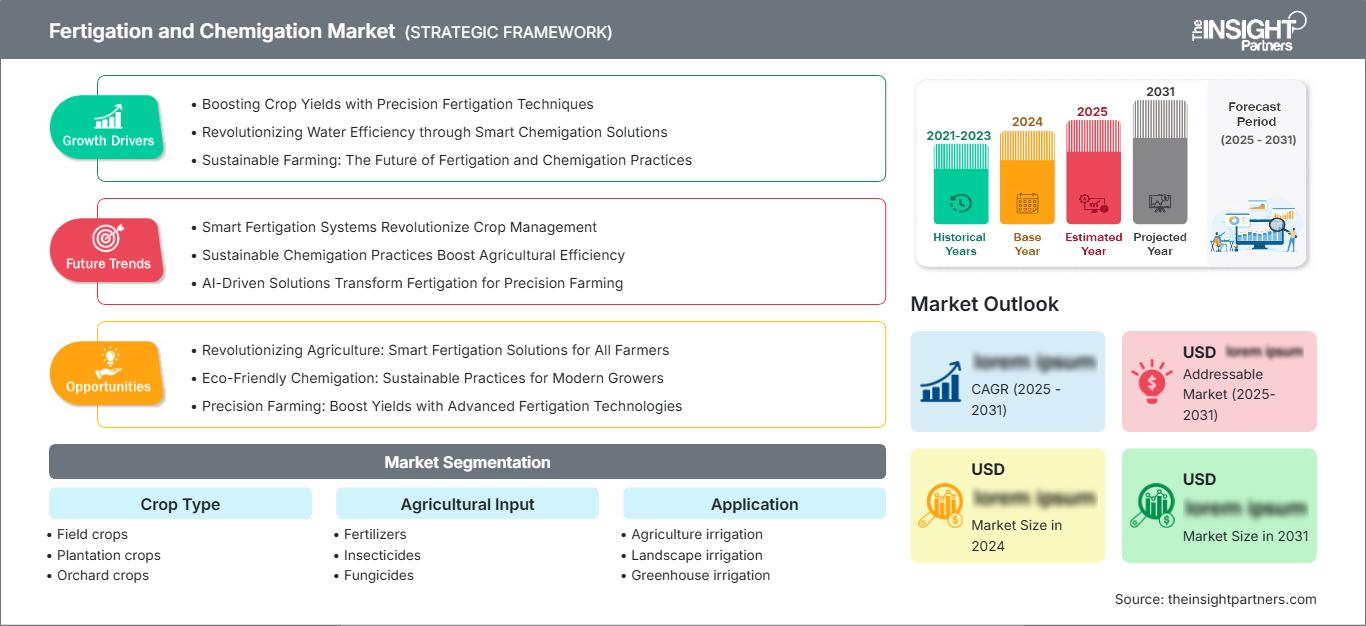
Fertigation and Chemigation Market: Strategic Insights
Regional Insights
North America Fertigation and Chemigation Market
The Fertigation and Chemigation Market report shows that North America accounted for ~26.5% of the global market in 2025 and is expected to grow at ~7.1% CAGR. The region is characterized by comparatively mature irrigation infrastructure and a strong installed base of mechanized irrigation, drip systems, pumps, injection equipment, and automated controls. The commercial opportunity therefore increasingly comes from modernization, precision upgrades, replacement parts, and integration of digital management rather than first-time irrigation adoption.
USA is the dominant force in demand due to their irrigated farming practices and crop protection systems that distribute products. Requirements of chemigation create technical challenges especially when labels require particular safety equipment. Canada has a lesser market that is still technically significant, while Mexico has benefited through expansion in protected crops farming and efficient irrigation.
U.S. Fertigation and Chemigation Market Market
The US represents ~78% of North American demand and is projected to expand at ~7.0% CAGR. Major uses include field crop production, specialty crops, nurseries, turf and protected cultivation. Center pivot irrigation systems are used for large-scale chemigation operations while drip and micro irrigation systems play a major role in orchards, vegetables and other crops that require precise application of inputs and water.
The distinguishing feature is the proximity of the irrigation equipment to the requirements of pesticide usage regulation by EPA, which involves proper labeling as well as, when necessary, the use of check valves, pressure regulators, shutoff devices and metering pumps.
Europe Fertigation and Chemigation Market
Europe represented ~20.5% of global demand in 2025 and is projected to grow at ~7.8% CAGR. Spain and Italy are particularly important because irrigation is strategically significant for horticulture, orchards, vineyards, and water-stressed agricultural regions. Spain's emphasis on irrigation modernization supports precision delivery, while Italy's horticultural and orchard production provides a substantial addressable base.
France combines broad agricultural production with growing interest in efficient water and input management. Germany has a smaller irrigated-agriculture base than southern Europe but contributes through high-value horticulture, greenhouse production, technology adoption, and engineering capabilities. Across Europe, regulatory and environmental pressure favors systems that reduce nutrient losses and improve traceability of water and input application.
APAC Fertigation and Chemigation Market
APAC represented ~39.5% of global demand in 2025 and is projected to grow at ~9.7% CAGR, making it the largest regional market and one of the strongest expansion centers. China benefits from agricultural modernization and large-scale irrigation demand, while India is supported by micro-irrigation adoption, horticulture expansion, and the need to improve water productivity.
Japan provides a technologically advanced market centered on high-value crops, protected cultivation, and automation. Australia adds demand from large irrigated farms, horticulture, and water-management constraints. The regional supply chain combines multinational irrigation providers with strong local manufacturers and distributors. This creates opportunities for equipment that can operate reliably under variable water quality, provide simple controls, and deliver measurable reductions in water and input waste.
Segmentation Analysis
Crop Type
Crop Type covers field crops, plantation crops, orchard crops, and forage and turf grasses. Demand patterns vary according to crop value, irrigation method, root-zone characteristics, and the economic benefit of precise input placement. Orchard and plantation production generally supports sophisticated localized application, while field crops favor scalable equipment compatible with larger irrigation systems.
- Field crops: The broadest addressable base, supported by mechanized irrigation and scalable fertilizer or pesticide injection. Buyers prioritize throughput, uniformity, reliability, and compatibility with existing irrigation equipment.
- Plantation crops: Fertigation is strategically relevant where perennial crops require recurring nutrient delivery and irrigation scheduling. System durability and root-zone targeting are important purchasing factors.
- Orchard crops: Localized irrigation and frequent nutrient application favor precision dosing. Growers increasingly value automation that can adapt schedules to crop development and environmental conditions.
- Forage and turf grasses: Adoption is more dependent on irrigation economics, land management requirements, and uniform coverage. Equipment simplicity and operating cost remain important.
Agricultural Input
Agricultural Input is divided into fertilizers, insecticides, fungicides, and herbicides. Fertilizers represent the leading input category because fertigation directly links nutrient delivery with irrigation scheduling and is widely compatible with drip, sprinkler, and protected-cultivation systems.
- Fertilizers: The core fertigation use case, driven by nutrient-placement efficiency and the ability to adjust application according to crop requirements.
- Insecticides: Chemigation provides an alternative application pathway where product labels permit irrigation-based delivery. Calibration and uniform distribution are critical.
- Fungicides: Irrigation-based delivery can support disease-management programs in suitable crops and systems, with effectiveness dependent on product compatibility and application timing.
- Herbicides: Adoption depends heavily on product labeling, crop conditions, distribution uniformity, and environmental safeguards, making compliance a major purchasing consideration.
Application
Application comprises agriculture irrigation, landscape irrigation, and greenhouse irrigation. Agriculture irrigation remains the largest application, while greenhouse irrigation is the fastest-growing because controlled environments demand high dosing precision and increasingly automated water management.
- Agriculture irrigation: The dominant application base, spanning mechanized field systems, drip irrigation, orchards, plantations, and specialty crops. Integration with existing hydraulic infrastructure supports adoption.
- Landscape irrigation: Fertigation and chemigation are used selectively in turf, sports grounds, nurseries, and managed landscapes. Regulatory and environmental considerations influence product selection.
- Greenhouse irrigation: The most automation-intensive application, requiring accurate dosing, filtration, monitoring, and rapid adjustment of irrigation and nutrient recipes.
Opportunity Snapshot
| Application | Revenue Contribution | Trend Tag | Adoption Stage |
|---|---|---|---|
| Agriculture irrigation | High | Precision dosing | Mature |
| Landscape irrigation | Low | Compliance control | Scaling |
| Greenhouse irrigation | Medium | Closed-loop | Scaling |
Fertigation and Chemigation Market Growth Drivers and Impact Analysis
Water scarcity is shifting irrigation from volume delivery to precision management
Water availability is becoming a stronger constraint on agricultural production, increasing the economic value of delivering water and inputs at the appropriate time and location. FAO identifies water stress and irrigation performance as central agricultural-management issues, while pressurized irrigation systems are increasingly considered part of modernization strategies. This favors systems capable of coordinating irrigation with nutrient delivery rather than treating the two activities independently.
Rising input costs increase the value of controlled application
Fertilizer, pesticide, energy, and labor expenses make application efficiency increasingly relevant to farm profitability. Fertigation allows growers to synchronize nutrient delivery with irrigation events and crop requirements, potentially reducing inefficient applications and improving operational control. The market implication is greater demand for accurate injectors, automated dosing, filtration, monitoring, and systems capable of adjusting application recipes.
Digital agriculture is connecting irrigation decisions with input dosing
Remote irrigation management, soil-moisture monitoring, weather information, and crop data are increasingly being integrated into irrigation control. Lindsay's FieldNET ecosystem and Netafim's GrowSphere platform demonstrate how irrigation equipment is evolving into a digitally managed operating layer. This supports higher-value system configurations in which hardware, software, agronomy, and service are purchased as an integrated solution.
Fertigation and Chemigation Market Future Trends
AI-assisted dosing will move precision fertigation toward closed-loop control
The Fertigation and Chemigation Market trends increasingly center on automated decision-making rather than simple remote monitoring. AI-enabled dosing systems can combine irrigation schedules, crop requirements, sensor information, and operating conditions to adjust input delivery. Netafim's Dosing 5G portfolio illustrates this transition, with automated dosing and GrowSphere integration positioning fertigation as part of a broader digital farm-management workflow.
Connected irrigation platforms will become a procurement differentiator
Growers are increasingly evaluating irrigation systems according to their ability to generate actionable information and reduce field intervention. Remote monitoring, alerts, scheduling, and equipment diagnostics can reduce operational friction and support more consistent fertigation. The shift benefits suppliers with installed digital platforms and creates opportunities for interoperability between irrigation hardware, sensors, agronomic software, and farm-management systems.
Sustainability will influence irrigation hardware design
Irrigation suppliers are increasingly incorporating resource conservation into product development, including more efficient water delivery and lower-impact materials. Toro's recycled-resin drip tape launch shows how sustainability considerations are moving into agricultural irrigation products themselves rather than remaining limited to corporate reporting.
Fertigation and Chemigation Market Opportunities
Integrated dosing packages for mid-sized farms
The Fertigation and Chemigation Market Forecasts point toward attractive whitespace in simplified, modular dosing systems designed for growers who need precision without the complexity or capital requirements of large automated installations. Mid-sized farms in India, Southeast Asia, Latin America, and other irrigation-expansion markets can benefit from packages combining filtration, injection, valves, basic sensors, and application guidance. Suppliers that localize system configuration, financing, installation, and agronomic support can address the adoption barrier created by technical complexity.
Precision fertigation for protected cultivation
Greenhouse and protected-cultivation operators provide another strategic opportunity because crop value and controlled growing conditions justify higher levels of automation. Demand is concentrated around accurate dosing, water-quality management, sensor integration, and recipe-based irrigation. Suppliers can differentiate through integrated hardware-software packages that reduce manual intervention while allowing growers to modify nutrient and irrigation programs as crops progress through different production stages.
Recent Developments
- August 2026: Orbia Netafim - Netafim launched GrowSphere FLEX, a smart irrigation and fertigation controller designed to make connected automation more accessible to smallholders and mid-sized farms. The product expands Netafim's digital farming portfolio and strengthens the company's positioning around integrated irrigation, fertigation, monitoring, and automation rather than standalone irrigation hardware.
- November 2025: Rivulis Irrigation - Rivulis opened a large automated manufacturing facility dedicated to drippers and sprinklers in Israel. The investment expands manufacturing capability for core micro-irrigation components and supports the company's global strategy of combining precision irrigation technology with scalable production. Greater component capacity can strengthen supply availability as demand for water-efficient irrigation and fertigation systems expands.
Frequently Asked Questions

- Comprehensive Market Sizing and Forecast Analysis
- Detailed Segmentation Analysis
- In-Depth Market Dynamics Assessment
- Regional and Country-Level Insights
- Competitive Landscape and Company Benchmarking
- Strategic Business Intelligence
Recent Reports
Testimonials

The Insight Partners provided valuable market intelligence that supported our global go-to-market strategy. Their team was professional, responsive, and attentive to our feedback, providing thoughtful analysis and helpful methodological clarifications throughout the project.
Junmo Kim Chief Financial Officer (CFO), Enertech Co., Ltd.
The Insight Partners' SCADA System Market report is comprehensive, with valuable insights on current trends and future forecasts. The team was highly professional, responsive, and supportive throughout. We are very satisfied and highly recommend their services.
RAN KEDEM Partner, Reali Technologies LTDs
I requested a report on a very specific software market and the team produced the report in a few days. The information was very relevant and well presented. I then requested some changes and additions to the report. The team was again very responsive and I got the final report in less than a week.
JEAN-HERVE JENN Chairman, Future Analytica
We worked with The Insight Partners for an important market study and forecast. They gave us clear insights into opportunities and risks, which helped shape our plans. Their research was easy to use and based on solid data. It helped us make smart, confident decisions. We highly recommend them.
PIYUSH NAGPAL Sr. Vice President, High Beam Global
The Insight Partners delivered insightful, well-structured market research with strong domain expertise. Their team was professional and responsive throughout. The user-friendly website made accessing industry reports seamless. We highly recommend them for reliable, high-quality research services
YUKIHIKO ADACHI CEO, Deep Blue, LLC.
This is the first time I have purchased a market report from The Insight Partners.While I was unsure at first, I visited their web site and felt more comfortable to take the risk and purchase a market report.I am completely satisfied with the quality of the report and customer service. I had several questions and comments with the initial report, but after a couple of dialogs over email with their analyst I believe I have a report that I can use as input to our strategic planning process.Thank you so much for taking the extra time and making this a positive experience.I will definitely recommend your service to others and you will be my first call when we need further market data.
JOHN SUZUKI President and Chief Executive Officer, Board Director, BK Technologies
I wish to appreciate your support and the professionalism you displayed in the course of attending to my request for information regarding to infectious disease IVD market in Nigeria. I appreciate your patience, your guidance, and the fact that you were willing to offer a discount, which eventually made it possible for us to close a deal. I look forward to engaging The Insight Partners in the future, all thanks to the impression you have created in me as a result of this first encounter.
DR CHIJIOKE ONYIA MANAGING DIRECTOR, PineCrest Healthcare Ltd.Reason to Buy
- Informed Decision-Making
- Understanding Market Dynamics
- Competitive Analysis
- Identifying Emerging Markets
- Customer Insights
- Market Forecasts
- Risk Mitigation
- Boosting Operational Efficiency
- Strategic Planning
- Investment Justification
- Tracking Industry Innovations
- Aligning with Regulatory Trends





 Get Free Sample for