
Ferrite Market Growth, Demand & Size by 2034
Coverage: By Type (Soft Ferrite, Permanent Ferrite); Application (Consumer Electronics, Household appliances, Communication, Automotive, Other), and Geography (North America, Europe, Asia Pacific, and South and Central America)
- Status : Data Released
- Report Code : TIPRE00014353
- Category : Chemicals and Materials
- No. of Pages : 150
- Available Report Formats :


- Last update date : September 22, 2026


2025 Market Size
US$ 7.23 Bn
Base year value
2034 Forecast
US$ 11.48 Bn
Projected by 2034
CAGR 2026-2034
5.27 %
Growth rate
Addressable Market
US$ 84.86 Bn
(2026-2034)
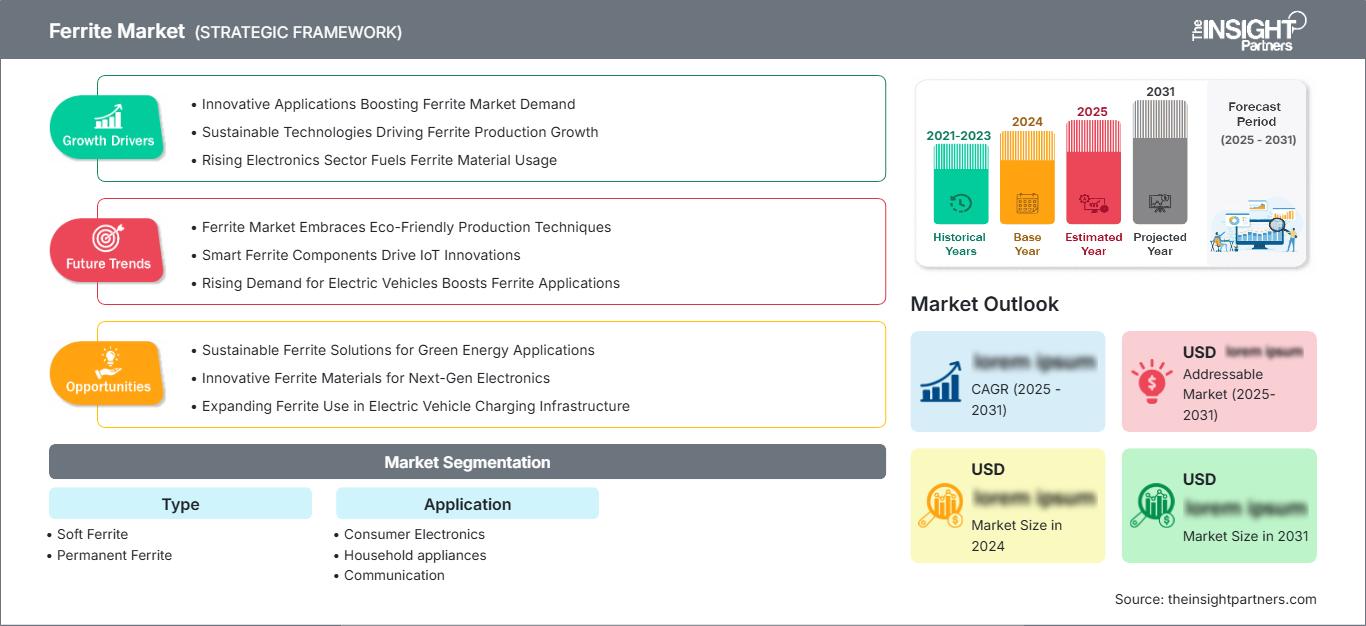
The ferrite market was valued at US$ 7.23 Billion in 2025 and is projected to reach US$ 11.48 Billion by 2034, registering a CAGR of 5.27% during 2026–2034. Growth is supported by expanding requirements for magnetic components used in power conversion, consumer electronics, communications infrastructure, household appliances, and automotive electrical systems. Material innovation remains important as manufacturers seek lower core losses, improved thermal performance, and reliable operation at increasingly demanding frequencies and power densities.
North America is expected to expand at an estimated 4.5–5.0% CAGR during 2026–2034, supported by electrification of transport and investment in power electronics, charging equipment, data infrastructure, and renewable-energy systems. The regional ferrite market size is also supported by replacement demand for efficient magnetic components in industrial equipment. Semiconductor and advanced electronics manufacturing initiatives further strengthen local demand for inductors, transformers, electromagnetic-interference suppression components, and associated ferrite materials.
Ferrite Market Assessment and Insights
- North America: Share in 2025 is estimated at 16–20%, with growth at a 4.5–5.0% CAGR between 2026–2034. Automotive electrification, industrial automation, power conversion equipment, and expanding data infrastructure support demand for high-performance soft magnetic components.
- US: The US represented an estimated 72–76% of North American demand in 2025 and is projected to grow at a 4.6–5.1% CAGR during 2026–2034, supported by automotive, communications, industrial, and energy applications.
- Europe: Europe accounted for an estimated 18–22% share in 2025 and is expected to grow at 4.4–4.9% CAGR during 2026–2034. Germany remains the leading market, followed by the UK, France, Italy, and Spain, with electrification and industrial equipment sustaining demand.
- Asia Pacific: Asia Pacific held an estimated 52–58% share in 2025 and is projected to grow at a 5.8–6.4% CAGR during 2026–2034. China, Japan, South Korea, and India lead regional consumption through electronics manufacturing, automotive production, communications equipment, and power infrastructure.
- Largest Segment: Soft Ferrite represented an estimated 62–68% market share in 2025 and is expected to expand at a 5.4–5.9% CAGR, supported by broad use in transformers, inductors, filters, and high-frequency power electronics.
- High Growth Segment: Automotive accounted for an estimated 17–21% share in 2025 and is expected to register a 6.3–6.9% CAGR, benefiting from vehicle electrification and increasing electronic content.
- Key companies analyzed in detail: Acme Electronics Corporation, FERROXCUBE B.V., Haining Lianfeng Magnet Industry Co., Ltd., HEC Group, Proterial, Ltd., KaiYuan Magnetism Co., Ltd., Nanjing New Conda Magnetic Industrial Co., Ltd., Samwha Electronics Co., Ltd., TDK Corporation, and Toshiba Materials Co., Ltd.
Source: The Insight Partners' analysis based on proprietary research, government publications, company annual reports, investor presentations, industry databases, and expert interviews.
Ferrites have moved from an ecosystem of suppliers of components focused mainly on classic RF and transformer applications to a system serving power conversion and electrification at higher frequencies. There has been an increasing emphasis on the use of lower-loss Mn-Zn and Ni-Zn alloys, innovative core designs, and simulation of magnetic circuits. There is high production concentration in Asia since assembly lines and component manufacturers are also highly concentrated in that part of the world. There is increasing differentiation by material composition, application expertise, thermal properties, and the provision of standard and custom core shapes.
In the future, the focus of investments will shift from consumer electronics replacements to electrification and digital infrastructure. Manufacturing sites such as India and Southeast Asia can stimulate component consumption, and higher demands for energy efficiency will drive lower-loss magnetic solutions. The market will be well-positioned to take advantage of growing power electronics use in transport, renewables, industrial automation, communications, and computing.
Ferrite Market Report Scope
| Report Attribute | Details |
|---|---|
| Market size in 2025 | US$ 7.23 Billion |
| Market Size by 2034 | US$ 11.48 Billion |
| Global CAGR (2026 - 2034) | 5.27% |
| Historical Data | 2021-2024 |
| Forecast period | 2026-2034 |
Ferrite Market Analysis
The drivers of growth for the ferrites market will become increasingly driven by the intensity of applications in power electronics rather than unit growth in an individual end-use product. The supply chain for ferrites includes raw-materials suppliers for iron oxide and additives, ferrites processing into powder, calcination, pressing, sintering, machining, assembling of components, and equipment installation. Higher frequencies necessitate materials that are a compromise between permeability, losses, stability, and fabrication characteristics. Competitiveness in the supply will be influenced by the process consistency as even slight deviations from the standard in the composition and conditions of sintering may influence the electrical and magnetic properties of the ferrites. Thus, electronics companies are concerned with having a supplier base for qualified ferrites.
Electrification of automobiles, energy conversion, telecommunication equipment, and industrial drives expand the demand for ferrites over various markets. The use of ferrites becomes important for transformers and inductors that need to work efficiently in the small space. The higher frequencies help reduce the size of the passive components, yet increase the requirements of their performance. Thus, there are opportunities for those who can offer application-specific materials.
In a competitive analysis of the ferrite industry, it is still evident that scale, materials engineering, manufacturing capabilities, and customer qualification are significant challenges. TDK Corporation and FERROXCUBE B.V. occupy dominant positions in the market of soft magnetic materials and components, whereas Samwha Electronics Co., Ltd. takes part in electronic component supply. Meanwhile, Toshiba Materials Co., Ltd. and Proterial, Ltd. offer advanced materials, and Haining Lianfeng Magnet Industry Co., Ltd. and Nanjing New Conda Magnetic Industrial Co., Ltd. represent regional production capabilities in Asia.
The strategic positioning involves more value-added applications. Acme Electronics Corporation, HEC Group, KaiYuan Magnetism Co., Ltd., and many others can participate in regional manufacturing through offering special products and proximity to customers. Automation, process engineering, materials development, and large core production are especially significant in terms of renewable energy converters, charging stations, industrial drives, and power supplies, which demand better magnetic properties.
● REPORT CUSTOMIZATION
Tailor This Report To Align With Your Specific Business Requirements
This report can be customized to align precisely with your business objectives, scope, and target markets. Customization options include tailored segmentation, geography, competitive analysis, and strategic insights to support informed decision-making.
Customize This Report →WHAT YOU CAN ADJUST
- ● Segmentations
- ● Geography
- ● Competitive Analysis
- ● Language Preferences
Ferrite Market: Strategic Insights
Regional Insights
North America Ferrite Market
North America accounted for an estimated 16–20% share in 2025 and is projected to grow at a 4.5–5.0% CAGR during 2026–2034. Demand is driven by electrification of transport, automation in industry, information networks, conversion of renewable energy, and medical electronics. Furthermore, the regional manufacturing footprint generates a need for transformers, inductors, filters, and electromagnetic interference suppression parts. Higher power densities in charge and power supply devices favor those materials that can reduce magnetic losses and operate stably under high temperature conditions.
Supply is still internationally integrated, but domestic sourcing becomes strategically important for select electronics and automotive projects. Hence, the ferrites market in North America enjoys the benefit of engineering-driven products instead of only low cost consumer products. Investments in semiconductor manufacturing, smart grids, and electrification may be utilized for component demand generation. Component makers with engineering capabilities are likely to gain from the trend due to growing customer demand for efficient, thermally stable, and compact magnetic designs.
U.S. Ferrite Market Market
The US represented an estimated 72–76% of North American demand in 2025 and is expected to register a 4.6–5.1% CAGR during 2026–2034. Key applications include automotive electric drives, industrial machinery, telecommunications infrastructure, and data centers. Foreign raw materials and components remain an important element, whereas local systems producers focus more on supply security. Ferrite components contribute to power conversion, filtering, isolation, and electromagnetic compatibility of industrial and electronic equipment.
Suppliers of materials such as TDK Corporation, FERROXCUBE B.V., Acme Electronics Corporation, and other international producers operate within supply chains that cater to US equipment manufacturers. Trends in applications include high frequency and high temperature operation of power supplies, charging equipment, renewable energy inverters, and industrial drives. Technology development in the US is another factor that makes collaboration between material and component suppliers and equipment manufacturers possible. All these elements provide for gradual improvements of product quality in the regional ferrite market..
Europe Ferrite Market Market
Europe accounted for an estimated 18–22% share in 2025 and is projected to grow at a 4.4–4.9% CAGR during 2026–2034. Germany is the major regional market, due to the country’s base for automobile products, industrial automation, electrical engineering, and renewable energy equipment.
The contribution of the UK includes communications, electronic design, aerospace electronics, and special industrial applications. Germany is the main continental market, while France, Italy, and Spain support the demand with their automotive, industrial machinery, renewable energy equipment, home appliances, and electronics production. In all of these countries, power conversion and electrification generate greater demand than mere replacement of mature consumer electronics.
Another aspect of Europe’s advantage comes from the region’s extensive installed base of industry which requires replacement and upgrades. Companies like FERROXCUBE B.V. enjoy regional presence, while Asia’s producers supply the European original equipment manufacturers via global networks. The market of ferrites therefore shows not only engineering capability but also reliance on distributed materials production.
APAC Ferrite Market Market
Asia Pacific accounted for an estimated 52–58% share in 2025 and is projected to grow at a 5.8–6.4% CAGR during 2026–2034. China is the largest regional market, followed by Japan, South Korea, and India. Consumer electronics production, communications equipment, automotive manufacturing, and power infrastructure provide broad demand.
Japan and South Korea retain advanced materials and electronics capabilities, while China combines scale in electronics and electrified manufacturing. India is gaining importance through industrialization and electronics production. Australia contributes specialized industrial and energy demand. Regional manufacturing concentration gives Asia Pacific the strongest ferrite market share within the global supply ecosystem.
Middle East & Africa Ferrite Market Market
The Middle East & Africa is expected to grow at a 4.8–5.4% CAGR during 2026–2034, supported by electricity infrastructure, communications networks, industrial projects, and transportation investment. Saudi Arabia and the UAE lead regional demand through infrastructure modernization, industrial diversification, and energy investments.
South Africa provides an important industrial and electrical-equipment base, while the Rest of MEA remains dependent on imported electronic components. Expansion of renewable-energy facilities and power infrastructure can increase demand for magnetic components used in converters and control equipment. Growth is therefore more closely linked to capital investment and industrial development than large-scale local ferrite manufacturing.
Segmentation Analysis
Type
The Type segment is expected to expand at a 5.3–5.8% CAGR during 2026–2034. Material selection depends on operating frequency, magnetic characteristics, temperature requirements, and application economics. The ferrite market scope extends from soft magnetic cores used in power conversion to permanent ferrites used where stable magnetic fields and cost efficiency are important. Continued electrification supports both categories, although soft materials benefit more directly from expanding high-frequency power-electronics applications.
- Soft Ferrite: Soft ferrite holds a leading position because it is widely used in transformers, inductors, chokes, filters, and electromagnetic-interference suppression components across power electronics, communications, automotive systems, and industrial equipment.
- Permanent Ferrite: Permanent ferrite remains strategically important for cost-sensitive magnetic applications, including motors, sensors, and consumer equipment, where material availability and stable magnetic performance support large-scale manufacturing requirements.
Application
The Application segment is projected to grow at a 5.6–6.1% CAGR during 2026–2034. Demand increasingly reflects the electronic content embedded within end products. Consumer and household equipment provide broad volume demand, while communication and automotive applications require increasingly sophisticated power management and electromagnetic control. Automotive electrification is particularly significant because electrical architectures require numerous magnetic components across charging, conversion, sensing, and auxiliary systems.
- Consumer Electronics: Smartphones, computing equipment, displays, chargers, and peripherals sustain demand for compact magnetic components, although suppliers face pressure to improve performance while reducing component dimensions and system-level losses.
- Household appliances: Inverter-based appliances, efficient motors, power supplies, and electronic control systems support ferrite consumption as manufacturers improve energy efficiency and integrate more sophisticated electronic functionality.
- Communication: Network equipment, radio-frequency systems, data infrastructure, and power supplies require magnetic components for filtering, isolation, and conversion, making communications strategically important for advanced material development.
- Automotive: Vehicle electrification and rising electronic content strengthen demand for power conversion, onboard charging, sensors, electromagnetic compatibility, and auxiliary systems, making automotive the fastest-growing application within the ferrite market.
Opportunity Snapshot
| Application | Revenue Contribution | Trend Tag | Adoption Stage |
|---|---|---|---|
| Consumer Electronics | High | Compact Power | Mature |
| Household appliances | High | Inverter Control | Mature |
| Communication | Medium | Network Power | Scaling |
| Automotive | High | Vehicle Electrification | Scaling |
Ferrite Market Growth Drivers and Impact Analysis
Expansion of High-Frequency Power Electronics
The use of power electronics is increasing in charger modules, drive motors, renewable energy converters, computing devices, and electronic consumer appliances. This increases the need for magnetic components that can work effectively at higher frequencies and temperatures and at the same time enable smaller-sized equipment. Ferrite materials are significant since the resistivity of their materials reduces the effect of eddy currents when compared to metallic magnetic materials in high frequency uses. As there is an increase in power density, the design and material composition of the cores become crucial. This results in increased demand for application-oriented products and engineering services. This driver will help create value for those companies that can maintain control over powder chemistry, sintering, machining, and magnetic characteristics.
Electrification of Vehicles and Transport Infrastructure
The complexity of automotive electrical systems is growing with the introduction of further electronic components in systems related to propulsion, charging, battery management, safety, connectivity, and comfort. According to the report from the International Energy Agency, more than 20 million electric cars were sold globally in 2025, which accounted for one-quarter of new car sales. Such growth of the electrified vehicles pool results in a growing demand for power conversion and charging systems. The application of ferrites is possible in inductors, transformers, filters, and electromagnetic interference suppression. However, the demands of the automotive qualification process are strict and may involve lengthy periods of development.
Energy Efficiency and Renewable Power Conversion
Investments in electricity networks call for more efficiency in converting energy between generators, storage facilities, transmission interface points, and terminal equipment. Inverters for solar systems, energy storage technologies, chargers for batteries, uninterruptible power supplies, and industrial power systems rely on magnetics. The trend towards reduction of conversion losses makes way for development of better ferrites and optimization of core designs. Large industrial cores are especially important in situations where large power needs to be transferred while ensuring efficient heat dissipation. The equipment vendors analyze magnetic performance along with price and availability of materials. This driver is favorable to vendors that have know-how in materials and design and are able to address multiple applications.
Ferrite Market Future Trends
Large Cores for Electrified Infrastructure
Future ferrite market trends would incorporate larger sizes of ferrites meant for higher-power use. In July 2025, TDK announced a program for larger size ferrite core covering various forms of cores used in industrial drives, electric vehicle chargers, railroads, power transformers, welding machines, medical equipment, uninterruptible power supply systems, and renewable energy equipment. This trend shows that future product development will no longer be restricted to miniaturization. Future suppliers would have to provide a wider range including small electronics and large industrial magnetic devices. Manufacturing of larger sintered products and accessories for mounting could be among the competitive issues.
Material Design Optimized Through Simulation
Magnetic-component design is likely to become progressively more digitized. The use of material data, simulation software, and applications models will cut down on prototype rounds and allow engineers to optimize for losses, temperature rise, and dimensional requirements prior to physical testing. The key to differentiation in the future, therefore, will be the quality of the technical support offered along with the ferrite product line. Manufacturers that are able to relate the attributes of their materials to the design software used by the customer will find themselves better able to engage in the early stages of design projects.
Ferrite Market Opportunities
Localized Supply for Emerging Electronics Manufacturing
The ferrite market forecast provides an opening towards developing capacity in proximity to new clusters of electronics and electrical equipment manufacture. India and Southeast Asia are particularly relevant because increased assembly operations can result in greater demand for domestically produced magnetic parts. Investors need to think not only about manufacturing but rather about developing capacity for powder production, core manufacture, machine operations, and parts assembly. Collaborations with local electronics manufacturers would be helpful in establishing requirements for applications prior to developing significant capacity. Quality consistency and technical support will be key as customers may need to qualify magnetic parts for their particular designs.
Advanced Materials for High-Power Conversion
Investment in high-power materials represents another actionable opportunity as charging, industrial drives, renewable energy, and data infrastructure require improved magnetic efficiency. Companies can prioritize lower-loss formulations, improved thermal performance, and core geometries suited to demanding power-conversion conditions. Development programs should combine materials research with application testing because laboratory properties do not automatically translate into superior system performance. Collaboration with inverter, charger, transformer, and power-supply manufacturers can accelerate commercialization. Investors should also consider the production requirements of advanced ferrites, including process control and specialized sintering capabilities. These initiatives can improve product differentiation and address higher-value applications with more demanding technical requirements.
Recent Developments
- August 2026: Vishay Intertechnology, Inc. (NYSE: VSH) announced that it has expanded its portfolio of Automotive Grade common mode chokes with four new surface-mount devices designed to improve system efficiency while saving board space. Offered in compact case sizes, the Vishay Dale ICM5050-A, ICM6050-A, IFLN-1210BE-A, and IFLN-1812CZ-A combine low DCR with high current capability and impedance. The ICM5050-A and ICM6050-A are wirewound ferrite common mode chokes that offer high current capabilities up to 11 A in the 5050 case size and 14 A in the 6050 case size. The IFLN-1210BE-A and IFLN-1812CZ-A are ferrite common mode chokes with precision winding.
- July 2025: TDK Corporation – TDK introduced various large-size ferrite cores covering E, U, I, PM, and PQ geometries and multiple power materials. The products target motor drives, EV charging stations, railway and traction systems, power transformers, welding, medical equipment, UPS systems, and renewable-energy applications, demonstrating growing focus on high-power and industrial magnetic applications.
Frequently Asked Questions

- Comprehensive Market Sizing and Forecast Analysis
- Detailed Segmentation Analysis
- In-Depth Market Dynamics Assessment
- Regional and Country-Level Insights
- Competitive Landscape and Company Benchmarking
- Strategic Business Intelligence
Recent Reports
Testimonials

The Insight Partners provided valuable market intelligence that supported our global go-to-market strategy. Their team was professional, responsive, and attentive to our feedback, providing thoughtful analysis and helpful methodological clarifications throughout the project.
Junmo Kim Chief Financial Officer (CFO), Enertech Co., Ltd.
The Insight Partners' SCADA System Market report is comprehensive, with valuable insights on current trends and future forecasts. The team was highly professional, responsive, and supportive throughout. We are very satisfied and highly recommend their services.
RAN KEDEM Partner, Reali Technologies LTDs
I requested a report on a very specific software market and the team produced the report in a few days. The information was very relevant and well presented. I then requested some changes and additions to the report. The team was again very responsive and I got the final report in less than a week.
JEAN-HERVE JENN Chairman, Future Analytica
We worked with The Insight Partners for an important market study and forecast. They gave us clear insights into opportunities and risks, which helped shape our plans. Their research was easy to use and based on solid data. It helped us make smart, confident decisions. We highly recommend them.
PIYUSH NAGPAL Sr. Vice President, High Beam Global
The Insight Partners delivered insightful, well-structured market research with strong domain expertise. Their team was professional and responsive throughout. The user-friendly website made accessing industry reports seamless. We highly recommend them for reliable, high-quality research services
YUKIHIKO ADACHI CEO, Deep Blue, LLC.
This is the first time I have purchased a market report from The Insight Partners.While I was unsure at first, I visited their web site and felt more comfortable to take the risk and purchase a market report.I am completely satisfied with the quality of the report and customer service. I had several questions and comments with the initial report, but after a couple of dialogs over email with their analyst I believe I have a report that I can use as input to our strategic planning process.Thank you so much for taking the extra time and making this a positive experience.I will definitely recommend your service to others and you will be my first call when we need further market data.
JOHN SUZUKI President and Chief Executive Officer, Board Director, BK Technologies
I wish to appreciate your support and the professionalism you displayed in the course of attending to my request for information regarding to infectious disease IVD market in Nigeria. I appreciate your patience, your guidance, and the fact that you were willing to offer a discount, which eventually made it possible for us to close a deal. I look forward to engaging The Insight Partners in the future, all thanks to the impression you have created in me as a result of this first encounter.
DR CHIJIOKE ONYIA MANAGING DIRECTOR, PineCrest Healthcare Ltd.Reason to Buy
- Informed Decision-Making
- Understanding Market Dynamics
- Competitive Analysis
- Identifying Emerging Markets
- Customer Insights
- Market Forecasts
- Risk Mitigation
- Boosting Operational Efficiency
- Strategic Planning
- Investment Justification
- Tracking Industry Innovations
- Aligning with Regulatory Trends





 Get Free Sample for