
FEP Heat Shrink Medical Tubing Market Size, Growth & Demand by 2034
FEP Heat Shrink Medical Tubing Market Size and Forecasts (2021–2034), Global and Regional Share, Trends, and Growth Opportunity Analysis Report Coverage : by Heat Shrink Ratio (1.3:1, 1.6:1. 2:1 & above); Application (Catheter Delivery Devices, Surgical & Vascular Instruments, Fixing Flexible Joints, Electrical Insulation); and Geography (North America, Europe, Asia Pacific, and South and Central America)
- Status : Data Released
- Report Code : TIPRE00040202
- Category : Chemicals and Materials
- No. of Pages : 150
- Available Report Formats :


- Last update date : September 22, 2026


2025 Market Size
US$ 157.87 Mn
Base year value
2034 Forecast
US$ 269.09 Mn
Projected by 2034
CAGR 2026-2034
6.1 %
Growth rate
Addressable Market
US$ 1,932.78 Mn
(2026-2034)
The FEP Heat Shrink Medical Tubing market was valued at US$ 157.87 million in 2025 and is expected to reach US$ 269.09 million by 2034; it is estimated to record a CAGR of 6.1% during 2026-2034.
FEP Heat Shrink Medical Tubing Market Assessment and Insights
- North America: North America accounted for an estimated 36–40% FEP Heat Shrink Medical Tubing Market share in 2025 and is projected to expand at a 6.4–7.1% CAGR during 2026–2034. Its established interventional-device ecosystem, stringent quality requirements, and concentration of specialized tubing suppliers underpin sustained demand.
- US: The US represented approximately 76–82% of North American demand in 2025 and is expected to grow at a 6.5–7.2% CAGR during 2026–2034, supported by catheter innovation and advanced medical-device manufacturing.
- Europe: Europe represented an estimated 24–28% share in 2025 and is projected to grow at a 5.9–6.7% CAGR during 2026–2034. Germany, the UK, France, Italy, and Spain support demand through medical-device engineering and hospital modernization.
- Asia Pacific: Asia Pacific accounted for approximately 27–31% share in 2025 and is forecast to register a 7.8–9.0% CAGR during 2026–2034. China, Japan, South Korea, India, and Australia are expanding medical-device production and minimally invasive care capabilities.
- Largest Segment: Catheter Delivery Devices held an estimated 43–48% market share in 2025 and is projected to expand at a 7.2–8.0% CAGR during 2026–2034, supported by microcatheter and interventional-device production.
- High Growth Segment: 2:1 & above is expected to expand at a 7.8–8.8% CAGR during 2026–2034 from an estimated 18–23% market share in 2025, benefiting specialized assemblies requiring greater dimensional accommodation.
- Key companies analyzed in detail: Zeus Company LLC, TE Connectivity Ltd., Parker-Hannifin Corporation, Teleflex Incorporated, Nordson Medical, APT Advanced Polymer Tubing GmbH, Junkosha Inc., ElringKlinger Kunststofftechnik GmbH, Polyfluor Plastics BV, and Polyflon Technology Ltd.
Source: The Insight Partners' analysis based on proprietary research, government publications, company annual reports, investor presentations, industry databases, and expert interviews.
With time, the evolution of materials has enabled the industry move away from standardized protective tubing to specialized processing materials designed based on catheter design and advanced tools. The need for constant recovered dimensions, controlled longitudinal shrink, optical clarity and lot-to-lot repeatability is increasingly becoming more significant in the manufacturers’ demands. TE Connectivity recognizes FEP as a processing aid used in catheter shaft reflowing and joint bonding and also offers products that have a shrink ratio of about 1.6:1.
Going forward, manufacturing capacity in the FEP Heat Shrink Medical Tubing Market is projected to expand in the Asia Pacific region, but North America and Europe will remain significant in manufacturing devices requiring engineering and regulation. Regulatory considerations related to traceability, consistency of materials, sterilizability and biocompatibility will still be factors in determining suppliers. Investments will therefore be made in companies with expertise in processing of fluoropolymers and prototyping and customization capabilities.
FEP Heat Shrink Medical Tubing Market Report Scope
| Report Attribute | Details |
|---|---|
| Market size in 2025 | US$ 157.87 Million |
| Market Size by 2034 | US$ 269.09 Million |
| Global CAGR (2026 - 2034) | 6.1% |
| Historical Data | 2021-2024 |
| Forecast period | 2026-2034 |
FEP Heat Shrink Medical Tubing Market Analysis
Growth in demand in the FEP Heat Shrink Medical Tubing Market will be highly related to the growing technical sophistication of the catheters and minimally invasive devices being manufactured. FEP is able to provide chemical resistance, clarity, thermal characteristics, and lubricity, which allow for its use in manufacturing and protective applications. According to TE Connectivity, FEP tubing is used in catheter shaft reflowing, joint bonding, flexible-joint protection, and insulation.
The value chain starts with high purity fluoropolymer feedstock and specialty extrusion process. Then comes expansion, dimensionality, finishing, cleaning, packaging, and quality control of the medical grade materials. In other words, the supply of this product is more specialized than the commodity heat shrink tubing. There are production qualification, tooling capacity, dimensional tolerances, material traceability, and validation issues involved, making it hard to switch suppliers.
The competitive structure of the FEP Heat Shrink Medical Tubing Market is made up of companies that are not only diversified component manufacturers but also fluoropolymer specialists and medical tubing suppliers. The firms such as Zeus Company LLC and TE Connectivity Ltd. gain an advantage through their expertise in working with different polymers and manufacturing medical device components, while Parker-Hannifin Corporation manufactures FEP heat shrink products for catheter manufacture and electrical insulation.
The FEP Heat Shrink Medical Tubing Market report shows that competitive positioning requires engineering flexibility rather than product availability. Different companies fill different niches in the specialty tubing market: Nordson Medical, APT Advanced Polymer Tubing GmbH, Junkosha Inc., Teleflex Incorporated, ElringKlinger Kunststofftechnik GmbH, Polyfluor Plastics BV, and Polyflon Technology Ltd. Investments should be directed towards smaller diameters, narrow tolerances, special finishes, minimal production variation, and the ability to prototype medical devices prior to full scale production.
● REPORT CUSTOMIZATION
Tailor This Report To Align With Your Specific Business Requirements
This report can be customized to align precisely with your business objectives, scope, and target markets. Customization options include tailored segmentation, geography, competitive analysis, and strategic insights to support informed decision-making.
Customize This Report →WHAT YOU CAN ADJUST
- ● Segmentations
- ● Geography
- ● Competitive Analysis
- ● Language Preferences
FEP Heat Shrink Medical Tubing Market: Strategic Insights
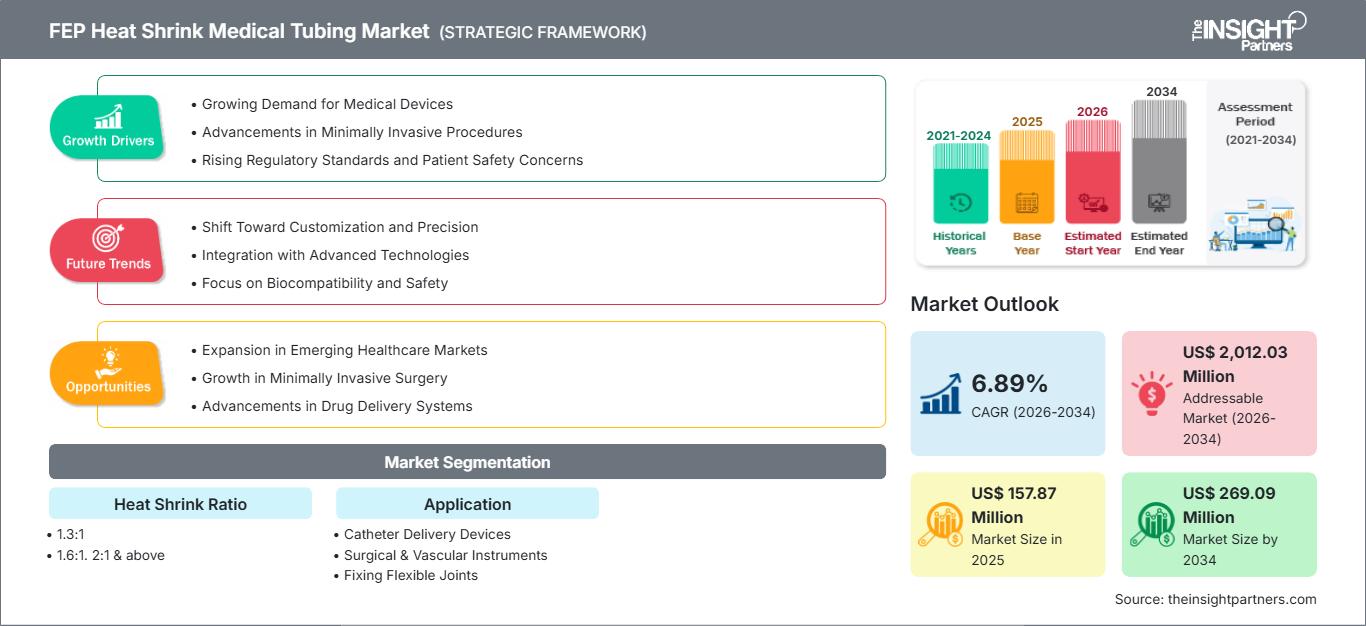
Regional Insights
North America FEP Heat Shrink Medical Tubing Market
North America accounted for an estimated 36–40% share in 2025 and is expected to grow at a 6.4–7.1% CAGR during 2026–2034. There is already a well-established ecosystem of catheter makers, contract development firms, component suppliers, and advanced healthcare institutions in the area. The market demand is driven by interventional cardiology, vascular medicine, electrophysiology, endoscopy, and other minimally invasive procedures needing accurate polymer fabrication.
FEP Heat Shrink Medical Tubing Market Share is high because of the focus of North American device programs on traceability, repeatability of the processes, and the availability of qualified material. There are even local manufacturing facilities for US and Mexican production sites. TE Connectivity includes medical tubing manufacturing in its facilities in Wilsonville, Oregon and Guaymas, Mexico.
U.S. FEP Heat Shrink Medical Tubing Market
The US represented approximately 76–82% of North American demand in 2025 and is projected to register a 6.5–7.2% CAGR during 2026–2034. The company’s management is shaped by its large number of domestic companies engaged in the development of medical devices, catheters, specialty manufacturing services, and research facilities. The sophisticated reimbursement models and adoption of minimally invasive procedures also help drive demand for more advanced disposable and reusable device components.
Having the presence of the company becomes especially critical due to the need to reduce development times and get quick engineering assistance. Such companies as Zeus Company LLC, TE Connectivity Ltd., Parker-Hannifin Corporation, Teleflex Incorporated, and Nordson Medical possess technologies associated with the development of medical-device components. As for application demands, they are trending toward small assembly, catheter-shaft control, instrument protection, and electrical insulation of surgical instruments.
Europe FEP Heat Shrink Medical Tubing Market
Europe accounted for an estimated 24–28% FEP Heat Shrink Medical Tubing Market share in 2025 and is forecast to grow at a 5.9–6.7% CAGR during 2026–2034. Demand is driven by existing medical technology clusters, high-end device manufacturing, and increased focus on quality system compliance. Germany will be the top European nation due to its excellent precision engineering and medical technology infrastructure.
The UK has expertise in specialty catheter, surgical, and diagnostic devices, as well as contract engineering and research. Germany offers combination of medical devices production and polymer processing capabilities, which makes room for suppliers capable of meeting high dimensional specifications and documentation. Both markets demand flexible development volumes and technical cooperation from suppliers before rolling out approved tubing programs.
France, Italy, and Spain contribute with hospital renovations, medical devices manufacturing, and increased use of minimally invasive technology. France has well-developed healthcare and diagnostics market, whereas Italy relies on manufacturing of medical devices. Spain contributes through healthcare investments and rising procedural volume. Across Europe, compliance and product documentation are most probable criteria for choosing suppliers.
APAC FEP Heat Shrink Medical Tubing Market
Asia Pacific represented approximately 27–31% FEP Heat Shrink Medical Tubing Market in 2025 and is expected to expand at a 7.8–9.0% CAGR during 2026–2034. China is the rising market in terms of becoming the largest regional hub for manufacturing and demand, whereas Japan and South Korea add to the mix through providing medical-device engineering technology. India is seen as being in the high-growth region due to investments made in healthcare and regional manufacture of medical devices.
The contribution made by Australia is in the form of highly developed adoption of clinical practice and the development of regional healthcare infrastructure. The growth in the region is facilitated by industrial policies which encourage local manufacture and investment in advanced medical technologies.
Middle East & Africa FEP Heat Shrink Medical Tubing Market
Middle East & Africa is expected to grow at a 6.6–7.8% CAGR during 2026–2034, although its demand base remains smaller than North America, Europe, and Asia Pacific. SA and UAE dominate the investment in healthcare infrastructure, with South Africa being the key hub for healthcare services and manufacturing in the African continent.
Investments made in energy sector development and infrastructure help indirectly in the development of healthcare industry by improving investments. SA is predicted to dominate the growth in regional demand through development and localization of the healthcare sector, while the UAE will be significant in providing clinical care services. In the rest of MEA region, demand will be a function of hospital investments and minimally invasive procedures.
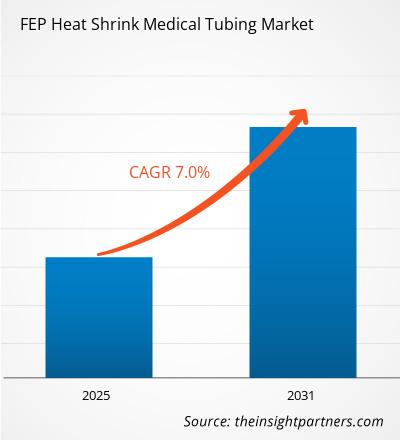
Segmentation Analysis
Heat Shrink Ratio
The Heat Shrink Ratio segment is projected to expand at a 6.8–7.7% CAGR during 2026–2034. Product selection depends on component geometry, required recovery behavior, assembly tolerances, and the manufacturer's processing method. The FEP Heat Shrink Medical Tubing Market scope includes standard ratios for controlled catheter assembly as well as higher-ratio products for complex geometries. Technical product information from TE Connectivity identifies FEP at approximately 1.6:1, highlighting the importance of this ratio in medical processing applications.
- 1.3:1: This ratio supports applications requiring limited dimensional recovery and close dimensional control. It is strategically relevant where delicate components require protection without excessive compression during medical-device assembly or finishing.
- 1.6:1: This segment holds a strong position because it provides a practical balance between controlled recovery and manufacturing versatility. It is widely relevant to catheter processing and precision medical assemblies requiring repeatable shrink performance.
- 2:1 & above: Higher shrink capability supports more complex or variable component geometries. Its strategic importance is increasing in specialized assemblies where manufacturers need greater accommodation while maintaining fluoropolymer performance characteristics.
Application
The Application segment in the FEP Heat Shrink Medical Tubing Market is expected to expand at a 7.1–8.0% CAGR during 2026–2034, driven by the growing use of high-performance polymer components in interventional and surgical devices. Application-specific qualification is important because tubing can function as a temporary manufacturing aid or as a protective and insulating device component. Catheter-related demand is expected to remain particularly significant because FEP is used in shaft reflowing and joint-processing operations.
- Catheter Delivery Devices: This application represents the leading demand area, supported by microcatheter development and increasingly complex interventional procedures. Transparency and controlled shrink behavior are especially valuable during shaft assembly and component bonding.
- Surgical & Vascular Instruments: FEP tubing provides abrasion resistance and mechanical protection for instrument components. Demand benefits from continuing development of minimally invasive surgical and vascular devices requiring compact, durable component architectures.
- Fixing Flexible Joints: The segment uses tubing where controlled mechanical protection and temporary assembly support are required. Product selection depends on flexibility requirements, recovery dimensions, and compatibility with adjacent device materials.
- Electrical Insulation: Electrically active surgical and diagnostic devices require reliable insulation solutions. FEP's thermal and chemical characteristics support specialized insulation needs, particularly where conventional materials face demanding processing or operating conditions.
Opportunity Snapshot
| Application | Revenue Contribution | Trend Tag | Adoption Stage |
| Catheter Delivery Devices | High | Microcatheter Assembly | Mature |
| Surgical & Vascular Instruments | High | Instrument Protection | Scaling |
| Fixing Flexible Joints | Medium | Joint Bonding | Scaling |
| Electrical Insulation | Medium | Electrosurgical Insulation | Mature |
FEP Heat Shrink Medical Tubing Market Growth Drivers and Impact Analysis
Expansion of Minimally Invasive Interventional Procedures
The ongoing shift from open procedures to catheter-based and minimally invasive methods is driving the need for precise device parts and unique processing materials. FEP Tubing is applicable in the process of reflowing and bonding of catheter shafts, where size uniformity and material properties affect the quality of fabrication. As the architectures of devices become more complex and small, there is a need by suppliers to offer size uniformity and consistent recovery. The demand does not only exist for the volume of the devices themselves but is further driven by the fact that new catheters have to go through a development and qualification phase prior to manufacture.
Need for High-Performance and Sterilization-Compatible Materials
Medical devices manufacturers are now assessing the polymers used in the manufacture of the tubes based on their heat properties, their resistance to chemicals, the clean state of the product, and how well they fit the validated process for manufacture. FEP provides some useful qualities in situations where there are high processing temperatures, fluids, or processing conditions that are hard on the components. TE Connectivity claims that its FEP medical heat shrink material is compatible with dry heat and autoclaving sterilization procedures and its products come with ISO 10993 and USP Class VI biocompatibility options. Such factors tend to be more favorable for specialized suppliers due to high qualification costs associated with substituting a material.
Medical Device Manufacturing Expansion in Asia Pacific
Asia Pacific is becoming increasingly important as governments and manufacturers invest in local medical-device production and higher-value healthcare technologies. China is expanding its medical manufacturing capacity, while India is strengthening domestic device production and healthcare infrastructure. This transition creates opportunities for tubing suppliers, converters, and regional manufacturing partners. Local availability can reduce development lead times and dependence on long international supply chains. However, regional expansion requires strict process controls because medical-device customers increasingly expect global quality and traceability standards. Companies that combine fluoropolymer processing knowledge with local technical support are therefore better positioned than suppliers offering undifferentiated tubing. This manufacturing shift supports the region's projected 7.8–9.0% CAGR during 2026–2034.
FEP Heat Shrink Medical Tubing Market Future Trends
Micro-Diameter and Ultra-Thin Precision Tubing
Future product development will increasingly prioritize smaller diameters, thinner walls, and tighter tolerances as catheter and minimally invasive device designs become more sophisticated. Manufacturers will seek tubing that maintains dimensional consistency while minimizing added bulk around assemblies. Greater optical clarity will remain important where operators or manufacturing technicians need visual confirmation of underlying components. Automation compatibility will also become more valuable as medical-device producers increase process consistency and throughput. The FEP Heat Shrink Medical Tubing Market trends therefore point toward engineering-led differentiation rather than volume-based standardization. Suppliers capable of controlling longitudinal movement and recovered dimensions while supporting customized cutting and finishing are likely to gain strategic importance in future product development programs.
Integration of Digital Quality and Traceability Systems
It is also likely that digital production history, batch tracking, inspection automation, and process control will be growingly significant elements within specialty medical tubing supply chain networks. Certificate and documentation access for certification and audits will need to be more rapid within the medical-device buyer's product qualification and audit process. Additionally, digitalization may increase yield through process variation identification before any non-compliant tubing enters further assembly processes. Future investment may therefore include not only new extrusion equipment but also measurement and management systems. Those companies which can align manufacturing repeatability and documentation will be well-placed to serve regulated global markets.
FEP Heat Shrink Medical Tubing Market Opportunities
Localized Technical Manufacturing in High-Growth Asian Markets
Investment in regional production, application engineering, and technical service represents a significant opportunity in Asia Pacific. Establishing localized finishing and qualification capabilities can shorten lead times and allow suppliers to work more closely with device manufacturers during development. Investors should prioritize locations with growing medical-device ecosystems, established polymer-processing capabilities, and supportive industrial policies. Partnerships with domestic contract manufacturers can provide access to emerging catheter and surgical-device programs without requiring immediate full-scale manufacturing investment. The FEP Heat Shrink Medical Tubing Market Forecasts support this strategic direction because Asia Pacific is expected to grow faster than mature Western regions. Success will depend on maintaining globally recognized quality systems while adapting technical support to regional customer requirements.
Customized Processing Solutions for Complex Catheter Assemblies
Suppliers can capture additional value by moving beyond standard tubing sales toward application-specific development services. Customized dimensions, controlled longitudinal behavior, specialized cutting, and prototype support can reduce device-development complexity for customers. This approach is particularly attractive in catheter applications where the tubing may function as a processing aid during shaft reflowing or joint bonding. Companies should invest in application laboratories that enable rapid evaluation of recovery performance with customer materials and manufacturing conditions. Commercial opportunities may include long-term supply agreements after successful device qualification. This strategy creates stronger customer relationships and higher switching costs while allowing suppliers to differentiate through engineering expertise rather than competing primarily on product price.
Recent Developments
- July 2026: Lubrizol, a global specialty chemicals leader, and Polyhose, a leading manufacturer in fluid conveyance systems, inaugurated a new medical manufacturing site in Chennai, Tamil Nadu. The facility will manufacture precision extruded medical tubing for minimally invasive devices, supporting India’s rapidly growing medical technology and healthcare sectors.
- September 2025: Leading peelable heat shrink tubing specialist, Junkosha, announced the launch of its Clear Peelable Heat Shrink Tubing product, a next-level solution enabling catheter manufacturers to achieve exceptional clarity, reduced assembly risk, and streamlined processes. Alongside its growing Peelable Heat Shrink Tubing range, Junkosha will take the opportunity to explain how the company's significant expansion in both capacity and manufacturing capabilities has provided customers with increased options in both its Peelable Heat Shrink Tubing and Etched PTFE Liner ranges.
Frequently Asked Questions

- Comprehensive Market Sizing and Forecast Analysis
- Detailed Segmentation Analysis
- In-Depth Market Dynamics Assessment
- Regional and Country-Level Insights
- Competitive Landscape and Company Benchmarking
- Strategic Business Intelligence
Recent Reports
Testimonials

The Insight Partners provided valuable market intelligence that supported our global go-to-market strategy. Their team was professional, responsive, and attentive to our feedback, providing thoughtful analysis and helpful methodological clarifications throughout the project.
Junmo Kim Chief Financial Officer (CFO), Enertech Co., Ltd.
The Insight Partners' SCADA System Market report is comprehensive, with valuable insights on current trends and future forecasts. The team was highly professional, responsive, and supportive throughout. We are very satisfied and highly recommend their services.
RAN KEDEM Partner, Reali Technologies LTDs
I requested a report on a very specific software market and the team produced the report in a few days. The information was very relevant and well presented. I then requested some changes and additions to the report. The team was again very responsive and I got the final report in less than a week.
JEAN-HERVE JENN Chairman, Future Analytica
We worked with The Insight Partners for an important market study and forecast. They gave us clear insights into opportunities and risks, which helped shape our plans. Their research was easy to use and based on solid data. It helped us make smart, confident decisions. We highly recommend them.
PIYUSH NAGPAL Sr. Vice President, High Beam Global
The Insight Partners delivered insightful, well-structured market research with strong domain expertise. Their team was professional and responsive throughout. The user-friendly website made accessing industry reports seamless. We highly recommend them for reliable, high-quality research services
YUKIHIKO ADACHI CEO, Deep Blue, LLC.
This is the first time I have purchased a market report from The Insight Partners.While I was unsure at first, I visited their web site and felt more comfortable to take the risk and purchase a market report.I am completely satisfied with the quality of the report and customer service. I had several questions and comments with the initial report, but after a couple of dialogs over email with their analyst I believe I have a report that I can use as input to our strategic planning process.Thank you so much for taking the extra time and making this a positive experience.I will definitely recommend your service to others and you will be my first call when we need further market data.
JOHN SUZUKI President and Chief Executive Officer, Board Director, BK Technologies
I wish to appreciate your support and the professionalism you displayed in the course of attending to my request for information regarding to infectious disease IVD market in Nigeria. I appreciate your patience, your guidance, and the fact that you were willing to offer a discount, which eventually made it possible for us to close a deal. I look forward to engaging The Insight Partners in the future, all thanks to the impression you have created in me as a result of this first encounter.
DR CHIJIOKE ONYIA MANAGING DIRECTOR, PineCrest Healthcare Ltd.Reason to Buy
- Informed Decision-Making
- Understanding Market Dynamics
- Competitive Analysis
- Identifying Emerging Markets
- Customer Insights
- Market Forecasts
- Risk Mitigation
- Boosting Operational Efficiency
- Strategic Planning
- Investment Justification
- Tracking Industry Innovations
- Aligning with Regulatory Trends





 Get Free Sample for