
Divinylbenzene Market Trends, Size & Growth by 2034
Coverage: By Type (DVB 50, DVB 63, DVB 80, Others); Application (Ion Exchange Resins, Chromatographic Resins, Adhesives and Coatings, Ceramics, Plastic and Elastomers, Others) , and Geography (North America, Europe, Asia Pacific, and South and Central America)
- Status : Data Released
- Report Code : TIPRE00018681
- Category : Chemicals and Materials
- No. of Pages : 150
- Available Report Formats :


- Last update date : September 28, 2026


2025 Market Size
US$ 84.18 Mn
Base year value
2034 Forecast
US$ 114.68 Mn
Projected by 2034
CAGR 2026-2034
3.50 %
Growth rate
Addressable Market
US$ 903.37 Mn
(2026-2034)
The Divinylbenzene market size was valued at US$ 84.18 million in 2025 and is projected to reach US$ 114.68 million by 2034, expanding at a CAGR of 3.50% from 2026 to 2034. The market covers divinylbenzene products classified by Type into DVB 50, DVB 63, and DVB 80, and by Application into Ion Exchange Resins, Chromatographic Resins, Adhesives and Coatings, Ceramics, and Plastic and Elastomers.
North America represents an established regional market supported by ion exchange resin manufacturing, specialty polymer production, water-treatment applications, and laboratory-scale chromatography. Its estimated share of the global market was 16.0% in 2025, with a 2.80% CAGR from 2026 to 2034. Demand is supported by established resin-processing capabilities and specialized chemical manufacturing, while continued use of styrene-divinylbenzene matrices in separation technologies provides a stable downstream base.
Divinylbenzene Market Assessment and Insights
- North America: North America held an estimated 16.0% of the global Divinylbenzene market share in 2025 and is projected to grow at a 2.80% CAGR from 2026 to 2034, supported by established ion exchange resin production, specialty polymers, and analytical separation applications.
- U.S.: The U.S. accounted for an estimated 82.0% of North America's market in 2025 and is expected to grow at a 2.70% CAGR, supported by water-treatment resins, chromatography media, and specialty chemical manufacturing.
- Europe: Europe represented an estimated 11.0% of the global market in 2025 and is projected to expand at a 3.00% CAGR. Germany, Italy, France, the UK, and Spain support demand through specialty chemicals, analytical applications, and process-resin manufacturing.
- Asia Pacific: APAC accounted for an estimated 68.0% of the global market in 2025 and is projected to grow at a 4.10% CAGR, led by China and Japan, with resin manufacturing, chemical processing, and industrial water treatment supporting consumption.
- Largest Segment: Ion Exchange Resins is the largest application segment, with a modeled 3.40% CAGR from 2026 to 2034, reflecting the extensive use of crosslinked styrene-divinylbenzene matrices in water purification and industrial separation.
- High Growth Segment: Chromatographic Resins is the fastest-growing application segment, with a modeled 4.50% CAGR from 2026 to 2034, supported by increasingly selective polymeric stationary phases for analytical and process separation.
- Key companies analyzed in detail: 3B Scientific (Wuhan) Corporation Ltd., Aaron Chemicals, Alfa Aesar, Alfa Chemistry, Deltech Corporation LLC, DuPont de Nemours, Inc., Polysciences, Inc., Nippon Steel Chemical & Material Co., Ltd., Shandong Bluestar Dongda Co., Ltd., TCI Chemicals, Jiangsu Evergreen New Material Technology Co., Ltd., and Jiangsu Andeli New Material Technology Co., Ltd.
Source: The Insight Partners' analysis based on proprietary research, government publications, company annual reports, investor presentations, industry databases, and expert interviews.
The need for divinylbenzene is now moving from traditional uses for cross-linking to improved high-performance polymers with controlled porosity, mechanical properties, and chemical resistance. The chemical continues to play a critical role in applications involving styrene-divinylbenzene copolymers in ion exchange and chromatography, where cross-linking density determines swelling, rigidity, selectivity, and resistance. Recent research shows modified polystyrene-divinylbenzene stationary phases in ion chromatography and hydrophilic interaction chromatography.
The prospects will favor companies which are capable of delivering consistently high-quality monomers and specialized grades of monomers. Asia Pacific will be the fastest-growing region because of the presence of production facilities for chemicals and resins, while North America and Europe will remain important regions in specialized applications. Localization of the supply chain will involve securing access to styrenic raw materials and inputs for polymerization as well as regional distribution. The economic significance of divinylbenzene will thus depend more on resins than on monomers.
Divinylbenzene Market Report Scope
| Report Attribute | Details |
|---|---|
| Market size in 2025 | US$ 84.18 Million |
| Market Size by 2034 | US$ 114.68 Million |
| Global CAGR (2026 - 2034) | 3.50% |
| Historical Data | 2021-2024 |
| Forecast period | 2026-2034 |
Divinylbenzene Market Analysis
The DVB market depends on crosslinked polymer formation. As the use of the polymer structures for water purification and industrial separation becomes more widespread, the need for ion exchange media will grow and controlled cross-linking will be necessary to achieve adequate properties. Therefore, DVB is produced somewhere between aromatic products and specialty resins manufacture. The value chain of DVB starts from aromatics and styrenes, then goes through DVB purification and stabilization and ends with polymerization and further functionalization of DVB in resins, stationary phases, microspheres, and specialty polymers. It means that purity and composition are still considered important purchase criteria for resin manufacturers.
In terms of supply, there are relatively few specialized producers of DVB, with the main part being located in China and Japan. Jiangsu Evergreen New Material Technology Co., Ltd. includes divinylbenzene as one of the main crosslinkers in its products and has production capacities, and Jiangsu Andeli New Material Technology Co., Ltd. has DVB production line and is active in resin sector.
Competition consists of integrated chemical manufacturers, specialty monomers producers and laboratory or materials suppliers. Nippon Steel Chemical & Material Co., Ltd. includes divinylbenzene in its basic chemicals, while Deltech Corporation LLC supplies DVB 63 and DVB 80 types for resins and cross-linking applications. Polysciences, Inc. concentrates on specialty and research oriented polymer materials, DVB included, establishing differentiation based on technical range of its products rather than bulk volumes.
More investment capital flows into process efficiency, product reliability and downstream specialization, not just volume expansion. The companies that have styrenic raw materials and resin customers may secure their margins through vertical integration. For instance, DuPont de Nemours, Inc. utilizes DVB cross-linked polystyrenic matrices in its ion exchange products.
● REPORT CUSTOMIZATION
Tailor This Report To Align With Your Specific Business Requirements
This report can be customized to align precisely with your business objectives, scope, and target markets. Customization options include tailored segmentation, geography, competitive analysis, and strategic insights to support informed decision-making.
Customize This Report →WHAT YOU CAN ADJUST
- ● Segmentations
- ● Geography
- ● Competitive Analysis
- ● Language Preferences
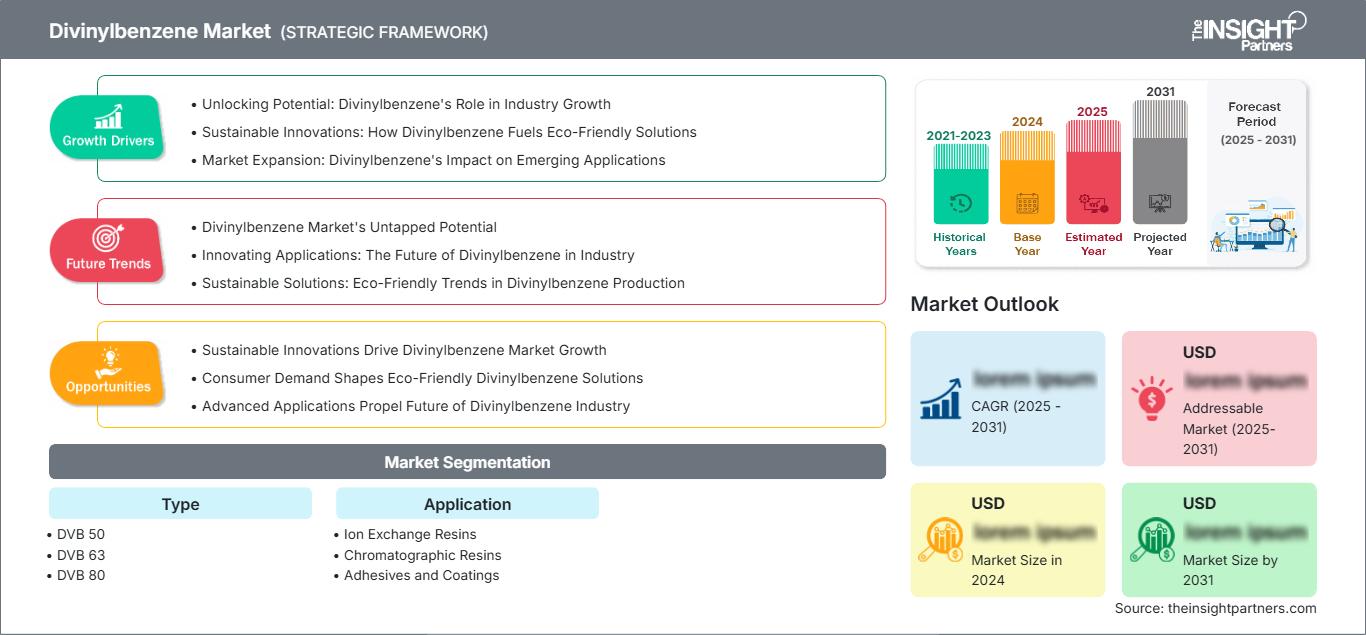
Divinylbenzene Market: Strategic Insights
Regional Insights
North America Divinylbenzene Market
North America accounted for an estimated 16.0% of the global market in 2025 and is projected to expand at a 2.80% CAGR from 2026 to 2034. It enjoys access to a well-developed specialty chemicals industry and applications in water treatment, industrial separations, laboratory chromatography, and polymer production. The United States is the leading country market due to its wide presence of resin producers, laboratories, chemical processors, and industrial water treatment plants.
The regional supply chain involves specialty monomer producers and their downstream resin producers. DVB serves as the cross-linker for the polystyrene matrix for ion exchange and chromatography resins. This makes the resin industry an important link between the monomer supplier and the end-users. Recent technical developments in DVB-based chromatographic phases have further ensured that demand for the specialty remains intact.
U.S. Divinylbenzene Market
The Divinylbenzene Market report shows that the U.S. represented an estimated 82.0% of North America's market in 2025 and is projected to grow at a 2.70% CAGR from 2026 to 2034. Demand is concentrated around ion exchange resins, chromatography materials, specialty polymers, and research-grade monomers. The presence of downstream resin producers creates a relatively mature customer base for DVB suppliers.
The U.S. market is differentiated by its combination of industrial water-treatment requirements and high-value analytical applications. Companies such as DuPont de Nemours, Inc. use DVB-crosslinked polystyrenic matrices in specialty ion exchange products, while Polysciences, Inc. supplies DVB for advanced polymer and microsphere applications.
Europe Divinylbenzene Market
Europe represented an estimated 11.0% of the global market in 2025 and is expected to expand at a 3.00% CAGR from 2026 to 2034. Germany leads in national markets owing to specialty chemicals and industrial processing. France and Italy add to the demand for these chemicals owing to their production of chemicals and advanced materials. The United Kingdom sustains the demand in terms of analytical laboratories, pharmaceuticals, and separation technology. Spain, on the other hand, makes an established contribution towards the industrial sector.
The demand in Europe is defined by purity levels of materials, chemical handling, efficiency in processes, and specialty applications. The European market is much less oriented towards general commodity consumption than it is to the performance of resins and the separations process as well as technically demanding polymer applications.
APAC Divinylbenzene Market
APAC accounted for an estimated 68.0% of the global market in 2025 and is forecast to grow at a 4.10% CAGR from 2026 to 2034, making it the largest and fastest-growing regional market. China leads regional demand and supply, followed by Japan and South Korea, while India represents an emerging downstream market.
China benefits from concentrated chemical and polymer manufacturing, while Japan has established specialty chemical capabilities. South Korea's advanced materials industry supports specialized polymer demand. India is supported by water treatment, pharmaceuticals, and chemical processing, while Australia provides a smaller market associated with industrial water applications. Regional production localization and proximity to resin manufacturers strengthen APAC's competitive position.
Middle East & Africa Divinylbenzene Market
The Middle East & Africa region represents an estimated 3.0% of global demand and is projected to expand at a 3.80% CAGR from 2026 to 2034. Saudi Arabia and the UAE provide the strongest commercial bases through water-intensive industrial operations, chemical processing, and infrastructure investment, while South Africa contributes through mining-related water treatment and industrial processing.
The region remains more dependent on imported specialty monomers and resin technologies than APAC. Expansion of desalination, industrial water treatment, and chemical processing creates downstream demand, although local DVB manufacturing remains limited. Regional growth, therefore, depends strongly on resin imports, chemical distribution networks, and the establishment of localized specialty-material capabilities.
South & Central America Divinylbenzene Market
South & Central America represented an estimated 2.0% of global demand in 2025 and is projected to grow at a 3.30% CAGR from 2026 to 2034. Brazil is the leading market because of its larger chemical-processing base, industrial water-treatment requirements, and established polymer sector. Argentina represents a smaller market linked to chemical and industrial applications.
Regional supply remains comparatively import-dependent, making distributor reliability and landed cost important purchasing considerations. Brazil's industrial scale provides a stronger platform for downstream resin consumption, while Argentina and the rest of South & Central America remain more dependent on imported specialty chemicals and application-specific resin systems.
Segmentation Analysis
Type
The Divinylbenzene Market forecast shows that the type segment comprises DVB 50, DVB 63, and DVB 80. Type selection is primarily determined by required crosslinking performance, polymerization behavior, resin architecture, and downstream processing requirements. Commercial availability of different active-content grades allows resin manufacturers to balance performance and formulation economics. Increasing specialization of ion exchange and chromatographic media is expected to favor consistent grades with tightly controlled composition.
- DVB 50: Provides a lower-active-content formulation suited to applications where controlled crosslinking and formulation flexibility are prioritized. Its role is linked to resin systems requiring balanced rigidity and processability.
- DVB 63: Serves as an important industrial crosslinking grade for ion exchange and resin production. Its combination of reactivity and formulation practicality supports broad adoption among polymer manufacturers.
- DVB 80: Provides higher DVB content for applications requiring stronger crosslinking and rigid polymer structures. It is particularly relevant to highly crosslinked matrices, specialty beads, and demanding polymer systems.
Application
The Application segment includes Ion Exchange Resins, Chromatographic Resins, Adhesives and Coatings, Ceramics, and Plastic and Elastomers. Downstream demand is governed by the need for crosslink density, chemical resistance, rigidity, porosity, and dimensional stability. Resin applications remain central, while specialty polymer uses create opportunities for application-specific DVB grades.
- Ion Exchange Resins: Form the principal downstream application because DVB establishes crosslinking in styrenic resin matrices. Water treatment, chemical separation, and industrial purification are major demand sources.
- Chromatographic Resins: Use DVB-based polymer matrices where controlled porosity, mechanical stability, and surface functionalization are required. Analytical and process chromatography increasingly favor customized stationary-phase structures.
- Adhesives and Coatings: Use DVB as a reactive crosslinking component to improve network rigidity and resistance. Adoption depends on formulation compatibility, curing behavior, and the performance requirements of specialty coatings.
- Ceramics: Represent a specialized application where DVB-containing polymer precursors or crosslinked structures can support controlled morphology and thermal conversion. Demand remains technically driven and application-specific.
- Plastic and Elastomers: DVB can act as a crosslinking or network-forming component in polymer systems where rigidity, dimensional stability, and resistance are required. Adoption depends on formulation economics and target mechanical properties.
Opportunity Snapshot
| Application | Revenue Contribution | Trend Tag | Adoption Stage |
|---|---|---|---|
| Ion Exchange Resins | High | Water treatment | Mature |
| Chromatographic Resins | Medium | Selective media | Scaling |
| Adhesives and Coatings | Medium | Network control | Mature |
| Ceramics | Low | Hybrid precursors | Emerging |
| Plastic and Elastomers | Medium | Crosslink tuning | Mature |
Divinylbenzene Market Growth Drivers and Impact Analysis
Expansion of Ion Exchange Resin Applications
Growth in industrial water purification and separation requirements is a direct demand driver for divinylbenzene because DVB provides the crosslinked structure required by many styrene-based ion exchange resins. Water treatment systems require polymer matrices that withstand repeated chemical exposure, swelling, regeneration, and mechanical stress. As resin manufacturers optimize exchange capacity and durability, crosslink density becomes a critical formulation variable. This creates recurring demand for controlled DVB grades rather than an undifferentiated monomer supply. The mechanism runs from water-treatment investment to resin production, then to higher consumption of crosslinking monomers. The strategic implication is that DVB producers with consistent specifications and strong relationships with resin manufacturers are positioned to capture stable downstream demand.
Growth of Advanced Separation Technologies
Expansion of chromatography and analytical separation technologies is creating a higher-value demand pathway for DVB-based polymer matrices. Modern stationary phases increasingly require controlled pore structures, functional surfaces, mechanical stability, and reproducible separation behavior. Recent research has demonstrated modified polystyrene-divinylbenzene phases for separating inorganic anions, organic acids, sugars, amino acids, and other compounds, showing how DVB remains relevant as a structural platform for advanced separation media. The market mechanism is therefore shifting from simple polymer crosslinking toward engineered separation performance. This supports higher-value specialty grades and encourages suppliers to strengthen technical customization and application-specific formulation capabilities.
Concentration of Chemical Manufacturing in APAC
APAC's concentration of aromatic chemicals, specialty monomer production, and downstream resin manufacturing is strengthening the region's position in the global DVB supply chain. China and Japan combine upstream chemical capabilities with large downstream polymer and industrial-processing markets, reducing logistical barriers between monomer production and resin conversion. Producers such as Jiangsu Evergreen and Jiangsu Andeli maintain dedicated DVB manufacturing capabilities, reinforcing regional supply depth. The mechanism is supply-chain clustering, where feedstock access, production expertise, customer proximity, and export infrastructure reinforce one another. The strategic implication is that regional producers can compete through scale and cost while international suppliers focus on specialty grades and technical differentiation.
Divinylbenzene Market Future Trends
Higher-Control Polymer Architectures
The Divinylbenzene Market trends indicate that DVB consumption is moving toward more controlled polymer architectures in which crosslink density, pore size, surface functionality, and mechanical stability are deliberately engineered. This trend is driven by higher performance requirements in chromatography, ion exchange, and specialty microspheres rather than by simple volume growth. Research published in recent years has demonstrated functionalized polystyrene-divinylbenzene stationary phases with tailored separation behavior, indicating continued movement toward application-specific resin structures. Resin manufacturers, analytical-material suppliers, and specialty chemical producers are affected because monomer specifications increasingly influence final resin performance. The likely implication is greater differentiation between standard industrial grades and tightly controlled grades designed for advanced applications.
Greater Regionalization of DVB Supply
DVB sourcing is increasingly influenced by supply-chain resilience, regional production concentration, and proximity to downstream resin manufacturers. APAC's large production base gives regional customers access to integrated chemical supply chains, while North American and European buyers continue to value dependable specialty-material supply and technical consistency. Dedicated production capabilities in China and Japan reinforce this structure. The shift affects resin producers that must manage monomer availability, inhibitor control, quality consistency, and logistics simultaneously. The likely implication is a two-track competitive market in which large producers emphasize reliable regional supply while specialty suppliers compete through purity, grade customization, and technical service.
Divinylbenzene Market Opportunities
Specialty Chromatography Media
The development of advanced chromatographic media represents a commercially attractive opportunity for DVB suppliers serving analytical laboratories, pharmaceutical processing, environmental testing, and specialty separation applications. The opportunity is strongest where customers require mechanically stable, chemically resistant polymer particles with tailored surface functionality. Recent research demonstrates that polystyrene-divinylbenzene platforms can be modified to improve selectivity across ion chromatography and hydrophilic interaction chromatography applications. Suppliers can target this opportunity by developing tightly controlled monomer grades, supporting particle-size consistency, and working with resin manufacturers on application-specific polymerization conditions. The main barrier is technical qualification, making long-term customer collaboration more important than commodity pricing alone.
Localized Supply for Resin Manufacturers
Localized DVB supply presents an opportunity in regions where ion exchange and specialty resin production are expanding faster than domestic monomer availability. India, selected Middle Eastern markets, and parts of South & Central America provide potential demand centers because water treatment, industrial separation, and chemical processing require increasing quantities of functional resin systems. The opportunity is particularly relevant for distributors and chemical producers that can provide reliable inventory, controlled storage, technical documentation, and consistent grade specifications. Rather than competing solely on price, participants can reduce customer exposure to long lead times and imported-material volatility. Regional partnerships with resin manufacturers can provide a practical route to market entry.
Frequently Asked Questions

- Comprehensive Market Sizing and Forecast Analysis
- Detailed Segmentation Analysis
- In-Depth Market Dynamics Assessment
- Regional and Country-Level Insights
- Competitive Landscape and Company Benchmarking
- Strategic Business Intelligence
Recent Reports
Testimonials

The Insight Partners provided valuable market intelligence that supported our global go-to-market strategy. Their team was professional, responsive, and attentive to our feedback, providing thoughtful analysis and helpful methodological clarifications throughout the project.
Junmo Kim Chief Financial Officer (CFO), Enertech Co., Ltd.
The Insight Partners' SCADA System Market report is comprehensive, with valuable insights on current trends and future forecasts. The team was highly professional, responsive, and supportive throughout. We are very satisfied and highly recommend their services.
RAN KEDEM Partner, Reali Technologies LTDs
I requested a report on a very specific software market and the team produced the report in a few days. The information was very relevant and well presented. I then requested some changes and additions to the report. The team was again very responsive and I got the final report in less than a week.
JEAN-HERVE JENN Chairman, Future Analytica
We worked with The Insight Partners for an important market study and forecast. They gave us clear insights into opportunities and risks, which helped shape our plans. Their research was easy to use and based on solid data. It helped us make smart, confident decisions. We highly recommend them.
PIYUSH NAGPAL Sr. Vice President, High Beam Global
The Insight Partners delivered insightful, well-structured market research with strong domain expertise. Their team was professional and responsive throughout. The user-friendly website made accessing industry reports seamless. We highly recommend them for reliable, high-quality research services
YUKIHIKO ADACHI CEO, Deep Blue, LLC.
This is the first time I have purchased a market report from The Insight Partners.While I was unsure at first, I visited their web site and felt more comfortable to take the risk and purchase a market report.I am completely satisfied with the quality of the report and customer service. I had several questions and comments with the initial report, but after a couple of dialogs over email with their analyst I believe I have a report that I can use as input to our strategic planning process.Thank you so much for taking the extra time and making this a positive experience.I will definitely recommend your service to others and you will be my first call when we need further market data.
JOHN SUZUKI President and Chief Executive Officer, Board Director, BK Technologies
I wish to appreciate your support and the professionalism you displayed in the course of attending to my request for information regarding to infectious disease IVD market in Nigeria. I appreciate your patience, your guidance, and the fact that you were willing to offer a discount, which eventually made it possible for us to close a deal. I look forward to engaging The Insight Partners in the future, all thanks to the impression you have created in me as a result of this first encounter.
DR CHIJIOKE ONYIA MANAGING DIRECTOR, PineCrest Healthcare Ltd.Reason to Buy
- Informed Decision-Making
- Understanding Market Dynamics
- Competitive Analysis
- Identifying Emerging Markets
- Customer Insights
- Market Forecasts
- Risk Mitigation
- Boosting Operational Efficiency
- Strategic Planning
- Investment Justification
- Tracking Industry Innovations
- Aligning with Regulatory Trends





 Get Free Sample for