
Bench-top Automated Biochemical Analyzers Market Share, Growth & Demand by 2034
Coverage: By Type (Semi-automated, Fully-automated); Application (Hospitals, Clinics, Others) , and Geography (North America, Europe, Asia Pacific, and South and Central America)
- Status : Data Released
- Report Code : TIPRE00021644
- Category : Life Sciences
- No. of Pages : 150
- Available Report Formats :


- Last update date : October 23, 2026


2025 Market Size
US$ 1.33 Bn
Base year value
2034 Forecast
US$ 2.54 Bn
Projected by 2034
CAGR 2026-2034
7.45 %
Growth rate
Addressable Market
US$ 17.44 Bn
(2026-2034)
The bench-top automated biochemical analyzers market was valued at US$ 1.33 Billion in 2025 and is projected to reach US$ 2.54 Billion by 2034, registering a CAGR of 7.45% during 2026–2034. Expansion is supported by rising diagnostic testing volumes, decentralization of laboratory services, growing chronic disease screening, and demand for compact automation. Improvements in throughput, reagent management, quality control, and laboratory connectivity are strengthening adoption across lower-volume testing environments.
Across North America, the bench-top automated biochemical analyzers market size is projected to expand at a CAGR of ~7% through 2034. Replacement of aging laboratory equipment, consolidation of routine chemistry testing, and demand for rapid results in community hospitals and outpatient clinics support regional growth. Laboratories increasingly prioritize compact instruments offering continuous loading, automated calibration, bidirectional connectivity, low sample consumption, and predictable maintenance requirements.
Bench-top Automated Biochemical Analyzers Market Assessment and Insights
Regional Outlook
- North America: ~36% of the global bench-top automated biochemical analyzers market share in 2025 | ~7% CAGR through 2034. Market position: North America leads through developed laboratory infrastructure, high diagnostic expenditure, established quality standards, analyzer replacement cycles, and demand for compact automation across hospitals, clinics, and decentralized testing networks.
- US: ~87% of North American market revenue in 2025 | ~7% CAGR through 2034. Market position: The US dominates regional revenue through extensive hospital testing capacity, advanced laboratory connectivity, rapid technology adoption, outpatient diagnostics, and substantial demand for automated chemistry workflows.
- Europe: ~29% of the global market in 2025 | ~7% CAGR through 2034. Market position: Europe represents a mature market supported by universal healthcare systems, laboratory accreditation, equipment replacement, and substantial diagnostic demand across Germany, the UK, France, Italy, and Spain.
- Asia Pacific: ~26% of the global market in 2025 | ~10% CAGR through 2034. Market position: Asia Pacific is the fastest-growing region as diagnostic networks, hospital capacity, local manufacturing, chronic disease screening, and private laboratory investment expand across China, India, Japan, South Korea, and Australia.
Segment Outlook
- Fully-automated: ~67% Share in 2025 | ~9% CAGR through 2034. Market position: Fully automated systems lead through reduced operator intervention, consistent pipetting, integrated quality control, higher throughput, automated reagent handling, and stronger compatibility with connected laboratory workflows.
- Hospitals: ~71% Share in 2025 | ~8% CAGR through 2034. Market position: Hospitals lead because emergency, inpatient, outpatient, and preventive testing generates sustained chemistry workloads requiring timely results, broad assay menus, continuous availability, and standardized quality management.
Competitive Coverage
Thermo Fisher Scientific Inc., Zoetis Inc., ELITechGroup SAS, Shandong Gaomi Caihong Analytical Instruments Co., Ltd., Sunostik Medical Technology Co., Ltd., Sysmex Corporation, HORIBA, Ltd., Tecom Science Corporation, Randox Laboratories Ltd., Dirui Industrial Co., Ltd.
Methodology
The Insight Partners follows Data Collection & Secondary Research, Primary Research, Data Analysis, and Data Triangulation & Final Review to validate market estimates and insights.
Source: The Insight Partners' analysis based on proprietary research, government publications, company annual reports, investor presentations, industry databases, and expert interviews.
The clinical chemistry analyzer has evolved from a photometry test that required manual effort into a compact system that incorporates aspiration of samples, dispensing and mixing of reagents, incubation, measurement, calculation, and transmission of results. The bench-top models are incorporating refrigerated reagent positions, barcode scanning, clot detection, cuvette reuse or disposability, electrolyte analyzers, and automatic rerun capability. Production logistics require high levels of accuracy of the fluidics, optical integrity, temperature control, software validation, compatible reagents, and reliable service logistics.
Until 2034, there will be investments made in developing connected laboratory systems, low volume sampling, automated quality control, environmental efficiency, and local manufacturing of reagents. The growth of emerging health care systems of Asia and the Middle East provides growth areas due to development of hospitals and diagnostic facilities. Regulatory concern with analytical performance, calibration traceability, cybersecurity, quality management, and post-market surveillance will promote suppliers who are able to provide an integrated package of support for instruments, reagents, controls, software, training, and preventative maintenance.
Bench-top Automated Biochemical Analyzers Market Report Scope
| Report Attribute | Details |
|---|---|
| Market size in 2025 | US$ 1.33 Billion |
| Market Size by 2034 | US$ 2.54 Billion |
| Global CAGR (2026 - 2034) | 7.45% |
| Historical Data | 2021-2024 |
| Forecast period | 2026-2034 |
Bench-top Automated Biochemical Analyzers Market Analysis
Growth in the bench-top automated biochemical analyzers market is supported by the increase in metabolic, renal, liver, cardiovascular, and diabetes assays, as well as the trend toward decentralization of laboratory activities. Compact instruments providing accurate tests without the floor space, labor, water, and infrastructure needed by high-throughput laboratory instruments are essential for community hospitals and clinics. Increased testing needs bolster the commercial rationale for automation.
The value chain includes optical component makers, fluidics manufacturers, electronic component suppliers, instrument makers, reagent makers, quality control providers, distributors, laboratories, and service providers. The costs of instrumentation go beyond the initial purchase cost to reagents, calibrators, quality control samples, cuvettes, water, maintenance, software, and downtime. Thus, laboratories consider the cost per test.
The bench-top automated biochemical analyzers market is competitive on the basis of throughput, menu, sample volume, reagent flexibility, interface, quality control, and service provision. These include Thermo Fisher Scientific Inc., HORIBA, Ltd., Randox Laboratories Ltd., ELITechGroup SAS, and Dirui Industrial Co., Ltd. Sysmex Corporation has strengths in the realm of laboratory automation and informatics, while Zoetis Inc. has expertise from its former Abaxis business.
The veterinary point-of-care diagnostics industry has the support of Sunostik Medical Technology Co., Ltd., Tecom Science Corporation, and Shandong Gaomi Caihong Analytical Instruments Co., Ltd. Areas of interest for investment include remote diagnostics, automated maintenance, cybersecurity, electrolyte integration into small machines, and packaging of reagents.
● REPORT CUSTOMIZATION
Tailor This Report To Align With Your Specific Business Requirements
This report can be customized to align precisely with your business objectives, scope, and target markets. Customization options include tailored segmentation, geography, competitive analysis, and strategic insights to support informed decision-making.
Customize This Report →WHAT YOU CAN ADJUST
- ● Segmentations
- ● Geography
- ● Competitive Analysis
- ● Language Preferences
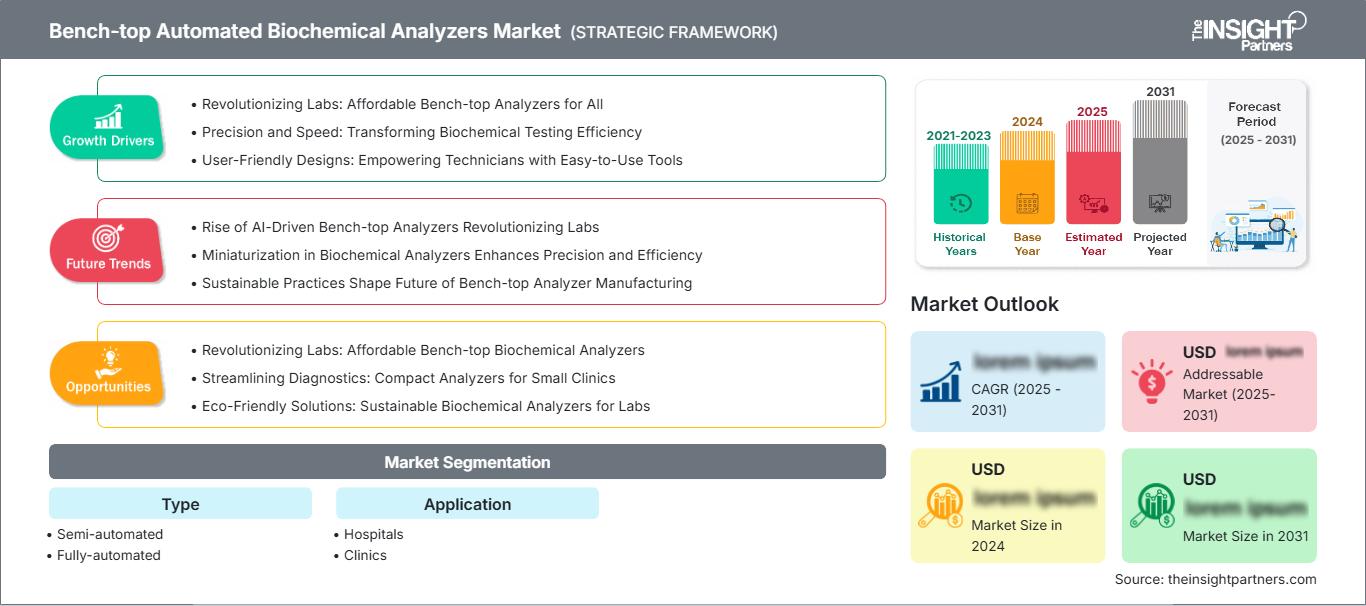
Bench-top Automated Biochemical Analyzers Market: Strategic Insights
Regional Insights
North America Bench-Top Automated Biochemical Analyzers Market
North America accounted for approximately ~36% of global revenue in 2025 and is projected to register a CAGR of ~7% through 2034. The regional bench top automated biochemical analyzers market share is based on matured laboratory systems, high spending on diagnostics, prevalence of chronic diseases screening tests, and periodic replacement of old analyzers. Small-sized systems are for use in critical access hospitals, physician office laboratories, outpatient clinics, veterinary practices, and specialty test sites.
Canada provides its contribution by way of public hospital laboratories, community diagnostics, and geographic delivery of healthcare services. Mexico offers its contribution through privately-owned lab chains, hospital upgrading, and increasing preventive tests. The regional purchasing process places importance on the clearance of the product from regulatory agencies, proficiency testing, calibration with traceability, connectivity to electronic records, cybersecurity, technical service, and availability of reagents.
U.S. Bench-Top Automated Biochemical Analyzers Market
The US represented approximately ~87% of North American revenue in 2025 and is projected to grow at a CAGR of ~7% through 2034. The justification of its position is backed up by its broad base of hospitals, decentralization of testing at outpatient facilities, stringent laboratory quality standards, and quick acceptance of instruments improving the turnaround time. The replacement potential continues to be substantial as the labs upgrade their existing systems and improve their connectivity.
The leading players in this market in terms of commercial exposure include Thermo Fisher Scientific Inc., Zoetis Inc., HORIBA, Ltd., Randox Laboratories Ltd., Sysmex Corporation, and ELITechGroup SAS. Bench-top analyzers are used by the hospitals for low volume departments, back-up purposes, satellite laboratories, and some specialized processes. Clinics emphasize ease of handling, less maintenance, small size, stable reagents, and technical support.
Europe Bench-Top Automated Biochemical Analyzers Market
Europe held approximately ~29% of global revenue in 2025 and is projected to expand at a CAGR of ~7% through 2034. Universal healthcare coverage, laboratory accreditation, population aging, and routine chronic disease monitoring support sustained clinical chemistry demand. Germany is assessed as the leading country in Europe because of its healthcare scale, medical-technology infrastructure, decentralized laboratory network, and strong adoption of automated diagnostics.
UK incorporates hospital laboratory needs with community diagnostics programs and also private pathology services. The French benefit from wide testing availability and an advanced in vitro diagnostics industry. Replacement and growth demand in Italy and Spain are driven by regional hospitals, private laboratories, ambulatory centers, and continuous modernization of diagnostic capabilities.
European buying is becoming increasingly focused on quality of analysis, conformity to standards, reagent disposal, energy usage, water usage, cyber security, connectivity, and equipment lifecycle. HORIBA, Ltd., Randox Laboratories Ltd., ELITechGroup SAS, and Sysmex Corporation operate under competition arising from direct selling as well as specialization of distributors. The market will grow from the replacement of semi-automation systems, extension of testing to regional centers, and consolidation of routine and specialty tests using smaller machines.
APAC Bench-Top Automated Biochemical Analyzers Market
Asia Pacific accounted for approximately ~26% of global revenue in 2025 and is the fastest-growing region, with a CAGR of ~10% through 2034. China is assessed as the leading country in Asia Pacific through diagnostic volume, hospital scale, local analyzer production, and laboratory investment. India combines unmet diagnostic need with rapid private laboratory and hospital expansion.
Japan contributes through mature testing infrastructure, while South Korea supports adoption through technologically advanced healthcare facilities. Australia maintains accredited laboratory networks and substantial replacement demand. Regional policy support for domestic medical-device production, public health screening, healthcare access, and diagnostic localization is improving adoption, although service quality and laboratory resources vary considerably.
Middle East & Africa Bench-Top Automated Biochemical Analyzers Market
The Middle East & Africa market is projected to grow at a CAGR of ~9% through 2034. Saudi Arabia is assessed as the leading country in the Middle East & Africa due to hospital investment, laboratory modernization, healthcare transformation, and procurement of automated diagnostic equipment. The UAE contributes through private healthcare, medical tourism, and advanced laboratory networks.
South Africa maintains comparatively developed private pathology and hospital testing capacity. Across the Rest of MEA, limited laboratory infrastructure, reagent availability, maintenance support, and trained personnel constrain adoption. Hospital construction, public diagnostic programs, telecommunications infrastructure, and distributor development can support compact systems that tolerate variable workloads and operating conditions.
Segmentation Analysis
Type
The bench-top automated biochemical analyzers market scope covers compact platforms differentiated by the degree of automated sample handling, reagent dispensing, measurement, calculation, and result management. Selection depends on workload, staffing, assay menu, infrastructure, budget, and required turnaround time. Fully-automated systems are projected to register a CAGR of ~9% during 2026–2034 as laboratories prioritize standardized operation, higher productivity, reduced manual error, and integrated quality monitoring.
- Semi-automated: Semi-automated instruments retain manual steps for sample or reagent preparation while automating photometric measurement and result calculation. They remain relevant for low-volume laboratories seeking affordability, flexible reagent use, and limited infrastructure requirements.
- Fully-automated: Fully-automated analyzers integrate sample aspiration, reagent dispensing, reaction control, measurement, calculation, and data transfer. Adoption is supported by workflow consistency, continuous processing, reduced hands-on time, barcode identification, and automated quality-control functions.
Application
Application demand reflects test volume, urgency, clinical complexity, staffing, operating hours, and access to central laboratory services. Hospitals require continuous testing capacity, while clinics need compact systems aligned with moderate workloads and simpler workflows. Hospitals are projected to grow at a CAGR of ~8% during 2026–2034 as inpatient activity, emergency testing, chronic disease management, analyzer replacement, and decentralized hospital laboratories sustain procurement.
- Hospitals: Hospitals use bench-top systems in central, satellite, emergency, specialty, and backup laboratories. Procurement emphasizes broad chemistry menus, rapid turnaround, continuous availability, quality control, information-system connectivity, technical servicing, and dependable reagent supply.
- Clinics: Clinics use compact analyzers to perform routine metabolic, liver, renal, lipid, and glucose-related testing closer to consultations. Demand favors intuitive operation, limited sample volume, small footprint, affordable reagents, and straightforward maintenance.
Opportunity Snapshot
| Application | Revenue Contribution | Trend Tag | Adoption Stage |
| Hospitals | High | Satellite Labs | Mature |
| Clinics | Medium | Near-Patient Testing | Scaling |
Bench-top Automated Biochemical Analyzers Market Growth Drivers and Impact Analysis
Expansion of Routine Chemistry and Chronic Disease Testing
Increasing prevalence and diagnosis of diabetes, cardiovascular disorders, renal conditions, liver disease, and metabolic abnormalities are expanding routine chemistry workloads. These conditions require recurring measurement rather than one-time diagnosis, supporting sustained reagent and analyzer utilization. Hospitals and clinics need platforms capable of processing core chemistry panels consistently while managing calibration, quality control, and urgent samples. The commercial impact includes recurring revenue from reagents, controls, calibrators, consumables, maintenance, and software. Suppliers with broad assay menus can help laboratories consolidate tests that would otherwise be referred externally. Adoption remains influenced by reimbursement, physician ordering, prevention programs, and the availability of qualified laboratory personnel.
Decentralization of Diagnostic Laboratory Services
Healthcare systems are extending diagnostic capacity beyond large central laboratories to community hospitals, outpatient clinics, emergency departments, regional centers, and specialty facilities. Bench-top automation supports this shift by providing a smaller footprint and more manageable throughput than floor-standing systems. Local testing can reduce sample transportation, shorten turnaround time, and support faster clinical decisions. Commercial demand is strongest where instruments offer simple loading, stable reagents, limited maintenance, and remote support. Decentralization also increases the number of instrument placements, although individual sites may conduct fewer tests. Vendors must therefore balance affordable acquisition with sustainable reagent consumption and service economics across geographically dispersed installations.
Need to Reduce Manual Error and Laboratory Workload
Semi-manual chemistry workflows require repeated pipetting, timing, calculation, transcription, and quality-control review. These tasks can consume skilled staff time and introduce variability. Fully automated analyzers standardize fluid handling, reaction timing, optical measurement, result calculation, and data transfer. Laboratories can redirect personnel toward validation, troubleshooting, and higher-value clinical work. The operational impact is particularly important where workforce shortages coincide with rising test volumes. Automation must still be supported by specimen-quality checks, maintenance, calibration, and professional result review. Manufacturers that provide intuitive software, automated reruns, remote diagnostics, and effective training can strengthen utilization and customer retention.
Bench-top Automated Biochemical Analyzers Market Future Trends
Connected Analyzers and Automated Quality Management
Bench-top automated biochemical analyzers market trends are moving toward bidirectional laboratory connectivity, remote monitoring, automated quality-control review, predictive maintenance, and centralized fleet management. Future systems may transmit reagent status, calibration performance, error codes, and maintenance requirements to laboratory managers or authorized service teams. Rules-based software can flag quality shifts before patient reporting is affected. Adoption will depend on cybersecurity, interoperability, validated data transfer, user permissions, and dependable offline operation. Connected functionality is particularly valuable for diagnostic networks managing compact analyzers across multiple clinics, where centralized oversight can improve standardization without placing specialist personnel at every location.
Low-Volume Sampling and Resource-Efficient Chemistry Platforms
Future product development is expected to reduce sample, reagent, water, electricity, and consumable requirements. Lower sample volumes are particularly relevant for pediatric, geriatric, critically ill, and difficult-to-bleed patients. Efficient reagent management can strengthen onboard stability and reduce expiration-related waste in laboratories with variable workloads. Manufacturers may also adopt LED-based optics, reusable cuvettes, concentrated wash systems, sleep modes, and recyclable packaging. Procurement decisions will increasingly consider environmental performance and total resource consumption alongside throughput and analytical precision. Suppliers must substantiate sustainability claims using reproducible operating conditions because actual savings depend on test mix, utilization, maintenance, and laboratory workflow.
Bench-top Automated Biochemical Analyzers Market Opportunities
Compact Automation for Emerging Diagnostic Networks
Manufacturers can target regional hospitals, independent laboratories, and urban clinics across Asia Pacific, the Middle East, Africa, and Latin America. Bench-top automated biochemical analyzers market Forecasts indicate that these settings offer expansion potential as governments and private providers increase diagnostic access. Commercial strategies should combine affordable instruments, locally appropriate assay menus, distributor training, reagent inventory, preventive maintenance, and remote technical assistance. Products must tolerate environmental variability and inconsistent workloads while maintaining calibration and quality-control performance. Reagent-rental and leasing models can reduce capital barriers, although suppliers need sufficient test volume and contract discipline to preserve commercial viability.
Integrated Instrument, Reagent, and Service Platforms
Vendors can differentiate by offering analyzers, dedicated reagents, controls, calibrators, software, installation, training, and preventive maintenance within one managed solution. Integrated platforms simplify procurement and reduce compatibility risk for laboratories lacking extensive technical resources. Commercial models can include per-test agreements, reagent commitments, leasing, and multi-year service contracts. Suppliers should provide transparent calculations covering reportable-result cost, reagent wastage, repeat testing, downtime, and service response. Open-system flexibility may remain important in price-sensitive markets, but closed or paired reagent systems can improve standardization when assay performance and supply continuity are dependable.
Recent Developments
- July 2026: Randox Laboratories Ltd. updated its RX clinical chemistry portfolio documentation, including the RX Imola fully automated analyzer. The system provides combined photometric and electrolyte throughput, continuous priority loading, onboard reagent cooling, quality-control functions, sample integrity checks, and direct testing capabilities. These functions address laboratories seeking chemistry consolidation and reduced manual preparation.
- May 2026: Sysmex Corporation introduced the next-generation XR-Series hematology solution in the US, incorporating upgraded analytics, modular automation, higher throughput, and workflow-support capabilities. Although the platform addresses hematology rather than clinical chemistry, the development demonstrates Sysmex’s continuing investment in laboratory automation, standardized interfaces, software analytics, and service-supported diagnostic workflows.
- During 2025: HORIBA, Ltd. expanded the visibility of its compact clinical chemistry portfolio, including automated and semi-automated Yumizen systems. The portfolio supports photometric testing, electrolyte integration, automated calibration and quality control, barcode traceability, continuous sample loading, and information-system connectivity across hospital, reference, and specialty laboratory environments.
Frequently Asked Questions

- Comprehensive Market Sizing and Forecast Analysis
- Detailed Segmentation Analysis
- In-Depth Market Dynamics Assessment
- Regional and Country-Level Insights
- Competitive Landscape and Company Benchmarking
- Strategic Business Intelligence
Recent Reports
Testimonials

The Insight Partners provided valuable market intelligence that supported our global go-to-market strategy. Their team was professional, responsive, and attentive to our feedback, providing thoughtful analysis and helpful methodological clarifications throughout the project.
Junmo Kim Chief Financial Officer (CFO), Enertech Co., Ltd.
The Insight Partners' SCADA System Market report is comprehensive, with valuable insights on current trends and future forecasts. The team was highly professional, responsive, and supportive throughout. We are very satisfied and highly recommend their services.
RAN KEDEM Partner, Reali Technologies LTDs
I requested a report on a very specific software market and the team produced the report in a few days. The information was very relevant and well presented. I then requested some changes and additions to the report. The team was again very responsive and I got the final report in less than a week.
JEAN-HERVE JENN Chairman, Future Analytica
We worked with The Insight Partners for an important market study and forecast. They gave us clear insights into opportunities and risks, which helped shape our plans. Their research was easy to use and based on solid data. It helped us make smart, confident decisions. We highly recommend them.
PIYUSH NAGPAL Sr. Vice President, High Beam Global
The Insight Partners delivered insightful, well-structured market research with strong domain expertise. Their team was professional and responsive throughout. The user-friendly website made accessing industry reports seamless. We highly recommend them for reliable, high-quality research services
YUKIHIKO ADACHI CEO, Deep Blue, LLC.
This is the first time I have purchased a market report from The Insight Partners.While I was unsure at first, I visited their web site and felt more comfortable to take the risk and purchase a market report.I am completely satisfied with the quality of the report and customer service. I had several questions and comments with the initial report, but after a couple of dialogs over email with their analyst I believe I have a report that I can use as input to our strategic planning process.Thank you so much for taking the extra time and making this a positive experience.I will definitely recommend your service to others and you will be my first call when we need further market data.
JOHN SUZUKI President and Chief Executive Officer, Board Director, BK Technologies
I wish to appreciate your support and the professionalism you displayed in the course of attending to my request for information regarding to infectious disease IVD market in Nigeria. I appreciate your patience, your guidance, and the fact that you were willing to offer a discount, which eventually made it possible for us to close a deal. I look forward to engaging The Insight Partners in the future, all thanks to the impression you have created in me as a result of this first encounter.
DR CHIJIOKE ONYIA MANAGING DIRECTOR, PineCrest Healthcare Ltd.Reason to Buy
- Informed Decision-Making
- Understanding Market Dynamics
- Competitive Analysis
- Identifying Emerging Markets
- Customer Insights
- Market Forecasts
- Risk Mitigation
- Boosting Operational Efficiency
- Strategic Planning
- Investment Justification
- Tracking Industry Innovations
- Aligning with Regulatory Trends





 Get Free Sample for