
Assisted Living Facility Market Size, Growth & Growth Opportunities by 2034
Assisted Living Facility Market Size and Forecasts (2021 - 2034), Global and Regional Share, Trends, and Growth Opportunity Analysis Report Coverage : by Service Type (Cooking, Personal Care, Housekeeping and Laundry, Monitoring Medication); Facility Type (Adult Family Home, Community-Based Residential Facility, Residential Care Apartment Complex); Gender Type (Men, Women); Age Group Type (Less than 65 Years, 65-74 Years, 75-84 Years, More than 85 Years); and Geography (North America, Europe, Asia Pacific, and South and Central America)
- Status : Data Released
- Report Code : TIPRE00039983
- Category : Life Sciences
- No. of Pages : 150
- Available Report Formats :


- Last update date : September 08, 2026


2025 Market Size
US$ 50.66 Bn
Base year value
2034 Forecast
US$ 103.21 Bn
Projected by 2034
CAGR 2026-2034
8.23 %
Growth rate
Addressable Market
US$ 691.29 Bn
(2026-2034)
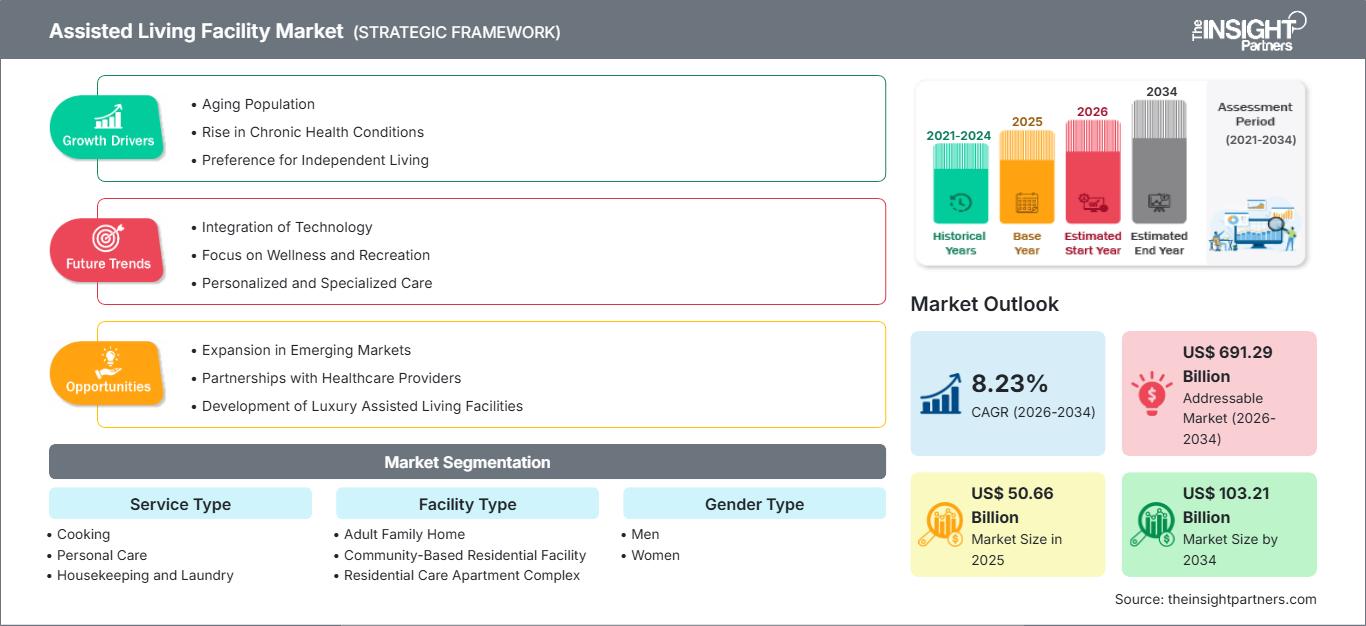
The assisted living facility market was valued at US$ 50.66 Billion in 2025 and is projected to reach US$ 103.21 Billion by 2034, expanding at a CAGR of 8.23% during 2026–2034. The factors influencing the demand include the process of aging of the population, the growing inclination towards support-oriented residential settings, the growing incidence of age-specific disabilities, and changing attitudes toward individualized services, safety, wellness, and community care.
North America continues to be a primary source of demand owing to aging demographics along with existing senior housing facilities, higher private pay capabilities, and growing inclination toward professionally-managed residential care. The assisted living facility market size of assisted living facilities is also driven by limited new supply that has been responsible for rising occupancy rates. The estimated regional CAGR of 7.8–8.4% for 2026–2034 represents demographic replacement demand and capacity additions.
Assisted Living Facility Market Assessment and Insights
- North America: North America is estimated to hold a 47–51% share in 2025, supported by mature senior housing infrastructure and strong private-pay demand, with growth projected at a 7.8–8.4% CAGR between 2026–2034.
- US: The US represents approximately 88–92% of North American revenue in 2025, supported by established operators and demographic demand, with a 7.7–8.3% CAGR between 2026–2034.
- Europe: Europe is estimated at a 24–28% share in 2025, led by the UK, Germany, France, Italy, and Spain, and is projected to expand at a 7.4–8.0% CAGR between 2026–2034.
- Asia Pacific: Asia Pacific is estimated at a 15–19% share in 2025, with Japan, China, Australia, South Korea, and India contributing to a 9.0–9.7% CAGR between 2026–2034.
- Largest Segment: Personal Care is estimated to represent a 32–36% market share in 2025, reflecting core resident needs, with a 8.5–9.1% CAGR from 2026–2034.
- High Growth Segment: Monitoring Medication is estimated at a 14–18% market share in 2025, supported by medication complexity and safety requirements, with a 9.2–9.9% CAGR from 2026–2034.
- Key companies analyzed in detail: Brookdale Senior Living, Amedisys, LCS, Holiday Retirement, Five Star Senior Living, Sunrise Senior Living, Enlivant, Capital Senior Living, Benchmark Senior Living, Kisco Senior Living.
Source: The Insight Partners' analysis based on proprietary research, government publications, company annual reports, investor presentations, industry databases, and expert interviews.
The assisted living facilities industry has transformed to one that focuses on offering comprehensive services such as accommodation, personal assistance, meals, housekeeping, medications, wellness programs, and safety services. The competition within this sector has been intensified by factors such as experience offered to residents, staffing arrangements, care coordination, and use of technologies to oversee operations.
Future demand for the services of this industry will not be limited to the traditional senior housing centers but will expand to cover secondary metropolitan areas as well as regions where there is an aging demographic. Some of the investment areas will be acquisitions, repositioning of communities, work force technologies, and facilities that are specifically built. There will also be increased regulatory concerns on staffing, resident safety, medication management, and quality of care.
Assisted Living Facility Market Report Scope
| Report Attribute | Details |
|---|---|
| Market size in 2025 | US$ 50.66 Billion |
| Market Size by 2034 | US$ 103.21 Billion |
| Global CAGR (2026 - 2034) | 8.23% |
| Historical Data | 2021-2024 |
| Forecast period | 2026-2034 |
Assisted Living Facility Market Analysis
As is evident, the growth of the assisted living facilities sector depends greatly on the shift away from independence-based household living to assisted living without involving the complexities of skilled nursing. The need for this type of living is dependent on age, disability, availability of caregivers within the family, income levels of the household, and location near healthcare facilities. As such, assisted living providers operate within a multifaceted value chain involving real estate acquisition, development, staff recruitment, food services, personal care, transport, medication, and resident engagement.
There exist supply constraints in various existing markets owing to the high capital requirements for developing the facilities, suitable locations, well-trained labor, and approvals. The latest assisted living facility market figures for 2025 show that assisted living occupancy rates in the fourth quarter were at 87.7% for NIC MAP primary markets while senior housing inventory was very low.
The competition within the assisted living facility market report comprises players of different sizes and backgrounds, including multi-state providers, regional specialists, healthcare service providers, and even integrated senior living platforms. Brookdale Senior Living offers both comprehensive community coverage and capability in operations and care provision, and Amedisys brings to the table a healthcare-oriented platform that can be useful for seniors' care pathways. LCS, Sunrise Senior Living, Five Star Senior Living, and Benchmark Senior Living all compete on community models, service offerings, and geography.
Capital Senior Living, Holiday Retirement, Enlivant, and Kisco Senior Living are additional competitors in the space. The trend of strategic activity involves buying distressed properties, increasing occupancy rates, renovating communities, and using data for pricing and staffing considerations. Companies with solid balance sheets can allocate capital into high-demand markets, while smaller companies can rely on specialized care services, geographical knowledge, and customizing their services.
● REPORT CUSTOMIZATION
Tailor This Report To Align With Your Specific Business Requirements
This report can be customized to align precisely with your business objectives, scope, and target markets. Customization options include tailored segmentation, geography, competitive analysis, and strategic insights to support informed decision-making.
Customize This Report →WHAT YOU CAN ADJUST
- ● Segmentations
- ● Geography
- ● Competitive Analysis
- ● Language Preferences
Assisted Living Facility Market: Strategic Insights
Regional Insights
North America assisted living facility market
North America is estimated to account for a 47–51% of the assisted living facility market share in 2025 and is projected to grow at a 7.8–8.4% CAGR through 2034. The US dominates regional demand because of its extensive senior housing base, private-pay model, established operators, and rapidly aging population. Canada contributes through expanding retirement communities and increasing institutional support for aging-in-place alternatives.
The supply environment in the region is still relevant for future success. In the fourth quarter of 2025, assisted living occupancy was 87.7% in the markets monitored by NIC MAP, and new construction remained limited. With high occupancy rates, lack of growth in the number of units, and more seniors in the population, it encourages operators to explore acquisitions, redevelopment, and selected new construction.
U.S. assisted living facility Market
The US market holds around 88-92% of North American revenue in 2025 and is expected to grow at a 7.7-8.3% CAGR. The demand drivers include an aging Baby Boomer generation, shortage of caregivers, high healthcare usage and preference by consumers for communities that combine freedom with care. The upcoming Baby Boomer 80-year-olds in 2026 reinforces the demographic dynamics even further.
Brookdale Senior Living, Sunrise Senior Living, Benchmark Senior Living, Five Star Senior Living, Capital Senior Living, Holiday Retirement, Enlivant, LCS, Amedisys and Kisco Senior Living participate through various operational and service formats. Growth is being driven more and more by personal care, pharmacy, memory care, dining, transportation and wellness services. Secondary metro markets can offer additional development options when affordability and local supply are positive.
Europe assisted living facility Market
The market share of Europe is expected to be around 24–28% in 2025 and is expected to have a CAGR of 7.4–8.0%. United Kingdom is still one of the dominant players owing to the presence of well-established infrastructure for retirement homes and growing demand for assisted care. Germany has aged demographics along with an advanced infrastructure in place. While France follows a combined approach in the provision of care, both Italy and Spain are facing growing demands owing to an expanding senior population and changing family care structure.
APAC assisted living facility Market
APAC is expected to have a 15-19% share in 2025 and will grow at a 9.0-9.7% CAGR. APAC countries adopting such arrangements include Japan, followed by Australia, South Korea, China, and India. These factors include aging population, smaller household size, urbanization, and increased health care facilities, which have led to an increased demand for organized living for seniors. These figures for APAC countries stand at 9.1-9.7% for Japan, 8.8-9.4% for Australia, 9.0-9.6% for South Korea,
Middle East & Africa assisted living facility Market
Middle East & Africa is projected to expand at a 7.0–7.7% CAGR, with Saudi Arabia and the UAE leading investment activity and South Africa representing an established regional senior care market. Rising healthcare infrastructure investment and diversification programs are creating opportunities for organized senior residential services.
Saudi Arabia is projected at 7.2–7.8%, the UAE at 7.3–7.9%, and South Africa at 6.5–7.1%. The region remains smaller than North America and Europe, but expanding hospital infrastructure, private healthcare investment, and development of mixed-use communities can support senior living capacity.
Segmentation Analysis
Service Type
The Service Type segment is projected to grow at a 8.2–8.8% CAGR from 2026–2034. Service intensity is becoming a primary determinant of resident selection and operator economics. Personal care remains foundational, while medication monitoring is gaining importance as residents present with more complex treatment routines. Cooking and housekeeping continue to support daily living, resident satisfaction, and retention.
- Cooking: Cooking services remain essential because residents increasingly expect nutritious meals, dietary flexibility, and community dining. Operators can use centralized procurement and menu planning to manage costs while supporting wellness-oriented resident experiences.
- Personal Care: Personal care represents the core assisted living requirement, covering activities such as bathing, dressing, grooming, mobility, and daily support. Demand rises as residents seek independence with structured assistance.
- Housekeeping and Laundry: Housekeeping and laundry reduce routine household burdens and support community cleanliness. These services contribute to resident convenience while allowing operators to standardize workflows through centralized staffing and scheduling.
- Monitoring Medication: Medication monitoring is increasingly important as residents manage multiple prescriptions. Structured administration, reminders, documentation, and oversight can improve safety and reduce medication-related operational risks.
Facility Type
The Facility Type segment in the assisted living facility market is projected to grow at a 7.9–8.5% CAGR during 2026–2034. Facility formats differ according to regulation, community design, resident autonomy, and service intensity. Adult Family Homes provide smaller-scale residential care, while community-based residential facilities support larger populations. Residential Care Apartment Complexes combine residential independence with structured assistance.
- Adult Family Home: Adult Family Homes provide smaller residential environments with individualized assistance. Their home-like setting can appeal to residents seeking close caregiver relationships and lower-density accommodation.
- Community-Based Residential Facility: Community-Based Residential Facilities support larger resident populations and can offer structured dining, activities, personal care, transportation, and medication services within a dedicated operating environment.
- Residential Care Apartment Complex: Residential Care Apartment Complexes combine private residential units with access to supportive services. Their format can appeal to residents seeking greater autonomy while retaining assistance when required.
Gender Type
The Gender Type segment in the assisted living facility market is forecast to grow at a 8.0–8.6% CAGR from 2026–2034. Women represent a larger resident base in many senior living environments because of longer life expectancy and demographic composition at advanced ages. Men nevertheless represent an expanding opportunity as longevity increases and household caregiving patterns change.
- Men: Male residents increasingly represent an addressable population as longevity improves and family structures become more diverse. Operators can tailor programming, dining, wellness, and social activities to broaden community appeal.
- Women: Women constitute a major resident population because they generally live longer and are more likely to reach ages associated with supportive residential care. Community design increasingly considers safety, independence, and social engagement.
Age Group Type
The Age Group Type segment in the assisted living facility market is projected to expand at a 8.4–9.0% CAGR during 2026–2034. Demand rises substantially with age because functional limitations and care requirements increase. Residents aged 75 and above therefore represent the principal addressable population, while younger residents can enter facilities because of disability or specific support requirements.
- Less than 65 Years: This group remains comparatively small but includes residents requiring assistance because of disability, chronic conditions, or specialized support needs. Accessible design and individualized care are important selection criteria.
- 65-74 Years: Residents in this group often seek communities offering preventive wellness, social engagement, and flexible assistance. Operators can attract them through lifestyle-oriented programming before higher-intensity care becomes necessary.
- 75-84 Years: This group represents a substantial demand pool because functional assistance requirements generally become more prevalent. Personal care, medication support, and transportation services become increasingly important to retention.
- More than 85 Years: The oldest resident cohort has the highest need for assistance and safety oversight. Communities serving this population require stronger staffing models, medication management, mobility support, and care coordination.
Opportunity Snapshot
| Service Type | Revenue Contribution | Trend Tag | Adoption Stage |
| Cooking | Medium | Wellness Dining | Mature |
| Personal Care | High | Daily Assistance | Mature |
| Housekeeping and Laundry | Medium | Service Bundling | Mature |
| Monitoring Medication | High | Medication Safety | Scaling |
Assisted Living Facility Market Growth Drivers and Impact Analysis
Rapid aging and rising longevity
The underlying demand generator is population aging since the likelihood of requiring help in activities of daily living is proportional to age. When the first cohort of baby boomers turns 80 by 2026, this will represent a pivotal demographic shift for providers of senior housing. Increased longevity expands the window in which families might need residential options beyond just the health care options of temporary stay. While there is an expansion of the resident stream for the operators, there are also higher expectations for quality of services provided, staffing needs, health and wellness initiatives, as well as coordinated care management. Communities situated closer to health care delivery systems and locations with higher populations of older individuals will be able to leverage their strategic position.
Limited new supply and rising occupancy
The rising constraint of supply in the senior housing industry is making existing communities more strategic than before. NIC's reports showed the occupancy of assisted living units to be at 87.7% during the fourth quarter of 2025, while the growth of the stock of senior housing units was moderate. High levels of occupancy may enhance the predictability of revenues, however, the difficulty in providing enough units, well-trained personnel, and suitable places for new residents will cause problems for operators. Investors can also benefit from the rising constraint of supply through asset valuation and through acquisitions or development rather than speculative development. Operators can meet the needs of the market by positioning their properties differently and developing their relationships with referral sources.
Increasing complexity of resident care needs
Residents entering assisted living increasingly require combinations of personal assistance, medication oversight, mobility support, nutrition management, and healthcare coordination. This complexity is changing operator economics because communities must maintain adequate staffing and training while managing regulatory requirements and family expectations. Medication monitoring is particularly important when residents take multiple prescriptions or transition between healthcare settings. The operational response includes standardized care assessments, electronic documentation, workforce scheduling, and stronger communication between communities and external providers. Operators able to manage higher-acuity residents without compromising resident experience can increase service relevance and potentially improve retention. However, higher care intensity also increases labor requirements and operating costs. Consequently, providers are increasingly evaluating technology and process redesign as mechanisms for improving consistency without reducing personalization.
Assisted Living Facility Market Future Trends
Technology-enabled personalized resident management
Future communities are likely to integrate connected technologies across medication reminders, emergency response, resident monitoring, scheduling, and family communication. Rather than operating as standalone systems, these tools can increasingly share information with community staff and care coordinators. Wearable devices may support mobility monitoring, while room-based sensors can identify unusual activity patterns without requiring continuous manual observation. Artificial intelligence can assist staff with scheduling, documentation, and risk identification, although implementation will remain subject to privacy, consent, and regulatory considerations. The commercial implication is a shift from technology as an amenity toward technology as an operational infrastructure layer. Providers investing selectively in interoperable platforms can improve visibility across resident needs while reducing administrative workload. Successful deployment will depend on staff adoption, resident acceptance, cybersecurity, and demonstrable workflow benefits.
Purpose-built communities combining housing and wellness
Future development in the assisted living facility market trends is likely to emphasize communities that integrate residential comfort with wellness, social participation, preventive health, and flexible assistance. Residents increasingly expect environments that preserve independence rather than resemble institutional care settings. Developers can respond through accessible apartments, walkable internal layouts, outdoor spaces, fitness facilities, dining venues, activity areas, and adaptable service packages. Mixed-use locations near retail, healthcare, cultural facilities, and transportation can further strengthen community attractiveness. Flexible design also allows operators to adjust service intensity as resident needs change, potentially extending length of stay. This approach can influence capital allocation because developers may prioritize locations and buildings capable of supporting multiple resident profiles. Over time, the distinction between housing, wellness, and care is likely to become less pronounced.
Assisted Living Facility Market Opportunities
Middle-market senior living development
A significant opportunity in the assisted living facility market forecast exists in developing communities positioned between premium private-pay facilities and subsidized senior housing. Rising construction, labor, and operating costs have encouraged many new developments to target higher-income residents, leaving a potential affordability gap for middle-income households. Operators can address this opportunity through efficient building designs, standardized service packages, smaller unit footprints, regional procurement, and technology-supported administration. Locations in secondary metropolitan markets may offer more manageable land and labor economics while retaining access to healthcare and family networks. Investors can evaluate projects using local age demographics, household income, existing occupancy, and supply pipelines to identify underserved markets. A middle-market strategy can broaden the addressable customer base while creating a differentiated position for operators that balance affordability with dependable care and resident experience.
Acquisition and repositioning of underperforming communities
Acquisition and repositioning provide another opportunity where existing properties have strong locations but outdated facilities, weak occupancy, or inefficient operating models. Investors can create value through targeted renovations, service redesign, staffing improvements, pricing optimization, and stronger referral relationships rather than relying entirely on new construction. Properties near hospitals, medical offices, retail centers, and established residential neighborhoods can be particularly attractive because location advantages are difficult for new competitors to replicate. Operators can also evaluate whether facilities should be repositioned toward higher-acuity residents, memory support, or broader lifestyle offerings. Successful strategies require detailed assessment of physical condition, regulatory requirements, local competition, workforce availability, and resident affordability. Capital deployment should therefore prioritize assets where operational improvements can generate sustainable occupancy gains without excessive renovation risk.
Recent Developments
- June 2026: Benchmark Senior Living and National Development acquired and financed a property in East Islip, New York, for development into Benchmark at East Islip, a 90-unit assisted living and memory care community expected to open in 2028. The transaction represents continued expansion through joint ventures and demonstrates the use of targeted property acquisitions to increase senior living capacity in established Northeastern markets.
- June 2026: Brookdale Senior Living Inc. appointed Margaret Cabell as Chief Sales Officer, effective June 15, 2026. The company stated that the appointment is intended to strengthen sales strategy and relationship development while supporting operational priorities across its senior living platform. The move highlights increasing emphasis on pricing, occupancy, customer acquisition, and coordinated commercial execution as demand for senior housing continues to strengthen.
- February 2026: Brookdale Senior Living Inc. created a new Senior Vice President, Strategic Operations position and appointed Clark Jones to the role. His responsibilities include pricing analysis, go-to-market strategy, targeted capital expenditure, workforce management, and planning. The organizational change reflects the increasing importance of data-driven portfolio optimization and disciplined resource allocation as operators address strong demand alongside constrained senior housing development.
Frequently Asked Questions

- Comprehensive Market Sizing and Forecast Analysis
- Detailed Segmentation Analysis
- In-Depth Market Dynamics Assessment
- Regional and Country-Level Insights
- Competitive Landscape and Company Benchmarking
- Strategic Business Intelligence
Recent Reports
Testimonials

The Insight Partners provided valuable market intelligence that supported our global go-to-market strategy. Their team was professional, responsive, and attentive to our feedback, providing thoughtful analysis and helpful methodological clarifications throughout the project.
Junmo Kim Chief Financial Officer (CFO), Enertech Co., Ltd.
The Insight Partners' SCADA System Market report is comprehensive, with valuable insights on current trends and future forecasts. The team was highly professional, responsive, and supportive throughout. We are very satisfied and highly recommend their services.
RAN KEDEM Partner, Reali Technologies LTDs
I requested a report on a very specific software market and the team produced the report in a few days. The information was very relevant and well presented. I then requested some changes and additions to the report. The team was again very responsive and I got the final report in less than a week.
JEAN-HERVE JENN Chairman, Future Analytica
We worked with The Insight Partners for an important market study and forecast. They gave us clear insights into opportunities and risks, which helped shape our plans. Their research was easy to use and based on solid data. It helped us make smart, confident decisions. We highly recommend them.
PIYUSH NAGPAL Sr. Vice President, High Beam Global
The Insight Partners delivered insightful, well-structured market research with strong domain expertise. Their team was professional and responsive throughout. The user-friendly website made accessing industry reports seamless. We highly recommend them for reliable, high-quality research services
YUKIHIKO ADACHI CEO, Deep Blue, LLC.
This is the first time I have purchased a market report from The Insight Partners.While I was unsure at first, I visited their web site and felt more comfortable to take the risk and purchase a market report.I am completely satisfied with the quality of the report and customer service. I had several questions and comments with the initial report, but after a couple of dialogs over email with their analyst I believe I have a report that I can use as input to our strategic planning process.Thank you so much for taking the extra time and making this a positive experience.I will definitely recommend your service to others and you will be my first call when we need further market data.
JOHN SUZUKI President and Chief Executive Officer, Board Director, BK Technologies
I wish to appreciate your support and the professionalism you displayed in the course of attending to my request for information regarding to infectious disease IVD market in Nigeria. I appreciate your patience, your guidance, and the fact that you were willing to offer a discount, which eventually made it possible for us to close a deal. I look forward to engaging The Insight Partners in the future, all thanks to the impression you have created in me as a result of this first encounter.
DR CHIJIOKE ONYIA MANAGING DIRECTOR, PineCrest Healthcare Ltd.Reason to Buy
- Informed Decision-Making
- Understanding Market Dynamics
- Competitive Analysis
- Identifying Emerging Markets
- Customer Insights
- Market Forecasts
- Risk Mitigation
- Boosting Operational Efficiency
- Strategic Planning
- Investment Justification
- Tracking Industry Innovations
- Aligning with Regulatory Trends





 Get Free Sample for