
Antimicrobial Hospital Textiles Market Share, Size & Demand by 2034
Antimicrobial Hospital Textiles Market Size and Forecasts (2021–2034), Global and Regional Share, Trends, and Growth Opportunity Analysis Report Coverage : by Material (Cotton, Polyester, Polyamide); Usability (Reusable and Disposable); Application (Attire, Surgical Supplies and Wipes, Sheets and Blankets); End Use (General Ward, Surgical Rooms, ICU); and Geography (North America, Europe, Asia Pacific, and South and Central America)
- Status : Data Released
- Report Code : TIPRE00040372
- Category : Chemicals and Materials
- No. of Pages : 150
- Available Report Formats :


- Last update date : September 15, 2026


2025 Market Size
US$ 1.31 Bn
Base year value
2034 Forecast
US$ 2.45 Bn
Projected by 2034
CAGR 2026-2034
7.2 %
Growth rate
Addressable Market
US$ 16.96 Bn
(2026-2034)
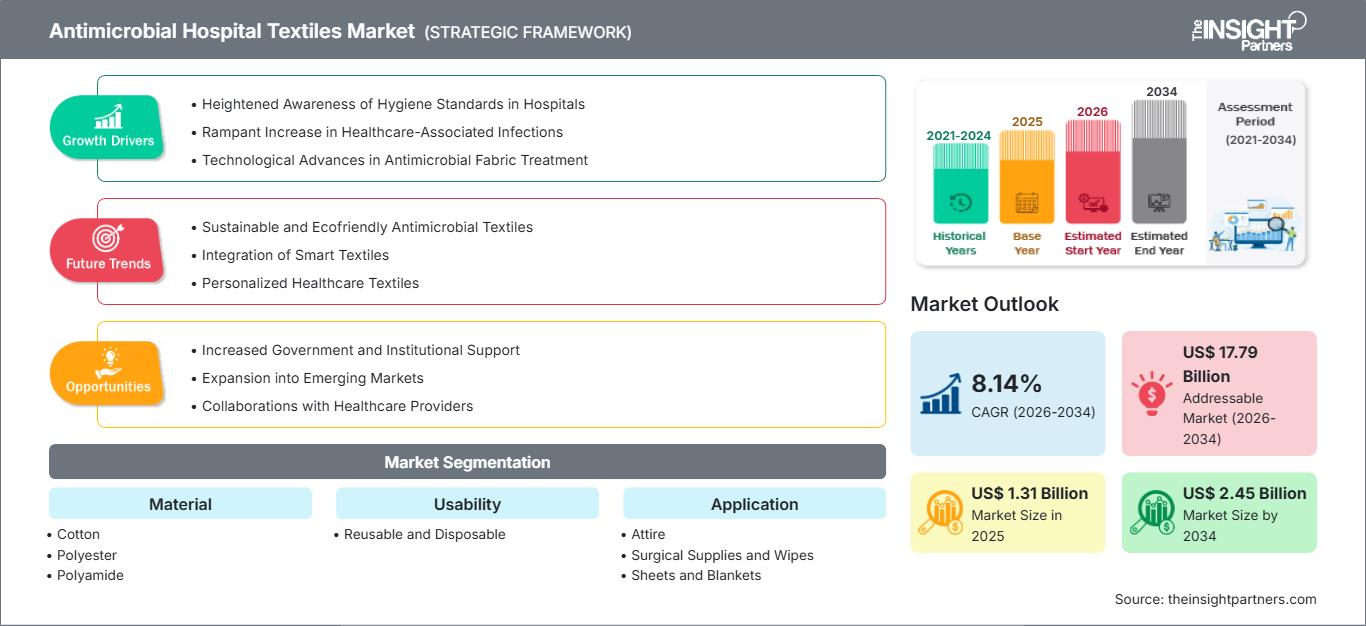
The Antimicrobial Hospital Textiles market was valued at US$ 1.31 billion in 2025 and is expected to reach US$ 2.45 billion by 2034; it is estimated to record a CAGR of 7.2% during 2026-2034.
Antimicrobial Hospital Textiles Market Assessment and Insights
- North America: North America held an estimated 36–40% antimicrobial hospital textiles market share in 2025 and is projected to grow at a 7.6–8.2% CAGR during 2026–2034, supported by established healthcare infrastructure, infection prevention programs, and demand for durable reusable textiles.
- US: The US represented approximately 82–86% of North America's 2025 market and is expected to expand at a 7.7–8.3% CAGR during 2026–2034, led by hospital procurement and infection-control requirements.
- Europe: Europe accounted for approximately 24–28% share in 2025 and is forecast to grow at a 7.5–8.1% CAGR during 2026–2034, with Germany, the UK, France, Italy, and Spain supporting medical textile adoption.
- Asia Pacific: Asia Pacific represented approximately 22–26% share in 2025 and is expected to register an 8.8–9.4% CAGR during 2026–2034, driven by China, Japan, South Korea, India, and Australia.
- Largest Segment: Reusable textiles represented approximately 62–66% market share in 2025 and are projected to grow at a 7.9–8.5% CAGR during 2026–2034, reflecting repeated hospital use and lifecycle economics.
- High Growth Segment: Surgical Rooms accounted for approximately 25–29% share in 2025 and are projected to grow at a 9.0–9.6% CAGR during 2026–2034, supported by stringent infection-control requirements.
- Key companies analyzed in detail: Milliken & Company, Trevira GmbH, Unitika Trading Co., Ltd., Thai Acrylic Fibre Co., Ltd., PurThread Technologies, Inc., LifeThreads LLC, Indorama Ventures Lifestyle Italy S.p.A., Smith & Nephew plc, Herculite Products, Inc., and Microban International, Ltd.
Source: The Insight Partners' analysis based on proprietary research, government publications, company annual reports, investor presentations, industry databases, and expert interviews.
The antimicrobial hospital textiles market will shift from traditional treatments of textiles to engineered systems of antimicrobials that have been incorporated into the production of fibers, yarns, or coatings. The suppliers will focus on wash resistance, controlled release of agents, compatibility of the agents, and resistance of the textiles to hospital disinfectants. Cotton will be used for its properties of comfort and absorption, whereas polyester and engineered blends will be used for durability and dimensional stability in reusable gowns, curtains, linens, and other clinical attire.
It is expected that future developments in antimicrobial hospital textiles market will include durable treatments, biobased chemistry, low release of chemicals, and antimicrobial systems that are suitable for sustainability goals. Emerging healthcare facilities in Asia Pacific are expected to drive demand for these products, and North American and European hospitals will value proven efficacy, cost-effectiveness, and compliance.
Antimicrobial Hospital Textiles Market Report Scope
| Report Attribute | Details |
|---|---|
| Market size in 2025 | US$ 1.31 Billion |
| Market Size by 2034 | US$ 2.45 Billion |
| Global CAGR (2026 - 2034) | 7.2% |
| Historical Data | 2021-2024 |
| Forecast period | 2026-2034 |
Antimicrobial Hospital Textiles Market Analysis
The demand in the antimicrobial hospital textiles market is driven by infection prevention regulations, hospital expansion, heavy wash, and the need to preserve the hygiene of the patient and contact textiles. Market growth ecosystem of antimicrobial hospital textiles involves fiber manufacturers, antimicrobial agents, spinning mills, fabric producers, finishers, textile converters, industrial laundries, distribution channels, and healthcare procurement agencies. Each step impacts antimicrobial efficacy, comfort, price, and compliance.
Supply forces in the antimicrobial hospital textiles market tend more to the side of vertical integration or differentiation due to the increasing demands of hospitals. The fibers determine moisture handling, strength, drying characteristics, and suitability for antimicrobial finishes, whereas finishing technology determines the effectiveness after numerous wash cycles. Fluid resistance, stain resistance, compatibility with thermal disinfection and replacement frequency are evaluated by hospitals.
Competitors consist of diversified textile companies, antimicrobial technology companies, specialty fiber companies, and medical device companies. Milliken & Company holds a combination of textile and healthcare expertise whereas Trevira GmbH and Unitika Trading Co., Ltd hold specialty fiber and textile expertise. PurThread Technologies, Inc. and LifeThreads LLC have their emphasis on antimicrobial healthcare textiles whereas Herculite Products, Inc. holds expertise on antimicrobial protective healthcare fabrics.
The strategic position will now emphasize durability, formulation, sustainability, and engineering by application. The company needs to collaborate with Microban International, Ltd. for antimicrobial technology whereas collaboration with Smith & Nephew plc will enable the company to obtain expertise in medical products platform. Collaboration with Thai Acrylic Fibre Co., Ltd will enable the company to add specialty fiber expertise whereas Indorama Ventures Lifestyle Italy S.p.A. will enable the company to gain expertise in polyester yarns.
● REPORT CUSTOMIZATION
Tailor This Report To Align With Your Specific Business Requirements
This report can be customized to align precisely with your business objectives, scope, and target markets. Customization options include tailored segmentation, geography, competitive analysis, and strategic insights to support informed decision-making.
Customize This Report →WHAT YOU CAN ADJUST
- ● Segmentations
- ● Geography
- ● Competitive Analysis
- ● Language Preferences
Antimicrobial Hospital Textiles Market: Strategic Insights
Regional Insights
North America Antimicrobial Hospital Textiles Market
North America represented 36–40% share in 2025 and is expected to expand at a 7.6–8.2% CAGR during 2026–2034. The US is the key player of regional consumption due to procurement programs for gowns, uniforms, sheets, curtains, and other textiles at hospitals. Infection prevention departments become more focused on textile properties, laundry specifications, contamination, longevity, and replacement cost. Canada provides its contribution via hospital modernization and institutional healthcare procurement, and Mexico capitalizes on the growth of healthcare infrastructure and textile manufacturing capacities.
The structural strength of the region consists of a well-developed commercial laundry system, standards, and the use of reusable products. That is why manufacturers pay attention to preservation of anti-microbial properties of their products and compatibility with disinfection processes. Moreover, the demand goes beyond acute hospitals and includes long-term care and ambulatory facilities. The US is the leader of the region, and the suppliers compete not in fabric pricing but in technical documentation, material tracking, antimicrobial properties, and lifecycle costing.
U.S. Antimicrobial Hospital Textiles Market
The US accounted for approximately 82–86% of North America's 2025 market and is projected to grow at a 7.7–8.3% CAGR during 2026–2034. Hospitals, long-term care providers, surgical centers, and commercial laundries are important demand channels. Milliken & Company, PurThread Technologies, Inc., LifeThreads LLC, Herculite Products, Inc., and Microban International, Ltd. have relevant technology or product exposure.
Reusable gowns, scrubs, privacy curtains, bedding, mattress covers, and surgical textiles represent major application areas. Procurement decisions increasingly consider antimicrobial durability, cleaning compatibility, fluid management, comfort, and total ownership cost. Hospital infection prevention teams are also becoming more involved in textile specifications, particularly for high-contact environments. The market therefore rewards products supported by standardized testing and clear instructions regarding laundering, antimicrobial claims, and appropriate use.
Europe Antimicrobial Hospital Textiles Market
Europe accounted for approximately 24–28% share in 2025 and is expected to grow at a 7.5–8.1% CAGR during 2026–2034. Germany is the leading nation, which is facilitated by healthcare industry manufacturing, specialty textiles, and industrial prowess. The other countries include the UK, France, Italy, and Spain, whose demand is fueled by hospital renovation, infection control, and the manufacture of medical textiles.
According to the antimicrobial hospital textiles market report, there is substantial healthcare institution base in the UK where reusable hospital gowns, uniforms, bedding and privacy textiles will need efficient laundering performance. Germany has the advantage of textile engineering and specialty fiber manufacturing, which includes Trevira GmbH. There is demand facilitation from public and private healthcare institutions in France, whereas Italy facilitates demand via specialty textile manufacture through established yarn and fabric producers. Spain is facilitated by hospital infrastructure and healthcare procurement and textile conversion capability.
APAC Antimicrobial Hospital Textiles Market
APAC represented approximately 22–26% antimicrobial hospital textiles market in 2025 and is projected to grow at an 8.8–9.4% CAGR during 2026–2034. China is the leading country, followed by Japan, South Korea, India, and Australia. Expanding hospital capacity, textile manufacturing, and healthcare investment support regional demand.
China benefits from production scale, while Japan and South Korea contribute advanced textile technology. India is developing domestic medical-textile capabilities, supported by healthcare expansion and public-sector technology initiatives. Australia has mature infection-control practices and healthcare procurement systems. Regional manufacturers increasingly evaluate antimicrobial performance together with wash durability and sustainability. Government-supported healthcare infrastructure and domestic textile production should improve access to specialized medical fabrics.
Middle East & Africa Antimicrobial Hospital Textiles Market
Middle East & Africa is expected to register a 6.5–7.2% CAGR during 2026–2034, with Saudi Arabia leading regional demand. The UAE sees a positive impact in terms of investment in healthcare infrastructure and the development of medical tourism, while South Africa has developed its healthcare infrastructure and has its own textile industry. Rest of MEA represents additional demand via expansion of its public healthcare facilities.
Demand for hygienic clinical textiles is being driven by healthcare infrastructure initiatives, establishment of hospitals, specialty care centers, and infection control initiatives. The investment in healthcare infrastructure of Saudi Arabia offers market opportunities for suppliers of reusable gowns, bed sheets, curtains, and surgical textiles. Premium healthcare focus of the UAE, while South Africa represents both public and private hospitals demand.
Segmentation Analysis
Material
Material is segmented into Cotton, Polyester, and Polyamide. Cotton remains important because of softness, breathability, moisture absorption, and patient comfort, while synthetic fibers offer strength and dimensional stability. The material segment is expected to grow at a 7.8–8.4% CAGR during 2026–2034. Fiber selection increasingly depends on laundering frequency, antimicrobial-agent compatibility, durability, and application-specific performance.
- Cotton: Cotton maintains strong relevance in bedding, gowns, uniforms, and patient-contact textiles because of comfort and absorbency. Antimicrobial finishing improves functional performance while preserving familiar textile characteristics.
- Polyester: Polyester supports reusable hospital textiles requiring dimensional stability, rapid drying, strength, and resistance to repeated industrial laundering. Its compatibility with engineered finishes makes it important for uniforms, curtains, and blended fabrics.
- Polyamide: Polyamide provides strength, abrasion resistance, flexibility, and lightweight performance. Its strategic role is strongest in specialized healthcare textiles where durability and mechanical performance are prioritized alongside antimicrobial functionality.
Usability
Usability segment in the antimicrobial hospital textiles market comprises Reusable and Disposable products. Reusable textiles dominate because hospitals can repeatedly deploy them following validated laundering and disinfection processes. The segment is projected to expand at a 7.9–8.5% CAGR during 2026–2034, supported by lifecycle economics and waste-reduction priorities. Disposable products remain relevant where contamination risk, convenience, or procedural requirements outweigh repeated-use economics.
- Reusable: Reusable products are widely used for gowns, scrubs, bedding, curtains, and other institutional textiles. Their strategic importance is increasing as hospitals assess lifecycle cost, waste generation, wash durability, and antimicrobial retention.
- Disposable: Disposable textiles support applications where rapid turnover and controlled contamination exposure are priorities. Demand is concentrated around procedures and environments where laundering logistics or cross-contamination concerns favor single-use products.
Application
Application includes Attire, Surgical Supplies and Wipes, and Sheets and Blankets. The segment is expected to grow at an 8.1–8.7% CAGR during 2026–2034 as hospitals expand antimicrobial coverage beyond garments toward patient-contact and procedure-related textiles. Application-specific requirements increasingly determine the appropriate fiber, antimicrobial chemistry, moisture-management characteristics, and laundering profile.
- Attire: Hospital attire includes scrubs, gowns, uniforms, and patient garments. Demand is supported by frequent contact with patients and staff, repeated laundering, and requirements for comfort, durability, and hygiene.
- Surgical Supplies and Wipes: Surgical textiles and wipes operate in high-control environments where contamination management is critical. Suppliers prioritize reliable antimicrobial performance, fluid management, sterility compatibility, and material consistency.
- Sheets and Blankets: Bedding remains a high-volume application because textiles remain in prolonged contact with patients. Antimicrobial finishes can complement cleaning and disinfection practices while supporting durability through repeated laundering.
End Use
End Use covers General Ward, Surgical Rooms, and ICU. The segment is projected to grow at a 8.2–8.8% CAGR during 2026–2034, with demand varying according to patient vulnerability, contact intensity, textile turnover, and infection-control protocols. Surgical Rooms represent the highest-growth environment, while General Wards provide broad-volume consumption.
- General Ward: General wards represent broad-based demand for bedding, patient garments, staff attire, curtains, and other frequently handled textiles. Procurement emphasizes durability, comfort, wash performance, and cost efficiency.
- Surgical Rooms: Surgical Rooms require stringent textile hygiene because procedures involve invasive interventions and controlled clinical environments. Antimicrobial fabrics are strategically relevant for gowns, drapes, wipes, and supporting textile products.
- ICU: ICU environments involve highly vulnerable patients and frequent interaction with healthcare workers. Demand therefore emphasizes dependable hygiene performance, moisture management, durability, and compatibility with intensive cleaning routines.
Opportunity Snapshot
| Application | Revenue Contribution (High/Medium/Low) | Trend Tag | Adoption Stage |
|---|---|---|---|
| Attire | High | Staff Protection | Mature |
| Surgical Supplies and Wipes | High | Surgical Hygiene | Scaling |
| Sheets and Blankets | High | Bedside Protection | Scaling |
Antimicrobial Hospital Textiles Market Growth Drivers and Impact Analysis
Growing Focus on Healthcare-Associated Infection Prevention
The problem of healthcare-associated infections continues to be a major issue in terms of patient safety, thus, increasing focus on any surface and material involved in the process of microorganism transfer. According to WHO's global infection prevention and control reporting, HAIs have significant clinical and financial implications, and appropriate IPC methods may reduce a considerable amount of infections. This highlights the strategic importance of antimicrobial textiles as a part of such prevention efforts. More and more hospitals are beginning to evaluate garments, bed linen, curtains, and other textiles based on their exposure to pathogens, the frequency of washing, and durability of materials used. The most influential in the market are products that provide antimicrobial properties but do not affect the comfort of use and launderability of the fabric.
Expansion and Modernization of Healthcare Infrastructure
The build-out of healthcare infrastructure will lead to an increase in the existing pool of beds, operating theaters, critical care facilities, and associated hospital operations which will use up medical textiles. There will be a need for continual supplies of gowns, uniforms, bedding, curtains, mattress covers, and other procedural textiles in new and refurbished facilities. This development is especially crucial when one considers that the process of modernization will entail the introduction of more stringent requirements regarding hygiene as well as capacity growth. In the context of more mature markets, renovations and replacements offer an easier avenue of steady demand generation. Antimicrobial textiles companies can leverage the growth in healthcare infrastructure through offering textiles compatible with the region’s washing process and the hospital purchasing criteria, as well as local fiber supply conditions.
Shift Toward Durable and Reusable Clinical Textiles
There is an increasing recognition of the need to achieve balance between infection control demands and cost of operation, waste generation, and efficiency of acquisition in hospitals. Reusability of textiles can be achieved if such textiles can survive repeated laundering and disinfection processes without significant degradation in their physical and antimicrobial properties. This means that manufacturers are encouraged to develop finishes that can maintain their effectiveness after being subjected to repeated heat treatment, exposure to detergents, mechanical action, and drying. The commercial implications are especially true for gown, scrub, sheet, blanket, curtain, and mattress textiles. Suppliers are thus differentiating themselves based on issues of durability, lifecycle performance, and compatibility with industrial laundry systems. Sustainability goals can also be used to reinforce the trend as hospitals consider costs of both acquisition and disposal of textiles.
Antimicrobial Hospital Textiles Market Future Trends
Long-Life Multifunctional Antimicrobial Treatments
The antimicrobial hospital textiles market trends are likely to center increasingly on treatments engineered for long service life rather than short-duration surface activity. Hospitals operate demanding laundering cycles, making retention after repeated washing a decisive performance criterion. Future technologies will increasingly combine antimicrobial action with hydrophobicity, stain resistance, moisture management, odor control, and mechanical durability. Fiber-level incorporation, controlled-release systems, durable finishes, and nanostructured coatings could gain greater attention where they demonstrate consistent performance without compromising textile hand or breathability. Manufacturers are also likely to develop treatment platforms that can be applied to multiple fiber compositions, simplifying hospital procurement. Greater use of standardized durability testing should improve comparability between products and encourage purchasing decisions based on verified performance rather than antimicrobial claims alone.
Sustainable and Lower-Impact Antimicrobial Technologies
Future development will increasingly focus on antimicrobial systems that balance efficacy, regulatory compliance, worker safety, environmental impact, and textile performance. Manufacturers are exploring bio-based active materials, lower-release technologies, mineral-based systems, and process approaches that reduce chemical consumption. Recycled polyester and other circular textile inputs will create additional formulation challenges because antimicrobial treatments must remain compatible with recycled fibers and existing finishing processes. Hospitals are also expected to scrutinize chemical disclosures and lifecycle impacts more closely as sustainability programs become integrated into procurement. Suppliers that can demonstrate durable performance with reduced environmental burden may gain an advantage in institutional tenders. Over time, the competitive benchmark is likely to shift from simple antimicrobial activity toward a broader combination of efficacy, durability, chemical stewardship, recyclability, and documented lifecycle performance.
Antimicrobial Hospital Textiles Market Opportunities
Multifunctional Healthcare Textile Platforms
The Antimicrobial Hospital Textiles Market Forecasts indicate an opportunity to combine antimicrobial protection with moisture management, temperature regulation, fluid repellence, pressure management, and sensor-compatible textile structures. Healthcare providers increasingly seek materials that solve multiple operational requirements without adding unnecessary layers or increasing product complexity. Manufacturers can develop multifunctional fabrics for ICU bedding, patient gowns, surgical garments, and specialized support products. Such solutions could command greater value when they reduce replacement frequency or simplify inventory requirements. Investment should prioritize compatibility between antimicrobial agents and performance finishes because interactions can affect durability, hand feel, breathability, and laundering behavior. Partnerships between fiber producers, antimicrobial-technology developers, medical-device manufacturers, and healthcare laundries can accelerate qualification. Application-specific development may create stronger differentiation than standardized antimicrobial fabric offerings.
Localized Manufacturing in Emerging Healthcare Markets
Emerging healthcare systems present opportunities for local production of antimicrobial fabrics, particularly where hospitals depend on imported specialized textiles. India, Southeast Asia, the Middle East, and selected Latin American markets can support localized manufacturing through established textile industries and expanding healthcare capacity. Local production can shorten lead times, reduce supply-chain exposure, and allow manufacturers to adapt fiber blends and finishing systems to regional laundering practices. Public-sector healthcare procurement can further support adoption when specifications recognize verified antimicrobial performance and lifecycle durability. Companies entering these markets should prioritize local testing, regulatory understanding, technical partnerships, and scalable finishing capacity. The strongest opportunity lies in producing standardized medical textiles locally while retaining internationally recognized testing methods, enabling hospitals to obtain qualified products without relying entirely on overseas supply.
Recent Developments
- August 18, 2026: Indian Institute of Technology Delhi reported that its incubated startup Medicfibers, in collaboration with AIIMS New Delhi, developed Viroclog, an antimicrobial textile coating designed to reduce survival of viruses, bacteria, and fungi on fabrics. The technology uses a surface mechanism intended to limit microbial adhesion and disrupt microbial membranes, targeting hospital clothing and other healthcare textiles.
- September 30, 2025: Sugu Fabrics and Linings introduced reusable, washable antibacterial fabric for healthcare applications under its Hilsan brand. The company reported that the nanotechnology-treated material can be converted into wipes and hospital bedsheets, with the fabric designed for repeated washing and autoclave sterilization. The development illustrates increasing interest in reusable alternatives to conventional disposable healthcare textiles.
Frequently Asked Questions

- Comprehensive Market Sizing and Forecast Analysis
- Detailed Segmentation Analysis
- In-Depth Market Dynamics Assessment
- Regional and Country-Level Insights
- Competitive Landscape and Company Benchmarking
- Strategic Business Intelligence
Recent Reports
Testimonials

The Insight Partners provided valuable market intelligence that supported our global go-to-market strategy. Their team was professional, responsive, and attentive to our feedback, providing thoughtful analysis and helpful methodological clarifications throughout the project.
Junmo Kim Chief Financial Officer (CFO), Enertech Co., Ltd.
The Insight Partners' SCADA System Market report is comprehensive, with valuable insights on current trends and future forecasts. The team was highly professional, responsive, and supportive throughout. We are very satisfied and highly recommend their services.
RAN KEDEM Partner, Reali Technologies LTDs
I requested a report on a very specific software market and the team produced the report in a few days. The information was very relevant and well presented. I then requested some changes and additions to the report. The team was again very responsive and I got the final report in less than a week.
JEAN-HERVE JENN Chairman, Future Analytica
We worked with The Insight Partners for an important market study and forecast. They gave us clear insights into opportunities and risks, which helped shape our plans. Their research was easy to use and based on solid data. It helped us make smart, confident decisions. We highly recommend them.
PIYUSH NAGPAL Sr. Vice President, High Beam Global
The Insight Partners delivered insightful, well-structured market research with strong domain expertise. Their team was professional and responsive throughout. The user-friendly website made accessing industry reports seamless. We highly recommend them for reliable, high-quality research services
YUKIHIKO ADACHI CEO, Deep Blue, LLC.
This is the first time I have purchased a market report from The Insight Partners.While I was unsure at first, I visited their web site and felt more comfortable to take the risk and purchase a market report.I am completely satisfied with the quality of the report and customer service. I had several questions and comments with the initial report, but after a couple of dialogs over email with their analyst I believe I have a report that I can use as input to our strategic planning process.Thank you so much for taking the extra time and making this a positive experience.I will definitely recommend your service to others and you will be my first call when we need further market data.
JOHN SUZUKI President and Chief Executive Officer, Board Director, BK Technologies
I wish to appreciate your support and the professionalism you displayed in the course of attending to my request for information regarding to infectious disease IVD market in Nigeria. I appreciate your patience, your guidance, and the fact that you were willing to offer a discount, which eventually made it possible for us to close a deal. I look forward to engaging The Insight Partners in the future, all thanks to the impression you have created in me as a result of this first encounter.
DR CHIJIOKE ONYIA MANAGING DIRECTOR, PineCrest Healthcare Ltd.Reason to Buy
- Informed Decision-Making
- Understanding Market Dynamics
- Competitive Analysis
- Identifying Emerging Markets
- Customer Insights
- Market Forecasts
- Risk Mitigation
- Boosting Operational Efficiency
- Strategic Planning
- Investment Justification
- Tracking Industry Innovations
- Aligning with Regulatory Trends




 Get Free Sample for