
Aerospace Quick Lock Pins Market Demand, Share & Growth by 2034
Coverage: By Type (Double Action, Single Action, Detent Pins); Application (Civil Aircraft, Military Aircraft) , and Geography (North America, Europe, Asia Pacific, and South and Central America)
- Status : Data Released
- Report Code : TIPRE00018328
- Category : Aerospace and Defense
- No. of Pages : 150
- Available Report Formats :


- Last update date : October 16, 2026


2025 Market Size
US$ 34.52 Mn
Base year value
2034 Forecast
US$ 70.01 Mn
Projected by 2034
CAGR 2026-2034
8.17 %
Growth rate
Addressable Market
US$ 469.61 Mn
(2026-2034)
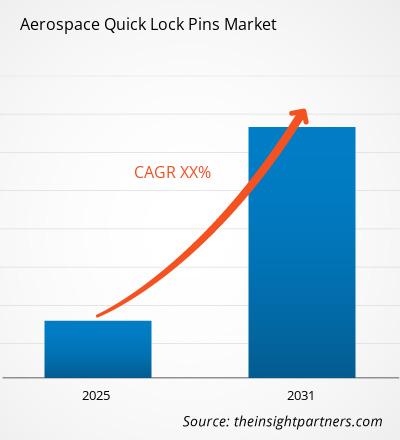
The aerospace quick lock pins market was valued at US$ 34.52 Million in 2025 and is projected to reach US$ 70.01 Million by 2034, registering a CAGR of 8.17% from 2026 to 2034. The market covers aerospace-grade pins designed for rapid installation, positive locking, alignment, adjustment, and repeated removal across aircraft structures and equipment. Demand is shaped by aircraft production, maintenance requirements, lightweight fastening design, and the need for secure connections that can be operated without conventional threaded fastening tools.
In North America, the aerospace quick lock pins market size is supported by established aircraft manufacturing, military aviation programs, MRO activity, and a mature supplier base for aerospace-standard fastening components. The regional market is expected to expand at a modeled ~7% CAGR through 2034, supported by aircraft production ramp-ups and recurring replacement demand. High requirements for traceability, dimensional consistency, and standardized aerospace components also favor suppliers capable of producing certified quick-lock and ball-lock configurations.
Aerospace Quick Lock Pins Market Assessment and Insights
Regional Outlook
- North America: ~36% of the global market in 2025 | ~7% CAGR through 2034. Market position: North America represents the largest regional market, supported by major aircraft and defense manufacturing ecosystems, established MRO networks, and recurring demand for standardized pins used in structural, tooling, access, and adjustment applications.
- US: ~78% of North American market revenue in 2025 | ~7% CAGR through 2034. Market position: The US represents the largest country market within North America, reflecting its concentration of commercial aircraft production, military aviation programs, MRO facilities, aerospace tooling activity, and suppliers serving recurring fastening requirements.
- Europe: ~32% of the global market in 2025 | ~8% CAGR through 2034. Market position: Europe has a mature aerospace manufacturing base centered on Germany, France, the UK, Italy, and Spain. Germany represents the leading country in Europe, supported by aircraft manufacturing, component production, industrial engineering, and aerospace supplier networks.
- Asia Pacific: ~23% of the global market in 2025 | ~10% CAGR through 2034. Market position: Asia Pacific is the fastest-growing region, supported by expanding aircraft fleets, localized aerospace manufacturing, MRO development, and increasing procurement of certified fastening components. China represents the leading country in Asia Pacific.
Segment Outlook
- Double Action: ~45% Share in 2025 | ~8% CAGR through 2034. Market position: Double-action pins lead because their push-and-pull actuation supports positive locking while enabling repeated installation and removal. Their flexibility makes them suitable for aircraft structures, tooling, access arrangements, and assemblies requiring controlled fastening operations.
- Military Aircraft: ~28% Share in 2025 | ~9% CAGR through 2034. Market position: Military aircraft represent the high-growth main segment because fleet modernization, mission-equipment changes, maintainability requirements, and repeated configuration adjustments increase demand for robust removable fastening systems.
Competitive Coverage
AERO SPECIALTIES, INC., ARV, CAM, Erwin Halder KG, KVT-Fastening, LISI AEROSPACE, norelem, Precision Castparts Corp., Vlier Inc., Wixroyd Group
Methodology
The Insight Partners follows Data Collection & Secondary Research, Primary Research, Data Analysis, and Data Triangulation & Final Review to validate market estimates and insights.
Source: The Insight Partners' analysis based on proprietary research, government publications, company annual reports, investor presentations, industry databases, and expert interviews.
The aerospace quick-lock pins market has evolved from basic removable locating and retention components toward engineered fastening solutions designed around repeatability, positive locking, corrosion resistance, weight control, and aircraft-specific standards. Product configurations now include single-action, double-action, and detent mechanisms, with variations in handles, grip lengths, materials, retention features, and receptacles. Manufacturing increasingly emphasizes controlled machining, heat treatment, surface finishing, dimensional inspection, and traceability because aerospace assemblies require predictable mechanical performance over repeated operating cycles.
The Aerospace Quick Lock Pins Market Forecast is increasingly linked to aircraft production expansion, fleet modernization, regional MRO development, and investment in aerospace manufacturing capacity. Emerging aerospace production clusters in the Asia Pacific are creating additional demand for certified fastening components, while established markets continue to generate replacement and retrofit requirements. Regulatory and customer qualification processes also favor suppliers with documented aerospace quality systems, standardized product portfolios, and the ability to support both catalog components and application-specific configurations.
Aerospace Quick Lock Pins Market Report Scope
| Report Attribute | Details |
|---|---|
| Market size in 2025 | US$ 34.52 Million |
| Market Size by 2034 | US$ 70.01 Million |
| Global CAGR (2026 - 2034) | 8.17% |
| Historical Data | 2021-2024 |
| Forecast period | 2026-2034 |
Aerospace Quick Lock Pins Market Analysis
The aerospace quick-lock pins market growth is driven by the operational value of removable fastening. Aircraft structures, panels, seats, access systems, tooling assemblies, and maintenance equipment frequently require components that can be secured without lengthy threaded fastening procedures. Quick locks save on installation and disassembly but allow controlled retention. The double-action types are especially useful where both locking and unlocking are desired. The detent pins suit applications that emphasize positioning, whereas the single-action types perform simple locking suitable for repeated servicing.
The value chain includes specialist steel and alloys manufacturers, machining, heat treating, plating/passivation, springs and balls manufacturing and assembly, quality control, certification, distribution, and fitting on aircraft or MRO. Competitors compete based on dimensional tolerances, material specifications, availability, customization, and aerospace specification compliance. Distribution is important since the maintenance organizations need small quantities with quick delivery rather than bulk quantities.
The Aerospace Quick Lock Pins Market Trends are increasingly shaped by competitive activity among manufacturers with aerospace-specific product portfolios and broader industrial fastening companies adapting quick-release technologies to aviation requirements. The two companies, LISI AEROSPACE and KVT Fastening, both supply aerospace fasteners and quick-release solutions. The Wixroyd Group manufactures aviation pip-pins based on NASM standards. Erwin Halder KG and Norelem have taken part in the precision fastening and locating components market. The additional companies include AERO SPECIALTIES, ARV, CAM, Vlier Inc. and Precision Castparts Corp. The areas of investment focus include production capacity, quality control, customization, digital product documentation and availability.
The investment focus for existing firms is centered on aerospace program ramps that present an opportunity for them to acquire regular production quantities, whereas specialists could compete through short lead times and customization. LISI AEROSPACE has emphasized capacity utilization and productivity in the fasteners market.
● REPORT CUSTOMIZATION
Tailor This Report To Align With Your Specific Business Requirements
This report can be customized to align precisely with your business objectives, scope, and target markets. Customization options include tailored segmentation, geography, competitive analysis, and strategic insights to support informed decision-making.
Customize This Report →WHAT YOU CAN ADJUST
- ● Segmentations
- ● Geography
- ● Competitive Analysis
- ● Language Preferences
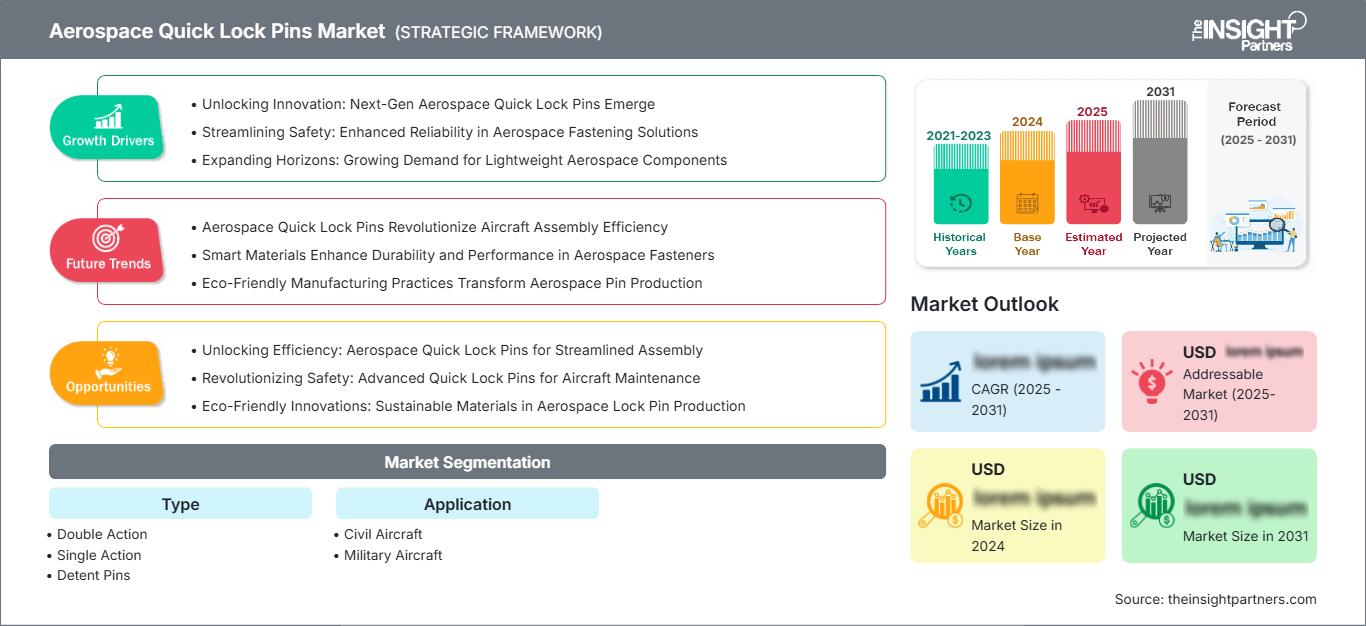
Aerospace Quick Lock Pins Market: Strategic Insights
Regional Insights
North America Aerospace Quick Lock Pins Market
North America accounts for a modeled ~36% share of the global aerospace quick lock pins market in 2025 and is projected to expand at ~7% CAGR through 2034. The area has access to a strong aerospace cluster that includes aircraft OEMs, defense companies, engine companies, component makers, MRO entities, and specialists that provide tools. The US is the major source of demand since commercial and defense aircraft require periodic installation of removable fasteners and alignment devices.
Regional demand in this segment includes demand for standardized aviation-grade pins, adjustable grip lengths, corrosion-resistant material, and components that can be used in repeated MRO cycles. Demand also arises from defense purposes since military aircraft usually undergo equipment changes and are subject to maintenance schedules. North American companies also benefit from already existing distribution channels and specifications-based procurement, where qualification history and traceability can affect the purchasing decision-making process. Demand from the installed aircraft base is another source of demand that complements production demand.
U.S. Aerospace Quick Lock Pins Market
The US represents ~78% of North American aerospace quick lock pins market revenue in 2025 and is projected to grow at ~7% CAGR through 2034. This placement depends on the magnitude of commercial and defense aerospace production, the presence of MRO capacity, and the installed base of aircraft. The demands range from assembly, tooling, access systems, adjuster mechanisms, to maintenance equipment.
US purchasers tend to put a high regard on aerospace specifications, material approval, dimensional accuracy, and timeliness of delivery. Manufacturers of components such as AERO SPECIALTIES, Inc., Vlier Inc., Precision Castparts Corp., among others, can cater to each part of the supply chain. The civil aircraft development gives volume orders, while military programs demand more ruggedness, configurability, and maintenance access.
Europe Aerospace Quick Lock Pins Market
Europe represents ~32% of the global aerospace quick lock pins market in 2025 and is expected to expand at ~8% CAGR through 2034. Germany is the leading country in Europe, followed by significant aerospace manufacturing and component activity in France, the UK, Italy, and Spain. The regional ecosystem combines aircraft assembly, propulsion, structures, interiors, defense aviation, and specialist component manufacturing.
The position held by Germany is due to the industrial engineering capacity of the nation and the substantial supplier base for aerospace and mechanical engineering applications. There is an advantage to the position held by France due to the concentration of OEM aerospace and component manufacturing in the country. On the other hand, there are the aircraft, engines, and defense aerospace capacities of the UK. In addition, there are aircraft structures, systems, components, and maintenance, repair, and overhaul facilities from Italy and Spain. Companies such as LISI AEROSPACE, Erwin Halder KG, KVT-Fastening, norelem, and Wixroyd Group have an influence on the access to precision fastening solutions.
APAC Aerospace Quick Lock Pins Market
Asia Pacific holds ~23% of the global aerospace quick lock pins market in 2025 and is projected to grow at ~10% CAGR through 2034, making it the fastest-growing regional market. China is the leading country in Asia Pacific, supported by expanding aircraft manufacturing, fleet requirements, defense aviation, and aerospace supply-chain localization.
Japan and South Korea contribute through advanced manufacturing and aerospace component capabilities, while India and Australia provide expanding aircraft maintenance, defense, and aviation support demand. Industrial localization and development of regional aerospace supply chains can increase the need for qualified fastening components. As manufacturers expand production and MRO capacity, suppliers with aerospace certifications, application engineering, and localized distribution can address shorter lead-time requirements.
Middle East & Africa Aerospace Quick Lock Pins Market
The Middle East & Africa market is supported by aviation fleet expansion, MRO infrastructure investment, defense modernization, and increasing use of specialized aerospace maintenance equipment. Saudi Arabia and the United Arab Emirates are important markets in the Middle East region, while South Africa is a key aerospace and defense engineering base for manufacturing and MRO services.
The region will post a modeled CAGR of ~8% to 2034. In the Middle East & Africa region, the UAE stands out as the top country for its existing aviation and MRO infrastructure, while the industrial development of the aerospace sector in Saudi Arabia will create further demand. South Africa is also contributing through defense and aerospace engineering activities. The supplier market is connected to aircraft MRO services, component replacements, industrial development, and certified fastening solutions.
Segmentation Analysis
Type
The Type segment of the Aerospace Quick Lock Pins Market covers Double Action, Single Action, and Detent Pins. Double Action represents the largest main segment and is projected to register a ~8% CAGR from 2026 to 2034. Its demand is supported by positive locking, controlled release, and suitability for repeated aircraft assembly and maintenance operations. Double-action mechanisms provide operators with a deliberate actuation sequence while supporting frequent installation and removal. Their application extends across structural fixtures, access arrangements, tooling, and assemblies where accidental disengagement must be minimized.
- Double Action: Double-action pins combine push-and-pull actuation with positive locking, making them suitable for assemblies requiring deliberate release and repeatable installation. Their flexibility supports structural, tooling, maintenance, and adjustment applications where operators need secure retention without threaded fastening.
- Single Action: Single-action pins provide straightforward positive locking through a defined actuation mechanism. They are useful in applications where installation and release procedures are standardized, particularly in maintenance equipment, removable assemblies, access arrangements, and aircraft support tooling.
- Detent Pins: Detent pins emphasize rapid positioning and alignment rather than the positive locking characteristics of ball-lock configurations. Their operating simplicity supports locating, temporary retention, fixture adjustment, and frequently repeated assembly tasks across aircraft and ground-support environments.
Application
The Application segment of the Aerospace Quick Lock Pins Market comprises Civil Aircraft and Military Aircraft. Military Aircraft is the high-growth main segment, with a modeled ~9% CAGR from 2026 to 2034. Military platforms undergo configuration changes, mission-system modifications, maintenance activities, and equipment integration that create recurring requirements for removable fastening solutions. Civil aircraft remain the largest application base because of fleet scale, production programs, scheduled maintenance, cabin work, and MRO activity. Both applications require reliable retention, repeatability, and documented material and manufacturing characteristics.
- Civil Aircraft: Civil aircraft represent the largest application base because commercial fleets require recurring maintenance, inspection, component replacement, tooling, and production assembly. Quick-lock components can reduce maintenance handling time while supporting repeatable installation across aircraft and ground-support applications.
- Military Aircraft: Military aircraft generate strong demand for removable fastening because mission equipment, access arrangements, maintenance configurations, and structural components may require frequent adjustment. Durability, positive locking, traceability, and application-specific customization remain important procurement considerations.
Opportunity Snapshot
| Application | Revenue Contribution | Trend Tag | Adoption Stage |
|---|---|---|---|
| Civil Aircraft | High | Fleet MRO | Mature |
| Military Aircraft | Medium | Mission Retrofit | Scaling |
Aerospace Quick Lock Pins Market Growth Drivers and Impact Analysis
Aircraft Production and Fleet Expansion Increase Recurring Fastener Demand
The manufacture of airplanes, as well as their operational usage, has a direct correlation with the consumption of fastener parts. New planes involve the use of many fasteners and positioning mechanisms, while the existing plane fleet creates a constant demand due to inspections, maintenance, modifications and overhaul. Quick-lock pins are especially convenient in cases when repeated assembly is required without using standard screw and nut fastening systems. Market demand is thus not limited by original equipment production, as the replacement cycle, as well as the maintenance procedures, create a constant demand level. Commercial airplane production meets the volume requirements, while military fleet renewal creates additional demand for more durable and purposeful pins. Suppliers capable of providing constant sizes and material compliance, along with scheduled deliveries, will get a steady stream of orders due to the aircraft program production ramp-up process.
Maintenance Efficiency Encourages Adoption of Removable Locking Components
There is a growing emphasis within maintenance operations on components that reduce the need for repeated assembly and disassembly processes. The quick-lock pin makes it possible for assembly and disassembly to occur without the labor of traditional screw threads, especially in situations where access is difficult or an interface is required to be frequently opened. This property allows for usage in tooling, access, adjustable structures, fixtures, and maintenance equipment. The economic effects are most pronounced where labor and maintenance turnaround are crucial factors. Differentiation can come through design and customization in handles, grips, retention systems, materials, and not simply through basic pin design. In addition, aviation-grade pins must be reliable in repeated locking cycles.
Aerospace Quality Requirements Strengthen Demand for Certified Components
There is considerable stress on traceability of materials, dimensional accuracy, manufacturing processes, and engineering documentation in procurement in the aerospace industry. This results in the creation of an entry barrier for manufacturers that do not have an aerospace capability and qualifications in place. Quick-lock pins in applications related to the aircraft may be required to comply with some specified aerospace or military standards, materials, surface finish and drawings of the customers. In this respect, market implications include a trend towards those suppliers who can combine catalog solutions with engineering and certification. Standard solutions can satisfy repeat demand, while custom solutions can enable suppliers to cater to aircraft interface. Technical documentation and distribution capabilities can also help in lowering the procurement difficulty for MRO customers.
Aerospace Quick Lock Pins Market Future Trends
Higher Customization and Digital Product Definition
The aerospace quick lock pins market is likely to move toward greater customization as aircraft manufacturers and MRO organizations seek components optimized for specific interfaces, access constraints, grip requirements, and maintenance procedures. Digital product definition can simplify selection by providing three-dimensional models, technical drawings, material specifications, and configuration data before procurement. Suppliers already offering CAD files and multiple standardized configurations demonstrate how digital engineering can shorten the specification process. Over time, digital catalogs can become more closely connected with engineering workflows, enabling customers to identify compatible pin dimensions and retention arrangements earlier in the design cycle. This trend could increase the importance of configuration management, digital documentation, and rapid engineering support alongside physical manufacturing capability.
Automation-Ready Fastening and Traceability
Future aircraft production environments are expected to place greater emphasis on repeatable assembly processes, inspection, and traceability. Quick-lock pin suppliers can respond by improving dimensional consistency, documenting material and process information, and designing products that support predictable operator handling. Where pins are used in fixtures or repeatable production operations, automation-compatible geometries and standardized interfaces can improve process consistency. LISI AEROSPACE's broader investment in fastener capacity, industrial productivity, and automation illustrates the direction of aerospace fastening manufacturing toward higher production efficiency and controlled quality. The implication for quick-lock pin suppliers is that product design and manufacturing systems may increasingly be evaluated together rather than independently.
Aerospace Quick Lock Pins Market Opportunities
Localized Supply in Emerging Aerospace Manufacturing Hubs
Expansion of aerospace manufacturing and MRO capacity in Asia Pacific creates opportunities for suppliers to establish localized distribution, technical support, and production capabilities. Customers operating in developing aerospace clusters may prioritize shorter lead times and local access while retaining stringent requirements for aerospace-grade materials and documentation. China, India, Japan, South Korea, and Australia each offer different combinations of aircraft production, defense demand, MRO activity, and industrial capability. Suppliers can use regional warehouses, certified distributors, and engineering partnerships to reduce delivery friction without duplicating every manufacturing operation locally. A localized commercial model can also improve access to small-batch requirements, where MRO customers may need specific pin configurations rather than large production quantities.
Application-Specific Pin Systems for Defense and MRO
Defense aviation and MRO provide opportunities for suppliers to develop application-specific quick-lock systems rather than competing solely through standardized catalog products. Military platforms can require specialized grip lengths, materials, retention features, corrosion resistance, or configuration flexibility because equipment may be modified repeatedly throughout its service life. MRO organizations similarly value components that simplify access and reduce handling time. Suppliers can therefore expand their addressable opportunity through engineered variants, custom dimensions, lanyard systems, receptacles, and application-specific locking arrangements. The commercial opportunity is particularly relevant for manufacturers with precision machining and engineering capabilities because customization can create differentiated offerings while remaining within established aerospace-quality frameworks.
Frequently Asked Questions

- Comprehensive Market Sizing and Forecast Analysis
- Detailed Segmentation Analysis
- In-Depth Market Dynamics Assessment
- Regional and Country-Level Insights
- Competitive Landscape and Company Benchmarking
- Strategic Business Intelligence
Recent Reports
Testimonials

The Insight Partners provided valuable market intelligence that supported our global go-to-market strategy. Their team was professional, responsive, and attentive to our feedback, providing thoughtful analysis and helpful methodological clarifications throughout the project.
Junmo Kim Chief Financial Officer (CFO), Enertech Co., Ltd.
The Insight Partners' SCADA System Market report is comprehensive, with valuable insights on current trends and future forecasts. The team was highly professional, responsive, and supportive throughout. We are very satisfied and highly recommend their services.
RAN KEDEM Partner, Reali Technologies LTDs
I requested a report on a very specific software market and the team produced the report in a few days. The information was very relevant and well presented. I then requested some changes and additions to the report. The team was again very responsive and I got the final report in less than a week.
JEAN-HERVE JENN Chairman, Future Analytica
We worked with The Insight Partners for an important market study and forecast. They gave us clear insights into opportunities and risks, which helped shape our plans. Their research was easy to use and based on solid data. It helped us make smart, confident decisions. We highly recommend them.
PIYUSH NAGPAL Sr. Vice President, High Beam Global
The Insight Partners delivered insightful, well-structured market research with strong domain expertise. Their team was professional and responsive throughout. The user-friendly website made accessing industry reports seamless. We highly recommend them for reliable, high-quality research services
YUKIHIKO ADACHI CEO, Deep Blue, LLC.
This is the first time I have purchased a market report from The Insight Partners.While I was unsure at first, I visited their web site and felt more comfortable to take the risk and purchase a market report.I am completely satisfied with the quality of the report and customer service. I had several questions and comments with the initial report, but after a couple of dialogs over email with their analyst I believe I have a report that I can use as input to our strategic planning process.Thank you so much for taking the extra time and making this a positive experience.I will definitely recommend your service to others and you will be my first call when we need further market data.
JOHN SUZUKI President and Chief Executive Officer, Board Director, BK Technologies
I wish to appreciate your support and the professionalism you displayed in the course of attending to my request for information regarding to infectious disease IVD market in Nigeria. I appreciate your patience, your guidance, and the fact that you were willing to offer a discount, which eventually made it possible for us to close a deal. I look forward to engaging The Insight Partners in the future, all thanks to the impression you have created in me as a result of this first encounter.
DR CHIJIOKE ONYIA MANAGING DIRECTOR, PineCrest Healthcare Ltd.Reason to Buy
- Informed Decision-Making
- Understanding Market Dynamics
- Competitive Analysis
- Identifying Emerging Markets
- Customer Insights
- Market Forecasts
- Risk Mitigation
- Boosting Operational Efficiency
- Strategic Planning
- Investment Justification
- Tracking Industry Innovations
- Aligning with Regulatory Trends





 Get Free Sample for